When homeowners start researching hardwired Level 2 charging stations, the Schneider Electric EV charger lineup consistently surfaces as a utility-grade option built by one of the world's largest electrical infrastructure companies. Unlike consumer-electronics brands that entered the EV space recently, Schneider brings decades of panel, breaker, and power-management expertise to home charging. This guide breaks down what Schneider's residential chargers actually deliver in 2026 — from the Square D branded EVlink models to full install costs, electrical requirements, and how they stack up against alternatives like the ChargePoint Home Flex or Tesla Wall Connector.
Understanding EV Charging Levels: kW vs kWh
Before evaluating any charger, it is essential to distinguish between kW (kilowatts) and kWh (kilowatt-hours). This is the single most common confusion in EV ownership:
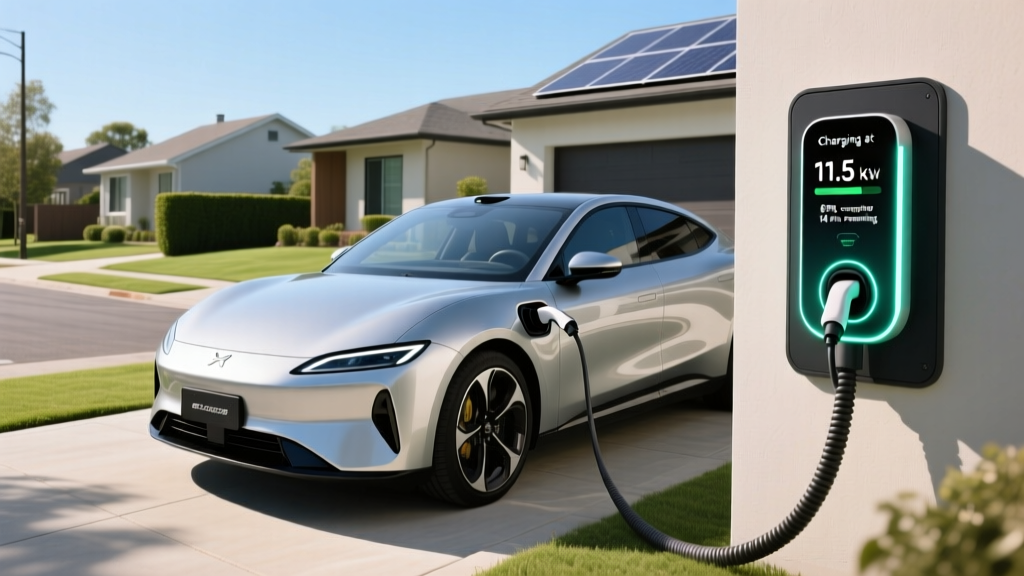
- kW (kilowatts) = the rate of power delivery — think of it as the width of the water hose. A 48-amp charger delivers up to 11.5 kW of power to your car.
- kWh (kilowatt-hours) = the total energy stored in your battery — think of it as the size of the water tank. A Hyundai Ioniq 5 has a 77.4 kWh battery; a Tesla Model Y Long Range has roughly 75 kWh usable.
A charger's kW rating determines how quickly it fills your battery's kWh capacity. Here is what each charging level delivers in practice:
| Level | Voltage | Max Power (kW) | Miles of Range Added Per Hour | Typical Use Case |
|---|---|---|---|---|
| Level 1 | 120V (standard outlet) | 1.2–1.9 kW | 3–5 miles | Overnight top-up for PHEVs or low-mileage BEV drivers |
| Level 2 | 240V (dryer-style circuit) | 3.8–19.2 kW | 14–65 miles | Primary home charging for all BEVs |
| DC Fast Charging | 400–800V DC | 50–350 kW | 150–1,200+ miles (in peak minutes) | Road trips, highway corridors, commercial fleets |
Schneider Electric's residential lineup operates at Level 2. The flagship Square D EVlink Smart Wallbox delivers up to 11.5 kW (48 amps on a 60-amp circuit) on 240V, which translates to roughly 35–45 miles of range per hour for a mid-efficiency EV like the Tesla Model Y or Ford Mustang Mach-E.
Schneider Electric EV Charger Lineup: Models and Specs
Schneider sells its residential chargers primarily under the Square D brand in North America. As of 2026, the key models include:
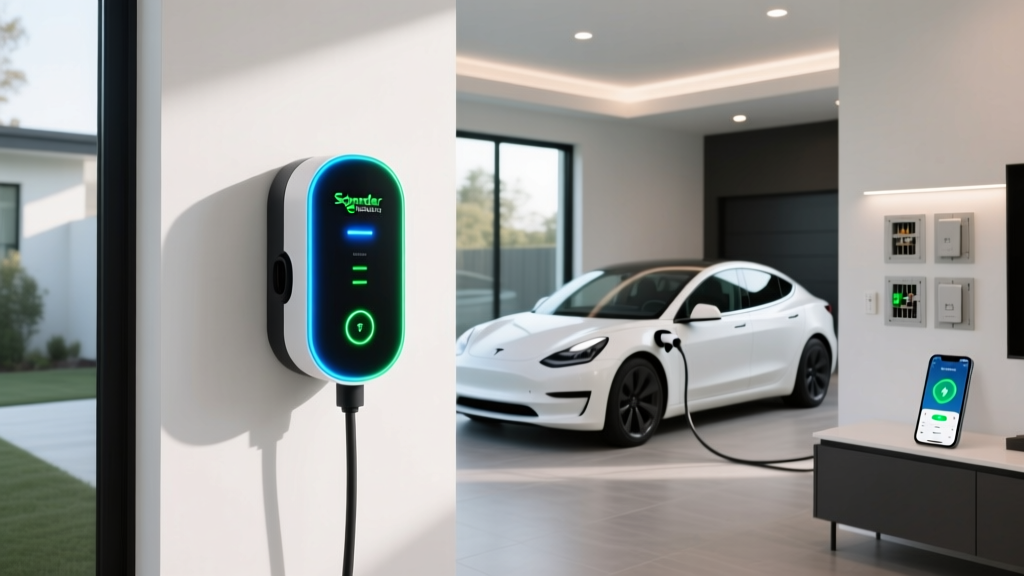
Square D EVlink Smart Wallbox (Model EVJ2SP424)
- Power Output: 11.5 kW (48A) on 240V hardwired; configurable down to 16A
- Connector: J1772 (standard for non-Tesla EVs; Tesla owners use the included or aftermarket NACS adapter)
- Cable Length: 24 feet
- Smart Features: Wi-Fi enabled, Schneider Home app, energy monitoring, scheduled charging, utility demand-response compatible
- Enclosure: NEMA 4 rated (indoor/outdoor), -22°F to 122°F operating range
- Price: Approximately $599–$699 (MSRP, varies by retailer)
- Warranty: 3 years
Square D EVlink Pro Wallbox (Commercial/Multi-Unit)
- Power Output: Up to 19.2 kW (80A) on 208/240V hardwired
- Connector: J1772, dual-cable option available
- Smart Features: RFID access control, OCPP network protocol, load management for multi-charger installations
- Use Case: Apartment complexes, workplaces, fleet depots
- Price: $1,800–$3,200+ depending on configuration
For single-family homeowners, the EVlink Smart Wallbox is the relevant model. Its 11.5 kW output is competitive with the ChargePoint Home Flex (up to 50A / 12 kW) and slightly below the Tesla Wall Connector (up to 48A / 11.5 kW on a 60A circuit). The key differentiator for Schneider is integration with Square D electrical panels and Schneider's broader home energy-management ecosystem.
How Much Does It Cost to Install a Home EV Charger?
The total installed cost of a Schneider Electric EV charger depends on four variables: the charger unit itself, electrical labor, permit fees, and whether your panel needs an upgrade. Here is a realistic cost breakdown for a 2026 installation:
| Cost Component | Low End | Typical | High End | Notes |
|---|---|---|---|---|
| Charger Unit (EVlink Smart Wallbox) | $549 | $649 | $699 | Varies by retailer and promotions |
| Electrician Labor (hardwired, 60A circuit) | $400 | $800 | $1,500 | Depends on run length from panel to garage |
| Materials (wire, conduit, breaker, junction box) | $100 | $250 | $500 | Longer wire runs and conduit increase cost |
| Electrical Permit | $50 | $150 | $300 | Varies by municipality |
| Panel Upgrade (100A → 200A, if needed) | $1,500 | $2,500 | $4,000 | Older homes with 100A service often need this |
| Total (no panel upgrade) | $1,099 | $1,849 | $2,999 | Most homeowners fall in this range |
| Total (with panel upgrade) | $2,599 | $4,349 | $6,999 | Significant but adds home value |
The panel-upgrade gotcha: If your home has a 100-amp main service panel — common in homes built before the 1990s — adding a 60-amp dedicated circuit for an EV charger may exceed your panel's capacity. A licensed electrician will perform a load calculation per NEC Article 220 to determine if an upgrade is required. Do not skip this step; undersized panels are a fire hazard.
Federal incentive note: The IRS §30D alternative fuel vehicle refueling property credit offers up to $1,000 (30% of cost) for home charging equipment installed in qualifying census tracts. This credit has specific eligibility requirements including location-based restrictions. Always verify current-year rules on irs.gov and consult a tax professional before claiming.
Electrical Requirements: What Your Installer Needs to Know
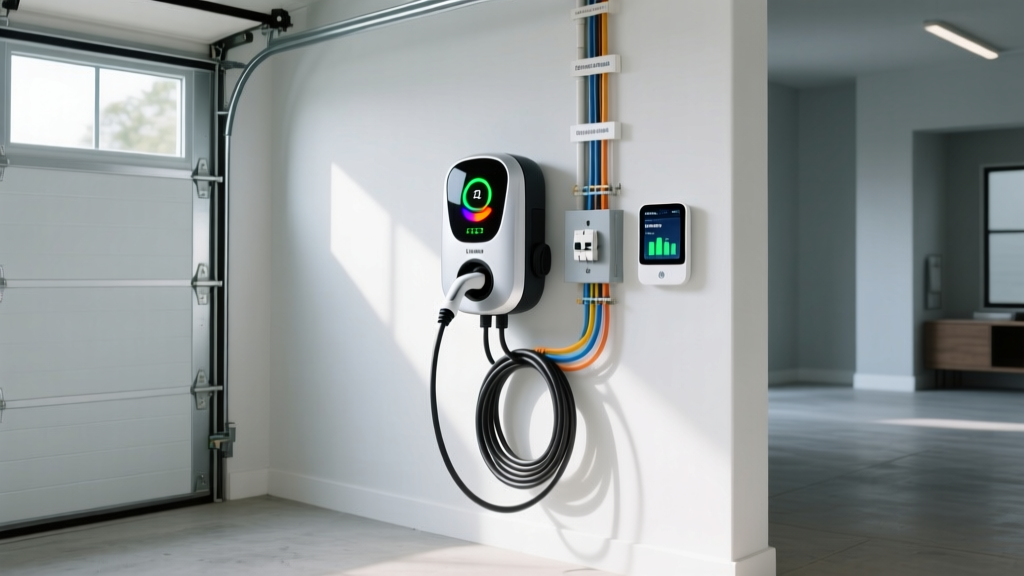
The Square D EVlink Smart Wallbox at its full 48A output requires a 60-amp dedicated circuit on a 240V split-phase supply. The NEC (National Electrical Code) requires that continuous loads — which EV charging qualifies as — be limited to 80% of the circuit breaker rating. Therefore:
- 48A continuous draw → 60A breaker (48 ÷ 0.80 = 60)
- 32A continuous draw → 40A breaker (configurable in the EVlink app)
- Wire gauge: 6 AWG copper (THHN in conduit) or 4 AWG aluminum for a 60A circuit
Safety and code requirements to confirm with your electrician:
- Dedicated circuit: The charger must be on its own breaker — not shared with other appliances.
- GFCI protection: NEC 2020 and later requires GFCI protection for all EV supply equipment. Hardwired units like the EVlink have built-in ground-fault protection; if using a NEMA 14-50 receptacle instead, a GFCI breaker is required.
- Outdoor rating: The EVlink's NEMA 4 enclosure handles rain, dust, and hose-directed water — suitable for exterior garage walls or carports.
- Disconnect: Some jurisdictions require a visible disconnect switch within sight of the charger for hardwired installations over 60A.
Connector Compatibility: Will It Fit Your EV?
Connector standards have shifted significantly since Tesla opened its Supercharger network and the industry began adopting NACS (North American Charging Standard). Here is where things stand in 2026:
| Connector Type | Brands Using It (2026) | Schneider EVlink Compatible? |
|---|---|---|
| NACS (Tesla/J3400) | Tesla (all models), Ford, GM, Rivian, Hyundai, Kia, BMW, Mercedes, Volvo, Polestar, and most others transitioning | Yes — with a J1772-to-NACS adapter (sold separately, ~$150–$250) |
| J1772 (legacy standard) | Older model-year EVs pre-NACS transition, some PHEVs | Yes — native connector on the EVlink |
| CCS1 (Combined Charging System) | Phased out for new vehicles after 2024; remaining on some 2023–2024 models | Yes for AC Level 2 via the J1772 portion of CCS1 |
| CHAdeMO | Nissan Leaf (discontinued after 2025 model year) | Yes for AC Level 2 via J1772 inlet on the Leaf |
Practical advice: If you are buying a 2025 or 2026 model-year EV from Ford, GM, Hyundai, Kia, Rivian, or BMW, your vehicle will have a NACS charge port. The Schneider EVlink ships with a J1772 connector, so you will need a J1772-to-NACS adapter (available from Tesla, Lectron, or Telian for roughly $150–$250). This adds a minor inconvenience — one extra piece to plug in — but the adapter is compact and can live in your glove box or hang near the charger.
Alternatively, if you own a Tesla and prefer a native NACS connector without an adapter, the Tesla Wall Connector ($475) remains a strong option with identical 11.5 kW output and a NACS plug built in.
Charging Times: How Long to Fill Common EV Batteries
Real-world charging time depends on battery size (kWh), the charger's power output (kW), and the vehicle's onboard charger acceptance rate. Here are approximate 10%–80% charge times using the Schneider EVlink at 11.5 kW, assuming the vehicle can accept the full rate:
| Vehicle | Battery (kWh usable) | Energy Needed (10–80%) | Estimated Time at 11.5 kW |
|---|---|---|---|
| Tesla Model Y Long Range | 75 kWh | ~52.5 kWh | ~4 hours 35 min |
| Hyundai Ioniq 5 (Long Range) | 77.4 kWh | ~54.2 kWh | ~4 hours 45 min |
| Ford Mustang Mach-E (Extended Range) | 91 kWh | ~63.7 kWh | ~5 hours 30 min |
| Chevrolet Equinox EV | 85 kWh | ~59.5 kWh | ~5 hours 10 min |
| Toyota Prius Prime (PHEV) | 13.6 kWh | ~9.5 kWh | ~50 min |
Real-world caveat: These times assume the vehicle's onboard charger can accept the full 11.5 kW. Most modern BEVs (Tesla, Hyundai E-GMP, GM Ultium) have onboard chargers rated at 11.5 kW or higher, so you will get the full rate. However, some PHEVs and older EVs have onboard chargers limited to 6.6 kW or 7.2 kW — in those cases, the charger's extra capacity is unused and charging will take proportionally longer.
For overnight home charging, 4–6 hours for a 10–80% fill is more than adequate. Plug in when you get home at 7 PM and your car is fully topped up by midnight or 1 AM — well before any morning commute.
Cost to Charge: EV Electricity vs. Gasoline Per Mile
Charging at home is where EVs deliver their strongest economic advantage. Here is a cost-per-mile comparison using 2026 national averages:
| Scenario | Rate / Price | Vehicle Efficiency | Cost Per Mile |
|---|---|---|---|
| Home charging (national avg. residential) | $0.16/kWh | 3.5 miles/kWh (typical BEV) | $0.046/mile |
| Home charging (off-peak TOU rate) | $0.09/kWh | 3.5 miles/kWh | $0.026/mile |
| Public Level 2 (network charging) | $0.30/kWh | 3.5 miles/kWh | $0.086/mile |
| DC Fast Charging (Electrify America, EVgo) | $0.45/kWh | 3.5 miles/kWh | $0.129/mile |
| Gasoline car (25 MPG combined) | $3.30/gallon | 25 MPG | $0.132/mile |
| Gasoline car (35 MPG highway-efficient) | $3.30/gallon | 35 MPG | $0.094/mile |
The takeaway: Home charging on an off-peak time-of-use (TOU) plan delivers fuel costs at roughly one-fifth the cost of gasoline per mile. Even public DC fast charging at premium rates is comparable to or slightly cheaper than gasoline. The savings compound: a driver covering 12,000 miles per year saves approximately $1,000–$1,300 annually by charging at home versus fueling a 25 MPG gas car, according to data from fueleconomy.gov.
The Schneider EVlink's smart scheduling feature lets you set charging windows to coincide with your utility's cheapest off-peak hours — typically 10 PM to 6 AM — maximizing this savings without any manual intervention.
How the Schneider EVlink Compares to Top Alternatives
| Feature | Schneider Square D EVlink Smart Wallbox | ChargePoint Home Flex | Tesla Wall Connector | Emporia Level 2 Smart Charger |
|---|---|---|---|---|
| Max Power Output | 11.5 kW (48A) | 12 kW (50A) | 11.5 kW (48A) | 11.5 kW (48A) |
| Circuit Required | 60A | 60A (for 50A output) | 60A | 60A |
| Connector | J1772 | J1772 | NACS (J1772 adapter included) | J1772 |
| Cable Length | 24 ft | 23 ft | 24 ft | 24 ft |
| Wi-Fi / Smart App | Yes (Schneider Home) | Yes (ChargePoint) | Yes (Tesla app) | Yes (Emporia Vue) |
| Energy Monitoring | Yes | Yes | Limited | Yes (detailed) |
| Outdoor Rating | NEMA 4 | NEMA 4 | NEMA 3R | NEMA 4 |
| Approximate Price | $599–$699 | $649–$699 | $475 | $399 |
| Warranty | 3 years | 3 years | 4 years | 3 years |
When the Schneider EVlink makes the most sense:
- You already have a Square D electrical panel and want brand synergy for potential future load-management integration.
- You value Schneider's industrial-grade electrical engineering pedigree and UL certification.
- Your utility participates in Schneider's demand-response programs for grid-balancing incentives.
- You prefer hardwired installation for maximum reliability (no plug receptacle to loosen over time).
When an alternative may be better:
- You own a Tesla and want a native NACS plug without an adapter → Tesla Wall Connector at $475 is the most cost-effective and seamless choice.
- You want the lowest price with robust energy monitoring → Emporia at $399 offers strong value, especially paired with the Emporia Vue whole-home energy monitor.
- You want maximum configurability (adjustable amperage from 16A to 50A on one unit) → ChargePoint Home Flex is the most flexible.
Frequently Asked Questions
How fast will a Schneider Electric EV charger add range to my car?
At its full 11.5 kW output on a 60-amp circuit, the Square D EVlink Smart Wallbox adds approximately 35–45 miles of range per hour of charging for a typical mid-size BEV like a Tesla Model Y or Hyundai Ioniq 5. For a full overnight session of 6–8 hours, expect 210–320 miles of range replenished — more than enough for any daily driving needs.
Do I need a panel upgrade to install a Schneider EV charger?
Not necessarily, but it depends on your home's existing electrical service. Homes with 200-amp panels typically have sufficient headroom for a 60-amp dedicated EV circuit. Homes with 100-amp or 150-amp service, especially those running electric ranges, dryers, and HVAC, may require an upgrade. A licensed electrician will perform a NEC Article 220 load calculation to determine this. Budget $1,500–$4,000 if a panel upgrade is needed.
Is the Schneider EVlink compatible with Tesla vehicles?
Yes, but with an adapter. The EVlink ships with a J1772 connector. Since 2025, Tesla vehicles sold in North America use the NACS charge port. You will need a J1772-to-NACS adapter (approximately $150–$250) to use the EVlink with a Tesla. For a seamless native-NACS experience without an adapter, the Tesla Wall Connector is a more direct fit.
Can I install the Schneider EVlink myself?
Schneider strongly recommends — and most local electrical codes require — that a licensed electrician perform the installation. Hardwired 240V/60A circuits involve working inside your main service panel, pulling wire through conduit, and obtaining a permit with inspection. DIY installation of this circuit is dangerous, likely violates code, and may void your home insurance coverage in the event of a fire.
Does the Schneider EVlink qualify for any tax credits or rebates?
The federal Alternative Fuel Vehicle Refueling Property Credit (IRS Form 8911) provides a credit of up to $1,000 (30% of equipment and installation cost) for home charger installations, but eligibility depends on your property being located in a qualifying census tract (non-urban or low-income area as defined by the IRS). Many utilities also offer rebates of $200–$500 for installing a smart Level 2 charger — check with your local provider. Always verify current eligibility on irs.gov and with a tax professional.
What happens if my EV's onboard charger is rated below 11.5 kW?
The charger will only deliver what the vehicle can accept. For example, a PHEV with a 6.6 kW onboard charger will draw only 6.6 kW from the EVlink, even though the unit can supply 11.5 kW. This is perfectly safe — the vehicle controls the draw, not the charger. The EVlink's configurable amperage setting in the app lets you match the circuit to your vehicle's needs if you want to use a smaller breaker.