Plug in, walk away, and let a robot handle the rest. That's the promise of robotic EV charging systems — automated arms, inductive pads, and snake-like connectors that eliminate the physical act of plugging in. But before you chase the automation dream, you need to understand the fundamentals of EV charging: what speeds are actually available, what your home electrical panel can support, and whether a $2,000+ robotic system makes sense compared to a $400 smart Level 2 wallbox.
This guide covers the full charging landscape — Level 1, Level 2, and DC fast charging — then examines where robotic EV charging systems fit for home garages, fleets, and accessibility use cases. Every number here is grounded in real-world specs and 2026 equipment pricing.
Charging Levels Explained: Speeds, kW, and Miles Per Hour
The single most common EV confusion is mixing up kW (kilowatts — the rate of power flow, like water pressure) with kWh (kilowatt-hours — the total energy stored, like gallons in a tank). A charger's kW rating tells you how fast energy flows into your battery. Your battery's kWh capacity tells you how much it holds. Keep these separate and everything else clicks.
| Level | Voltage | Power (kW) | Miles of Range Added Per Hour | Typical Use Case |
|---|---|---|---|---|
| Level 1 | 120V AC | 1.0–1.4 kW | 3–5 mi/hr | Overnight top-up, low-mileage drivers |
| Level 2 | 240V AC | 3.3–19.2 kW | 12–75 mi/hr | Home daily charging, workplace, public destinations |
| DC Fast Charge | 400–900V DC | 50–350+ kW | 150–1,200+ mi/hr (peak) | Road trips, highway corridors, fleet depots |
A few real-world caveats: Level 2 speeds depend on both the charger's output and your car's onboard charger limit. A Hyundai Ioniq 5 with an 10.9 kW onboard charger won't charge faster than 10.9 kW even on a 19.2 kW wallbox. DC fast charging follows a charge curve — peak kW is only sustained at low state of charge (SoC). Expect charging to taper significantly above 80% SoC to protect battery health. A "10–80% in 18 minutes" claim assumes ideal battery temperature and preconditioning; cold batteries can double that time.
Home Charger Installation: Electrical Requirements and Real Costs
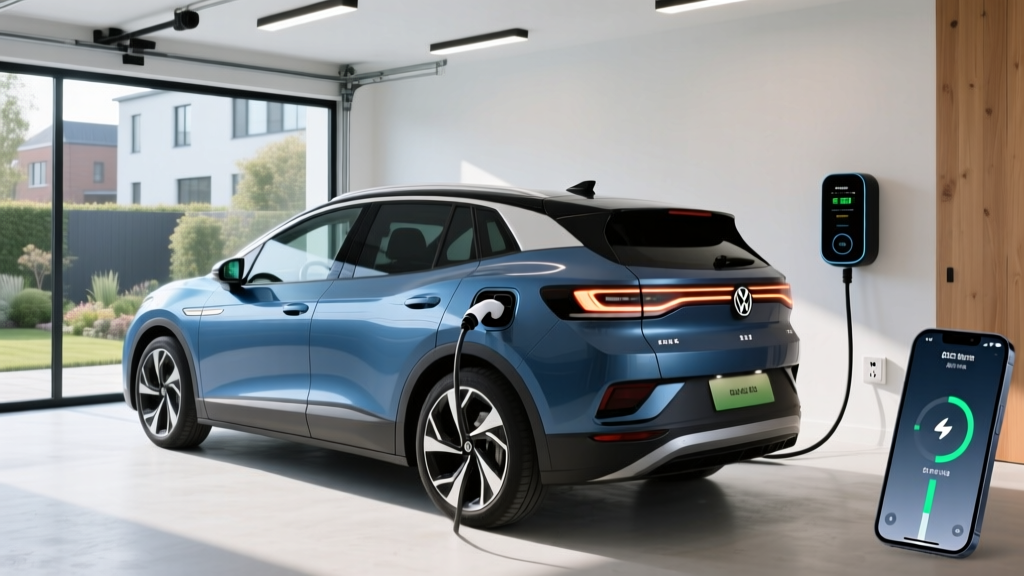
Most EV owners charge at home, and a dedicated Level 2 wallbox on a 240V circuit is the standard setup. Here's what's actually involved.
Electrical Specifications
- Voltage: 240V (same as a dryer or oven outlet)
- Amperage: 40A circuit for a 32A continuous charger (NEC requires circuits rated 125% above continuous load); 60A circuit for a 48A charger
- Dedicated circuit: Required — you cannot share with other appliances
- GFCI protection: Required by NEC 2020 and later for EV outlets and hardwired chargers
- Outdoor rating: NEMA 4 or NEMA 4X enclosure if mounted outside
Installation Cost Breakdown
| Item | Low End | High End | Notes |
|---|---|---|---|
| Level 2 charger equipment | $300 | $750 | Smart WiFi-connected units; basic units from $200 |
| Electrician labor (standard install) | $400 | $1,200 | Short wire run, panel nearby, no upgrades |
| Permit and inspection | $50 | $300 | Varies by municipality |
| Electrical panel upgrade (if needed) | $1,500 | $4,000+ | 100A → 200A service; common in pre-2000 homes |
| Total (no panel upgrade) | $750 | $2,250 | Most homes with 200A service |
| Total (with panel upgrade) | $2,250 | $6,250+ | Older homes, added loads (solar, heat pumps) |
Panel upgrade reality check: If your home has a 100A main panel and you already run electric heat, a dryer, and an oven, adding a 40A EV circuit may exceed capacity. A licensed electrician will perform a load calculation per NEC Article 220. Don't skip this step — an overloaded panel is a fire risk. Some utilities offer managed-charging programs that reduce your circuit size in exchange for off-peak scheduling, which can avoid a panel upgrade entirely.
Connector Compatibility: NACS, CCS, and CHAdeMO
The North American charging connector landscape consolidated significantly in 2024–2025 when Ford, GM, Rivian, Volvo, and others adopted Tesla's NACS (North American Charging Standard) for new vehicles. Here's where things stand for 2026 models.
| Connector | Brands Using It | Home Charging | DC Fast Charging | Adapter Needed? |
|---|---|---|---|---|
| NACS (Tesla standard) | Tesla, Ford, GM, Rivian, Volvo, Polestar, Mercedes, Fisker | NACS wallbox or J1772 with adapter | Direct access to Tesla Supercharger network | CCS-to-NACS adapters available (~$200) |
| CCS1 (Combined Charging System) | Hyundai, Kia, BMW, VW, Audi, Porsche, Stellantis, Honda, Toyota (bZ) | J1772/CCS wallbox | Electrify America, EVgo, ChargePoint, Ionity | NACS-to-CCS adapters available (~$200–$250) |
| CHAdeMO | Nissan Leaf (legacy); discontinued for new models after 2025 | J1772 | Limited and shrinking public network | No viable CHAdeMO-to-NACS adapter for DC fast |
For home Level 2 charging, the physical connector matters less than you might think. All Level 2 chargers use the J1772 protocol for communication. NACS-equipped vehicles come with a J1772-to-NACS adapter in the box, so any standard Level 2 wallbox works. The connector war primarily affects DC fast charging on the road.
Where Robotic EV Charging Systems Fit
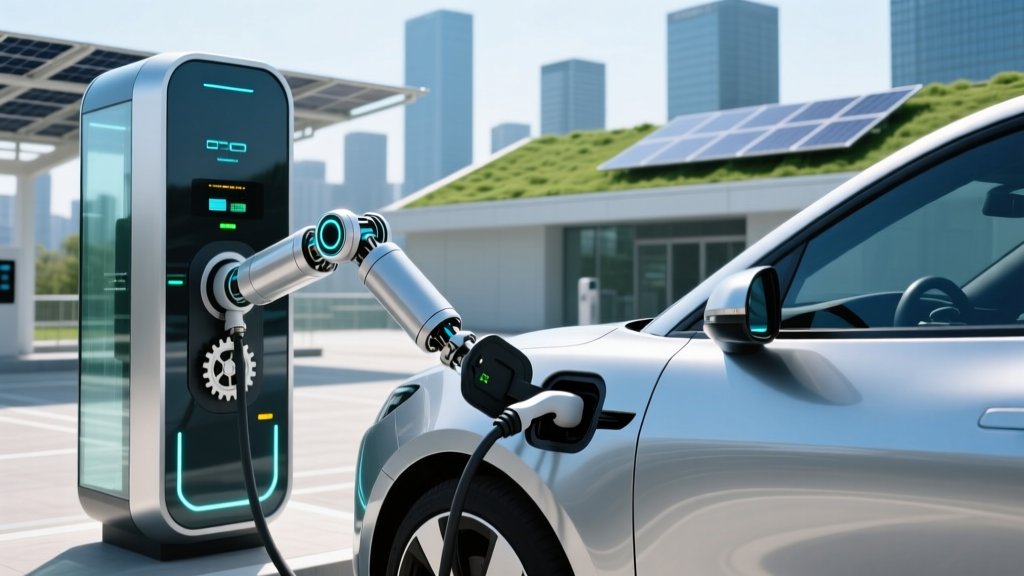
Robotic EV charging systems automate the physical connection between charger and vehicle. Instead of manually plugging in, a robotic arm, guided by cameras and sensors, locates the charge port and inserts the connector. The main categories in 2026:
Types of Robotic Charging
- Robotic arm systems (garage-mounted): Ceiling or wall-mounted arms that extend to plug into a parked vehicle. Companies like Volkswagen's concept systems, Ziggy (a mobile charging robot by EV Safe Charge), and several Chinese manufacturers (e.g., Enovate's robotic arm prototype) have demonstrated these. Most remain in pilot or fleet deployment.
- Inductive/wireless charging pads: Ground-mounted pads that transfer energy electromagnetically to a receiver coil under the vehicle. No physical plug. WiTricity and Plugless Power have commercialized versions, typically delivering 3.6–11 kW wirelessly — comparable to Level 2 wired speeds. Efficiency loss is roughly 5–10% compared to wired.
- Mobile charging robots: Autonomous battery-on-wheels units that drive to a parked vehicle and plug in. Deployed primarily in parking garages and fleet depots. Examples include Ziggy and Continental's CUbE-based concepts.
- Automatic pantograph/coupler systems: Used in heavy-duty and bus fleets, where vehicles align over a fixed charging point. Common in European transit depots.
Who Benefits from Robotic Charging?
Consider a robotic/automated system if:
- You have mobility limitations that make handling heavy charge cables difficult
- You operate a fleet depot with high vehicle turnover and want to reduce labor
- You use autonomous vehicles (robotaxis, AGVs) that cannot plug themselves in
- You want a premium garage experience and budget allows $3,000–$15,000+ for automation
Stick with a standard smart Level 2 wallbox if:
- You're a typical residential EV owner plugging in once daily
- Your budget is under $2,500 total (equipment + install)
- You want proven, warrantied equipment with broad compatibility
As of early 2026, no robotic EV charging system is widely available through consumer retail channels for single-family home installation. Most deployments are pilot programs, fleet operations, or luxury custom integrations. For the vast majority of EV owners, a high-quality smart Level 2 wallbox remains the practical choice.
Charging Cost Per Mile: Home vs. Public vs. Gas
One of the strongest economic arguments for EV ownership is lower per-mile energy cost — but only if you charge smart. Here's a realistic breakdown using a 3.5 mi/kWh efficiency (typical for a midsize crossover like the Tesla Model Y or Hyundai Ioniq 5).
| Scenario | Rate | Cost per kWh | Cost per Mile (at 3.5 mi/kWh) |
|---|---|---|---|
| Home, off-peak utility rate | $0.08–$0.14/kWh | $0.11 avg | $0.031/mi |
| Home, standard residential rate | $0.14–$0.22/kWh | $0.18 avg | $0.051/mi |
| Public Level 2 (ChargePoint, etc.) | $0.25–$0.49/kWh | $0.35 avg | $0.100/mi |
| DC Fast Charging (Electrify America, EVgo) | $0.35–$0.65/kWh | $0.48 avg | $0.137/mi |
| Tesla Supercharger (member rate) | $0.25–$0.40/kWh | $0.32 avg | $0.091/mi |
| Gasoline (25 MPG avg, $3.40/gal) | — | — | $0.136/mi |
The takeaway: Home off-peak charging delivers roughly a 75% per-mile savings vs. gasoline. Public DC fast charging at peak rates is cost-comparable to gas — the savings come from charging at home. Time-of-use (TOU) utility plans are essential for maximizing savings. According to fueleconomy.gov, most EVs achieve 3–4 mi/kWh in combined driving; highway and cold-weather driving reduce this to 2.5–3.0 mi/kWh.
Charging Time Examples for Common Battery Sizes
How long does a 10–80% charge actually take? It depends on battery capacity (kWh), charger power (kW), and the vehicle's charge curve. Here are real-world estimates assuming battery preconditioning and moderate temperatures:
| Battery Size | Example Vehicles | Level 2 (11.5 kW) | DC Fast (150 kW peak) | DC Fast (250–350 kW peak) |
|---|---|---|---|---|
| 58 kWh usable | VW ID.4 Standard, Chevy Equinox EV | ~4 hrs 15 min | ~28 min | ~22 min |
| 75 kWh usable | Tesla Model Y LR, Ford Mustang Mach-E ER | ~5 hrs 30 min | ~35 min | ~26 min |
| 84 kWh usable | Hyundai Ioniq 5, Kia EV6 (800V) | ~6 hrs 10 min | ~38 min | ~18 min |
| 100 kWh usable | Tesla Model S, Rivian R1T Max Pack | ~7 hrs 20 min | ~45 min | ~32 min |
| 131 kWh usable | Ford F-150 Lightning ER, GMC Hummer EV | ~9 hrs 40 min | ~58 min | ~42 min |
Charge curve reality: A vehicle advertising "250 kW peak" only sustains that rate at low SoC and optimal temperature. Above 60–70% SoC, charging power tapers — often dramatically. A 250 kW-capable Ioniq 5 might sustain 230 kW from 10–55% SoC, then drop to 100 kW from 55–70%, and below 50 kW from 70–80%. The 10–80% time accounts for this taper. This is why 10–80% is the standard metric — charging past 80% at a DC fast charger is painfully slow and hard on the battery.
Recommended Home Level 2 Chargers (2026)
While robotic EV charging systems remain niche, these proven Level 2 wallboxes cover the needs of most residential EV owners:
ChargePoint Home Flex
- Power output: Up to 12 kW (50A circuit) — adjustable down to 16A for smaller panels
- Connector: J1772 (works with NACS vehicles via included adapter)
- Cable length: 23 ft
- Smart features: WiFi, Alexa/Google, scheduling, energy tracking, load sharing
- Price: ~$550 (unit only)
- Best for: Flexibility across panel sizes; proven reliability
Tesla Wall Connector
- Power output: Up to 11.5 kW (48A / 60A circuit)
- Connector: NACS native (J1772 adapter included for non-Tesla EVs)
- Cable length: 24 ft
- Smart features: WiFi, OTA updates, Power Sharing (link up to 6 units on one circuit), vehicle integration
- Price: ~$475 (unit only)
- Best for: Tesla and NACS-native vehicle owners; multi-EV households
Emporia Level 2 EV Charger
- Power output: Up to 11.5 kW (48A)
- Connector: J1772 (NACS adapter included)
- Cable length: 24 ft
- Smart features: WiFi, app scheduling, energy monitoring, solar integration with Emporia Vue panel monitor
- Price: ~$400 (unit only)
- Best for: Budget-conscious buyers with solar panels; best value-to-feature ratio
Grizzl-E Smart
- Power output: Up to 10 kW (40A)
- Connector: J1772
- Cable length: 24 ft
- Smart features: WiFi, OCPP protocol, adjustable amperage, built-in GFCI
- Price: ~$450 (unit only)
- Best for: Extreme cold climates (rated to -40°F); Canadian-built durability
Safety, Code, and Installation Best Practices
EV charging draws sustained high current for hours — unlike a dryer that cycles on and off. This makes proper installation non-negotiable.
- Dedicated circuit: NEC Article 625 requires EVSE to be on a dedicated branch circuit. No sharing with outlets, lights, or appliances.
- GFCI protection: Required for all EV charging outlets (NEMA 14-50 or hardwired) per NEC 2020+. Many quality chargers include built-in GFCI; confirm with your electrician.
- Hardwired vs. plug-in: Hardwired chargers eliminate the outlet as a failure point and are preferred for 48A+ installations. Plug-in (NEMA 14-50) offers portability but requires a quality industrial-grade receptacle — cheap residential outlets have caused melting incidents under sustained EV loads.
- Outdoor rating: Any charger mounted outside must carry a NEMA 4 (splash-proof) or NEMA 4X (corrosion-resistant) rating. All units listed above meet this.
- Permit and inspection: Most jurisdictions require an electrical permit for new 240V circuits. Your electrician pulls the permit; a city inspector verifies the work. Skip this and you risk insurance denial in the event of a fire.
- Wire gauge: 6 AWG copper for 50A circuits; 4 AWG for 60A. Aluminum wire requires larger gauge. Your electrician will spec this based on run length and amperage.
For authoritative installation guidance, the National Fire Protection Association's NEC resources and your local building department are the definitive sources. Always hire a licensed electrician — EV charging is not a DIY electrical project.
Frequently Asked Questions
How much does it cost to install a home EV charger?
A standard Level 2 home installation (equipment + electrician + permit) costs $750–$2,250 if your electrical panel has sufficient capacity. If a panel upgrade from 100A to 200A is needed, total costs rise to $2,250–$6,250+. The charger unit itself runs $300–$750; the rest is labor, materials, and permitting. Robotic EV charging systems, where available for custom installation, add $3,000–$15,000+ on top of standard costs.
How fast will each charging level add range?
Level 1 (120V) adds 3–5 miles of range per hour. Level 2 (240V, 32–48A) adds 12–75 miles per hour depending on amperage and your vehicle's onboard charger. DC fast charging adds 150–1,200+ miles per hour at peak power, but is measured in 10–80% session time (typically 18–58 minutes) because the charge rate tapers significantly as the battery fills.
Which connector and charger is compatible with my EV?
Check your vehicle's charge port. 2026 Teslas, Fords, GMs, Rivians, and Volvos use NACS. Most Hyundai, Kia, BMW, VW, and Stellantis models use CCS1. For home Level 2 charging, any J1772 wallbox works with any EV using the adapter included with the vehicle. For DC fast charging on road trips, your connector determines network access — NACS unlocks Tesla Superchargers; CCS1 accesses Electrify America, EVgo, and others.
How much does charging cost per mile compared to gas?
Home off-peak charging costs roughly $0.03–$0.05 per mile — about 65–75% less than gasoline at $3.40/gal and 25 MPG. Public DC fast charging at $0.35–$0.65/kWh costs $0.10–$0.14 per mile, comparable to gas. The economic advantage of EVs depends heavily on home charging access and time-of-use utility rates.
What electrical upgrades might I need?
The most common upgrade is a panel replacement from 100A to 200A service ($1,500–$4,000), needed in older homes or those with multiple high-draw electric appliances. You may also need a new conduit run if the panel is far from the garage, or a sub-panel installation. Some utilities offer demand-response programs that allow a smaller circuit in exchange for controlled charging windows — ask your utility before committing to a panel upgrade.
Are robotic EV charging systems available for home use?
As of 2026, robotic EV charging systems are primarily deployed in fleet, commercial, and pilot settings — not consumer retail. Wireless inductive pads (WiTricity, Plugless) are available for select models at ~$3,000–$5,000 installed but deliver lower efficiency than wired charging. Robotic arm systems for home garages remain in limited demonstration phases. For most buyers, a smart Level 2 wallbox is the proven, cost-effective solution.