Portable EV chargers have carved out a niche for drivers who can't install a permanent wallbox — renters, apartment dwellers, and road-trippers who want a reliable backup. The Roadie EV Charger positions itself as a compact, travel-friendly Level 2 unit that bridges the gap between slow Level 1 trickle charging and fixed home installations. But does a portable charger actually deliver enough power to be practical for daily use? Let's break down the specs, real-world charging times, connector compatibility, and total cost to find out.
What the Roadie EV Charger Actually Is
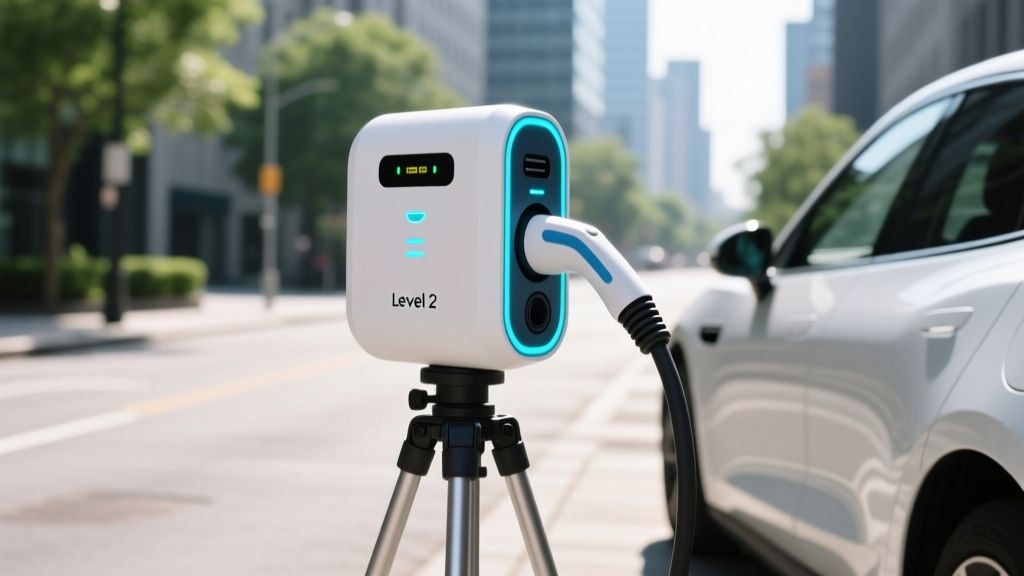
The Roadie EV Charger is a portable Level 2 charging unit designed to plug into a 240V outlet (NEMA 14-50 or NEMA 6-50) and deliver up to 32 amps of continuous current — translating to a maximum power output of 7.7 kW. Unlike hardwired wallbox chargers that require permanent electrical work, the Roadie connects via a standard high-amperage receptacle, making it removable and transportable.
This matters for a specific set of EV owners: those renting homes with existing 240V dryer or RV outlets, travelers who want to charge at campgrounds or relatives' houses, and anyone who wants a backup charger without committing to a $500–$1,200 hardwired installation. It's also relevant for workplaces or vacation properties where a permanent install isn't justified.
Understanding Charging Levels: How the Roadie Fits In
Before evaluating the Roadie, it's essential to understand where Level 2 sits in the charging hierarchy. Here's how each level translates to real range recovery:
| Level | Voltage | Max Power (kW) | Miles of Range/Hour | Typical Use |
|---|---|---|---|---|
| Level 1 | 120V AC | 1.4–1.9 kW | 3–5 mi/hr | Overnight trickle; PHEVs; emergency top-ups |
| Level 2 (Roadie class) | 240V AC | 7.7 kW (32A) | 25–35 mi/hr | Home daily charging; portable; workplace |
| Level 2 (hardwired) | 240V AC | 11.5–19.2 kW (48–80A) | 35–65 mi/hr | Dedicated home wallbox; high-capacity batteries |
| DC Fast Charging | 400–800V DC | 50–350 kW | 150–1,200 mi/hr | Road trips; highway corridors; commercial fleets |
At 7.7 kW, the Roadie adds roughly 25–35 miles of range per hour for a typical midsize EV. That means a 75 kWh battery (like the Tesla Model Y Long Range) charging from 10% to 80% — the practical daily window — takes approximately 6.5 to 7.5 hours. For overnight charging, that's entirely sufficient: plug in at 10 PM, and you'll have a full daily charge by morning.
Connector Compatibility: NACS, CCS1, and What You Need
The EV charging connector landscape has consolidated significantly since 2024, when Ford, GM, Rivian, and most major automakers committed to adopting the North American Charging Standard (NACS) developed by Tesla. By 2026, NACS is the dominant connector for new EVs sold in North America, though many vehicles from the 2022–2024 model years still use CCS1.
| Connector | Brands Using It | Notes |
|---|---|---|
| NACS (Tesla-style) | Tesla, Ford, GM, Rivian, Volvo, Polestar, Hyundai, Kia (2025+) | Becoming the universal standard; smaller, lighter plug |
| CCS1 | VW ID.4 (pre-2025), BMW i4/iX, older Hyundai/Kia, Mercedes EQ | Still widely used on 2022–2024 models; adapters available |
| CHAdeMO | Nissan Leaf (legacy) | Discontinued for new vehicles; declining public infrastructure |
The Roadie EV Charger ships in two connector variants: a NACS-native version and a CCS1 version. If you own a 2025 or newer vehicle from Ford, GM, Hyundai, Kia, or Rivian, you'll want the NACS model. For older CCS1-equipped vehicles, select the CCS1 variant. A CCS1-to-NACS adapter (approximately $100–$200 from reputable brands like Lectron or A2Z) can bridge the gap, but adds bulk to a charger designed for portability.
CHAdeMO owners (primarily Nissan Leaf drivers) are out of luck — no mainstream portable Level 2 charger supports CHAdeMO, and the standard is effectively sunset for new equipment. Public CHAdeMO stations are increasingly rare, with NHTSA-funded NEVI corridor chargers prioritizing CCS and NACS.
Electrical Requirements and Installation Costs
The Roadie EV Charger's portability is its main advantage — but it still requires a properly rated 240V outlet on a dedicated circuit. Here's what that entails electrically:
- Outlet type: NEMA 14-50 (most common, also used for RV parks and electric ranges) or NEMA 6-50 (welder/dryer outlets). The Roadie ships with a NEMA 14-50 plug standard; a 6-50 adapter pigtail is available.
- Circuit rating: 40-amp dedicated breaker minimum. The National Electrical Code (NEC) requires continuous loads (like EV charging) to be derated to 80% of breaker capacity, so a 40A breaker supports 32A continuous — matching the Roadie's 7.7 kW draw.
- Wire gauge: 8 AWG copper (THHN in conduit) or 6 AWG for runs exceeding 50 feet to minimize voltage drop.
- GFCI protection: The 2023 NEC update requires GFCI protection for all EV charging receptacles. If your existing 14-50 outlet predates this code, a licensed electrician may need to install a GFCI breaker (~$50–$120 for the breaker alone).
How Much Does It Cost to Install a Home EV Charger?
Since the Roadie is plug-in rather than hardwired, installation costs are significantly lower than a permanent wallbox — but not zero if you don't already have a suitable 240V outlet. Here's a realistic cost breakdown:
| Component | Simple Install (existing panel capacity, short run) | Complex Install (panel upgrade, long conduit run) |
|---|---|---|
| Roadie EV Charger unit | $349–$449 | $349–$449 |
| NEMA 14-50 outlet + wiring (8 AWG) | $250–$500 | $600–$1,200 |
| 40A breaker | $15–$30 | $15–$30 |
| GFCI breaker (if required by code) | $50–$120 | $50–$120 |
| Permit + inspection | $50–$150 | $50–$150 |
| Electrical panel upgrade (100A → 200A) | $0 (not needed) | $1,500–$3,500 |
| Total estimated cost | $714–$1,249 | $2,564–$5,449 |
For homeowners who already have a NEMA 14-50 outlet (common in garages with electric dryers or workshop setups), the Roadie becomes a true plug-and-play solution: buy the unit, plug it in, and start charging. Total investment: under $450.
Charging Times: What to Expect with Common EV Batteries
The practical question every EV buyer asks: how long does a full session take? Here's what the Roadie's 7.7 kW output delivers across popular 2026 battery sizes, charging from 10% to 80% state of charge:
| Vehicle | Battery (kWh usable) | Energy needed (10–80%) | Estimated time |
|---|---|---|---|
| Chevrolet Equinox EV | 85 kWh | ~59.5 kWh | ~7 hr 45 min |
| Tesla Model Y Long Range | 75 kWh | ~52.5 kWh | ~6 hr 50 min |
| Hyundai Ioniq 5 (Long Range) | 77.4 kWh | ~54.2 kWh | ~7 hr |
| Ford F-150 Lightning (Std) | 98 kWh | ~68.6 kWh | ~8 hr 55 min |
| BMW i4 eDrive40 | 81.5 kWh | ~57.1 kWh | ~7 hr 25 min |
| Toyota bZ4X | 64 kWh | ~44.8 kWh | ~5 hr 50 min |
These times assume the vehicle's onboard charger can accept the full 7.7 kW — most 2025+ EVs can, but some older or base-model vehicles (particularly the Nissan Leaf and some PHEVs) have onboard chargers limited to 3.3 or 6.6 kW, which would bottleneck charging regardless of the supply.
Cost to Charge: Home vs. Public vs. Gas
The economics of EV charging depend heavily on where and when you plug in. Here's a side-by-side cost comparison using 2026 national averages:
| Scenario | Price | Vehicle Efficiency | Cost Per Mile |
|---|---|---|---|
| Home Level 2 (off-peak TOU rate) | $0.09/kWh | 3.2 mi/kWh | $0.028 |
| Home Level 2 (standard rate) | $0.16/kWh | 3.2 mi/kWh | $0.050 |
| Public Level 2 (ChargePoint/EVgo) | $0.30/kWh | 3.2 mi/kWh | $0.094 |
| DC Fast Charging (Electrify America) | $0.48/kWh | 3.0 mi/kWh (highway) | $0.160 |
| Tesla Supercharger (member rate) | $0.30/kWh | 3.3 mi/kWh | $0.091 |
| Gasoline (28 MPG vehicle) | $3.40/gallon | 28 MPG | $0.121 |
| Gasoline (22 MPG truck/SUV) | $3.40/gallon | 22 MPG | $0.155 |
Home charging on an off-peak time-of-use (TOU) rate is the clear economic winner at under 3 cents per mile — roughly one-quarter the cost of gasoline. Even at standard residential rates, Level 2 home charging costs about half what gas does per mile. The Roadie, used at home, unlocks these savings without a permanent installation commitment.
Public DC fast charging, however, can equal or exceed gasoline costs on a per-mile basis. This is the trade-off of road-trip convenience. The Roadie isn't a replacement for DC fast charging on long trips — it's a solution for destination charging (hotels, campgrounds, family visits) where you have several hours to spare.
Roadie EV Charger vs. Competing Portable Level 2 Units
The portable Level 2 market has matured, and the Roadie faces stiff competition. Here's how it compares to the most credible alternatives in 2026:
Roadie EV Charger
- Power: 7.7 kW (32A, 240V)
- Connector: NACS or CCS1 (select at purchase)
- Cable length: 20 ft
- Smart features: Bluetooth app scheduling, energy tracking
- Weight: 8.2 lbs
- Weather rating: NEMA 4 (indoor/outdoor)
- Price: $349–$449
Emporia Level 2 Portable
- Power: 9.6 kW (40A, 240V)
- Connector: J1772 (NACS adapter included)
- Cable length: 24 ft
- Smart features: Wi-Fi, solar integration, load management
- Weight: 11 lbs
- Weather rating: NEMA 4
- Price: $399–$499
Lectron V-BOX Pro
- Power: 9.6 kW (40A, 240V)
- Connector: J1772 or NACS
- Cable length: 20 ft
- Smart features: Basic LED status, no app
- Weight: 9.5 lbs
- Weather rating: IP65
- Price: $279–$349
ChargePoint Home Flex (portable config)
- Power: 12 kW (50A, 240V)
- Connector: J1772 (NACS adapter sold separately)
- Cable length: 23 ft
- Smart features: Wi-Fi, Alexa, detailed app, scheduling
- Weight: 13 lbs (not truly portable)
- Weather rating: NEMA 4
- Price: $599–$699
The Roadie's advantage is weight and simplicity — at 8.2 lbs with a native NACS option, it's the lightest true Level 2 portable on the market. The trade-off is a 32A ceiling (vs. 40A or 50A on competitors), which adds roughly 45–90 minutes to a 10–80% session on a large battery. For overnight charging, this is irrelevant. For mid-day top-ups on a road trip, it's noticeable.
Safety, Code, and Best Practices
Portable EV chargers operate at high amperage for extended periods — this is not a phone charger. Follow these non-negotiable safety guidelines:
- Dedicated circuit only: Never share the 14-50 circuit with another high-draw appliance (dryer, welder, AC unit). Simultaneous use can overload the breaker or overheat wiring.
- Inspect the plug and outlet: Before each session, check for scorch marks, melted plastic, or loose fit. A worn 14-50 receptacle can arc under 32A continuous load. Replace outlets showing any discoloration.
- No extension cords: Never use an extension cord between the outlet and the Roadie. If the 20-foot cable doesn't reach, have an electrician relocate the outlet.
- Outdoor use: The Roadie's NEMA 4 rating protects against splashing water and dust, but the NEMA 14-50 plug connection at the outlet is not weather-sealed. For outdoor charging, install an in-use weatherproof cover ("bubble cover") over the receptacle — roughly $25–$40 at any hardware store.
- UL listing: Verify the specific unit carries a UL or ETL listing mark. Some budget portable chargers sold on marketplace sites lack independent safety certification. The NHTSA recommends only using certified equipment.
Who Should (and Shouldn't) Buy the Roadie EV Charger
Choose the Roadie if:
- You rent and can't install a hardwired wallbox but have access to a 240V outlet
- You travel frequently and want to charge at RV parks, campgrounds, or family homes
- Your EV has a battery under 85 kWh and you charge overnight (7+ hours available)
- You want NACS-native compatibility without adapters
- Budget is a priority and 7.7 kW is sufficient for your daily mileage
Choose a hardwired 48A+ wallbox instead if:
- You own your home and plan to stay 5+ years
- Your EV has a large battery (100+ kWh) and you need faster turnaround
- You drive 80+ miles daily and need 30+ miles of range added per hour
- You want utility demand-response programs (many require Wi-Fi-enabled hardwired units)
- Your vehicle supports 11.5 kW or 19.2 kW AC charging and you want to use it
Frequently Asked Questions
How much does it cost to install a home EV charger for the Roadie?
If you already have a NEMA 14-50 outlet on a dedicated 40A circuit, your cost is just the charger itself: $349–$449. If you need a new outlet installed, expect $700–$1,250 total (charger + electrician + permit) for a straightforward install. Homes needing a panel upgrade should budget $2,500–$5,500 total. Always get a licensed electrician's load calculation before committing.
How fast will the Roadie add range compared to Level 1?
The Roadie at 7.7 kW adds roughly 25–35 miles of range per hour for a midsize EV — about 6 to 8 times faster than Level 1 at 1.4 kW (3–5 mi/hr). A full overnight session (8 hours) adds approximately 200–280 miles of range, enough to fully replenish most EVs.
Which connector do I need for my EV?
If your vehicle is a 2025 or newer Tesla, Ford, GM, Rivian, Hyundai, Kia, or Volvo, you need NACS. For 2022–2024 models from VW, BMW, Mercedes, and older Hyundai/Kia, you likely need CCS1. Check your vehicle's charge port or owner's manual. CHAdeMO is limited to the Nissan Leaf and is no longer supported by new portable chargers.
How much does charging cost per mile vs. gasoline?
Home Level 2 charging costs $0.03–$0.05 per mile depending on your electricity rate — roughly one-quarter to one-half the cost of gasoline at $0.12–$0.16 per mile for a 22–28 MPG vehicle. Public DC fast charging narrows the gap to $0.10–$0.16 per mile, approaching gas parity on road trips.
What electrical upgrades might I need?
The most common upgrade is installing a new NEMA 14-50 outlet on a dedicated 40A circuit — typically $250–$600 if your panel has spare capacity. Homes with 100A service panels or panels already near capacity may need a full upgrade to 200A ($1,500–$3,500). GFCI breaker requirements (per 2023 NEC) add $50–$120. A licensed electrician's load calculation is the definitive answer.
Can I use the Roadie for daily home charging long-term?
Yes — the Roadie is rated for continuous daily use, and many owners use it as their primary charger for years. The main trade-off versus a hardwired wallbox is the lower 7.7 kW ceiling (vs. 11.5–19.2 kW) and the physical wear of a plug-in connection vs. hardwired terminals. If your daily driving is under 60 miles and you charge overnight, the Roadie handles it without issue.