Can Rivian Use Tesla Superchargers? The Short Answer
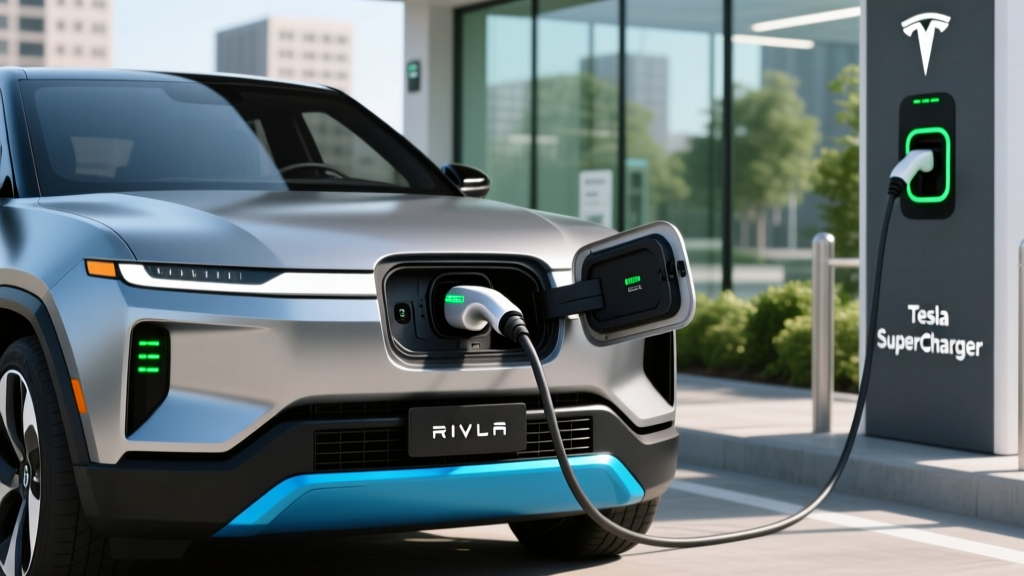
Yes. As of 2026, every Rivian R1T and R1S on the road can access the Tesla Supercharger network using a NACS (North American Charging Standard) adapter. Rivian began shipping official NACS adapters to owners in mid-2024, and all 2025 and 2026 model-year Rivians leave the factory equipped with a native NACS charge port — no adapter required.
This shift matters because the Tesla Supercharger network is the largest and most reliable DC fast-charging infrastructure in North America, with over 6,000 stations and 30,000+ stalls as of early 2026. For Rivian owners planning road trips, this effectively doubles the usable fast-charging map overnight.
But accessing Superchargers is only one piece of the charging puzzle. Whether you own an R1T Dual-Motor, an R1S Tri-Motor, or you're shopping for a used 2023 model with the original CCS1 port, you need to understand charging levels, home installation costs, connector compatibility, and the real cost per mile. This guide covers all of it with exact numbers.
- 2022–2024 Rivian R1T/R1S: Shipped with CCS1 port. Require a Rivian-approved NACS adapter (officially shipped starting June 2024) to use Tesla Superchargers.
- 2025–2026 Rivian R1T/R1S (Gen 2): Native NACS port. Plug directly into any Supercharger — no adapter needed. CCS1 charging requires a NACS-to-CCS adapter for older Electrify America or non-Tesla DC fast stations still using CCS.
Understanding EV Charging Levels: Speeds in kW and Miles Per Hour
Before we get into adapters and install costs, let's nail down the three charging levels. The critical distinction: kW (kilowatts) measures power — how fast energy flows into the battery. kWh (kilowatt-hours) measures energy — the total capacity of the battery pack. Think of kW as the flow rate of a hose and kWh as the size of the bucket.
| Level | Voltage | Power (kW) | Miles of Range Added Per Hour | Typical Use Case |
|---|---|---|---|---|
| Level 1 | 120V AC | 1.0–1.4 kW | 3–5 mi/hr | Emergency/trickle; standard household outlet |
| Level 2 | 240V AC | 7.2–19.2 kW | 20–55 mi/hr | Home charging, workplace, shopping centers |
| DC Fast Charge | 400–800V DC | 50–350 kW | 150–700+ mi/hr (varies) | Road trips, highway corridors, Superchargers |
For context, a Rivian R1T with the Large battery pack (approximately 128.9 kWh usable) charging at a Level 2 station delivering 11.5 kW will add roughly 30 miles of range per hour — or about 9 hours for a full 10–100% charge. On a Tesla V3 Supercharger delivering a peak 150 kW to the R1T (Rivian's DC fast-charge acceptance peaks around 200–220 kW on Gen 2 vehicles), you'll see roughly 140 miles added in the first 20 minutes, with the charge curve tapering significantly above 80% state of charge.
Connector Compatibility: NACS, CCS1, and Adapters Explained
The connector landscape in 2026 has largely consolidated around NACS, but legacy CCS1 stations still exist. Here's how Rivian maps to the current ecosystem:
| Connector Type | 2022–2024 Rivian (CCS1 Port) | 2025–2026 Rivian (NACS Port) | Network Examples |
|---|---|---|---|
| NACS (Tesla) | Requires Rivian NACS adapter | Native — plug directly | Tesla Superchargers, Electrify America (new stalls), EVgo (new stalls) |
| CCS1 | Native — plug directly | Requires NACS-to-CCS adapter | Older Electrify America, ChargePoint DC, some municipal stations |
| CHAdeMO | Not compatible (no adapter available) | Not compatible | Largely deprecated; some older Nissan Leaf stations |
| J1772 (Level 2 AC) | Requires J1772-to-NACS or included adapter | Requires J1772-to-NACS adapter | Public Level 2 stations, older home chargers |
The Rivian official NACS adapter (for CCS1-port vehicles) retails for approximately $200 through the Rivian shop and supports DC fast charging at up to the vehicle's peak acceptance rate. Third-party adapters from companies like Lectron and A2Z exist at lower price points ($120–$160), but Rivian recommends using only their officially validated adapter to avoid communication protocol issues that could throttle charging speeds or trigger fault codes.
Home Level 2 Charger Installation: Requirements, Costs, and Equipment
Home charging is where the vast majority of Rivian charging sessions happen — the U.S. Department of Energy estimates that over 80% of EV charging occurs at home. For a truck like the R1T with its large battery pack, a robust Level 2 setup isn't optional — it's essential for waking up to a full charge.
Electrical Requirements for Rivian Home Charging
The Rivian Wall Connector supports up to 11.5 kW (48 amps on a 60-amp dedicated circuit) or up to 19.2 kW (80 amps on a 100-amp circuit) for Gen 2 vehicles with the dual onboard charger option. Here's what your electrical system needs to support:
- Minimum recommended: 240V / 40A dedicated circuit (NEMA 14-50 outlet or hardwired), delivering up to 9.6 kW
- Optimal for R1T/R1S Large Pack: 240V / 60A dedicated circuit (hardwired), delivering 11.5 kW — adds ~30 miles of range per hour
- Maximum (dual charger equipped): 240V / 80A dedicated circuit (hardwired), delivering 19.2 kW — adds ~52 miles of range per hour
Installation Cost Breakdown
Costs vary dramatically based on your home's electrical panel capacity, the distance from the panel to your garage or parking spot, and local permit fees. Here's a realistic breakdown:
| Component | Simple Install (panel near garage, 200A service) | Complex Install (panel far, may need upgrade) |
|---|---|---|
| Level 2 Charger (hardware) | $500–$700 | $500–$700 |
| Electrician labor (2–4 hrs @ $85–$150/hr) | $170–$600 | $600–$1,500 |
| Electrical materials (conduit, wire, breaker) | $100–$300 | $300–$800 |
| Permit fee | $50–$200 | $50–$200 |
| Panel upgrade (100A→200A service, if needed) | N/A | $1,500–$3,500 |
| Total estimated cost | $820–$1,800 | $2,950–$6,700 |
The panel upgrade is the budget killer. Homes built before 2000 often have 100-amp or 150-amp electrical service. Adding a 60-amp EV circuit to a maxed-out 100-amp panel requires a service upgrade to 200 amps — a job that costs $1,500 to $3,500 and requires coordination with your local utility. Always have a licensed electrician perform a load calculation before assuming you can simply add a circuit.
Safety and Code Considerations
- Dedicated circuit required: NEC Article 625 requires EV chargers to be on a dedicated branch circuit — you cannot share it with other appliances.
- GFCI protection: The 2020 NEC update mandates GFCI protection for outdoor receptacles used for EV charging. Hardwired installations may have different GFCI requirements depending on jurisdiction.
- Outdoor rating: If your charger is mounted outside or in an unsealed garage, ensure it carries a NEMA 4 (weatherproof) rating. The Rivian Wall Connector and ChargePoint Home Flex are both rated for outdoor use.
- Permit and inspection: Most jurisdictions require an electrical permit and post-installation inspection. Skipping this can void homeowner's insurance claims related to electrical fires.
Recommended Home Chargers for Rivian R1T and R1S
Not all Level 2 chargers are equal. Here are three proven options matched to Rivian's capabilities:
Rivian Wall Connector
- Power output: Up to 11.5 kW (48A) / 19.2 kW (80A with dual charger)
- Connector: NACS native (2025+); CCS1 adapter included for older vehicles
- Cable length: 25 feet
- Smart features: Integrated with Rivian app, scheduled charging, energy tracking
- Price: ~$650 (48A) / ~$850 (80A)
- Best for: Rivian owners who want seamless app integration and maximum charge rate
ChargePoint Home Flex
- Power output: Up to 12 kW (50A) — adjustable down to match circuit
- Connector: NACS (2025 model) or J1772 with NACS adapter
- Cable length: 23 feet
- Smart features: Wi-Fi, ChargePoint app, Alexa integration, amperage selector
- Price: ~$550–$700
- Best for: Multi-EV households or those wanting network flexibility
Emporia Level 2 EV Charger
- Power output: Up to 11.5 kW (48A)
- Connector: J1772 (NACS adapter available separately)
- Cable length: 24 feet
- Smart features: Real-time energy monitoring, solar integration, load management
- Price: ~$400–$500
- Best for: Budget-conscious installers; excellent for homes with solar panels
Charging Cost Per Mile: Home vs. Public vs. Gas
The economics of charging a Rivian depend heavily on where and when you plug in. The R1T Dual-Motor with the Large pack has an EPA efficiency rating of approximately 2.0–2.2 kWh/mile (or roughly 70 MPGe combined per fueleconomy.gov). Let's translate that into dollars.
| Charging Scenario | Rate ($/kWh) | Cost to Add 100 Miles (R1T) | Cost Per Mile |
|---|---|---|---|
| Home — off-peak utility rate | $0.08–$0.12 | $16.80–$25.20 | $0.17–$0.25 |
| Home — standard rate (no TOU plan) | $0.14–$0.18 | $29.40–$37.80 | $0.29–$0.38 |
| Tesla Supercharger (V3/V4 average) | $0.28–$0.38 | $58.80–$79.80 | $0.59–$0.80 |
| Electrify America / EVgo DC fast | $0.35–$0.48 | $73.50–$100.80 | $0.74–$1.01 |
| Gas truck equivalent (Ford F-150 4WD, 20 MPG, $3.40/gal) | $3.40/gal | $17.00 | $0.17 |
At home on an off-peak rate, the R1T is competitive with or cheaper per mile than a gas F-150. On public DC fast chargers, it costs significantly more — sometimes 4–5x the home rate. This is why home charging isn't just convenient; it's the economic foundation of EV ownership. If you rely exclusively on public DC fast charging, the cost advantage over gas evaporates for a large, heavy truck like the R1T.
Rivian Charging Times: 10–80% by Battery Pack and Charger Type
Rivian offers multiple battery configurations across the R1T and R1S lineup. Here are approximate 10–80% charge times based on real-world charge curve behavior, not just peak kW figures:
| Battery Pack | Usable Capacity | DC Fast Peak kW | 10–80% on 150 kW Supercharger | 10–80% on 350 kW CCS Station | Level 2 at 11.5 kW (10–100%) |
|---|---|---|---|---|---|
| Standard (R1T Gen 2) | ~95 kWh | ~200 kW | ~28 min | ~25 min | ~8 hrs |
| Large (R1T/R1S) | ~128.9 kWh | ~220 kW | ~40 min | ~35 min | ~11 hrs |
| Max (R1T/R1S) | ~149 kWh | ~220 kW | ~48 min | ~42 min | ~13 hrs |
Important caveats: these times assume battery preconditioning is active (the R1T automatically preconditions the pack when a charger is set as your navigation destination). Without preconditioning — for instance, plugging in at a random station without navigating there first — cold battery temperatures can reduce peak acceptance rates by 30–50%, especially in winter. Always navigate to your charging stop in the Rivian's built-in nav to trigger thermal prep.
Frequently Asked Questions
How much does it cost to install a home EV charger for a Rivian?
Expect $820–$1,800 for a straightforward install on a 200-amp panel with the breaker box near the garage. If your home needs a panel upgrade from 100A to 200A service, total costs can reach $2,950–$6,700 including equipment, labor, materials, and permits. Always get a load calculation from a licensed electrician before committing.
How fast will each charging level add range to my Rivian?
Level 1 (120V) adds roughly 3–5 miles per hour — essentially useless for the R1T's large battery. Level 2 (240V at 48A/11.5 kW) adds about 30 miles per hour. DC fast charging at 150 kW adds roughly 140 miles in 20 minutes during the peak portion of the charge curve. The key metric is 10–80% time, which ranges from 28 minutes (Standard pack) to 48 minutes (Max pack) on a V3 Supercharger.
Which connector and charger is compatible with my Rivian?
2022–2024 Rivians have a CCS1 port and need the official Rivian NACS adapter (~$200) to use Tesla Superchargers. 2025–2026 Rivians have a native NACS port and plug directly into Superchargers. For older CCS1 public stations, 2025+ owners need a NACS-to-CCS adapter. For home Level 2 charging, any NACS-equipped charger (or J1772 with adapter) will work.
How much does charging a Rivian cost per mile vs. a gas truck?
Charging at home on off-peak electricity ($0.08–$0.12/kWh) costs roughly $0.17–$0.25 per mile — competitive with or cheaper than a gas F-150 at $3.40/gallon and 20 MPG. Public DC fast charging ($0.28–$0.48/kWh) costs $0.59–$1.01 per mile, making it more expensive than gas. Home charging is where the economics work for large-battery EVs.
What electrical upgrades might I need for a home charger?
If your home has a 200-amp electrical panel with available capacity, you likely just need a dedicated 60-amp breaker and wiring run. If you have a 100-amp panel — common in homes built before 2000 — you'll likely need a full service upgrade to 200 amps, costing $1,500–$3,500. Some utilities offer rebates of $250–$500 for panel upgrades paired with EV charger installation. Check with your local utility and the IRS Residential Clean Energy Credit for potential tax incentives on related electrical work.
Can I use a Tesla Supercharger without an adapter if I have a 2025 or 2026 Rivian?
Yes. All 2025 and 2026 model-year Rivian R1T and R1S vehicles ship with a native NACS charge port, which is physically identical to the Tesla connector. You can pull up to any Supercharger, plug in, and initiate a session through the Rivian app or the Tesla app (after linking your Rivian VIN to your Tesla account for billing). No adapter is needed.