If you own or are considering a Rivian R1T or R1S, home charging is where the vast majority of your electrons will come from. Rivian's smart charging ecosystem — spanning the Rivian Wall Charger, the vehicle's built-in scheduling software, and utility demand-response integrations — is designed to make overnight Level 2 charging as seamless as possible. But behind the polished app experience are real electrical requirements, real costs, and real decisions about which hardware to install.
This guide breaks down everything you need to know about setting up a home EV charging system optimized for Rivian's large battery packs (128.9 kWh usable on the Standard Pack, up to 149.5 kWh on the Max Pack), including exact power figures, installation cost ranges, connector standards, and how Rivian's smart charging features interact with your electrical panel and utility rate plan.
Charging Levels Explained: How Fast Will Each Level Add Range?
Before choosing equipment, you need to understand the three charging tiers available to Rivian owners. Power is measured in kW (kilowatts) — the rate of energy delivery — while battery capacity is measured in kWh (kilowatt-hours) — the total energy stored. Confusing the two is the most common EV mistake; a 11.5 kW charger delivers 11.5 kWh of energy per hour into your battery.
| Level | Voltage | Max Power (kW) | Miles of Range Added/Hour | Typical Use Case |
|---|---|---|---|---|
| Level 1 | 120V AC | 1.4–1.9 kW | 3–5 mi/hr | Emergency/top-up only; ~50 mi overnight |
| Level 2 | 240V AC | 7.7–19.2 kW | 20–59 mi/hr | Daily home and workplace charging |
| DC Fast | 400V+ DC | 50–220+ kW | 150–250+ mi in 20 min | Road trips, highway corridors |
For Rivian vehicles specifically, the onboard charger determines how fast Level 2 charging can occur. The R1T and R1S (2025–2026 model years) accept up to 11.5 kW on a single charger, or 20 kW with the available dual onboard charger configuration. That means even if you install a 19.2 kW (80A) hardwired charger, a single-charger Rivian will only pull 11.5 kW (48A). The dual-charger option, available on R1T Dual-Motor and tri/quad-motor trims, lets you take full advantage of higher-amperage circuits.
On DC fast charging, Rivian's Max Pack vehicles can peak at approximately 220 kW, achieving a 10–80% charge in roughly 30 minutes. The Standard Pack peaks around 200 kW with a 10–80% time of about 28 minutes. The charge curve tapers significantly above 80% — a physics limitation of lithium-ion cells to prevent lithium plating — so DC fast charging to 100% is rarely time-efficient.
Rivian Smart Charging: What the Software Does
Rivian's "smart charging" isn't just a hardware play — it's a software layer built into the vehicle and the Rivian app. Here's what it actually does:
- Scheduled Charging: Set a departure time and the vehicle begins charging during off-peak utility hours (typically 10 PM–6 AM), when electricity rates can be 40–60% lower than peak.
- Charging Limit: Configure a daily maximum state of charge (SoC) — Rivian recommends 85–90% for daily use on NMC batteries to reduce degradation, with 100% reserved for road trips.
- Utility Demand Response: In select regions, Rivian partners with utilities (e.g., PG&E, ConEdison) to participate in demand-response programs, earning bill credits by pausing or reducing charging during grid stress events.
- Preconditioning: When you set a departure time, the vehicle warms or cools the battery pack to optimal temperature before you leave — critical in cold weather, where an un-preconditioned pack can lose 20–30% of range and accept DC fast charging at significantly reduced power.
These features work with any Level 2 charger that supplies continuous power, but they're optimized for chargers that remain "always on" (hardwired or plugged into a dedicated 240V outlet that doesn't get switched off).
Home Electrical Requirements: What Your Panel Needs
A Level 2 charger for a Rivian is a significant electrical load — comparable to running a large electric oven or two simultaneously. Here's what the circuit needs to support:
Standard Single-Charger Setup (11.5 kW)
- Circuit: 60-amp dedicated breaker (EVSE draws a continuous 48A; NEC requires 125% headroom for continuous loads)
- Wire: 6 AWG copper (THHN in conduit) or 4 AWG aluminum
- Voltage: 240V single-phase
- Outlet option: NEMA 14-60 (if plug-in) or hardwired (preferred for reliability and code compliance in many jurisdictions)
Dual-Charger Setup (20 kW)
- Circuit: 100-amp dedicated breaker (80A continuous draw)
- Wire: 3 AWG copper or 1 AWG aluminum
- Voltage: 240V single-phase
- Connection: Hardwired only (no standard residential receptacle rated for 100A continuous EV charging)
Do You Need a Panel Upgrade?
This is the make-or-break cost question. Most homes built after 2000 have a 200-amp main service panel. If your panel is already heavily loaded (electric range, electric dryer, electric HVAC, hot tub), adding a 60A EV circuit may push total calculated load beyond your panel's capacity. A licensed electrician will perform a NEC Article 220 load calculation to determine if you have headroom.
Homes with 100-amp or 150-amp service — common in houses built before 1990 — almost certainly require a panel upgrade to 200A before adding a Level 2 charger. This is not optional; it's a code requirement and a fire-safety issue.
Some homeowners opt for a lower-amperage circuit (e.g., 30A or 40A breaker) to avoid a panel upgrade. A 40A circuit still delivers 9.6 kW (32A continuous) — enough to fully recharge a Rivian Standard Pack from 20–80% overnight in roughly 8 hours. It's slower, but it can save $2,000–$5,000 on panel work.
How Much Does It Cost to Install a Home EV Charger?
Installation costs vary dramatically based on your home's electrical infrastructure, the distance from panel to charger location, and local labor rates. Here's a realistic breakdown for a 2026 installation:
| Component | Low Estimate | High Estimate | Notes |
|---|---|---|---|
| Level 2 EVSE (charger hardware) | $400 | $750 | Quality smart chargers; Rivian Wall Charger ~$599 |
| Electrician labor (60A circuit, <25 ft run) | $600 | $1,500 | Short run, accessible panel, no conduit complications |
| Electrician labor (60A circuit, 25–75 ft run) | $1,200 | $2,800 | Longer wire runs, conduit, attic/crawlspace routing |
| Permit and inspection | $100 | $400 | Varies by municipality; some bundle with electrical |
| Panel upgrade (100A → 200A), if needed | $2,500 | $5,500 | Major project; includes new panel, utility coordination |
| NEMA 14-60 outlet (if plug-in) | $100 | $250 | Optional; hardwired is often preferred |
Typical total (no panel upgrade): $1,100–$2,800 for a standard 60A/48A installation with a quality charger.
Typical total (with panel upgrade): $3,600–$8,300 — the panel upgrade dominates the cost.
The federal Alternative Fuel Vehicle Refueling Property Credit (IRS Form 8911) may cover up to 30% of home charger equipment and installation costs (capped at $1,000), subject to census-tract eligibility and income requirements. Check current-year rules on irs.gov before assuming qualification.
Which Connector and Charger Are Compatible With Rivian?
Rivian's connector situation evolved significantly between 2024 and 2026. Here's the current landscape:
| Connector Standard | Rivian Compatibility (2025–2026) | Notes |
|---|---|---|
| NACS (Tesla/J3400) | Native on 2025+ R1T/R1S | 2025-and-later Rivians ship with NACS charge ports; direct access to Tesla Supercharger network |
| CCS1 | 2022–2024 R1T/R1S (native); adapter for 2025+ models | Older Rivians use CCS1 natively; Rivian offers a CCS-to-NACS adapter for newer vehicles at CCS stations |
| CHAdeMO | Not supported | CHAdeMO is effectively obsolete in North America; no adapter available from Rivian |
For home Level 2 charging, all North American chargers use the J1772 connector (for CCS-vehicle model years) or NACS connector (for 2025+ vehicles). Most modern smart chargers ship with NACS or offer J1772-to-NACS adapters. Verify the connector matches your vehicle's model year before purchasing.
Best Home Chargers for Rivian R1T and R1S
Based on power output, smart features, build quality, and compatibility with Rivian's charging system, here are the top options for 2026:
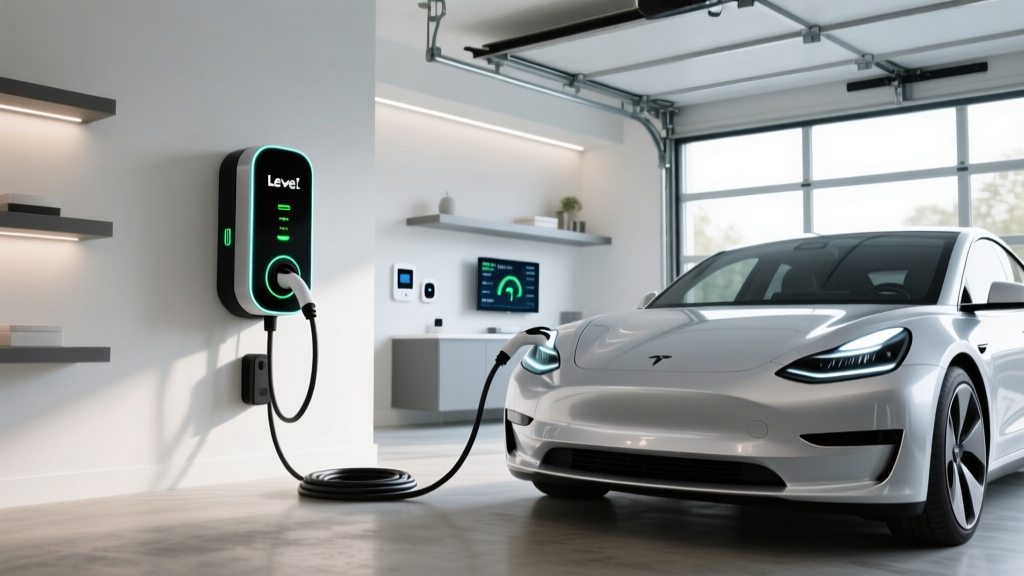
Rivian Wall Charger
- Power Output: 11.5 kW (48A) on a 60A circuit
- Connector: NACS (2025+ models)
- Cable Length: 25 ft
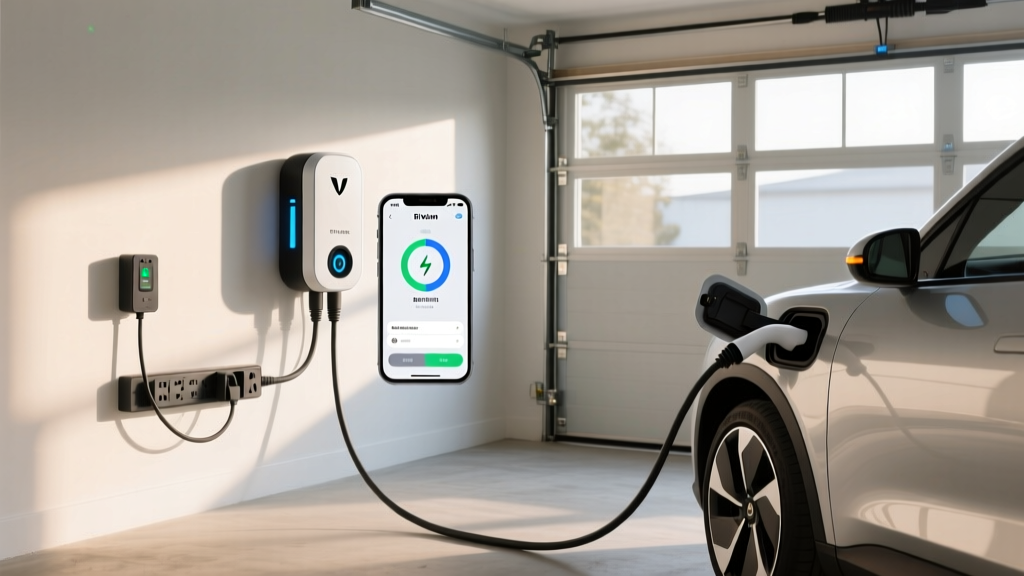
- Smart Features: Wi-Fi connected, integrates directly with Rivian app for scheduling and energy tracking, OTA firmware updates
- Price: ~$599
- Best For: Single-charger Rivian owners who want seamless app integration and don't need 80A
ChargePoint Home Flex
- Power Output: Configurable from 16A to 50A (up to 12 kW) on a 60A circuit; can be set to match your circuit breaker
- Connector: NACS or J1772 (select at purchase)
- Cable Length: 23 ft
- Smart Features: Wi-Fi, ChargePoint app with detailed energy reports, Alexa integration, utility demand-response compatible, works with any EV
- Price: ~$649
- Best For: Multi-EV households or those who want a proven, third-party platform with flexible amperage settings
Grizzl-E Smart
- Power Output: Up to 11.5 kW (48A) on a 60A circuit; adjustable DIP switches for lower-amperage panels
- Connector: J1772 or NACS
- Cable Length: 24 ft
- Smart Features: Wi-Fi via evnex platform, OCPP-compatible, energy tracking
- Price: ~$499
- Best For: Budget-conscious buyers who want a durable, Canadian-built unit with adjustable output for panel-limited homes
Tesla Wall Connector
- Power Output: Up to 11.5 kW (48A) on 60A circuit; supports load sharing when two units are installed on one circuit
- Connector: NACS native
- Cable Length: 24 ft
- Smart Features: Wi-Fi, OTA updates, power-sharing between two connectors, integrates with Tesla app (less relevant for Rivian)
- Price: ~$475
- Best For: Households with both a Tesla and a 2025+ Rivian; excellent value and build quality
Key selection note: If your Rivian has the dual onboard charger option (20 kW), none of the above single-circuit chargers will fully utilize it. You'd need a 100A hardwired circuit and an 80A EVSE (such as a Tesla Wall Connector configured for 80A on a 100A breaker, with the appropriate adapter). Most Rivian owners find that 11.5 kW overnight charging is more than sufficient — it adds roughly 30–35 miles of range per hour, fully replenishing even a Max Pack from 20–80% in about 8 hours.
Cost to Charge: Home vs. Public vs. Gas
The economic case for home charging is overwhelming once you compare real per-mile costs. Here's how a Rivian R1T Dual-Motor (EPA efficiency approximately 44 kWh/100 mi, per fueleconomy.gov) stacks up:
| Charging Scenario | Rate ($/kWh) | Cost per 100 Miles | Cost per Mile |
|---|---|---|---|
| Home off-peak (time-of-use rate) | $0.09–$0.14 | $3.96–$6.16 | $0.04–$0.06 |
| Home standard rate (no TOU) | $0.16–$0.22 | $7.04–$9.68 | $0.07–$0.10 |
| Public Level 2 (ChargePoint, EVgo L2) | $0.25–$0.49 | $11.00–$21.56 | $0.11–$0.22 |
| DC Fast Charging (Electrify America, Tesla Supercharger) | $0.35–$0.58 | $15.40–$25.52 | $0.15–$0.26 |
| Gas truck equivalent (Ford F-150 4x4, 20 MPG, $3.40/gal) | — | $17.00 | $0.17 |
At off-peak home rates, a Rivian R1T costs roughly $0.04–$0.06 per mile to "fuel" — about one-third the cost of a comparable gas truck. Even at standard residential rates without time-of-use optimization, you're saving $7–$10 per 100 miles. The smart charging scheduling feature in the Rivian app is specifically designed to capture those off-peak rates automatically.
However, if you rely exclusively on DC fast charging (no home access), your per-mile cost can approach or exceed gas — a critical consideration for apartment dwellers or those without garage access.
Safety, Code, and Installation Best Practices
EV charging is a continuous, high-amperage electrical load that runs for hours — often unattended overnight. Cutting corners here is a fire risk. Here's what proper installation looks like:
- Dedicated circuit: Your EV charger must be on its own breaker — never shared with other appliances. A 60A charger on a 60A breaker is a dedicated circuit; sharing that breaker with a dryer outlet via a splitter is a code violation and a hazard.
- GFCI protection: NEC 2020 and later require GFCI (Ground Fault Circuit Interrupter) protection for all outdoor receptacles, including NEMA 14-60 outlets used for EV charging. Hardwired installations may be exempt in some jurisdictions, which is one reason electricians often prefer hardwiring.
- Outdoor rating: If your charger is mounted outside (carport, driveway, exterior wall), the EVSE must carry a NEMA 4 or NEMA 4X rating for weather resistance. All chargers listed above meet this standard.
- Permit and inspection: Virtually all jurisdictions require an electrical permit for a new 240V circuit. The inspection verifies wire gauge, breaker sizing, grounding, and proper installation. Do not skip this — it protects your home and your insurance coverage.
- Cable management: A 25-foot charging cable left on the ground is a tripping hazard and will degrade from UV exposure and moisture. Use a wall-mounted cable organizer or retractor.
Frequently Asked Questions
How long does it take to fully charge a Rivian R1T at home?
With an 11.5 kW (48A) Level 2 charger, a Rivian Standard Pack (128.9 kWh usable) charges from 10–80% in approximately 8 hours and from 0–100% in roughly 12 hours. The Max Pack (149.5 kWh) takes about 9.5 hours for 10–80%. Because smart charging typically targets off-peak windows of 8–10 hours, this aligns well with overnight replenishment.
Can I use a regular 120V outlet to charge my Rivian?
Yes, but it's impractical for daily use. Level 1 charging at 120V/12A delivers about 1.4 kW — roughly 3–4 miles of range per hour. A full overnight session adds only 30–40 miles. For a vehicle with a 128.9 kWh battery, a 0–100% Level 1 charge would take over 90 hours. It's useful as an emergency backup or for trickle-charging during long-term storage.
Do I need the Rivian Wall Charger, or can I use a third-party charger?
You can use any Level 2 charger with the correct connector. Third-party chargers like the ChargePoint Home Flex or Grizzl-E Smart work perfectly with Rivian vehicles. The Rivian Wall Charger offers tighter app integration (charge scheduling and energy data appear in the Rivian app directly), but the vehicle's built-in scheduling works with any charger that provides continuous power.
Will smart charging void my Rivian battery warranty?
No. Using scheduled charging, SoC limits, and preconditioning — whether through the Rivian app or a smart third-party charger — is recommended by Rivian and aligns with best practices for NMC battery longevity. Rivian's battery warranty covers 8 years/175,000 miles with a minimum 70% capacity retention threshold.
What if my home has solar panels?
Solar pairs well with EV charging, but timing matters. Most solar production peaks midday, while smart charging targets overnight off-peak hours. To use solar directly, you'd charge during daylight hours (adjusting your Rivian's schedule) or invest in a home battery system (e.g., Tesla Powerwall) to store solar energy for evening charging. Net metering policies vary by state — check with your utility for how solar export credits offset overnight EV charging consumption.
How do I know if my electrical panel can handle an EV charger?
Request a NEC Article 220 load calculation from a licensed electrician. They'll tally your home's existing continuous and non-continuous loads against your panel's rated capacity. If your calculated load plus the EV charger exceeds 80% of panel capacity, you'll need either a panel upgrade or a lower-amperage charger circuit. Many electricians offer this assessment for free or a nominal fee ($50–$150) applied toward installation.
Setting up home charging for a Rivian is straightforward once you understand the electrical requirements and choose equipment matched to your vehicle's onboard charger capability. For most R1T and R1S owners, a 60A circuit with an 11.5 kW smart charger delivers the ideal balance of overnight speed, cost efficiency, and long-term battery health. Budget $1,100–$2,800 for a clean installation without a panel upgrade, schedule charging during off-peak hours, and you'll fuel your truck for roughly five cents a mile — a fraction of what any gas truck demands.