Rivian R3X Range and Charging: What Buyers Need to Know
The Rivian R3X — the tri-motor performance variant of Rivian's compact electric crossover — targets buyers who want serious off-road capability in a smaller footprint than the R1S or R1T. With an anticipated battery pack in the 85–100 kWh range and a tri-motor AWD layout producing an estimated 600+ horsepower, the R3X promises a compelling mix of trail-ready torque and daily-driver efficiency. But range and charging logistics are where ownership is won or lost.
This guide covers the Rivian R3X range you can realistically expect, how fast each charging level replenishes the pack, what a home Level 2 installation actually costs, and which chargers and connectors are compatible. All figures for the R3X are preliminary based on Rivian's announcements and comparable R1 platform data; final EPA-certified numbers will be confirmed closer to the vehicle's 2026 production start.
Real-World Expectation: ~240–270 miles at sustained highway speeds (70–80 mph); ~200–230 miles in freezing temperatures with cabin heat. Tri-motor AWD and off-road tires add rolling resistance that reduces efficiency versus single/dual-motor R3 trims.
Charging Levels Explained: kW, Miles per Hour, and 10–80% Times
Before discussing hardware, the critical distinction: kW (kilowatts) measures charging power — the rate at which energy flows into the battery. kWh (kilowatt-hours) measures energy capacity — the total amount of electricity the battery stores. Think of kW as the width of a hose and kWh as the size of the bucket.
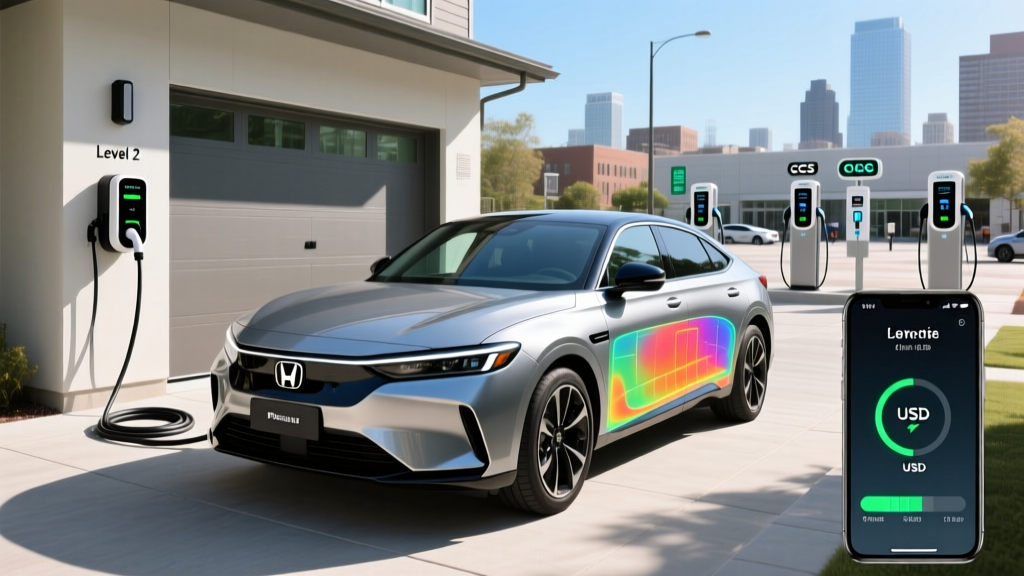
Here's how each charging level performs with a ~90 kWh usable battery pack like the R3X's anticipated configuration:
| Level | Power (kW) | Miles Added/Hour | 10–80% Time (~90 kWh) | Typical Use |
|---|---|---|---|---|
| Level 1 (120V) | 1.0–1.4 kW | 3–5 mi/hr | 45–60+ hours | Emergency/trickle |
| Level 2 (240V, 32A) | 7.7 kW | 22–28 mi/hr | 8–9 hours | Home daily charging |
| Level 2 (240V, 48A) | 11.5 kW | 33–40 mi/hr | 5.5–6.5 hours | Home fast overnight |
| DC Fast (peak ~200 kW) | Up to 200 kW | ~600+ mi/hr (peak) | ~22–28 minutes | Road trips |
Charging curve reality: DC fast charging does not sustain peak kW for the entire session. A pack accepting 200 kW at 10% SoC will taper to ~120 kW around 50% and drop below 50 kW past 80%. The 10–80% time above accounts for this taper. Charging from 80–100% on DC fast charging can take as long as the 10–80% portion — plan your road-trip stops to 80% unless you need the full pack.
Home Charger Installation: Costs, Electrical Requirements, and Gotchas
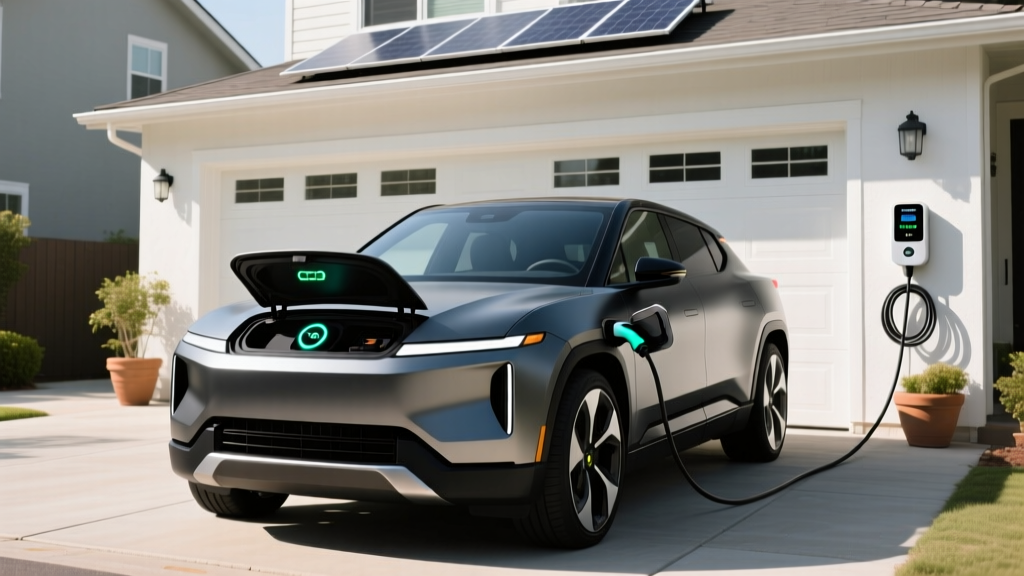
Most Rivian R3X owners will do 85%+ of their charging at home. A properly installed Level 2 charger on a 240V circuit is the single highest-impact upgrade for EV ownership satisfaction. Here's what's involved and what it costs.
Electrical Requirements
A 48-amp Level 2 charger — the sweet spot for a ~90 kWh pack — requires a dedicated 60-amp, 240V circuit (NEC code requires circuits rated at 125% of continuous load, so 48A × 1.25 = 60A breaker). The charger connects via a NEMA 14-60 outlet or is hardwired directly to the panel.
Panel capacity check: Your electrician will calculate your home's existing load against your panel's amperage rating. A 200-amp panel with moderate existing loads typically handles a 60A EV circuit without issue. A 100-amp panel in an older home almost certainly requires a panel upgrade to 200A — a significant added cost.
Installation Cost Breakdown
| Component | Simple Install (panel nearby) | Complex Install (long run, panel upgrade) |
|---|---|---|
| Level 2 charger (hardware) | $400–$700 | $400–$700 |
| Electrician labor (2–4 hrs standard) | $400–$800 | $1,200–$2,500 |
| Electrical materials (wire, conduit, breaker) | $100–$250 | $300–$600 |
| Permit and inspection | $50–$200 | $100–$300 |
| Panel upgrade (if needed: 100A → 200A) | N/A | $1,500–$3,500 |
| TOTAL | $950–$1,950 | $3,500–$7,600 |
Always get at least three quotes from licensed electricians. Ask specifically whether the quote includes the permit, inspection, and any make-ready work (conduit runs, drywall patching). The federal Alternative Fuel Vehicle Refueling Property Credit (IRC §30C) may cover up to 30% of home charging equipment and installation costs, capped at $1,000 — verify current-year eligibility with a tax professional.
Connector Compatibility: NACS, CCS, and What the R3X Uses
Rivian confirmed that all vehicles produced from 2025 onward, including the R3 and R3X, will use the NACS (North American Charging Standard) connector — the same plug used by Tesla. This is a significant advantage for public charging access, as it opens the Tesla Supercharger network (now branded for broader EV access) in addition to Electrify America, EVgo, and other networks via CCS-to-NACS adapters.
| Connector | R3X Native? | Network Access | Adapter Needed? |
|---|---|---|---|
| NACS (Tesla-style) | Yes — native | Tesla Superchargers, Rivian Adventure Network, growing third-party | No |
| CCS1 | No (adapter) | Electrify America, EVgo, ChargePoint DC stations | NACS-to-CCS adapter (~$200–$250) |
| CHAdeMO | No (adapter) | Legacy Nissan/Mitsubishi stations (declining) | NACS-to-CHAdeMO adapter (limited availability) |
| J1772 (Level 2 AC) | Via included adapter | Public Level 2 stations, most home chargers | J1772-to-NACS adapter (typically included) |
Practical advice: Budget for a NACS-to-CCS adapter at purchase. While NACS is becoming the dominant standard, many existing public DC fast chargers — especially Electrify America stations — still use CCS1 cables. Having the adapter eliminates range-anxiety dead zones on road trips.
Level 2 Home Charger Recommendations for the Rivian R3X
With a ~90 kWh pack, you want a charger that can fully replenish overnight. Here are three proven options across price points, all compatible with the R3X's NACS port (or J1772 with adapter):
Best Overall: ChargePoint Home Flex (NACS)
- Power output: Up to 11.5 kW (48A at 240V)
- Cable length: 23 feet
- Connector: NACS native (2025+ model) or J1772
- Smart features: Wi-Fi, app scheduling, utility rate optimization, Alexa integration
- Price: ~$550–$650
- Why for R3X: 11.5 kW adds ~250 miles in an 8-hour overnight session — more than enough for a full replenishment. Adjustable amperage (16A–48A) lets you match your circuit.
Best Value: Emporia Vue Level 2 Charger
- Power output: Up to 11.5 kW (48A at 240V)
- Cable length: 24 feet
- Connector: J1772 (use NACS adapter) or NACS version
- Smart features: Wi-Fi, app control, energy monitoring, solar integration
- Price: ~$350–$400
- Why for R3X: Delivers the same 48A output as chargers costing $200 more. The energy monitoring feature pairs well with solar-equipped homes.
Premium Pick: Tesla Wall Connector (NACS)
- Power output: Up to 11.5 kW (48A at 240V)
- Cable length: 24 feet
- Connector: NACS native
- Smart features: Wi-Fi, OTA updates, power sharing (multiple units on one circuit), load management
- Price: ~$450–$500
- Why for R3X: Native NACS means no adapter needed. Power-sharing feature is ideal if you add a second EV later. Clean, minimal hardware.
Cost to Charge the R3X: Home vs. Public vs. Gas Comparison
Charging economics depend heavily on where and when you plug in. The R3X's estimated efficiency of ~3.0–3.3 miles/kWh (roughly 100–110 MPGe combined, based on R1 platform data and tri-motor weight) lets us calculate real cost-per-mile figures.
| Scenario | Rate ($/kWh) | Cost for 90 kWh (full pack) | Cost per Mile (~3.1 mi/kWh) |
|---|---|---|---|
| Home off-peak (utility TOU rate) | $0.08–$0.12 | $7.20–$10.80 | $0.026–$0.039 |
| Home standard rate (no TOU) | $0.14–$0.18 | $12.60–$16.20 | $0.045–$0.058 |
| Public Level 2 (ChargePoint, etc.) | $0.20–$0.35 | $18.00–$31.50 | $0.065–$0.102 |
| DC Fast Charging (EA, EVgo, Supercharger) | $0.30–$0.55 | $27.00–$49.50 | $0.097–$0.159 |
| Gas equivalent (25 MPG avg, $3.50/gal) | — | — | $0.140 |
The bottom line: Home charging on off-peak rates makes the R3X roughly 70–80% cheaper per mile than a comparable gas vehicle. Even DC fast charging at the highest public rates stays roughly cost-competitive with gas — but the savings evaporate if you rely exclusively on public DC charging. Home Level 2 access is the economic linchpin of EV ownership.
Safety, Code, and Installation Best Practices
EV charging draws sustained high current for hours — this is not the same as plugging in a dryer for 45 minutes. Follow these non-negotiable safety and code requirements:
- Dedicated circuit: Your Level 2 charger must have its own dedicated breaker — never share a circuit with other appliances.
- GFCI protection: NEC 2020+ requires GFCI protection for 240V EV outlets in garages. Hardwired installations may have different requirements depending on your jurisdiction — your electrician will advise.
- Outdoor rating: If installing outside, the charger must carry a NEMA 4 or NEMA 4X rating for weather resistance. All three chargers recommended above are outdoor-rated.
- Wire gauge: A 60A circuit requires 6 AWG copper wire (or 4 AWG aluminum). Never undersize wire — this is a fire hazard.
- Permit and inspection: Skipping the permit saves $50–$200 upfront but can void your homeowner's insurance in the event of an electrical fire. Always permit and inspect.
- Ventilation: Indoor garage installations don't typically require additional ventilation for EV chargers (unlike gas water heaters), but ensure the charger's ambient temperature rating isn't exceeded in unconditioned spaces.
Rivian R3X: Preliminary Specifications
| Specification | Rivian R3X (Preliminary/Estimated) |
|---|---|
| Drivetrain | Tri-motor AWD |
| Horsepower | ~600+ HP (est.) |
| Battery capacity (usable) | ~85–100 kWh (est.) |
| Battery chemistry | Expected NMC (performance-oriented tri-motor) |
| EPA range (est.) | ~300–320 miles |
| Max DC fast charge rate | ~200 kW (est.) |
| 10–80% DC charge time | ~22–28 minutes (est.) |
| Level 2 onboard charger | ~11.5 kW (est.) |
| 0–60 mph | ~3.0 seconds (est.) |
| Connector | NACS (native) |
| Battery/powertrain warranty | 8 years / 175,000 miles (Rivian standard) |
| Base MSRP (est.) | ~$55,000–$65,000 |
Note: All R3X specifications are preliminary as of early 2026. Rivian has confirmed the R3 platform is in production preparation; final EPA range, pricing, and performance figures will be published at launch. Check Rivian's official site for updates.
Frequently Asked Questions
How much does it cost to install a home EV charger for the Rivian R3X?
A straightforward Level 2 installation with a nearby 200-amp panel typically costs $950–$1,950 all-in (charger, electrician, materials, permit). If your home needs a panel upgrade from 100A to 200A, expect $3,500–$7,600 total. Get three quotes and confirm the electrician is licensed and will pull a permit.
How fast will each charging level add range to the R3X?
Level 1 (120V) adds 3–5 miles per hour — adequate only for emergencies or very low daily mileage. Level 2 (240V, 48A) adds 33–40 miles per hour, fully replenishing the R3X's pack overnight in roughly 6 hours. DC fast charging at peak rate can add 200+ miles in 15–20 minutes, but the charge curve tapers significantly above 80% SoC.
Which connector and charger are compatible with the Rivian R3X?
The R3X uses the NACS connector natively, giving direct access to Tesla Superchargers and the growing NACS-equipped public network. For CCS1 stations (Electrify America, older EVgo locations), you'll need a NACS-to-CCS adapter. For home charging, any NACS-equipped Level 2 charger works directly; J1772 chargers work with the included adapter.
How much does charging the R3X cost per mile compared to gas?
Home charging on off-peak electricity ($0.10/kWh) costs roughly $0.03/mile — about 80% less than a 25 MPG gas vehicle at $3.50/gallon ($0.14/mile). Public DC fast charging at $0.45/kWh runs ~$0.15/mile, slightly above gas. The economic case for EV ownership depends heavily on consistent home charging access.
What electrical upgrades might I need for a Level 2 charger?
The most common upgrade is a panel increase from 100A to 200A service, costing $1,500–$3,500. You'll also need a dedicated 60A breaker and 6 AWG copper wiring run from the panel to the charger location. Homes built after 2000 with 200A panels rarely need upgrades. Your electrician will perform a load calculation to determine if your existing panel has sufficient headroom.
Is the Rivian R3X eligible for the federal EV tax credit?
Federal §30D tax credit eligibility depends on MSRP caps (currently $80,000 for SUVs), buyer income limits ($300,000 MFJ / $150,000 single), and battery component/critical mineral sourcing requirements. The R3X's estimated MSRP falls within the cap, but sourcing requirements change annually. Check the latest rules on IRS.gov and consult a tax professional before relying on credit eligibility.
Sources: Rivian official specifications (rivian.com), EPA fuel economy data (fueleconomy.gov), IRS clean vehicle credits (irs.gov).