The Rivian R3 is the automaker's most accessible electric vehicle yet — a compact crossover aimed at urban commuters and adventure seekers who don't need the full footprint of the R1S or R1T. But the question every prospective buyer asks is practical: what is the real Rivian R3 range, and how do you set up charging to actually use it? This guide covers the R3's battery specs, real-world range expectations, and a complete home-charging installation playbook so you can plug in with confidence from day one.
Rivian R3 Range: EPA Estimates vs. Real-World Expectations
Rivian has announced the R3 with multiple battery configurations. Based on preliminary specifications, the R3 is expected to offer a Standard battery pack and a larger Max pack, targeting a range of roughly 250+ miles (Standard) and 300+ miles (Max) on the EPA cycle. Because the R3 is an announced vehicle heading toward production, final EPA certification numbers may shift. Always verify the sticker at the time of purchase.
EPA estimate (announced): ~250–300+ miles depending on pack
Real-world highway (70 mph, 65°F): Expect ~85–90% of EPA, or roughly 215–270 miles
Cold weather (30°F, cabin heat): Plan for 20–30% reduction — approximately 175–240 miles
Why it varies: Aerodynamic drag at highway speed, battery thermal losses in cold, elevation changes, and payload all compress usable range below the sticker.
The R3's compact platform means a smaller frontal area than the R1S, which helps highway efficiency. However, its boxy adventure styling still creates more drag than a sleek sedan, so highway miles will always fall short of the EPA combined figure. If your commute is mostly city driving with regenerative braking opportunities, you'll land closer to — or occasionally above — the EPA number.
| Specification | Standard Pack (est.) | Max Pack (est.) |
|---|---|---|
| Usable Battery Capacity | ~65 kWh | ~85 kWh |
| Chemistry | LFP (expected) | NMC (expected) |
| EPA Range | ~250 mi | ~300+ mi |
| Peak DC Fast Charge | ~150 kW | ~190 kW |
| 10–80% DCFC Time | ~28 min | ~25 min |
| Level 2 Charge Rate | 11.5 kW | 11.5 kW |
| Base MSRP | ~$45,000 | ~$52,000 |
| Battery Warranty | 8 years / 100,000 miles | |
Charging Levels Explained: How Fast Will Each Level Add Range?
Before installing anything, understand the three charging tiers. The critical distinction: kW (kilowatts) measures power — how fast energy flows into the battery. kWh (kilowatt-hours) measures energy capacity — how much the battery holds. Think of kW as the hose diameter and kWh as the bucket size.
| Level | Voltage | Power (kW) | Miles of Range per Hour | Best For |
|---|---|---|---|---|
| Level 1 | 120V AC | 1.0–1.4 kW | 3–5 mi/hr | Overnight top-off, emergencies |
| Level 2 (Home) | 240V AC | 7.2–11.5 kW | 25–42 mi/hr | Daily home charging, primary setup |
| DC Fast Charge | 400V+ DC | 50–350 kW | 150–250+ mi in 20 min | Road trips, rapid top-ups |
For the Rivian R3 with its ~11.5 kW onboard charger, a 48-amp Level 2 home station delivers roughly 38–42 miles of range per hour of charging. That means a full overnight session (10 hours) easily replenishes 300+ miles — more than enough for any daily commute and most weekend adventures.
Home Charger Installation: Electrical Requirements and Costs
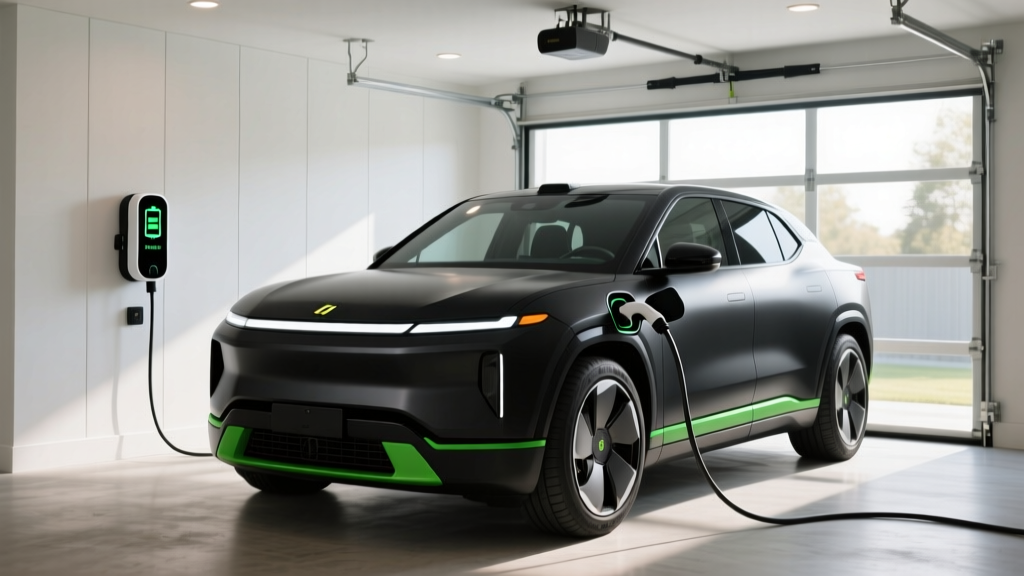
A Level 2 home charger is the single most impactful upgrade for EV ownership. Here's what's required for a proper R3 installation.
Electrical Requirements
- Circuit: Dedicated 60-amp breaker (to support a continuous 48-amp charger load per NEC 80% rule)
- Voltage: 240V, single-phase
- Wire gauge: 6 AWG copper (THHN in conduit or 6/2 NM-B for short indoor runs)
- Outlet vs. hardwired: Hardwired is preferred for 48A+ stations; a NEMA 14-50 outlet caps at 40A continuous (50A breaker)
- GFCI protection: NEC 2020+ requires GFCI breakers for EV outlets in garages — hardwired stations avoid nuisance tripping
Panel Upgrade Considerations
Many older homes have 100-amp or 150-amp main panels. Adding a 60-amp EV circuit may push you past the panel's safe capacity, especially if you already run electric dryers, ranges, or HVAC. A licensed electrician will perform a load calculation (NEC Article 220) to determine if an upgrade to 200-amp service is needed. Don't skip this step — it's the difference between a $1,200 install and a $4,500 one.
| Component | Cost Range | Notes |
|---|---|---|
| Level 2 Charger (48A, hardwired) | $500–$800 | ChargePoint Home Flex, Wallbox Pulsar Plus, Tesla Wall Connector |
| Electrician labor (standard install) | $500–$1,500 | Varies by run length, conduit, wall type |
| Permit and inspection | $100–$350 | Required in most jurisdictions |
| Panel upgrade (if needed) | $2,000–$4,000 | 200A service upgrade for older homes |
| Total (no panel upgrade) | $1,100–$2,650 | Typical for modern homes with 200A panel |
| Total (with panel upgrade) | $3,100–$6,650 | Older homes or high-load households |
Which Connector Does the Rivian R3 Use?
The EV connector landscape has consolidated significantly. Rivian confirmed that the R3 will ship with the NACS (North American Charging Standard) port — the same connector used by Tesla and now adopted by Ford, GM, Hyundai, and most major automakers. This is a significant advantage: the R3 will have native access to Tesla's Supercharger network without an adapter.
| Connector | Brands Using It | Notes for R3 Owners |
|---|---|---|
| NACS (Tesla) | Tesla, Rivian (R3/R2), Ford, GM, Hyundai, Kia, Volvo | Native on R3 — full Supercharger access |
| CCS1 | Legacy VW, BMW, older Ford/GM EVs | Use NACS-to-CCS adapter at Electrify America stations |
| CHAdeMO | Nissan Leaf (legacy) | Being phased out; not relevant for R3 |
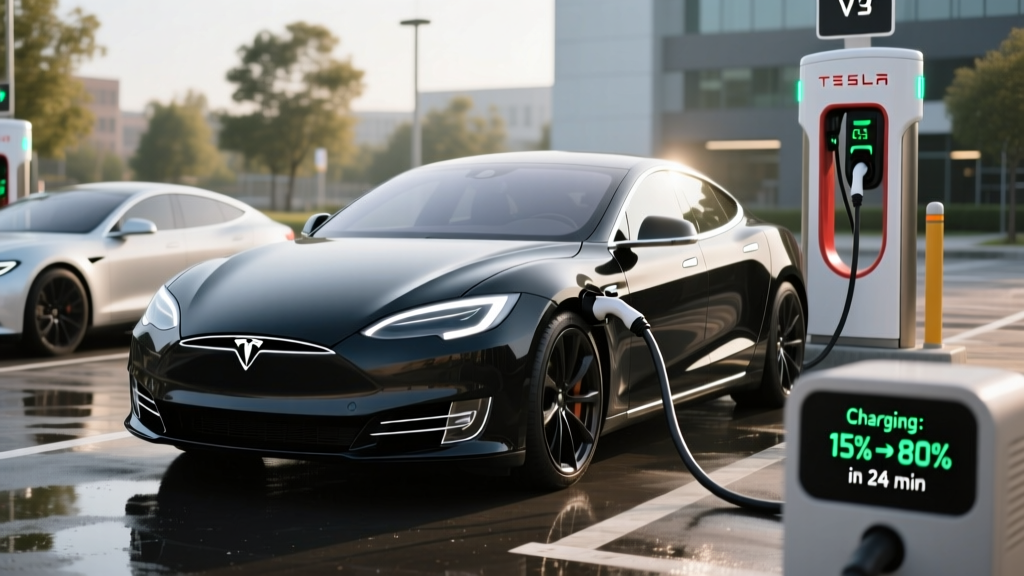
For public DC fast charging, the R3's NACS port connects directly to Tesla Superchargers (V3 and V4 stalls). For CCS-only networks like Electrify America, Rivian is expected to offer a NACS-to-CCS adapter — budget ~$150–$200 for one if you travel in areas with limited Supercharger coverage.
Cost to Charge: Home vs. Public vs. Gas
One of the strongest arguments for the R3 is fuel-cost savings. Here's how charging costs break down per scenario, using the R3 Max pack (~85 kWh usable) as the baseline.
| Scenario | Rate | Cost for 300 mi | Cost per Mile |
|---|---|---|---|
| Home (off-peak utility rate) | $0.12/kWh | $10.20 | $0.034 |
| Home (average US rate) | $0.17/kWh | $14.45 | $0.048 |
| Public Level 2 (ChargePoint, etc.) | $0.30/kWh | $25.50 | $0.085 |
| DC Fast Charge (Electrify America) | $0.48/kWh | $40.80 | $0.136 |
| Tesla Supercharger (avg) | $0.35/kWh | $29.75 | $0.099 |
| Gas SUV (25 MPG, $3.50/gal) | — | $42.00 | $0.140 |
Assuming ~3 kWh per mile of consumption (roughly 85 kWh / 300 mi ≈ 0.283 kWh/mi, rounded to account for charging losses), home charging on an off-peak rate costs roughly one-quarter of a comparable gas SUV per mile. Even at public DC fast charging rates, the R3 undercuts gasoline on a per-mile basis in most states. Source: fueleconomy.gov for efficiency benchmarks and EIA electricity rate data.
Recommended Home Chargers for the Rivian R3
Since the R3 uses NACS natively, your best home chargers are those offering a NACS plug or a universal cable. Here are three proven units matched to the R3's 11.5 kW onboard charger capability.
ChargePoint Home Flex (NACS)
- Power Output: Up to 12 kW (50A) / configurable down to 16A
- Connector: NACS native (2025+ models)
- Cable Length: 23 feet
- Smart Features: Wi-Fi, app scheduling, Alexa, utility demand-response
- Price: ~$699
- Best For: Flexible amperage if your panel can't support a full 60A circuit
Tesla Wall Connector (Gen 4)
- Power Output: Up to 11.5 kW (48A)
- Connector: NACS native
- Cable Length: 24 feet
- Smart Features: Wi-Fi, over-the-air updates, power-sharing with second unit
- Price: ~$450
- Best For: Budget pick with reliable NACS integration
Wallbox Pulsar Plus (NACS)
- Power Output: Up to 11.5 kW (48A)
- Connector: NACS (adapter cable available)
- Cable Length: 16 or 25 feet
- Smart Features: Bluetooth + Wi-Fi, Eco-Smart solar integration, load balancing
- Price: ~$649
- Best For: Homes with solar panels or tight panel capacity
Charging Time Examples for the Rivian R3
Charge times depend on battery size, starting state of charge (SoC), and ambient temperature. Below are realistic estimates for the R3, assuming battery preconditioning is active (the R3 will warm its pack when a DC fast charger is set as your navigation destination).
| Scenario | Standard (~65 kWh) | Max (~85 kWh) |
|---|---|---|
| Level 1 (120V, 1.4 kW) — 10→80% | ~32 hours | ~42 hours |
| Level 2 (240V, 48A / 11.5 kW) — 10→80% | ~4.5 hours | ~5.5 hours |
| DC Fast (150 kW peak) — 10→80% | ~28 minutes | ~25 minutes |
| DC Fast (50 kW) — 10→80% | ~55 minutes | ~70 minutes |
Charging curve reality: The peak kW figure (150 or 190 kW) is only sustained at low SoC — typically 10–30%. Above 50% SoC, the rate tapers significantly. Above 80%, it drops to a trickle to protect battery longevity. This is why 10–80% is the industry-standard measurement; charging to 100% on DC fast charging adds time and degradation for minimal range gain.
Safety, Code, and Permit Considerations
A Level 2 charger installation is a permanent electrical modification. Cutting corners risks fire, voided insurance, and failed home inspections. Here's what to get right:
- Dedicated circuit: Your EV charger must have its own breaker — never share with a dryer, range, or HVAC. NEC Article 625 governs EV charging specifically.
- Permit and inspection: Most municipalities require an electrical permit ($100–$350) and a post-install inspection. Your electrician should pull this — if they suggest skipping it, find a different electrician.
- Outdoor rating: If your charger mounts outside, ensure the unit carries a NEMA 4 (weatherproof) rating. All three recommended chargers above qualify.
- GFCI: If you install a NEMA 14-50 receptacle rather than hardwiring, NEC 2020+ requires a GFCI breaker. Hardwired installations typically avoid this requirement and eliminate nuisance trips.
- Utility incentives: Many utilities offer rebates of $250–$1,000 for Level 2 installations, especially if you agree to time-of-use (TOU) rates. Check with your local provider before installation — some require pre-approval.
Federal Tax Credit and Incentives for Home Charging
The IRS §30D Clean Vehicle Credit applies to the R3 itself (subject to MSRP caps, buyer income limits, and battery-sourcing requirements — see IRS guidance for current-year eligibility). For the home charger, the Alternative Fuel Vehicle Refueling Property Credit (§30C) was extended and can cover up to 30% of charger equipment and installation costs, capped at $1,000 for residential use. This credit is subject to census-tract eligibility requirements — it applies primarily in low-income or non-urban areas. Consult a tax professional to confirm your eligibility.
Frequently Asked Questions
How much does it cost to install a home EV charger for the Rivian R3?
Expect $1,100–$2,650 for a standard installation in a home with a 200-amp panel. If a panel upgrade is needed, total costs can reach $3,100–$6,650. Equipment (charger) runs $450–$800, with the remainder going to licensed electrician labor and permits.
How fast will each charging level add range to the R3?
Level 1 (120V) adds 3–5 miles per hour — useful only for overnight trickle charging. Level 2 (240V, 48A) adds roughly 38–42 miles per hour, fully replenishing the R3 overnight. DC fast charging at 150+ kW adds 150–200+ miles in 20 minutes during road trips.
Which connector and charger is compatible with the Rivian R3?
The R3 uses the NACS connector natively. This gives it direct access to Tesla Superchargers and any NACS-equipped public station. For CCS-only chargers, a NACS-to-CCS adapter will be needed. At home, any NACS-equipped Level 2 charger (Tesla Wall Connector, ChargePoint Home Flex NACS, Wallbox Pulsar Plus) is compatible.
How much does charging the Rivian R3 cost per mile vs. gas?
Home charging on an average US electricity rate ($0.17/kWh) costs roughly $0.05 per mile. A comparable gas SUV at 25 MPG and $3.50/gallon costs $0.14 per mile — nearly three times more. Even public DC fast charging at $0.35–$0.48/kWh typically undercuts gasoline.
What electrical upgrades might I need for a Level 2 charger?
The most common upgrade is a 200-amp panel replacement for older homes with 100A or 150A service ($2,000–$4,000). You'll need a dedicated 60-amp breaker and 6 AWG wiring. Homes with existing 200A panels usually need only the circuit run and breaker — no panel work required.
Can I use a Tesla Supercharger with the Rivian R3?
Yes. The R3's native NACS port provides direct access to Tesla's Supercharger network (V3 and V4 stalls) without an adapter. This is one of the R3's strongest charging advantages, as the Supercharger network remains the most reliable DC fast-charging infrastructure in North America.
Does the Rivian R3 qualify for the $7,500 federal tax credit?
Eligibility depends on current-year IRS §30D rules, including buyer income caps, vehicle MSRP limits (SUVs capped at $80,000), and battery critical-mineral and component sourcing requirements. Because these rules change frequently, verify eligibility on IRS.gov at the time of purchase. The credit may be transferable to the dealer as a point-of-sale discount.