Why Your Charging Strategy Directly Impacts R1S Range
The Rivian R1S is one of the most capable electric SUVs on the road, but its real-world range depends heavily on how you charge it. The 2026 R1S Dual-Motor Standard Pack carries a 106 kWh usable battery (LFP chemistry on Standard, NMC on Large/Max), delivering an EPA-estimated 270 to 410 miles depending on pack and motor configuration. Yet owners who rely exclusively on DC fast charging or undersized home equipment often see accelerated battery degradation and reduced State of Health (SoH) over time — which directly shrinks usable range.
This guide walks through the complete charging ecosystem for the R1S: home Level 2 installation, public DC fast charging realities, connector compatibility, and the exact equipment that will keep your battery healthy and your range intact for years.
- Dual-Motor Standard Pack: EPA 270 mi — expect ~220-240 mi highway, ~190 mi in sub-freezing weather
- Dual-Motor Large Pack: EPA 340 mi — expect ~280-300 mi highway, ~240 mi cold
- Quad-Motor Max Pack: EPA 410 mi — expect ~330-350 mi highway, ~280 mi cold
Source: fueleconomy.gov. Highway speeds above 70 mph and temperatures below 32°F reduce range 15-30%.
Charging Levels Explained: Speeds, kW, and Miles Added Per Hour
Before selecting equipment, understand the three charging tiers. A critical distinction: kW (kilowatts) measures power — the rate at which energy flows. kWh (kilowatt-hours) measures energy — the total capacity of your battery. Think of kW as the width of a hose and kWh as the size of the bucket.
| Level | Voltage | Max Power (kW) | Miles of Range Added Per Hour | Typical Use Case |
|---|---|---|---|---|
| Level 1 | 120V AC | 1.4 kW | 3-5 mi/hr | Overnight trickle; emergency top-up |
| Level 2 | 240V AC | 11.5-19.2 kW | 25-55 mi/hr | Daily home charging; workplace |
| DC Fast (Level 3) | 400-800V DC | 50-350 kW | 150-400+ mi/hr (peak) | Road trips; rapid top-up |
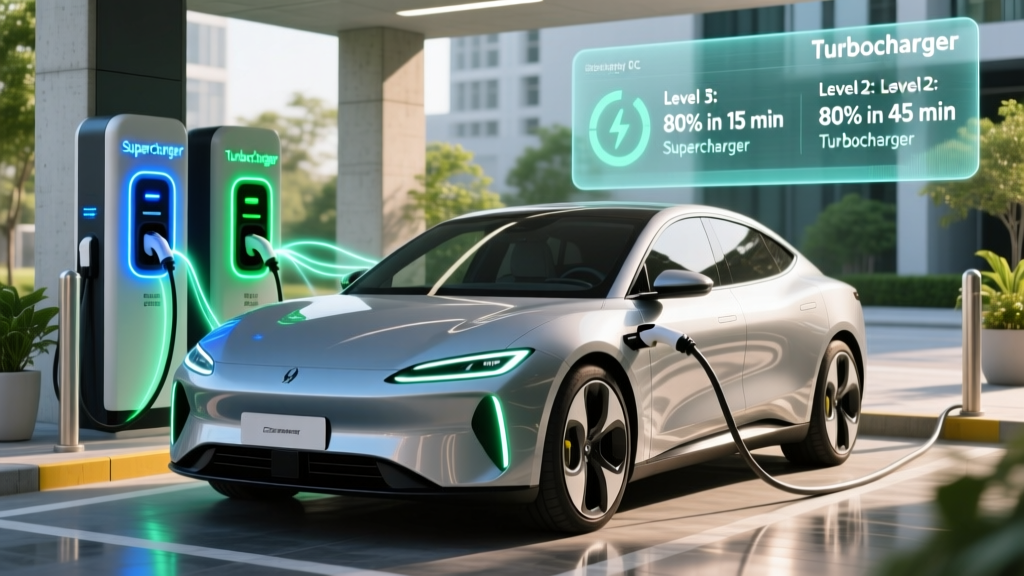
The R1S accepts up to 11.5 kW on Level 2 (48A) and peaks at approximately 220 kW on DC fast chargers. A 10-80% DC fast charge takes roughly 30-35 minutes at a capable station, though sustained speeds taper significantly above 80% State of Charge (SoC) to protect the battery. Plan road-trip stops around the 10-80% window — charging from 80-100% can take as long as the 10-80% session.
Home Level 2 Installation: Electrical Requirements, Panel Upgrades & Costs
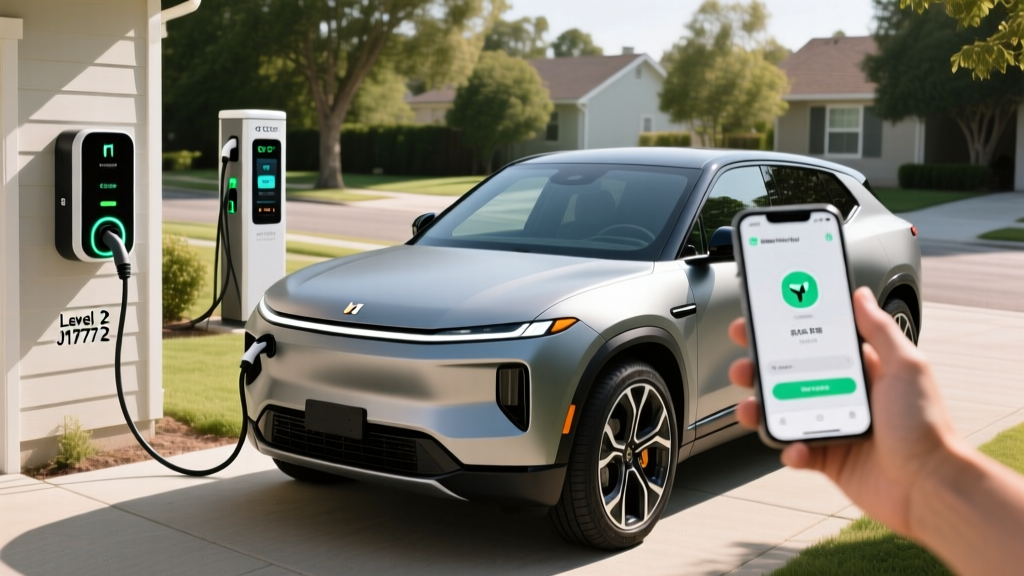
Installing a Level 2 home charger is the single most impactful upgrade for preserving your R1S range. Consistent, moderate-speed Level 2 charging generates less heat than DC fast charging, reducing long-term degradation.
Electrical Requirements
The R1S's onboard charger maxes out at 11.5 kW, which requires a 240V circuit rated for at least 60 amps (to deliver a continuous 48A, per NEC 80% rule). If you install a charger capable of 19.2 kW (80A), you'll need a 100A circuit — though the R1S won't use the extra capacity.
- Minimum recommended circuit: 60A / 240V dedicated breaker
- Wire gauge: 6 AWG copper (for 60A) or 4 AWG (for longer runs)
- Outlet vs. hardwired: NEMA 14-50 outlet offers portability; hardwired avoids GFCI nuisance trips and supports higher amperage
Will You Need a Panel Upgrade?
Most modern homes with 200A electrical service can accommodate a 60A EV circuit without a panel upgrade. However, older homes with 100A service, or those already running high-draw appliances (electric oven, dryer, HVAC, pool heater), may need a service upgrade to 200A — a significant added cost. A licensed electrician will perform a load calculation per NEC Article 220 to determine this.
| Cost Component | Typical Range | Notes |
|---|---|---|
| Level 2 Charger (Equipment) | $400 - $750 | Smart WiFi-enabled units; basic units from $300 |
| Electrician Labor (Standard Install) | $500 - $1,500 | Short run from panel to garage; conduit, wiring, breaker |
| Permit & Inspection | $50 - $300 | Varies by municipality; required for code compliance |
| Panel Upgrade (if needed) | $1,500 - $3,500 | 100A → 200A service upgrade; older homes |
| Total (No Panel Upgrade) | $950 - $2,550 | Most common scenario |
| Total (With Panel Upgrade) | $2,450 - $6,050 | Older homes with 100A service |
Some utility companies offer rebates of $200-$500 for Level 2 installation, and certain states provide additional incentives. Check your local utility and the AFDC state incentive database for current programs.
Connector Compatibility: NACS, CCS1, and Adapter Requirements
The connector landscape shifted dramatically in 2024-2025 when most automakers adopted the North American Charging Standard (NACS), originally developed by Tesla. Here's where the R1S stands for 2026:
| Connector Type | R1S Compatibility | Network Access | Adapter Needed? |
|---|---|---|---|
| NACS (Tesla-style) | Native on 2025+ R1S models | Tesla Superchargers, Electrify America (new stalls), Rivian Adventure Network | No (for 2025+ models) |
| CCS1 | Native on 2022-2024 R1S models | Electrify America, EVgo, ChargePoint DC stations | NACS-to-CCS adapter for Superchargers (~$200-250) |
| CHAdeMO | Not compatible | Limited legacy stations | No reliable adapter available |
| J1772 (Level 2 AC) | Compatible via NACS/CCS inlet | Public Level 2 stations | Usually included with vehicle |
Key takeaway: If you're buying a 2026 R1S, it ships with NACS natively. If you own a 2022-2024 R1S with CCS1, Rivian offers a NACS adapter that unlocks Tesla Supercharger access — a significant advantage for road trips given the Supercharger network's reliability. Confirm adapter availability and pricing directly with Rivian.
Charging Cost Per Mile: Home vs. Public vs. Gas
One of the strongest ownership arguments for the R1S is fuel cost savings, but the math depends heavily on where you charge. Here's a realistic breakdown using the R1S's efficiency rating of approximately 33-38 kWh per 100 miles (varies by pack and motor configuration):
| Charging Scenario | Cost per kWh | Cost per 100 Miles | Cost per Mile | Equivalent Gas Price (at 22 MPG) |
|---|---|---|---|---|
| Home Off-Peak (Utility Rate) | $0.08 - $0.12 | $2.80 - $4.20 | $0.03 - $0.04 | $0.66 - $0.92/gal |
| Home Standard Rate | $0.14 - $0.18 | $4.90 - $6.30 | $0.05 - $0.06 | $1.10 - $1.39/gal |
| Public Level 2 (ChargePoint, etc.) | $0.20 - $0.35 | $7.00 - $12.25 | $0.07 - $0.12 | $1.54 - $2.69/gal |
| DC Fast Charging (EA, EVgo) | $0.35 - $0.55 | $12.25 - $19.25 | $0.12 - $0.19 | $2.64 - $4.18/gal |
| Tesla Supercharger (NACS) | $0.28 - $0.42 | $9.80 - $14.70 | $0.10 - $0.15 | $2.20 - $3.30/gal |
| Gas SUV Baseline (22 MPG) | — | $15.00 (at $3.30/gal) | $0.15 | $3.30/gal |
Home charging on an off-peak utility rate delivers the equivalent of gasoline under $1/gallon. Even DC fast charging on road trips typically undercuts the cost of fueling a comparable gas SUV — though the gap narrows significantly at premium-priced stations. For R1S owners who charge at home 80%+ of the time, annual fuel savings versus a gas SUV like the Toyota Sequoia or Chevy Tahoe can reach $1,200-$1,800 depending on mileage and local rates.
Equipment Recommendations: Top Level 2 Chargers for the R1S
Based on power output, reliability, smart features, and value, these are our top Level 2 charger picks for R1S owners in 2026:
ChargePoint Home Flex (NACS)
- Power Output: Up to 12 kW (50A) — adjustable down to 16A
- Connector: NACS native (2025+ models); J1772 version available with adapter
- Cable Length: 23 feet
- Smart Features: WiFi, app scheduling, Alexa integration, energy reports, utility demand-response
- Price: ~$550-$650
- Verdict: Best all-around pick. Adjustable amperage works with any electrical panel. NACS version eliminates adapter clutter for 2025+ R1S owners.
Wallbox Pulsar Plus (NACS)
- Power Output: Up to 11.5 kW (48A)
- Connector: NACS native; CCS version available
- Cable Length: 25 feet
- Smart Features: WiFi + Bluetooth, app scheduling, Power Sharing (daisy-chain two units on one circuit), Eco-Smart solar integration
- Price: ~$500-$600
- Verdict: Compact, well-built, and the Power Sharing feature is ideal for two-EV households. Slightly less polished app than ChargePoint.
Grizzl-E Smart (NACS)
- Power Output: Up to 11.5 kW (48A) — DIP-switch adjustable
- Connector: NACS native
- Cable Length: 24 feet
- Smart Features: WiFi, OCPP-compatible (works with utility programs), built-in load management
- Price: ~$450-$550
- Verdict: Best value. Built in Canada with a robust aluminum enclosure rated for extreme cold (-40°F). Ideal for unheated garages and outdoor installs.
Important note: The R1S onboard charger caps at 11.5 kW (48A). Buying a 19.2 kW (80A) charger won't charge your R1S faster — it will simply cost more and require a heavier electrical circuit. Match your charger's output to your vehicle's acceptance rate.
Safety, Code Compliance, and Installation Best Practices
EV charging involves sustained high-current draw — more similar to running a welder than plugging in a phone. Cutting corners on installation creates fire risk and may void your homeowner's insurance. Follow these non-negotiable requirements:
- Dedicated circuit: Your Level 2 charger must have its own dedicated breaker — never share a circuit with other appliances.
- GFCI protection: NEC 2020 and later require GFCI for outdoor receptacles. Hardwired installations may not require GFCI (check local code). Note: NEMA 14-50 outlets on GFCI breakers are prone to nuisance tripping — hardwired avoids this.
- Outdoor rating: If installing outside, ensure the charger is NEMA 4-rated (weatherproof). All three recommendations above qualify.
- Permit and inspection: Always pull an electrical permit. An unpermitted install can cause issues during home sale and insurance claims.
- Cable management: Use a wall-mounted holster or retractor to keep cables off the ground and prevent trip hazards and connector damage.
Frequently Asked Questions
How much does it cost to install a home EV charger for the Rivian R1S?
A standard Level 2 installation with a 60A circuit typically costs $950-$2,550 including equipment ($400-$750), electrician labor ($500-$1,500), and permit ($50-$300). If your home requires a panel upgrade from 100A to 200A service, add $1,500-$3,500. Always get at least two quotes from licensed electricians.
How fast will each charging level add range to my R1S?
Level 1 (120V) adds 3-5 miles per hour — essentially overnight trickle charging. Level 2 at 11.5 kW (48A, 240V) adds approximately 25-30 miles per hour, fully replenishing a Large Pack overnight in 10-12 hours. DC fast charging at peak 220 kW adds roughly 150-200 miles in 15-20 minutes, but only within the 10-80% SoC window.
Which connector is compatible with my R1S?
2025 and newer R1S models use NACS natively, granting direct access to Tesla Superchargers and the growing NACS public network. 2022-2024 models use CCS1 and require a NACS-to-CCS adapter (~$200-250) for Supercharger access. For Level 2 home charging, all R1S models accept J1772 or NACS connectors depending on model year.
How much does charging the R1S cost per mile compared to gas?
Home charging on off-peak utility rates costs $0.03-$0.04 per mile — equivalent to $0.66-$0.92/gallon gasoline. Even public DC fast charging at $0.35-$0.55/kWh costs $0.12-$0.19/mile, typically below the $0.15/mile cost of a 22 MPG gas SUV at $3.30/gallon. Owners who charge at home save $1,200-$1,800 annually versus a comparable gas SUV.
What electrical upgrades might I need for a home charger?
Homes with 200A service typically need only a new 60A dedicated breaker and wiring run. Homes with 100A service or heavy existing electrical loads (electric heat, dryer, oven, pool) may require a panel upgrade to 200A — a $1,500-$3,500 job. A licensed electrician will perform an NEC Article 220 load calculation to determine your specific needs. Some utilities offer smart-panel solutions (like Span) that manage loads without a full upgrade.
Does frequent DC fast charging reduce my R1S range over time?
Yes, modestly. DC fast charging generates more heat in the battery cells than Level 2, accelerating degradation slightly. Rivian's battery management system (BMS) mitigates this through active thermal management and charge-curve tapering above 80% SoC. For maximum battery longevity, use Level 2 for daily charging and reserve DC fast charging for road trips. Rivian warranties its battery for 8 years/175,000 miles with a minimum 70% capacity retention threshold.
Can I use a Tesla Wall Connector to charge my R1S?
Yes. The Tesla Wall Connector (Gen 3) now ships with a NACS connector and is compatible with any NACS-equipped vehicle, including the 2025+ R1S. It delivers up to 11.5 kW (48A) on a 60A circuit and costs approximately $475. For 2022-2024 R1S owners with CCS1, the Tesla Wall Connector will not work without a NACS-to-CCS adapter on the vehicle side.
For the latest Rivian R1S specifications and charging compatibility updates, refer to the official Rivian R1S page and the EPA's fueleconomy.gov database. Tax credit eligibility for home charging equipment under IRS §25C (Energy Efficient Home Improvement Credit) may cover up to $1,000 — consult a tax professional for your specific situation.