Rivian's early adopters remember the excitement of unlimited Electrify America sessions bundled with the R1T and R1S launch editions. But as we move through 2026, the EV charging landscape has shifted — connectors have changed, networks have consolidated, and Rivian's own perks have evolved. If you're shopping for a Rivian or just took delivery, understanding what "free charging" actually covers (and what you'll pay for at home and on the road) is essential before you plug in.
This guide breaks down exactly what Rivian free charging includes today, how to set up Level 2 home charging, connector compatibility in the NACS era, and the real cost-per-mile math versus gas.
Does Rivian Still Offer Free Charging in 2026?
The short answer: it depends on your model year and trim. Rivian's original launch-edition R1T and R1S vehicles (2022–2023) came with a limited-time Electrify America pass that provided a set number of kWh or complimentary sessions. Many of those promotional periods have now expired for early owners.
For 2025 and 2026 model-year Rivian vehicles, Rivian has shifted away from blanket free public charging bundles. Instead, the company has focused on:
- Rivian Adventure Network: Rivian's proprietary DC fast-charging network at adventure-oriented destinations (national parks, trailheads, ski areas). These chargers have historically been complimentary for Rivian owners during the initial rollout phase, though Rivian has signaled plans to introduce per-session pricing as the network matures.
- Electrify America and partner networks: No longer bundled as unlimited free charging. Owners pay standard network rates unless a specific promotional offer applies at purchase.
- Tesla Supercharger access: With Rivian's adoption of the NACS (North American Charging Standard) port starting on 2025+ models, owners can access Tesla's Supercharger network using the included adapter (for CCS-equipped earlier models) or natively (2025+ NACS port). Standard Supercharger per-kWh pricing applies.
Bottom line: Don't buy a Rivian expecting unlimited free public charging. The real cost savings come from home Level 2 charging, which we detail below.
Charging Levels Explained: Speeds, kW, and Miles Per Hour
Before installing anything, you need to understand the three charging levels. The critical distinction: kW (kilowatts) measures power — how fast energy flows into your battery. kWh (kilowatt-hours) measures energy — the total capacity of your battery. Think of kW as the width of a hose and kWh as the size of the bucket.
| Level | Voltage | Power (kW) | Miles of Range Added Per Hour | Best For |
|---|---|---|---|---|
| Level 1 | 120V AC | 1.0–1.4 kW | 3–5 miles/hr | Overnight top-ups, PHEVs, emergencies |
| Level 2 | 240V AC | 3.3–19.2 kW | 12–75 miles/hr | Daily home charging, workplace |
| DC Fast Charge | 400–800V DC | 50–350 kW | 150–500+ miles/hr (peak) | Road trips, rapid top-ups |
For a Rivian R1S or R1T with the Large battery pack (~128.9 kWh usable) or the Max pack (~149 kWh usable), Level 1 charging is impractical as a daily solution — it would take over 100 hours to fill a depleted Max pack. Level 2 at 11.5 kW (48A) adds roughly 30–35 miles of range per hour, meaning a full overnight session (10 hours) restores around 300+ miles.
On DC fast charging, 2025+ Rivian models with NACS ports support peak rates up to approximately 200–220 kW on compatible stations. Expect a 10–80% charge in roughly 25–30 minutes on a 350 kW-capable station, though sustained rates taper significantly above 80% State of Charge (SoC) to protect battery health.
Home Level 2 Charger Installation: Costs, Electrical Requirements, and Gotchas
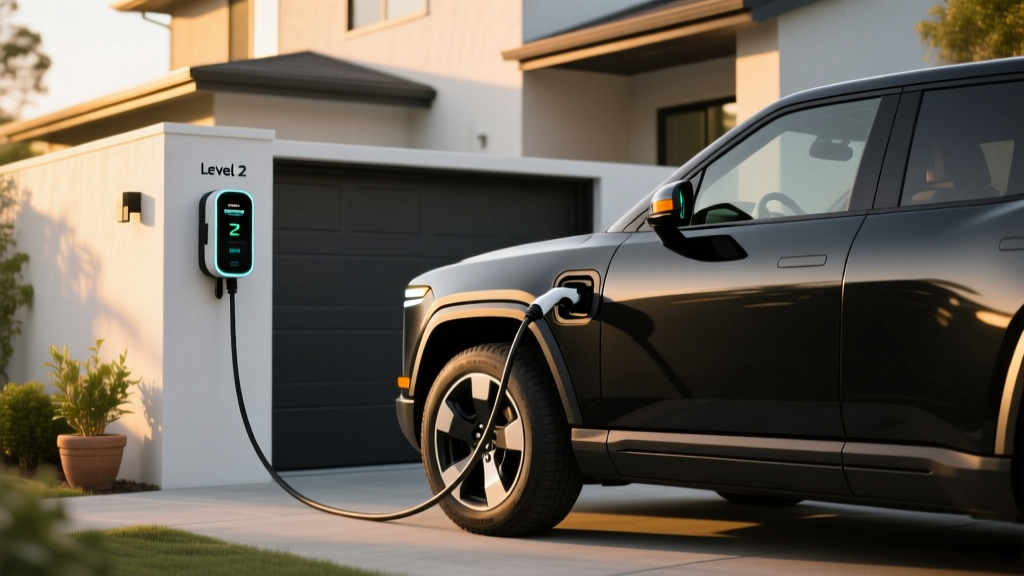
Most Rivian owners charge at home — it's cheaper, more convenient, and avoids public charger reliability headaches. Here's what a proper Level 2 installation requires.
Electrical Requirements
A Level 2 charger for a Rivian typically requires:
- 240V dedicated circuit (similar to a dryer or oven outlet)
- 40A to 60A breaker, depending on charger amperage (a 48A charger requires a 60A breaker per the NEC 80% continuous-load rule)
- Panel capacity: Your main electrical panel must have enough spare amperage. A 200A panel is standard in modern homes; older homes with 100A service will likely need a panel upgrade.
Panel Upgrade: The Hidden Cost
If your panel is at or near capacity, a licensed electrician will recommend upgrading to 200A service or adding a sub-panel. This is the single biggest variable in installation cost and can add $1,500–$4,000+ to the project. Some utilities offer panel-upgrade rebates — check with your local provider.
Installation Cost Breakdown
| Component | Low Estimate | High Estimate | Notes |
|---|---|---|---|
| Level 2 Charger (Equipment) | $350 | $750 | Smart Wi-Fi chargers cost more; hardwired vs. plug-in (NEMA 14-50) |
| Electrician Labor | $500 | $2,000 | Depends on run length from panel to garage/driveway |
| Permit & Inspection | $50 | $300 | Required in most jurisdictions; varies by municipality |
| Panel Upgrade (if needed) | $1,500 | $4,500 | 200A upgrade or sub-panel for older homes |
| Total (no panel upgrade) | $900 | $3,050 | Most common scenario for newer homes |
| Total (with panel upgrade) | $2,400 | $7,550 | Older homes with 100A service |
Safety and Code Considerations
- Dedicated circuit: NEC requires EV chargers to be on a dedicated breaker — no sharing with other appliances.
- GFCI protection: 2023 NEC (and most 2026 local adoptions) requires GFCI protection for outdoor receptacles. Many hardwired chargers have built-in GFCI, avoiding nuisance trips from double-GFCI setups.
- Outdoor rating: If your charger is mounted outside or in an open carport, ensure it carries a NEMA 4 or IP65 weather-resistance rating.
- NEMA 14-50 vs. hardwired: A NEMA 14-50 outlet gives you portability (take the charger when you move), but hardwired installations support higher amperage (up to 48A–80A) and avoid the NEC GFCI breaker conflict that plagues some plug-in setups.
Connector Compatibility: NACS, CCS1, and Rivian's Transition
The connector landscape has shifted dramatically. Here's where Rivian stands in 2026:
| Model Year | Native Port | DC Fast Connector | Adapter Needed? |
|---|---|---|---|
| 2022–2024 R1T / R1S | CCS1 (J1772 + DC pins) | CCS1 | CCS-to-NACS adapter required for Tesla Superchargers (Rivian-provided for eligible owners) |
| 2025+ R1T / R1S (Dual-Motor, Tri-Motor) | NACS (native) | NACS | NACS-to-CCS adapter for legacy Electrify America / ChargePoint CCS stations |
| 2025+ R2 (announced) | NACS (native) | NACS | Same as above |
Key takeaway: If you own a 2022–2024 Rivian with CCS1, Rivian has offered a CCS-to-NACS adapter to access Tesla Superchargers. Check your Rivian account or contact support to confirm adapter eligibility. For 2025+ models, NACS is native — you'll need the reverse adapter (NACS-to-CCS) only at older public stations that haven't retrofitted NACS cables.
Per Rivian's official charging support page, all current Rivian vehicles support Level 2 AC charging via J1772 (for older CCS models) or NACS (2025+), and the Rivian mobile charger ships with the vehicle for Level 1 (120V) and Level 2 (240V, with appropriate adapter) use.
Recommended Level 2 Chargers for Rivian Owners
These chargers are proven, well-reviewed, and match Rivian's charging capabilities. All support 240V and deliver at least 40A.
Emporia Level 2 Smart Charger
- Power output: Up to 48A (11.5 kW at 240V)
- Connector: J1772 (NACS adapter available)
- Cable length: 24 ft
- Smart features: Wi-Fi, app scheduling, solar integration, energy monitoring
- Price: ~$399
- Best for: Budget-conscious owners who want smart scheduling and energy tracking
ChargePoint Home Flex (2nd Gen)
- Power output: Up to 50A (12 kW at 240V) — adjustable via DIP switches
- Connector: J1772 or NACS (2025+ models)
- Cable length: 23 ft
- Smart features: Wi-Fi, app-based scheduling, Alexa integration, utility demand-response programs
- Price: ~$599
- Best for: Owners who want a UL-listed, utility-compatible charger with flexible amperage
Wallbox Pulsar Plus
- Power output: Up to 48A (11.5 kW at 240V)
- Connector: J1772 (NACS variant available)
- Cable length: 25 ft
- Smart features: Wi-Fi + Bluetooth, app control, Power Sharing (daisy-chain two units on one circuit)
- Price: ~$449
- Best for: Two-EV households needing dual charging on a single 60A circuit
Tesla Wall Connector (for 2025+ NACS Rivians)
- Power output: Up to 48A (11.5 kW at 240V)
- Connector: NACS (native — no adapter for 2025+ Rivian)
- Cable length: 24 ft
- Smart features: Wi-Fi, OTA updates, Power Sharing, load management
- Price: ~$425
- Best for: 2025+ Rivian owners with native NACS ports who want a clean, no-adapter setup
Note: Rivian also sells its own branded Wall Charger (48A, NACS for 2025+ models, ~$500), which integrates directly with the Rivian app for scheduled charging and status updates.
Charging Cost Per Mile: Home vs. Public vs. Gas
This is where EV ownership economics either shine or disappoint — depending on where and how you charge. Let's run the numbers for a 2026 Rivian R1S Dual-Motor with the Large battery (128.9 kWh, EPA-estimated ~352 miles of range).
| Charging Scenario | Cost per kWh | Cost to Fill 128.9 kWh (10–100%) | Cost Per Mile (est.) |
|---|---|---|---|
| Home (off-peak utility rate) | $0.08–$0.12 | $10.31–$15.47 | $0.03–$0.04 |
| Home (average US residential) | $0.16 | $20.62 | $0.06 |
| Public Level 2 (ChargePoint, etc.) | $0.25–$0.39 | $32.23–$50.27 | $0.09–$0.14 |
| DC Fast (Electrify America / EA Pass) | $0.39–$0.55 | $50.27–$70.90 | $0.14–$0.20 |
| Tesla Supercharger (avg. 2026) | $0.30–$0.45 | $38.67–$58.01 | $0.11–$0.16 |
Gasoline comparison: A comparable three-row gas SUV averaging 22 MPG combined at $3.40/gallon costs approximately $0.15 per mile in fuel alone.
The math is clear: home charging at off-peak rates delivers fuel costs roughly 75–80% lower than gasoline. Even public DC fast charging at premium rates roughly matches or slightly undercuts gas on a per-mile basis. The savings evaporate only if you rely exclusively on the most expensive public DC chargers.
For real-world context, the EPA rates the R1S Dual-Motor Large at approximately 2.0–2.2 kWh/mile. Your actual efficiency will vary with driving style, terrain, temperature (expect 15–30% range loss below freezing), and highway speeds above 70 mph. Source: fueleconomy.gov.
Charging Time Examples: What to Expect
Here's how long it takes to charge common Rivian battery configurations at each level:
| Battery Pack | Usable Capacity | Level 1 (1.4 kW) | Level 2 (11.5 kW / 48A) | DC Fast (10–80%, ~200 kW peak) |
|---|---|---|---|---|
| Standard (R1S/R1T) | ~95 kWh | ~68 hours | ~8.3 hours | ~20–22 minutes |
| Large (R1S/R1T) | ~128.9 kWh | ~92 hours | ~11.2 hours | ~25–30 minutes |
| Max (R1S/R1T) | ~149 kWh | ~106 hours | ~13 hours | ~30–35 minutes |
Real-world charging curve note: DC fast charging speeds peak at low State of Charge (roughly 10–40%) and taper progressively above 60%. The 10–80% times above assume a station capable of sustaining the vehicle's peak rate. On a 50 kW station, expect those times to roughly quadruple. Always precondition your battery (via the Rivian app or navigation to a charger) before arriving at a DC fast station — cold batteries charge significantly slower.
Federal Tax Credit for Home Charger Installation
The IRS §30C Alternative Fuel Vehicle Refueling Property Credit offers a 30% credit (up to $1,000) on the cost of home EV charging equipment and installation. For 2026, key eligibility rules include:
- The charger must be installed at your primary residence.
- The property must be located in an eligible census tract (non-urban or lower-income areas qualify — check the IRS eligibility map at irs.gov).
- The credit covers both equipment and installation labor.
- This is a non-refundable credit — it reduces your tax liability but won't generate a refund beyond what you owe.
Always consult a tax professional for your specific situation, as credit rules and eligible census tracts are subject to legislative updates.
Frequently Asked Questions
How much does it cost to install a home EV charger for a Rivian?
For most homes with a 200A panel and a short wire run, expect $900–$3,050 total (charger + electrician + permit). Older homes needing a panel upgrade can see $2,400–$7,550. Get at least three quotes from licensed electricians and ask about local utility rebates.
How fast will each charging level add range to my Rivian?
Level 1 (120V) adds 3–5 miles per hour — essentially unusable for the R1S/R1T's large battery. Level 2 (240V, 48A) adds roughly 30–35 miles per hour. DC fast charging at 200+ kW can add 150–200+ miles in 15–20 minutes at peak rate, tapering above 80% SoC.
Which connector and charger is compatible with my Rivian?
2022–2024 Rivians use CCS1 natively and need a CCS-to-NACS adapter for Tesla Superchargers. 2025+ models use NACS natively and need a NACS-to-CCS adapter for older public CCS stations. For home Level 2 charging, any J1772 charger works with 2022–2024 models; 2025+ models work with NACS chargers (like the Tesla Wall Connector) or J1772 with an adapter.
How much does charging a Rivian cost per mile vs. gas?
Home charging at average US rates (~$0.16/kWh) costs roughly $0.06/mile. Off-peak rates drop this to $0.03–$0.04/mile. A comparable gas SUV at 22 MPG and $3.40/gallon costs about $0.15/mile. Public DC fast charging ranges from $0.11–$0.20/mile depending on the network.
What electrical upgrades might I need for a Level 2 charger?
You'll need a dedicated 240V circuit with a 40A–60A breaker. If your electrical panel is already near capacity (common in homes with electric HVAC, water heaters, and dryers), you may need a 200A panel upgrade or a sub-panel. An electrician will perform a load calculation to determine this. Budget $1,500–$4,500 for a panel upgrade if required.
Is Rivian's Adventure Network free to use?
During its initial rollout, Rivian has offered complimentary charging at Adventure Network sites. However, as the network expands, Rivian has indicated that per-session pricing will be introduced. Check the Rivian app for current pricing at specific locations before planning a trip.
Should I get a plug-in (NEMA 14-50) or hardwired charger?
A NEMA 14-50 outlet gives you portability and is easier to replace if the charger fails. However, hardwired installations support higher amperage (up to 48A–80A continuous), avoid the double-GFCI nuisance-trip issue that affects some plug-in setups under current NEC, and are often required for 60A+ circuits. For a Rivian's large battery, hardwired at 48A is the optimal setup.