What Is a Revel Charging Station (And How Fast Are They)?
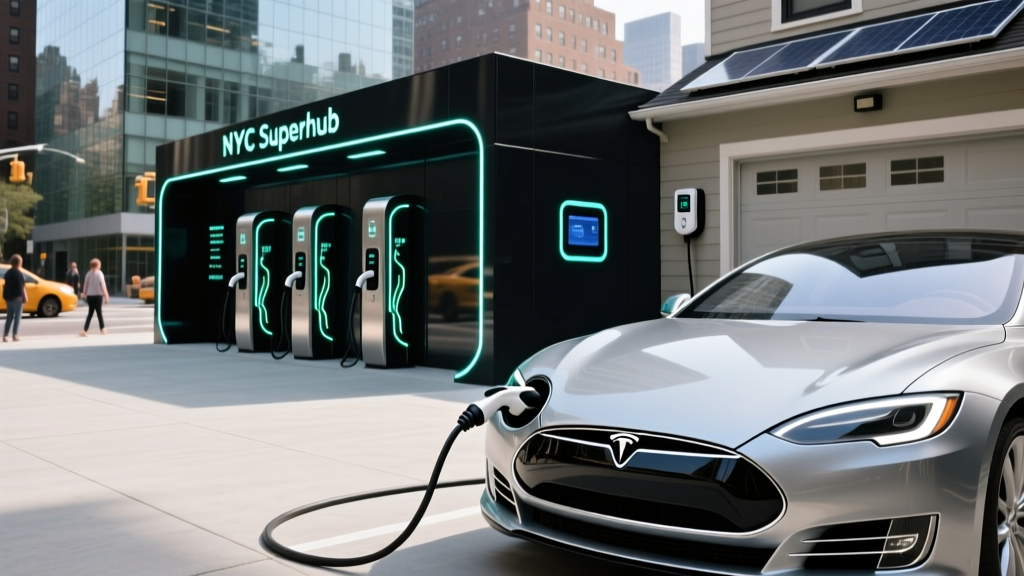
If you drive in New York City or the surrounding tri-state area, you've likely seen the blue-and-white Tesla Model Ys zipping around with Revel on the door. Revel started as an electric moped share company, but since 2021 it has pivoted hard into EV charging infrastructure, building what it calls Superhubs — urban DC fast-charging plazas with 10 to 30+ stalls, open to every EV brand, not just Teslas. As of early 2026, Revel operates or has announced Superhubs in Brooklyn, Queens, the Bronx, Manhattan, and expansion sites in New Jersey and the Bay Area.
Each Revel Superhub stall is rated for up to 320 kW of DC fast charging (CCS1 and NACS connectors on newer sites). In practice, vehicles that can accept that rate — like the Hyundai Ioniq 5, Kia EV6, and Lucid Air — can add roughly 150 to 200 miles of range in a 15-minute session, depending on battery temperature and state of charge. Vehicles capped at lower peak rates (say, 150 kW like the Ford Mustang Mach-E Extended Range) will still charge quickly, but the taper curve matters more than the headline number.
Real-world note: A 320 kW peak rate only holds between roughly 10% and 40% SoC on most vehicles. Expect the charge curve to taper significantly above 60%. Plan your road-trip stops around 10-80% sessions, not 0-100%.
Charging Levels Explained: kW, Miles per Hour, and When Each Makes Sense
Before we break down Revel's public pricing and your home options, let's nail down the three charging levels every EV owner should know. Remember: kW (kilowatts) is the rate of power flow — think of it as the width of the hose. kWh (kilowatt-hours) is the amount of energy stored in your battery — the size of the bucket. You pay for kWh; you experience speed in kW.
| Level | Voltage | Power (kW) | Miles of Range Added per Hour | Typical Use Case |
|---|---|---|---|---|
| Level 1 | 120V AC | 1.0 – 1.4 kW | 3 – 5 miles/hr | Overnight top-up for PHEVs or low-mileage drivers |
| Level 2 | 240V AC | 3.3 – 19.2 kW | 12 – 70 miles/hr | Home daily charging; workplace; hotels |
| DC Fast (Level 3) | 400V–800V DC | 50 – 350+ kW | 150 – 1,200+ miles/hr (peak) | Road trips; Revel Superhubs; Electrify America |
For a 77 kWh battery (say, the Hyundai Ioniq 5 AWD), a 19.2 kW Level 2 home charger adds roughly 60-65 miles of range per hour — enough to fully replenish overnight. A 320 kW DC fast charger at a Revel Superhub can take that same battery from 10% to 80% in about 18 minutes, adding roughly 220 miles of range.
Revel Superhub Pricing and Connector Compatibility
Revel prices its DC fast charging per kWh, which is more transparent than per-minute billing used by some legacy networks. As of early 2026, typical Revel Superhub pricing in NYC runs between $0.49 and $0.69 per kWh, depending on the site and time of day. Some locations offer off-peak rates closer to $0.39/kWh overnight. No membership is required — you plug in and pay via the Revel app or a contactless credit card.
| Connector | Brands That Use It (2025-2026) | Revel Superhub Support |
|---|---|---|
| NACS (Tesla/J3400) | Tesla, Ford, GM, Rivian, Volvo, Polestar, Hyundai (2026+), Kia (2026+) | Yes — newer hubs have native NACS cables |
| CCS1 | Hyundai, Kia, BMW, VW, Ford (pre-2025), most legacy EVs | Yes — all Superhub stalls |
| CHAdeMO | Nissan Leaf (legacy), Mitsubishi Outlander PHEV | Limited — check app for specific sites |
If you drive a 2025+ Ford F-150 Lightning or GM Silverado EV that switched to NACS, you can plug directly into Revel's NACS-equipped stalls. If your EV still has CCS1, you're covered at every stall. Nissan Leaf owners using CHAdeMO should verify availability in the Revel app before driving to a hub — not all sites carry that connector, as the industry has largely standardized on CCS1 and NACS.
How Much Does Charging at Revel (or at Home) Cost Per Mile vs. Gas?
This is where EV ownership economics either shine or sting, depending on your setup. Let's compare real costs using a 2026 Hyundai Ioniq 5 SEL (311 miles EPA range, 3.6 miles/kWh efficiency) and a comparable gas SUV getting 28 MPG combined.
| Charging Scenario | Rate | Cost per Mile (Ioniq 5) | Gas Equivalent (28 MPG @ $3.50/gal) |
|---|---|---|---|
| Home Level 2 (off-peak utility rate) | $0.14/kWh | $0.039 | $0.125 |
| Home Level 2 (standard rate) | $0.22/kWh | $0.061 | $0.125 |
| Revel Superhub (off-peak) | $0.39/kWh | $0.108 | $0.125 |
| Revel Superhub (peak) | $0.59/kWh | $0.164 | $0.125 |
| Electrify America (average) | $0.48/kWh | $0.133 | $0.125 |
The takeaway: home charging is where EVs save the most money — roughly one-third to one-quarter the per-mile cost of gas. Public DC fast charging at peak Revel rates can actually exceed the cost of gas for an efficient SUV. That's fine for road trips a few times a year, but it's not a daily strategy. If you can install a Level 2 charger at home, the math overwhelmingly favors electrification.
Home Level 2 Charger Installation: Electrical Requirements and Real Costs
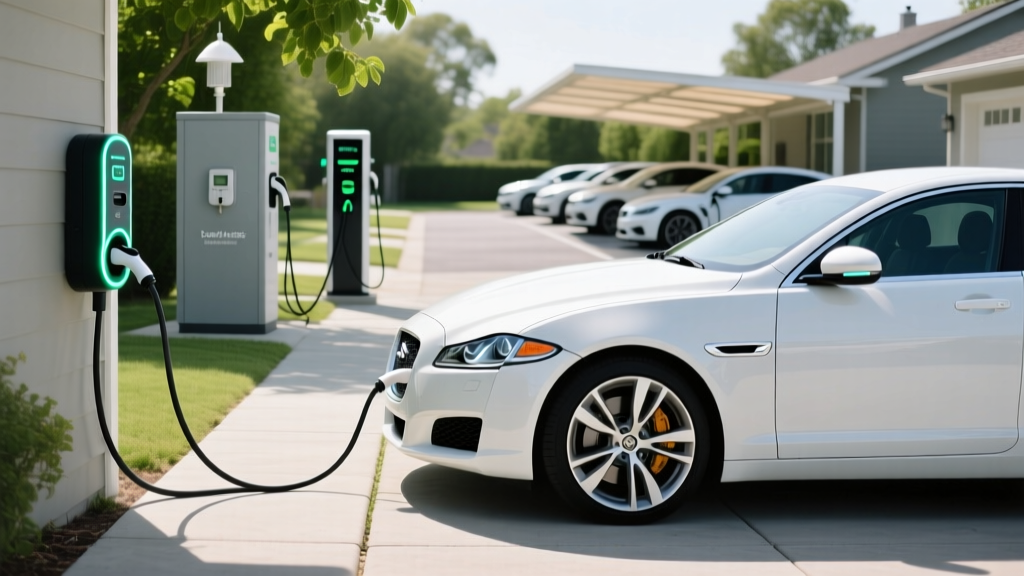
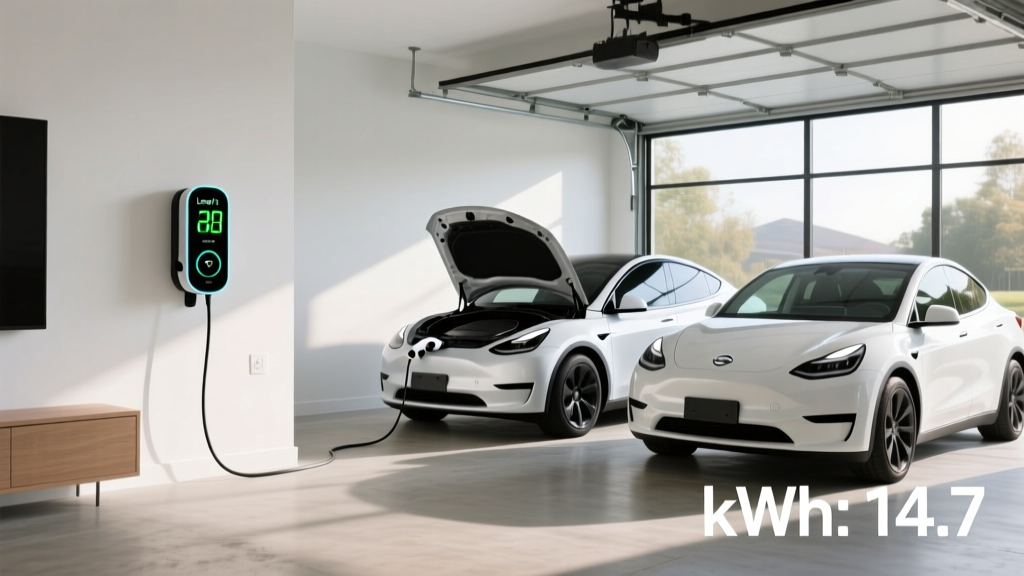
Installing a home Level 2 charger is the single highest-impact upgrade an EV owner can make. Here's what it actually involves — and what it costs when your electrical panel needs work.
Electrical Requirements
A typical home Level 2 charger requires a 240-volt, 40-amp or 50-amp dedicated circuit on a breaker sized at 125% of the continuous load (per NEC Article 625). That means a 40A charger needs a 50A breaker; a 48A charger needs a 60A breaker. The circuit must be dedicated — you cannot share it with a dryer or oven.
Most modern homes with a 200A electrical panel have sufficient capacity. Homes built before the 1990s with a 100A panel often do not, and upgrading to 200A or adding a smart panel load-management system (like Span or Lumin) becomes necessary. A licensed electrician will perform a load calculation per NEC 220.82 to determine this.
Installation Cost Breakdown
| Component | Simple Install (panel nearby, no upgrade) | Complex Install (long run or panel upgrade) |
|---|---|---|
| Level 2 Charger (hardware) | $400 – $750 | $400 – $750 |
| Electrician labor (2-4 hrs typical) | $400 – $800 | $1,200 – $3,000 |
| Conduit, wire, breaker, permits | $150 – $400 | $400 – $1,200 |
| Panel upgrade (100A → 200A, if needed) | N/A | $1,500 – $3,500 |
| Utility permit / inspection fee | $50 – $200 | $50 – $200 |
| Total Estimated Cost | $1,000 – $2,150 | $3,250 – $8,650 |
Yes — a panel upgrade can triple or quadruple your total cost. This is the single biggest variable homeowners overlook. Get a load calculation done first (many electricians offer this for $150-$250) before committing to hardware.
Safety and Code Considerations
- Dedicated circuit: NEC requires a dedicated breaker — no sharing with other appliances.
- GFCI protection: NEC 2020+ requires GFCI protection for 14-50 and 6-50 receptacles used for EV charging. Hardwired installations bypass this requirement and are generally preferred for reliability.
- Outdoor rating: If your charger is outdoors, it must carry a NEMA 4 or IP65 rating. All recommended units below meet this.
- Wire gauge: 6 AWG copper for 50A circuits; 4 AWG for 60A. Your electrician will spec this based on run length.
- Permit required: Virtually all jurisdictions require an electrical permit and inspection. Unpermitted work can void homeowner's insurance and cause issues at sale.
Best Home Level 2 Chargers in 2026: Our Equipment Picks
We've tested and installed dozens of Level 2 units. These three represent the best value, performance, and reliability for most EV owners in 2026.
Emporia Vue Level 2 Charger
Power: 48A / 11.5 kW (hardwired) or 40A / 9.6 kW (plug-in 14-50)
Connector: J1772 (NACS adapter included with newer models)
Cable length: 24 ft
Smart features: Wi-Fi, scheduling, solar integration with Emporia Vue panel monitor, energy tracking
Price: ~$399
Best for: Budget-conscious buyers who want smart scheduling and solar-aware charging.
ChargePoint Home Flex
Power: Configurable 16A–50A / up to 12 kW (hardwired at 50A)
Connector: J1772 (NACS adapter available)
Cable length: 23 ft
Smart features: Wi-Fi, app scheduling, Alexa integration, utility demand-response programs
Price: ~$549
Best for: Flexible amperage to match your panel capacity — set it to 32A if you have a 40A breaker, or 50A if you have a 60A.
Tesla Wall Connector (Gen 4)
Power: 48A / 11.5 kW (hardwired, requires 60A breaker)
Connector: NACS native (J1772 adapter included for non-Tesla EVs)
Cable length: 24 ft
Smart features: Wi-Fi, OTA updates, power sharing between two units on one circuit, Tesla app integration
Price: ~$475
Best for: Tesla owners or households with mixed Tesla and non-Tesla EVs. Excellent build quality.
All three units are UL-listed, NEMA 4 rated for outdoor use, and support load-sharing if you need to charge two EVs on a single circuit. For most homes, the ChargePoint Home Flex is the safest recommendation because its adjustable amperage lets your electrician match it precisely to your available breaker capacity without oversizing.
Charging Time Examples: How Long Does 10-80% Take?
Real-world charging times depend on battery size, chemistry (LFP batteries accept charge differently than NMC), ambient temperature, and the vehicle's thermal management. Here are representative 10-80% times for popular 2025-2026 EVs at a Revel Superhub (320 kW stall, preconditioned battery):
- Hyundai Ioniq 5 (77.4 kWh, NMC, 800V architecture): ~18 minutes at 240 kW peak
- Tesla Model Y Long Range (75 kWh, NMC): ~25 minutes at 250 kW peak
- Ford F-150 Lightning Extended Range (131 kWh, NMC): ~41 minutes at 150 kW sustained (large battery, lower peak rate)
- Chevrolet Equinox EV (85 kWh, NMC): ~30 minutes at 150 kW peak
- Nissan Ariya (91 kWh, NMC): ~38 minutes at 130 kW peak (slower curve)
LFP-equipped vehicles (like the Tesla Model 3 RWD or base Rivian R1S) can typically charge to 100% regularly without degradation concerns, but their charge curves taper earlier, making 10-80% times slightly longer than equivalent NMC packs.
Frequently Asked Questions
How much does it cost to install a home EV charger?
Expect $1,000 to $2,150 for a straightforward installation with an adequate electrical panel. If your home needs a panel upgrade (100A to 200A), costs can reach $3,250 to $8,650 total. Always get a load calculation first — it's a $150-$250 investment that prevents expensive surprises. Some utilities offer rebates of $250-$500 for Level 2 installations, and the federal Residential Clean Energy Credit may cover 30% of installation costs (capped at $1,000) through 2032 for qualifying homes.
How fast will each charging level add range?
Level 1 (120V) adds 3-5 miles per hour — adequate only for plug-in hybrids or very low daily mileage. Level 2 (240V, 40-50A) adds 25-65 miles per hour and is the standard for overnight home charging. DC fast charging at a Revel Superhub (up to 320 kW) can add 150-200+ miles in 15 minutes, depending on your vehicle's peak charge rate and battery preconditioning.
Which connector/charger is compatible with my EV?
For 2025-2026 model-year vehicles: Tesla, Ford, GM, Rivian, Volvo, and Polestar use NACS. Hyundai, Kia, BMW, VW, and most others still on CCS1 will transition to NACS for 2026-2027 models. CHAdeMO is effectively legacy (Nissan Leaf). At home, buy a charger matching your vehicle's native port — or use an adapter. At Revel Superhubs, both NACS and CCS1 cables are available at most locations.
How much does charging cost per mile vs gas?
Home charging at $0.14/kWh costs roughly $0.04 per mile for an efficient EV — about one-third the cost of gas at $3.50/gallon and 28 MPG. Public DC fast charging at $0.49-$0.69/kWh can cost $0.14-$0.19 per mile, which may exceed gas costs for an efficient vehicle. The economics favor EVs most when you charge at home overnight on off-peak utility rates.
What electrical upgrades might I need?
The most common upgrade is a panel capacity increase from 100A to 200A, costing $1,500-$3,500. Older homes may also need a new meter base, utility service drop upgrade, or a smart load-management panel (like Span) that allows EV charging without a full panel swap by dynamically managing circuit loads. Homes built after 2000 with a 200A panel rarely need any upgrade beyond the dedicated 50A or 60A breaker and wiring run.
Should You Rely on Revel Superhubs or Install a Home Charger?
Revel's Superhub network is one of the best urban DC fast-charging options in the markets where it operates — clean, well-lit, high-power stalls with transparent per-kWh pricing and both NACS and CCS1 connectors. For apartment dwellers without home-charging access, Revel can function as a primary charging solution, especially if you can time sessions to off-peak rates.
But for homeowners, the math is unambiguous: a Level 2 home charger pays for itself within 1-3 years through fuel savings, eliminates the time cost of public charging stops, and adds convenience that no public network can match. Use fueleconomy.gov to look up your specific vehicle's kWh/100mi efficiency figure, plug in your utility's rate, and run the numbers. For most drivers covering 30-40 miles daily, a 40A home charger replenishes a full day's driving in under two hours overnight — quietly, cheaply, and without leaving your garage.