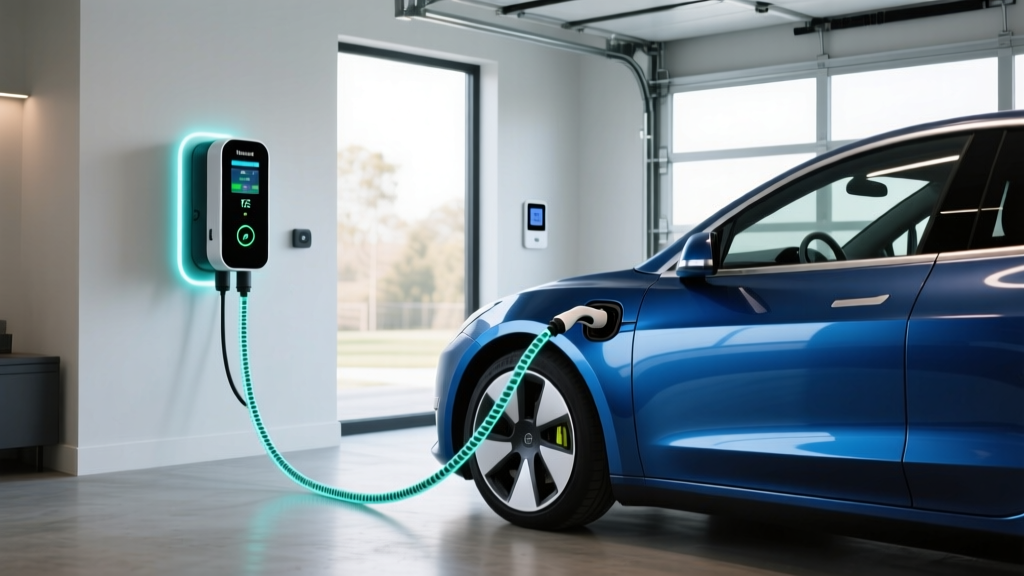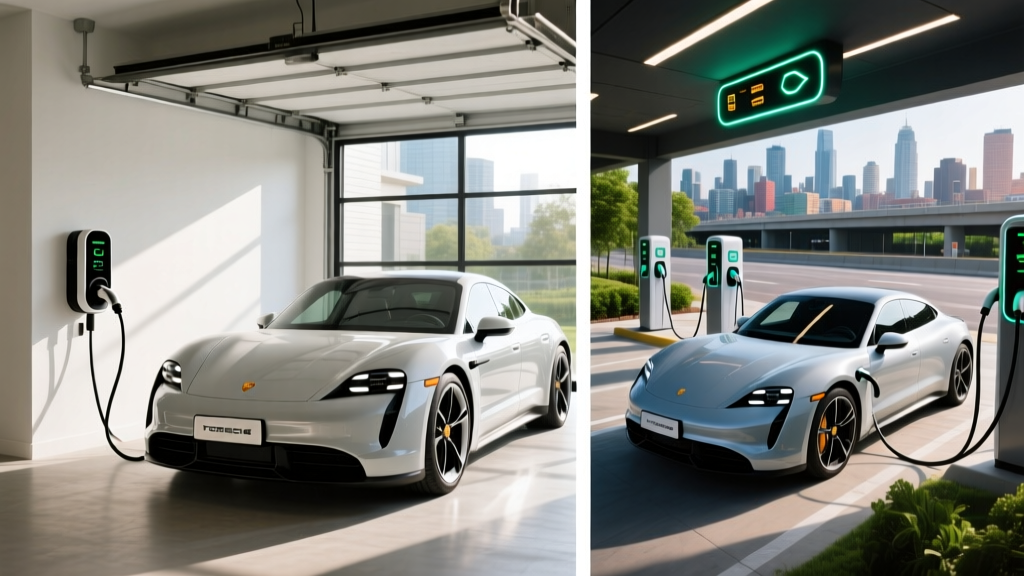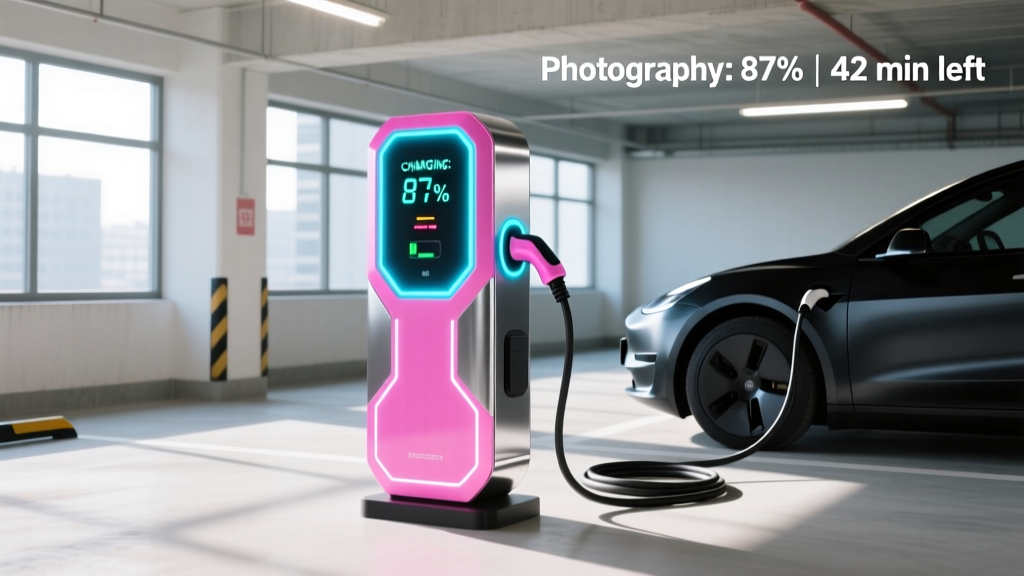
The neon-and-chrome aesthetic of the 1980s never really died — it just migrated from arcades and synth album covers into garage design. A growing niche of EV owners want their home charging setup to match that retro vibe: chunky toggle switches, LED bar-graph displays, brushed-metal faceplates, and that unmistakable 80s charger energy. But aesthetics mean nothing if the hardware can't deliver the kilowatts your battery demands.
This guide cuts through the nostalgia to evaluate what retro-styled Level 2 EV chargers actually deliver in 2026 — the real power output (kW), installation requirements, connector compatibility, and cost-per-mile math you need before you plug in.
Charging Levels Explained: How Fast Will Each Level Add Range?
Before picking any charger — retro-styled or otherwise — you need to understand the three charging tiers available to EV owners. The critical distinction: kW (kilowatts) measures power delivery rate (how fast energy flows), while kWh (kilowatt-hours) measures total energy stored in your battery. A 48-amp Level 2 charger delivers roughly 11.5 kW of power; your 75 kWh battery holds 75 kWh of energy. Never confuse the two.
| Level | Voltage | Power (kW) | Miles of Range per Hour | Typical Use Case |
|---|---|---|---|---|
| Level 1 | 120V AC | 1.2–1.9 kW | 3–5 mi/hr | Overnight top-ups, PHEVs, low-mileage drivers |
| Level 2 | 240V AC | 3.3–19.2 kW | 12–70 mi/hr | Home daily charging, workplace, destination |
| DC Fast Charging | 200–900V DC | 50–350 kW | 150–1,200+ mi/hr | Road trips, highway corridors, commercial fleets |
For context, a 2026 Tesla Model Y Long Range (81 kWh usable battery, EPA-rated 320 miles) charging on a 48-amp (11.5 kW) Level 2 unit will go from 10% to 80% State of Charge in roughly 5.5 hours. That same 10–80% session on a 250 kW DC fast charger takes approximately 22 minutes — though the charge curve tapers sharply above 80%, so charging to 100% on DC fast is rarely efficient.
Home Installation: Electrical Requirements and Cost Breakdown
A retro-styled 48-amp Level 2 charger requires a dedicated 240V/60A circuit (the National Electrical Code requires circuits rated at 125% of continuous load — so a 48A charger needs a 60A breaker). Here's what that actually costs in 2026.
| Component | Typical Cost Range | Notes |
|---|---|---|
| Level 2 Charger (Equipment) | $350–$750 | 40A–48A hardwired or NEMA 14-50 plug |
| Electrician Labor (standard install) | $500–$1,500 | Run 6 AWG copper wire, mount unit, connect to panel |
| Electrical Permit | $50–$200 | Varies by municipality; required for code compliance |
| Panel Upgrade (if needed) | $1,500–$4,000 | Upgrading from 100A to 200A service; common in homes built before 2000 |
| Trenching / Conduit (long runs) | $300–$1,200 | If panel is far from garage or charger is outdoors |
| Total (no panel upgrade) | $900–$2,450 | Most homes with 200A service and short wire runs |
| Total (with panel upgrade) | $2,400–$6,150 | Older homes or those with maxed-out panels |
The panel-upgrade gotcha: Many homes built in the 1980s and 1990s have 100A or 150A electrical service. If your panel is already near capacity — running electric range, dryer, HVAC, and water heater — adding a 60A EV circuit may require a service upgrade to 200A. Budget for this possibility. A licensed electrician can perform a load calculation before you commit. Some utilities offer rebates of $200–$500 toward panel upgrades when paired with EV charger installation.
For safety and code compliance, your installation must include:
- Dedicated circuit: The EV charger cannot share a breaker with other appliances.
- GFCI protection: Required for outdoor installations and garages per NEC 2023/2026 updates.
- NEMA 4 or NEMA 4X rating: Mandatory for any outdoor-mounted unit (weatherproof enclosure).
- Proper wire gauge: 6 AWG copper for 60A circuits; 4 AWG for runs exceeding 100 feet to minimize voltage drop.
Connector Compatibility: NACS, CCS, and CHAdeMO in 2026
The connector landscape has consolidated significantly since 2024, when Ford, GM, Rivian, and most major automakers adopted the North American Charging Standard (NACS), originally developed by Tesla. Here's where things stand for 2026 model-year vehicles.
| Connector | Brands Using It | Adapter Needed? |
|---|---|---|
| NACS (native) | Tesla, Ford, GM, Rivian, Hyundai, Kia, Mercedes, Volvo, Polestar, Nissan (new models) | No — plug and charge at Tesla Superchargers and NACS-equipped public stations |
| CCS1 | Legacy VW ID.4 (pre-2025), some Stellantis models, older BMW i4/iX | CCS-to-NACS adapter (~$200) needed for Tesla Supercharger access |
| CHAdeMO | Nissan Leaf (discontinued), Mitsubishi Outlander PHEV (older) | Limited public infrastructure; CHAdeMO stations declining |
For home Level 2 charging, nearly all chargers use a J1772 connector (or NACS, which includes J1772 signaling). If your 2026 EV has a native NACS port, you'll want a NACS-equipped home charger or a J1772-to-NACS adapter (typically included with the vehicle). Most retro-styled chargers on the market ship with J1772 connectors; adapters bridge the gap seamlessly.
Cost to Charge: Per-Mile Economics vs. Gas
The economic case for home charging is overwhelming — but public DC fast charging narrows the gap considerably. Here's the real math for 2026.
| Scenario | Rate | Cost per kWh | Cost per Mile* |
|---|---|---|---|
| Home (off-peak utility rate) | Time-of-use plan | $0.08–$0.14 | $0.025–$0.045 |
| Home (standard residential rate) | Flat rate | $0.13–$0.20 | $0.04–$0.065 |
| Public Level 2 (ChargePoint, EVgo) | Per kWh or session | $0.25–$0.49 | $0.08–$0.16 |
| DC Fast Charging (Electrify America, Tesla) | Per kWh | $0.32–$0.56 | $0.10–$0.18 |
| Gasoline vehicle (28 MPG combined) | $3.35/gal national avg | — | $0.12/mile |
*Based on an EV averaging 3.1 miles per kWh (e.g., 2026 Tesla Model Y, Hyundai Ioniq 5). Efficiency varies: larger SUVs like the Rivian R1S average ~2.5 mi/kWh.
Home off-peak charging delivers fuel costs roughly 70–80% lower than gasoline per mile. Even standard-rate home charging undercuts gas by 50–65%. However, exclusive reliance on DC fast charging at $0.48/kWh pushes per-mile costs to parity with a fuel-efficient gas car — the savings advantage depends heavily on home charging access.
Retro-Styled and Modern EV Chargers: Equipment Picks for 2026
The "80s charger" aesthetic — think industrial toggle switches, segmented LED displays, and brushed stainless enclosures — is a niche but growing category. Here's how the best options stack up on actual performance metrics.
Emporia Vue Smart EV Charger (48A)
- Power Output: 11.5 kW (48A @ 240V)
- Connector: J1772 (NACS adapter available)
- Cable Length: 24 feet
- Smart Features: Wi-Fi, energy monitoring via Emporia Vue panel integration, scheduled charging, solar-aware charging
- Enclosure: Matte black with industrial design cues; NEMA 4 outdoor rated
- Price: ~$399 (hardwired), ~$449 (NEMA 14-50 plug)
- Best For: Solar-panel owners wanting real-time energy matching
Grizzl-E Smart (40A)
- Power Output: 9.6 kW (40A @ 240V)
- Connector: J1772 (NACS version available)
- Cable Length: 24 feet
- Smart Features: OCPP-compatible, app control, firmware OTA updates, adjustable amperage (16A–40A)
- Enclosure: Brushed aluminum rugged housing — the closest mainstream unit to an industrial/retro look; NEMA 4X rated, operates down to -40°F
- Price: ~$449
- Best For: Cold-climate garages and outdoor installs; built in Canada for extreme weather
ChargePoint Home Flex (50A capable)
- Power Output: Up to 12 kW (50A @ 240V, configurable down to 16A)
- Connector: J1772 or NACS (select at purchase)
- Cable Length: 23 feet
- Smart Features: Wi-Fi, Alexa/Google integration, scheduled charging, ChargePoint network account, detailed session history
- Enclosure: Sleek modern design with subtle LED ring — less retro, more premium-tech
- Price: ~$649 (NACS), ~$599 (J1772)
- Best For: Buyers wanting a polished smart-home-integrated experience
Wallbox Pulsar Max (48A)
- Power Output: 11.5 kW (48A @ 240V)
- Connector: J1772 or NACS
- Cable Length: 25 feet (longest in class)
- Smart Features: Wi-Fi + Bluetooth, Power Sharing (daisy-chain two units on one circuit), Eco-Smart solar integration
- Enclosure: Compact rounded design, LED status strip
- Price: ~$549
- Best For: Two-EV households wanting shared-circuit charging
For the true 80s charger aesthetic, custom fabricators and small-batch makers like RetroVolt Customs and Synth Garage Works offer hand-built enclosures with LED bar-graph SoC displays, toggle-switch activation, and faux-CRT status screens — built around certified 40A or 48A internal charging modules. Expect $800–$1,400 for these custom units, plus standard electrician installation. Verify that any custom enclosure maintains UL or ETL certification for the internal charging components.
Charging Time Examples: 10–80% for Common Battery Sizes
Charging speed isn't linear. Lithium-ion batteries accept peak power only between roughly 10–50% State of Charge, then the charge curve tapers to protect battery health. Here's what 10–80% sessions look like on a 48A (11.5 kW) home Level 2 charger for popular 2026 EVs:
| Vehicle | Battery (usable kWh) | Chemistry | 10–80% Time |
|---|---|---|---|
| 2026 Tesla Model Y Long Range | 81 kWh | NMC | ~5.0 hours |
| 2026 Hyundai Ioniq 5 (Long Range) | 84 kWh | NMC | ~5.2 hours |
| 2026 Ford Mustang Mach-E Extended Range | 91 kWh | NMC | ~5.6 hours |
| 2026 Chevrolet Equinox EV | 85 kWh | NMC | ~5.3 hours |
| 2026 Tesla Model 3 (Standard, LFP) | 60 kWh | LFP | ~3.7 hours |
LFP (lithium iron phosphate) batteries, like those in the base Model 3, tolerate regular 100% charging better than NMC chemistry — Tesla and Ford recommend periodic 100% charges for LFP to recalibrate the BMS. NMC batteries benefit from daily charging limited to 80% to slow long-term degradation.
Electrical Upgrades You Might Need
Before purchasing any Level 2 charger, assess your home's electrical capacity:
- 100A service panels (common in homes built 1960–1995): Likely need a 200A upgrade to safely add a 60A EV circuit. Budget $1,500–$4,000.
- 150A panels: May support a 40A charger (32A continuous) without upgrade, pending a load calculation. A 48A charger may push you over.
- 200A panels: Typically handle a 48A–60A EV circuit without upgrade, unless you're simultaneously running electric heat, dryer, range, and hot tub.
- Smart panels / load management: Devices like the Emporia Smart Panel or Span Drive can dynamically throttle EV charging when other loads spike, potentially avoiding a panel upgrade entirely ($300–$800 for the device).
Always hire a licensed electrician for the final specification. Per the National Electrical Code, any 240V EV circuit installation requires a permit and inspection — skipping this step risks insurance claim denial in the event of an electrical fire.
Frequently Asked Questions
How much does it cost to install a home EV charger?
A standard Level 2 home charger installation runs $900–$2,450 all-in (equipment, electrician labor, and permit) if your electrical panel has sufficient capacity. If a panel upgrade from 100A to 200A is required, total costs range from $2,400–$6,150. The IRS §30C Alternative Fuel Vehicle Refueling Property Credit covers 30% of home charger installation costs up to $1,000, subject to census-tract eligibility requirements.
How fast will each charging level add range?
Level 1 (120V) adds 3–5 miles of range per hour — adequate for PHEVs with 30–40 mile batteries but impractical for full BEVs. Level 2 (240V, 48A) adds 30–40 miles per hour for most EVs, fully replenishing overnight. DC Fast Charging at 150–250 kW can add 150–300 miles in 20–30 minutes, though charge rates taper above 80% SoC.
Which connector/charger is compatible with my EV?
If you drive a 2025–2026 model from Tesla, Ford, GM, Hyundai, Kia, Rivian, or most other major brands, your vehicle uses NACS natively. Older CCS1 vehicles (pre-2025 VW ID.4, some BMWs) need a CCS-to-NACS adapter (~$200) for Tesla Supercharger access. For home charging, a J1772 charger works with all EVs using the appropriate adapter, and most new chargers now offer native NACS cables.
How much does charging cost per mile vs gas?
Home off-peak charging costs $0.025–$0.045 per mile, while gasoline at $3.35/gallon and 28 MPG costs about $0.12 per mile. Home charging saves 60–80% per mile. Public DC fast charging at $0.40–$0.56/kWh costs $0.10–$0.18 per mile — roughly comparable to gas, making home access the key economic driver.
What electrical upgrades might I need?
Homes with 100A service typically need a 200A panel upgrade ($1,500–$4,000) to support a 48A EV charger. Homes with 200A service usually accommodate a Level 2 charger without upgrade. Long wire runs from panel to garage may require conduit and trenching ($300–$1,200). Smart load-management devices ($300–$800) can sometimes avoid panel upgrades entirely by throttling charger draw when other appliances are active.
Can I get a retro or 80s-styled EV charger?
Mainstream brands like Grizzl-E offer industrial-brushed aluminum enclosures that evoke a retro-industrial feel. For authentic 80s aesthetics — LED bar graphs, toggle switches, CRT-style screens — small-batch custom fabricators build units around UL-certified 40A–48A charging modules for $800–$1,400. Always verify the internal charging hardware carries UL or ETL certification regardless of the enclosure design.
Whether you're chasing synthwave nostalgia or just want the best-performing Level 2 unit for your garage, the engineering fundamentals don't change: match the charger's kW output to your EV's onboard charger capacity, ensure your electrical panel can handle the load, and prioritize certified, code-compliant installation. The retro look is icing — reliable, fast electrons are the cake.