The "Redeye" in Redeye Chargers: What It Actually Is
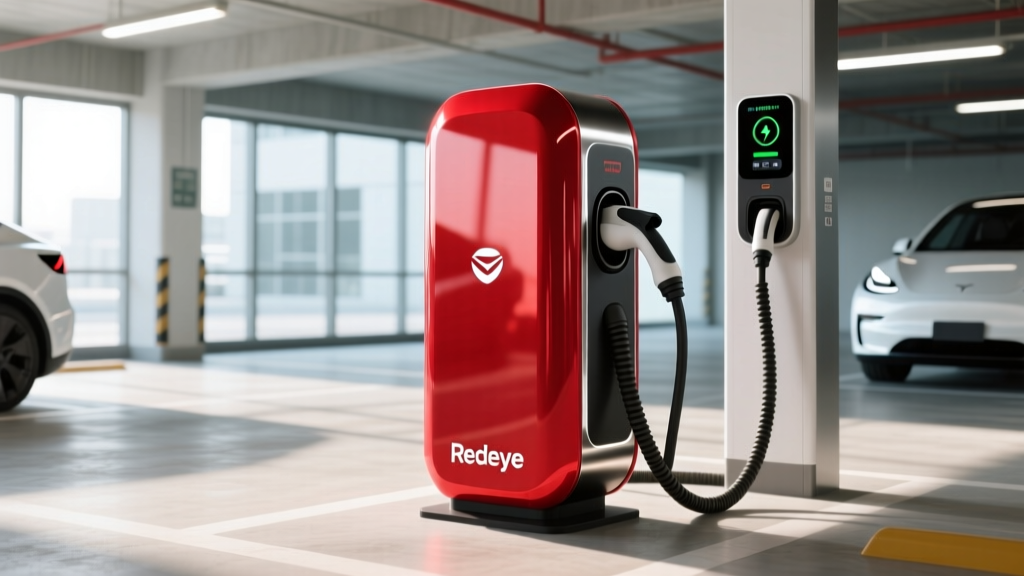
If you've searched for what material is the redeye in the redeye chargers, you've likely encountered the Redeye status-indicator LED found on certain EV charging cables and wall units — most commonly associated with aftermarket or regionally branded Level 2 and DC fast-charge connectors. The "Redeye" is not a structural or conductive component; it's a visual charge-status indicator lens made from polycarbonate (PC) or transparent ABS plastic, typically dyed red and diffused to scatter light evenly from an underlying RGB or red-only LED.
Polycarbonate is the industry-standard material for this application because it offers:
- High impact resistance — critical for equipment that may be stepped on, driven over, or exposed to hail
- UV stability — resists yellowing or cracking after years of outdoor sun exposure (UV-rated PC like Makrolon or Lexan is common)
- Thermal tolerance — maintains structural integrity from -40°F to 212°F (-40°C to 100°C), covering the full range of North American climates
- Optical clarity when molded thin, allowing efficient LED light transmission without hotspots
Some premium charger manufacturers use glass-filled nylon (PA66-GF) for the surrounding housing, but the actual light-pipe or lens dome you see glowing red is almost universally injection-molded polycarbonate. If your Redeye lens has cracked or yellowed, replacement lenses are typically available from the charger OEM for $5–$15.
Charging Levels Explained: Speeds, kW, and Miles Per Hour
Before buying any charger, understand the three charging tiers. The critical distinction: kW (kilowatts) measures power — the rate of energy flow, while kWh (kilowatt-hours) measures energy — the total amount stored in your battery. A 48 kW charger fills a 75 kWh battery from 10–80% faster than an 11.5 kW unit, but both deliver the same kWh of energy eventually.
| Level | Voltage | Max Power (kW) | Miles of Range Per Hour | Typical Use Case |
|---|---|---|---|---|
| Level 1 | 120V AC | 1.4–1.9 kW | 3–5 mi/hr | Overnight top-off, PHEVs, low-mileage drivers |
| Level 2 | 240V AC | 3.3–19.2 kW | 12–70 mi/hr | Home daily charging, workplace, destinations |
| DC Fast Charge | 200–900V DC | 50–350+ kW | 150–1,000+ mi/hr (peak) | Road trips, highway corridors, quick stops |
- 75 kWh battery (e.g., Tesla Model Y, Hyundai Ioniq 5): ~8 hrs at 7.2 kW L2; ~5 hrs at 11.5 kW L2; ~18–25 min at 250 kW DCFC (with preconditioning)
- 100 kWh battery (e.g., Ford F-150 Lightning Extended Range): ~11 hrs at 7.2 kW; ~7 hrs at 11.5 kW; ~20–30 min at 350 kW DCFC
- 18 kWh battery (e.g., PHEV like Toyota RAV4 Prime): ~2.5 hrs at 7.2 kW; DCFC not typically available
Note: DC fast charging follows a charge curve — peak kW is only sustained between ~10–50% SoC. Above 80%, speed drops sharply to protect battery chemistry. This is why 10–80% is the standard benchmark, not 0–100%.
Home Level 2 Installation: Electrical Requirements, Permits, and Costs
Installing a Level 2 home charger is the single most impactful upgrade an EV owner can make. Here's what's involved electrically and financially.
Electrical Requirements
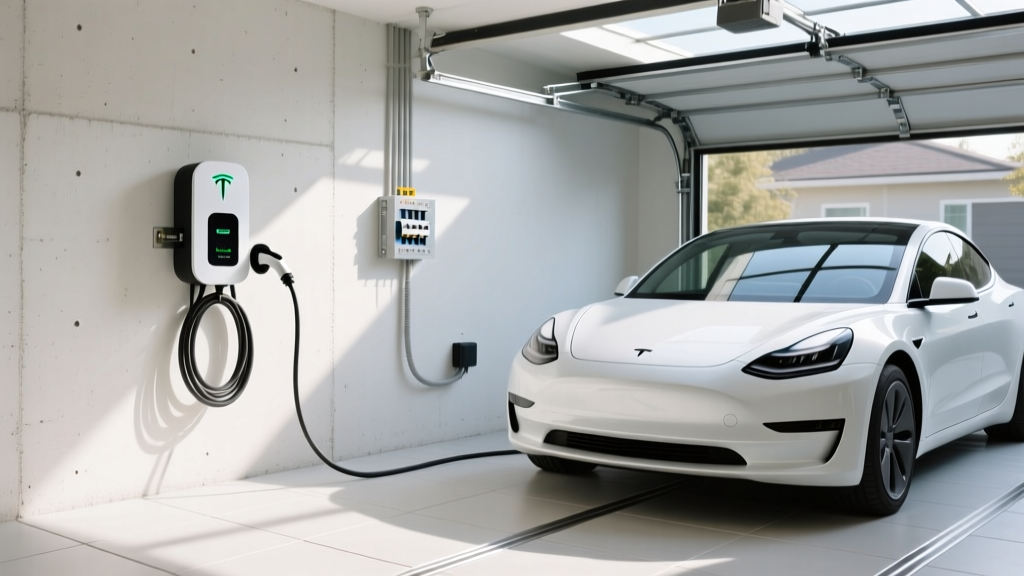
A typical Level 2 home charger requires a dedicated 240V circuit, similar to what an electric dryer or oven uses. The most common configurations:
- 40-amp circuit / 32-amp continuous (7.7 kW) — minimum practical for most BEVs
- 50-amp circuit / 40-amp continuous (9.6 kW) — recommended for 75+ kWh batteries
- 60-amp circuit / 48-amp continuous (11.5 kW) — ideal for large batteries or two-EV households (with load-sharing charger)
- 80-amp circuit / 64-amp continuous (15.4 kW) — maximum for some premium chargers; requires robust panel
The National Electrical Code (NEC) requires EV circuits to be rated at 125% of the charger's continuous draw. So a 48-amp charger needs a 60-amp breaker. Your charger should be hardwired or use a NEMA 14-50 (50A) or NEMA 6-50 (50A) receptacle.
Do You Need a Panel Upgrade?
This is the biggest cost wildcard. If your home has a 100-amp main panel (common in homes built before 1990), you likely need an upgrade to 200 amps to safely add a 50–60A EV circuit alongside existing loads. Homes with 200A panels usually have sufficient headroom. A licensed electrician will perform a load calculation (NEC Article 220) to determine this.
Alternatives if panel capacity is tight:
- Lower-amperage charger (e.g., 24A / 5.8 kW) — slower but avoids panel work
- Smart panel or load-management device (e.g., Emporia Load Management, Span panel) — dynamically throttles charger when household demand spikes
- Panel upgrade to 200A or 400A — expensive but future-proofs for a second EV, heat pump, or solar
Permits and Inspections
Most jurisdictions require an electrical permit for EV charger installation ($50–$200 depending on locality). The work must pass inspection to ensure code compliance — this protects your home insurance coverage and is often required to claim utility rebates. Never skip the permit; unpermitted work can void homeowner's insurance claims related to electrical fire.
| Item | Low End | Typical | High End | Notes |
|---|---|---|---|---|
| Level 2 Charger (Equipment) | $250 | $450 | $750 | 32A–48A Wi-Fi-enabled units |
| Electrician Labor (standard install) | $300 | $600 | $1,200 | Depends on run length, wall type, conduit |
| Electrical Materials (wire, conduit, breaker) | $100 | $200 | $400 | Copper 6 AWG for 50A; longer runs cost more |
| Permit & Inspection | $50 | $100 | $200 | Varies by municipality |
| Panel Upgrade (if needed) | $1,500 | $2,500 | $4,000 | 100A → 200A upgrade; not always required |
| Total (no panel upgrade) | $700 | $1,350 | $2,550 | Most homes with 200A panels |
| Total (with panel upgrade) | $2,200 | $3,850 | $6,550 | Older homes with 100A service |
Check with your local utility — many offer $250–$500 rebates for Level 2 charger installation, and some states stack additional incentives. The federal Residential Clean Energy Credit (IRC §25C) may cover up to 30% of charger equipment costs (capped at $1,000) through 2032, subject to IRS eligibility rules.
Connector Compatibility: NACS, CCS1, CHAdeMO, and Adapters
The North American charging connector landscape has consolidated significantly. As of 2026, nearly every new EV sold in the U.S. uses either the North American Charging Standard (NACS, J3400) or CCS1 (Combined Charging System). Here's how to identify what your vehicle needs:
| Connector | Vehicle Brands | Notes |
|---|---|---|
| NACS (Tesla/J3400) | Tesla (all), Ford, GM, Rivian, Volvo, Polestar, Mercedes-Benz, Fisker, Lucid (newer) | Industry standard going forward; access to Tesla Supercharger network |
| CCS1 | Hyundai, Kia, BMW, VW, Audi, Porsche, Subaru, some Stellantis | Still widely supported; many brands transitioning to NACS by 2027 |
| CHAdeMO | Nissan Leaf (legacy), Mitsubishi Outlander PHEV (legacy) | Effectively discontinued for new vehicles; infrastructure declining |
Adapter needs:
- CCS1 vehicle → NACS Supercharger: Tesla and third-party adapters (e.g., Lectron, A2Z) enable CCS1 cars to charge at Superchargers ($150–$300 for adapter). Confirm compatibility with your specific model.
- NACS vehicle → CCS1 DCFC: Most NACS-equipped vehicles ship with or offer a CCS1 adapter for Electrify America, EVgo, and ChargePoint stations.
- Level 2 (J1772) → NACS: Tesla ships a J1772-to-NACS adapter with every vehicle. Non-Tesla NACS cars increasingly include one as well.
When buying a home Level 2 charger, choose the connector that matches your vehicle natively. Adapters add a point of failure and are less convenient for daily plugging.
Cost to Charge: Per-Mile Economics vs. Gasoline
Charging cost depends entirely on where and when you charge. Here's how common scenarios break down for a typical EV averaging 3.0 miles per kWh (roughly the efficiency of a 2026 Hyundai Ioniq 6 or Tesla Model 3):
| Scenario | Cost per kWh | Cost per Mile | Equivalent MPG (at $3.50/gal gas) |
|---|---|---|---|
| Home, off-peak utility rate | $0.08–$0.12 | $0.03–$0.04 | 88–117 MPG |
| Home, standard rate | $0.14–$0.18 | $0.05–$0.06 | 58–70 MPG |
| Home, high-cost state (CA, HI) | $0.25–$0.40 | $0.08–$0.13 | 27–44 MPG |
| Public Level 2 (ChargePoint, etc.) | $0.25–$0.49 | $0.08–$0.16 | 22–44 MPG |
| DC Fast (Electrify America, EVgo) | $0.35–$0.55 | $0.12–$0.18 | 19–29 MPG |
| Tesla Supercharger (average) | $0.25–$0.38 | $0.08–$0.13 | 27–44 MPG |
| Gasoline car (30 MPG combined) | — | $0.12 | 30 MPG |
Recommended Home Level 2 Chargers (2026)
These are chargers we've evaluated based on reliability, smart features, build quality, and real-world charging performance. All prices are approximate MSRP as of early 2026.
ChargePoint Home Flex (NACS or J1772)
- Power: Up to 12 kW (50A) — adjustable down to 16A
- Cable: 23 ft
- Connector: NACS or J1772 (select at purchase)
- Smart features: Wi-Fi, app scheduling, Alexa, utility demand-response
- Price: ~$450
- Best for: Flexibility across amperages; strong app ecosystem
Tesla Wall Connector (NACS)
- Power: Up to 11.5 kW (48A)
- Cable: 24 ft
- Connector: NACS native
- Smart features: Wi-Fi, OTA updates, Power-Share (load balancing with 2nd unit), vehicle integration
- Price: ~$425
- Best for: Tesla owners; cleanest integration; best value at 48A
Emporia Vue EV Charger (J1772 or NACS)
- Power: Up to 11.5 kW (48A)
- Cable: 24 ft
- Connector: J1772 or NACS
- Smart features: Wi-Fi, energy monitoring, solar integration, load management with Emporia panel monitor
- Price: ~$400
- Best for: Solar homes; budget-conscious buyers wanting 48A
Grizzl-E Smart (J1772 or NACS)
- Power: Up to 10 kW (40A)
- Cable: 24 ft
- Connector: J1772 or NACS
- Smart features: Wi-Fi, OCPP-compatible, adjustable amperage, extreme cold rated (-40°F)
- Price: ~$450
- Best for: Cold-climate durability; Canadian-built; rugged outdoor installs
Safety, Code, and Installation Best Practices
EV chargers draw sustained high current for hours — this is a more demanding load than most household appliances. Follow these non-negotiable safety requirements:
- Dedicated circuit: Your charger must have its own breaker — never share a circuit with other loads. NEC 625.40 requires this for all EV supply equipment.
- GFCI protection: NEC 2023 and later require GFCI protection for outdoor receptacles used for EV charging (NEC 625.54). Hardwired chargers with integrated ground-fault protection may satisfy this without a GFCI breaker, which can nuisance-trip on some panels.
- Outdoor rating: If your charger is installed outside (garage exterior, driveway post, carport), it must be rated NEMA 4 (or NEMA 4X) for weather resistance. All chargers recommended above carry outdoor ratings.
- Wire gauge: 6 AWG copper for 50A circuits; 4 AWG for 60A. Aluminum wire requires upsizing. Your electrician will spec this based on run length and local code.
- Cable management: Use a holster or retractor to keep the cable off the ground. A cable lying in a driveway is a trip hazard and accelerates insulation wear.
- Surge protection: Consider a whole-home surge protector ($150–$300 installed) if you're in a lightning-prone area. EV charger electronics are sensitive to voltage spikes.
Frequently Asked Questions
How much does it cost to install a home EV charger?
A typical Level 2 home installation runs $700–$2,550 if your electrical panel has sufficient capacity (200A service). If you need a panel upgrade from 100A to 200A, add $1,500–$4,000. Utility rebates and the federal §25C credit can offset $250–$1,000 of that total. Always get 2–3 quotes from licensed electricians — prices vary significantly by region and installation complexity.
How fast will each charging level add range?
Level 1 (120V) adds roughly 3–5 miles of range per hour — adequate for PHEVs with small batteries but impractical for full BEVs. Level 2 (240V) adds 12–70 miles per hour depending on amperage; a 48A / 11.5 kW charger adds roughly 37–45 miles per hour for an efficient sedan. DC fast charging adds 150–1,000+ miles per hour at peak, but sustained rates taper significantly above 50–60% state of charge.
Which connector/charger is compatible with my EV?
Check your vehicle's charge port. If it's a 2025+ Tesla, Ford, GM, Rivian, or Volvo, you almost certainly have NACS. If it's a Hyundai, Kia, BMW, or VW from 2020–2025, you likely have CCS1. For home Level 2 charging, all EVs accept J1772 or NACS (with adapter). Buy a charger with your vehicle's native connector to avoid daily adapter hassle. See the connector compatibility table above for brand-by-brand detail.
How much does charging cost per mile vs gas?
Home charging on off-peak rates costs approximately $0.03–$0.06 per mile, compared to about $0.12/mile for a 30 MPG gasoline car at $3.50/gallon. Even at standard residential rates ($0.14–$0.18/kWh), EVs cost roughly half as much per mile to "fuel." DC fast charging on road trips can cost $0.12–$0.18/mile, approaching gasoline costs, but most drivers charge at home 80–90% of the time.
What electrical upgrades might I need?
The most common upgrade is a panel capacity increase from 100A to 200A, needed in roughly 20–30% of older homes. Other potential upgrades include: running new conduit and wire from the panel to the garage (especially if the panel is on the opposite side of the house), adding a sub-panel in the garage, or installing a smart load-management device if you want to avoid a panel upgrade. A licensed electrician's load calculation will determine what's required for your specific home. Always verify the electrician is familiar with NEC Article 625 (EV charging code) — not all general electricians are current on these requirements.