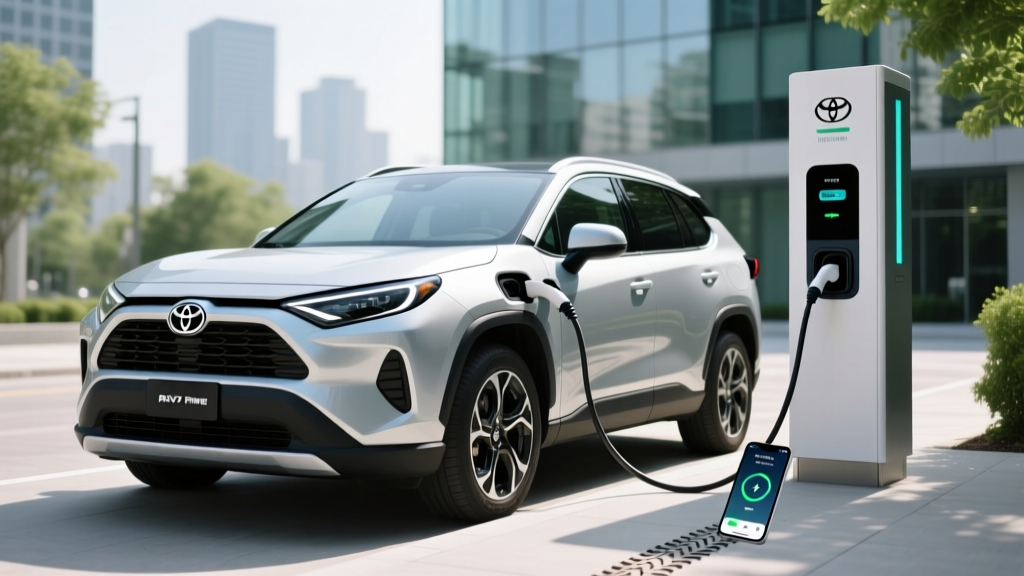
The Toyota RAV4 Prime plug-in hybrid remains one of the most popular electrified vehicles on the road, and for good reason: it pairs a usable electric-only commute with the flexibility of a gas engine for road trips. But if you're researching the RAV4 electric range and how to charge it at home, you need clarity on what this PHEV can actually deliver — not just the EPA sticker — and what electrical work your garage might require.
This guide covers the 2026 RAV4 Prime's real-world electric range, every charging level with exact speeds, home installation costs with a full breakdown, connector compatibility, and the per-mile math that decides whether plugging in beats pumping gas.
RAV4 Prime Electric Range: EPA vs Real-World Numbers
The 2026 Toyota RAV4 Prime carries an 18.1 kWh lithium-ion traction battery (NMC chemistry) with approximately 14.5 kWh usable after the system buffer. The EPA rates it at 42 miles of electric-only range and 94 MPGe when operating in EV mode, according to fueleconomy.gov.
Real-World Expectation: 34–40 miles in mild weather (city/suburban driving); 28–33 miles at sustained highway speeds (70+ mph); 25–32 miles in freezing temperatures with cabin heat. The RAV4 Prime's heat pump helps mitigate cold-weather losses compared to resistive heating, but battery chemistry still slows in sub-40°F conditions.
Once the battery depletes, the 2.5-liter four-cylinder hybrid system takes over, delivering an EPA-rated 38 MPG combined in hybrid mode. Total system output is 302 horsepower, making the RAV4 Prime the quickest RAV4 variant with a 0–60 mph time of approximately 5.7 seconds.
| Spec | 2026 RAV4 Prime |
|---|---|
| Battery (usable) | 14.5 kWh (NMC) |
| EPA EV Range | 42 miles |
| EPA MPGe (EV mode) | 94 MPGe |
| Hybrid MPG (combined) | 38 MPG |
| Total System HP | 302 hp |
| 0–60 mph | 5.7 seconds |
| Onboard Charger | 3.3 kW (6.6 kW available on select trims) |
| Max DC Fast Charge | None — AC only |
| Battery Warranty | 10 years / 150,000 miles |
| Base MSRP (SE) | ~$44,500 |
Critical note on DC fast charging: The RAV4 Prime does not support DC fast charging. It charges exclusively via AC power (Level 1 or Level 2). This is typical for PHEVs — the smaller battery doesn't require DCFC infrastructure, but it also means public fast-charging stations are irrelevant for this vehicle.
Charging Levels Explained: kW, Speeds, and Miles Per Hour
Before we get into hardware, let's clear up the single most common EV confusion: kW (kilowatts) measures power — the rate of charging, like water pressure from a hose. kWh (kilowatt-hours) measures energy — battery capacity, like the size of the tank. You'll see kW when discussing charge speed and kWh when discussing battery size.
| Level | Voltage / Amps | Power (kW) | Miles of EV Range Added Per Hour | RAV4 Prime Full Charge Time (0–100%) |
|---|---|---|---|---|
| Level 1 (Standard outlet) | 120V / 12A | ~1.4 kW | ~4–5 miles/hr | ~10–12 hours |
| Level 2 (Home/Public AC) | 240V / 16A (3.3 kW onboard) | 3.3 kW | ~12–14 miles/hr | ~4.5–5 hours |
| Level 2 (240V / 32A, 6.6 kW onboard) | 240V / 32A | 6.6 kW | ~22–26 miles/hr | ~2.5 hours |
| DC Fast Charging | N/A | N/A | N/A | Not supported |
The RAV4 Prime SE comes with a 3.3 kW onboard charger as standard. The XSE trim (and some option packages) offers a 6.6 kW onboard charger upgrade, which cuts Level 2 charging time roughly in half. Verify your trim's onboard charger capacity before buying a high-amperage Level 2 unit — plugging a 48A charger into a RAV4 Prime with a 3.3 kW onboard charger will still only draw 3.3 kW.
Home Charger Installation: Electrical Requirements and Full Cost Breakdown
Most RAV4 Prime owners will want a Level 2 home charger for daily convenience. A dedicated 240V circuit delivers a full overnight charge in 2.5–5 hours depending on your onboard charger, meaning you plug in when you get home and wake up to a full battery every morning.
Electrical Requirements
A Level 2 charger requires a 240-volt dedicated circuit, similar to what powers an electric dryer or oven. The amperage depends on your charger and onboard charger:
- 3.3 kW onboard charger: A 20A circuit (240V × 20A = 4.8 kW available, charger draws 3.3 kW) is sufficient. Uses a NEMA 14-50 or 6-20 outlet, or hardwired.
- 6.6 kW onboard charger: A 40A circuit is recommended (240V × 40A = 9.6 kW available, charger draws 6.6 kW). Typically requires a NEMA 14-50 outlet or hardwired connection.
- Future-proofing: If you plan to eventually own a full BEV, installing a 60A circuit now with a 48A-capable charger saves rework later.
Panel Upgrade Reality
Homes with 100A electrical service or panels already near capacity may require a panel upgrade to 200A before adding a 40–60A EV circuit. This is the single biggest variable in installation cost and catches many buyers by surprise. A licensed electrician will perform a load calculation per NEC Article 220 to determine if your panel can handle the additional draw.
| Cost Component | Low Estimate | High Estimate | Notes |
|---|---|---|---|
| Level 2 Charger Equipment | $250 | $700 | Varies by brand, power, smart features |
| Electrician Labor (standard install) | $400 | $1,200 | Depends on run length, conduit, outlet vs hardwire |
| Electrical Permit | $50 | $250 | Varies by municipality |
| Panel Upgrade (if needed) | $1,500 | $4,000 | 100A → 200A service upgrade |
| Utility Rebate / Federal Credit | -$300 | -$1,000 | 30C credit up to $1,000 for home charging equipment |
| Total (no panel upgrade) | $700 | $2,150 | Most common scenario |
| Total (with panel upgrade) | $2,200 | $6,150 | Older homes with 100A service |
The IRS Section 30C Alternative Fuel Vehicle Refueling Property Credit covers 30% of home charging equipment and installation costs, up to $1,000, subject to income limits and census-tract eligibility. Check your eligibility with a tax professional before filing.
Connector Compatibility: What Plugs Into a RAV4 Prime?
The RAV4 Prime uses the J1772 connector for all AC charging (Level 1 and Level 2). This is the universal standard for non-Tesla EVs and PHEVs in North America.
| Connector | Type | RAV4 Prime Compatible? | Notes |
|---|---|---|---|
| J1772 | AC (Level 1/2) | Yes — native | Standard on all RAV4 Prime trims |
| NACS (Tesla) | AC/DC | AC only with adapter | Tesla Wall Connector with J1772 adapter works; Tesla Superchargers (DC) are irrelevant — RAV4 Prime has no DCFC |
| CCS1 | DC Fast | No | RAV4 Prime has no DC charging capability |
| CHAdeMO | DC Fast | No | RAV4 Prime has no DC charging capability |
For home charging, any J1772 Level 2 charger works natively. If you have a Tesla Wall Connector at home, Tesla sells a J1772 adapter that allows non-Tesla vehicles to charge — but remember, the RAV4 Prime can only accept AC, so Tesla Superchargers (which deliver DC) will never be relevant to this vehicle.
Recommended Level 2 Chargers for the RAV4 Prime
Since the RAV4 Prime's onboard charger caps at either 3.3 kW or 6.6 kW, you don't need the most powerful charger on the market — but investing in a quality unit with a NEMA 14-50 plug, adequate cable length, and smart scheduling features pays dividends in convenience and utility-rate optimization.
ChargePoint Home Flex
- Power Output: Up to 12 kW (50A) — configurable down to 16A/3.8 kW
- Connector: J1772
- Cable Length: 23 feet
- Smart Features: Wi-Fi, app scheduling, utility rate optimization, Alexa integration
- Price: ~$550
- Why it works: Amperage is adjustable via DIP switches, so you can match your circuit. Overkill for the 3.3 kW onboard charger but future-proofs for a BEV later.
Emporia Vue Level 2 Charger
- Power Output: Up to 11.5 kW (48A)
- Connector: J1772
- Cable Length: 24 feet
- Smart Features: Wi-Fi, app control, solar integration, energy monitoring
- Price: ~$400
- Why it works: Excellent value with energy monitoring. If you have rooftop solar, it can prioritize solar-generated electricity for charging.
Grizzl-E Smart
- Power Output: Up to 10 kW (40A)
- Connector: J1772
- Cable Length: 24 feet
- Smart Features: OCPP-compatible, app scheduling, works with utility demand-response programs
- Price: ~$450
- Why it works: Built in Canada, rugged outdoor rating (IP67), and well-suited to cold climates. 40A pairs perfectly with the 6.6 kW onboard charger option.
Installation tip: All three units above support NEMA 14-50 plug-in installation or hardwiring. A plug-in setup allows you to take the charger when you move, but hardwiring eliminates the $80–$150 cost of an industrial-grade 14-50 receptacle and provides a marginally safer connection per NEC 2023 updates requiring GFCI breakers on plug-in outlets.
Cost to Charge: Per-Mile Math vs Gasoline
The RAV4 Prime's small battery makes it one of the cheapest electrified vehicles to charge. Here's what a full charge costs in different scenarios and how that translates to cost per mile:
| Scenario | Rate ($/kWh) | Cost for Full 14.5 kWh Charge | Cost Per EV Mile (42 mi range) | Equiv. Gas Cost (38 MPG hybrid) |
|---|---|---|---|---|
| Home — Off-Peak Utility Rate | $0.08 | $1.16 | $0.028/mi | $3.50/gal: $0.092/mi |
| Home — Average US Rate | $0.16 | $2.32 | $0.055/mi | $3.50/gal: $0.092/mi |
| Home — Peak / High-Cost State (CA, HI) | $0.30 | $4.35 | $0.104/mi | $3.50/gal: $0.092/mi |
| Public Level 2 (ChargePoint, EVgo) | $0.25–$0.49 | $3.63–$7.11 | $0.087–$0.169/mi | $3.50/gal: $0.092/mi |
The takeaway: Charging at home on an off-peak or average utility rate saves roughly 40–70% per mile compared to running the RAV4 Prime in hybrid mode on gasoline. At peak rates or on expensive public chargers, the savings shrink or even disappear — which is why a home Level 2 installation is the single highest-ROI upgrade for any PHEV owner.
For context, a RAV4 Prime driver commuting 30 miles round-trip and charging nightly at $0.12/kWh spends about $1.25/day on electricity for EV-mode driving. The same commute in hybrid mode at 38 MPG with $3.50/gallon gas costs about $2.76/day. Over a 250-workday year, that's roughly $378 in annual fuel savings from electric commuting alone.
Safety, Code, and the Panel-Upgrade Gotcha
EV charging involves sustained high-current draw for hours — unlike a dryer that cycles on and off. This makes proper installation non-negotiable:
- Dedicated circuit: Your Level 2 charger must be on its own dedicated breaker — not shared with other appliances. NEC 625 governs EV charging installations.
- GFCI protection: The 2023 NEC update requires GFCI protection for plug-in receptacles used for EV charging (not required for hardwired installations). This can add $50–$120 for a GFCI breaker.
- Outdoor rating: If your charger is installed outdoors or in an unconditioned garage, ensure the unit carries at least an IP55 rating (IP67 preferred for exposed installations).
- Permit and inspection: Most jurisdictions require an electrical permit and post-installation inspection. Skipping this can void homeowner's insurance coverage for electrical fires.
- Continuous load rule: NEC defines EV charging as a continuous load, meaning the circuit must be rated for 125% of the charger's draw. A 40A charger requires a 50A circuit; a 32A charger requires a 40A circuit.
The panel-upgrade gotcha deserves emphasis: if your electrician's load calculation shows your panel is already at 80%+ capacity, you'll need the upgrade before any EV circuit can be added. Homes built before 1990 with original 100A panels are the most common candidates. Budget $1,500–$4,000 and plan for a 1–3 day project.
Frequently Asked Questions
How much does it cost to install a home EV charger for a RAV4 Prime?
A typical Level 2 installation without a panel upgrade runs $700–$2,150 including equipment, electrician labor, and permits. If your home requires a panel upgrade from 100A to 200A service, add $1,500–$4,000. The federal 30C tax credit can offset up to $1,000 (30% of equipment + install costs), subject to income and census-tract eligibility per the IRS.
How fast will each charging level add range to my RAV4 Prime?
Level 1 (120V standard outlet) adds approximately 4–5 miles of EV range per hour — enough for overnight charging if your commute is under 30 miles. Level 2 at 3.3 kW adds 12–14 miles per hour, fully replenishing the battery in about 5 hours. Level 2 at 6.6 kW adds 22–26 miles per hour, filling the battery in roughly 2.5 hours. DC fast charging is not supported.
Which connector and charger is compatible with my RAV4 Prime?
The RAV4 Prime uses the J1772 connector for all AC charging. Any Level 1 or Level 2 charger with a J1772 plug is directly compatible. NACS/Tesla connectors require an adapter for AC charging; CCS1 and CHAdeMO connectors are DC-only and irrelevant to this PHEV. Verify your trim's onboard charger capacity (3.3 kW or 6.6 kW) before purchasing a high-amperage Level 2 unit.
How much does charging cost per mile vs gas?
At an average US residential electricity rate of $0.16/kWh, the RAV4 Prime costs about $0.055 per mile in EV mode — roughly 40% less than the $0.092/mile it costs in hybrid mode at $3.50/gallon gasoline. Off-peak utility rates ($0.08/kWh) push EV-mode cost down to $0.028/mile, a 70% savings. However, expensive public Level 2 chargers ($0.35+/kWh) can cost more per mile than gasoline.
What electrical upgrades might I need for a Level 2 charger?
At minimum, you need a dedicated 240V circuit (20A for 3.3 kW charging, 40A for 6.6 kW or future-proofing). If your electrical panel is at or near capacity — common in homes with 100A service — a panel upgrade to 200A is required, costing $1,500–$4,000. Your electrician will perform a NEC Article 220 load calculation to determine this. Additional costs may include conduit runs ($5–$15/foot for long runs from panel to garage), GFCI breakers ($50–$120), and permit fees ($50–$250).
Does the RAV4 Prime qualify for the $7,500 federal EV tax credit?
The RAV4 Prime is a PHEV and may qualify for a partial or full federal tax credit under IRS Section 30D, but eligibility depends on current battery-sourcing and critical-minerals requirements, your taxable income (capped at $150K single / $300K joint), and the vehicle's MSRP (capped at $80,000 for SUVs). The RAV4 Prime's MSRP falls under the cap, but battery component sourcing rules change annually. Consult a tax professional and check the latest IRS guidance before assuming credit eligibility. As of 2026, some RAV4 Prime trims may qualify for the full $7,500 while others may receive a reduced credit or none at all depending on manufacturing origin.
Can I charge my RAV4 Prime at a Tesla Supercharger?
No. Tesla Superchargers deliver DC fast charging, and the RAV4 Prime has no DC charging capability. You can use a Tesla Wall Connector (a Level 2 AC home charger) with Tesla's J1772 adapter, but public Supercharger stalls are not compatible with this vehicle.