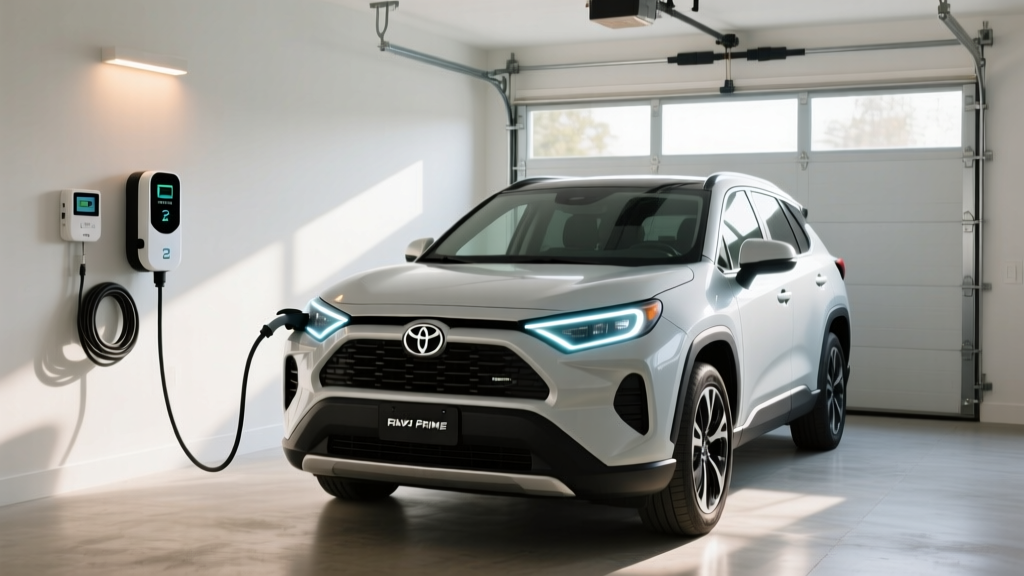
If you own or are shopping for the Toyota RAV4 Prime, you already know it's one of the most practical plug-in hybrids on the market. With an EPA-estimated 42 miles of electric-only range and a combined 94 MPGe, the RAV4 PHEV rewards owners who charge regularly with dramatic fuel savings. But here's the reality many new owners discover: the factory-included Level 1 charging cord adds only about 3–4 miles of range per hour. That means a full 0–100% charge on a standard 120V outlet takes roughly 10–12 hours — workable overnight, but far from optimal if you want to consistently maximize your RAV4 PHEV range every day.
The fix is straightforward: a properly installed Level 2 home charger. This guide walks you through exactly what that involves — from electrical requirements and real costs to the best 2026 charger models for your RAV4 Prime's 18.1 kWh battery pack.
Understanding RAV4 PHEV Range and Why Charging Speed Matters
The current-generation RAV4 Prime (sold through the 2025 model year and carried forward) pairs a 2.5-liter four-cylinder engine with front and rear electric motors for a combined 302 horsepower. Its 18.1 kWh lithium-ion battery (approximately 14.9 kWh usable) delivers that critical 42-mile EV-only envelope before the gas engine takes over as a conventional hybrid.
According to fueleconomy.gov, the RAV4 Prime achieves 94 MPGe in electric mode and 38 MPG combined once operating as a hybrid. The math is compelling: if your daily commute falls within that 42-mile window and you charge every night, you could go months between fill-ups. But that equation only works if your battery is fully replenished each morning.
EPA estimate: 42 miles electric-only. In practice, expect 35–40 miles in mild weather with mixed city/highway driving, and 28–34 miles in freezing conditions (battery chemistry becomes less efficient below 32°F, and cabin heating draws significant power). Highway-only driving at 70+ mph will also reduce range to roughly 32–36 miles due to aerodynamic drag.
Here's why Level 2 charging becomes essential: with an 18.1 kWh battery and roughly 14.9 kWh usable capacity, even a modest 3.3 kW Level 2 charger (the RAV4 Prime's onboard charger limit on earlier models) can fully replenish the pack in about 4.5 hours. Upgrading to a 6.6 kW onboard charger (available on XSE trims and standard on recent model years) cuts that to roughly 2.5 hours for a full charge — meaning a quick top-up during the day or a fast overnight session is effortless.
Charging Levels Explained: Speeds, Power, and Range Added
Before selecting equipment, it's critical to understand the three charging levels and how they apply to your RAV4 PHEV. Note: kW (kilowatts) measures power — how fast energy flows into the battery. kWh (kilowatt-hours) measures energy — the battery's total capacity. Think of kW as water pressure from a hose and kWh as the bucket size.
| Charging Level | Voltage / Power | kW Output | Miles of Range Added/Hour | RAV4 Prime Full Charge Time |
|---|---|---|---|---|
| Level 1 (Standard Outlet) | 120V / 12A | 1.4 kW | ~3–4 miles | 10–12 hours |
| Level 2 (Home/Public AC) | 240V / 16A–48A | 3.3–6.6 kW (RAV4 onboard limit) | ~12–24 miles | 2.5–4.5 hours |
| DC Fast Charging | 400V+ DC | N/A for RAV4 Prime* | N/A | N/A |
*Important: The RAV4 Prime does NOT support DC fast charging. Its battery is too small and the vehicle lacks a DC charge port. This is standard for most PHEVs — Level 2 is your fastest option, and for an 18.1 kWh battery, it's more than adequate.
Which Connector and Charger Is Compatible with My RAV4 PHEV?
The RAV4 Prime uses the J1772 connector for AC charging (Level 1 and Level 2). This is the universal North American standard for non-Tesla AC charging and will remain supported through the NACS transition period. If you purchase a J1772 Level 2 home charger, it will plug directly into your RAV4 Prime with no adapter required.
Here's how the connector landscape looks for PHEV and EV owners in 2026:
| Connector Type | Used By | RAV4 Prime Compatible? | Adapter Needed? |
|---|---|---|---|
| J1772 | Toyota, Honda, Hyundai, Kia, Ford, VW, BMW, most non-Tesla EVs/PHEVs | ✅ Yes — native port | None |
| NACS (Tesla) | Tesla (all models), Ford, GM, Rivian, Volvo, others (2025+ models) | ⚠️ With adapter only | NACS-to-J1772 adapter (~$100–$200) |
| CCS1 | DC fast charging standard for most non-Tesla BEVs | ❌ N/A (no DC port) | N/A |
| CHAdeMO | Nissan Leaf, Mitsubishi (legacy) | ❌ N/A | N/A |
Bottom line: Buy a J1772 Level 2 charger for your RAV4 Prime. If you also own a Tesla or plan to buy a NACS-equipped vehicle in the future, consider a dual-connector charger or keep a NACS-to-J1772 adapter on hand.
How Much Does It Cost to Install a Home EV Charger?
Home Level 2 charger installation costs vary widely based on your electrical panel's capacity, the distance from the panel to your desired charger location, and local permit fees. Here's a realistic breakdown for a 240V / 40A circuit installation — the most common setup for PHEV and EV owners:
| Cost Component | Low-End Estimate | High-End Estimate | Notes |
|---|---|---|---|
| Level 2 Charger Equipment | $250 | $700 | Smart Wi-Fi chargers from ChargePoint, Emporia, Wallbox |
| Electrician Labor (standard install) | $300 | $800 | Panel within 20–30 ft of charger location; conduit run through garage |
| Electrical Permit | $50 | $200 | Varies by municipality; some waive for EV installs |
| Materials (conduit, wire, breaker) | $50 | $200 | 6 AWG copper wire for 40A–50A circuit |
| Total — Standard Install | $650 | $1,900 | Most homeowners pay $800–$1,200 |
| Electrical Panel Upgrade (if needed) | $1,500 | $3,500 | Required if panel is at capacity or is 100A service; upgrade to 200A |
What Electrical Upgrades Might I Need?
Your RAV4 Prime's 6.6 kW onboard charger draws approximately 27.5 amps at 240V. Electrical code (NEC Article 625) requires that continuous loads not exceed 80% of the circuit rating, meaning you need a minimum 40A dedicated circuit (27.5 ÷ 0.80 = 34.4A, rounded up to the next standard breaker size). A 50A circuit is even better for future-proofing.
Your licensed electrician will assess these factors:
- Panel capacity: Does your main panel have available amperage headroom? A 200A panel serving a typical home usually has room. A 100A panel that's already near capacity will likely need an upgrade.
- Available breaker slots: You need two adjacent slots for a 240V double-pole breaker.
- Wire run distance: Runs over 50 feet may require thicker wire (4 AWG instead of 6 AWG) to prevent voltage drop, adding $100–$300 in materials.
- GFCI protection: The 2020 NEC and later require GFCI protection for EV charging outlets in garages. Your electrician will install a GFCI breaker or use a hardwired charger (which avoids this requirement in many jurisdictions).
Pro tip: Even if you only need 40A today, installing a 50A or 60A circuit costs only marginally more and lets you upgrade to a higher-output charger or charge a future full-electric vehicle without rewiring.
Level 2 Charger Recommendations for the RAV4 PHEV in 2026
Because the RAV4 Prime's onboard charger tops out at 6.6 kW (28A at 240V), you don't need a 48A charger to max out its capability. A quality 32A or 40A charger will fully utilize the vehicle's acceptance rate. Here are three proven picks across different budgets:
Best Value: Emporia Vue Level 2
Power Output: 40A (9.6 kW max)
Connector: J1772
Cable Length: 24 ft
Smart Features: Wi-Fi, app scheduling, energy monitoring, solar integration
Price: ~$349
Why for RAV4 Prime: Well beyond the 6.6 kW need, future-proof for a full EV, excellent app for tracking charge sessions and off-peak scheduling.
Best Smart Charger: ChargePoint Home Flex
Power Output: Up to 50A (12 kW) — configurable via DIP switches
Connector: J1772
Cable Length: 23 ft
Smart Features: Wi-Fi, Alexa integration, flexible amperage settings, detailed energy reports
Price: ~$549
Why for RAV4 Prime: Set to 32A or 40A for the RAV4, then reconfigure to 50A if you add a full EV later. Mature, reliable platform.
Best Compact: Wallbox Pulsar Plus
Power Output: 40A (9.6 kW)
Connector: J1772
Cable Length: 25 ft
Smart Features: Wi-Fi + Bluetooth, Power Sharing (daisy-chain two units on one circuit), compact form factor
Price: ~$449
Why for RAV4 Prime: Smallest footprint on the wall, excellent for tight garages. Power Sharing is ideal if you park two PHEVs side by side.
All three chargers are UL-listed (critical for insurance and code compliance), NEMA 4 rated for outdoor installation if your parking spot is outside, and compatible with the RAV4 Prime's J1772 port. For most RAV4 Prime owners, a 40A circuit with a 32A–40A charger is the sweet spot — it delivers a full charge in roughly 3 hours and costs significantly less to install than a 48A+ setup.
How Much Does Charging Cost Per Mile vs. Gas?
This is where the RAV4 PHEV's economics really shine — especially when you charge at home on off-peak electricity rates. Let's compare the cost per mile in EV mode versus operating as a hybrid on gasoline:
| Scenario | Energy Cost | Efficiency | Cost Per Mile | Annual Cost (12,000 mi) |
|---|---|---|---|---|
| Home Charging (Off-Peak) | $0.10/kWh | 3.5 mi/kWh (EV mode) | $0.029/mi | $348 |
| Home Charging (Peak) | $0.18/kWh | 3.5 mi/kWh | $0.051/mi | $612 |
| Public Level 2 Charger | $0.30/kWh | 3.5 mi/kWh | $0.086/mi | $1,032 |
| Gasoline (Hybrid Mode) | $3.50/gallon | 38 MPG | $0.092/mi | $1,104 |
| Gasoline (Avg. Gas Car, 27 MPG) | $3.50/gallon | 27 MPG | $0.130/mi | $1,560 |
The takeaway: Charging your RAV4 Prime at home on off-peak electricity costs roughly $0.03 per mile — about one-third the cost of driving it on gasoline and one-quarter the cost of an average gas car. Even on peak rates, home charging is cheaper than gas. The savings compound fast: a RAV4 Prime owner who charges nightly and drives 12,000 miles per year (with 70% of miles in EV mode) could save $500–$800 annually compared to operating the same vehicle exclusively on gasoline.
For context on time-of-use rates, check with your local utility — many offer EV-specific plans that drop electricity to $0.06–$0.10/kWh between midnight and 6 AM. The ChargePoint, Emporia, and Wallbox apps all let you schedule charging to automatically start during those off-peak windows.
Safety, Code Compliance, and Installation Best Practices
A Level 2 charger installation involves high-amperage 240V wiring — the same voltage as your electric dryer or oven. Safety and code compliance aren't optional. Here's what your installation should include:
- Dedicated circuit: Your charger must have its own breaker — never shared with other appliances. For a 40A charger, that means a dedicated 50A double-pole breaker.
- GFCI protection: Required by NEC 2020+ for EV outlets in garages (Article 625.54). Hardwired chargers may be exempt in some jurisdictions — ask your electrician.
- NEMA 14-50 outlet vs. hardwired: A NEMA 14-50 receptacle gives you flexibility to unplug the charger or use the outlet for a welder or RV. Hardwired installations eliminate the GFCI breaker requirement in some areas and reduce points of failure. Both are valid; discuss with your electrician.
- Outdoor rating: If your charger mounts outside, ensure it carries a NEMA 4 (or IP65+) rating for weather resistance. All three chargers recommended above meet this standard.
- Permit and inspection: Most jurisdictions require a permit for a new 240V circuit. The inspection ensures proper wire gauge, breaker sizing, grounding, and GFCI compliance. Skipping the permit risks voiding your homeowner's insurance if a fire originates from the circuit.
Frequently Asked Questions
How fast will each charging level add range to my RAV4 Prime?
Level 1 (120V standard outlet) adds approximately 3–4 miles of electric range per hour — about 35–42 miles overnight in 10–12 hours. Level 2 (240V home charger at 6.6 kW) adds roughly 20–24 miles per hour, fully replenishing the 42-mile EV range in about 2.5 hours. The RAV4 Prime does not support DC fast charging.
Can I use a Tesla Supercharger or NACS charger with my RAV4 Prime?
Not directly. The RAV4 Prime has a J1772 AC port and no DC fast-charge capability. You can use a NACS-to-J1772 adapter to connect to a Tesla Wall Connector or NACS-equipped Level 2 public charger, but you cannot use Tesla Superchargers (which deliver DC power that the RAV4 Prime cannot accept).
Does charging my RAV4 Prime every night degrade the battery?
Modern PHEV battery management systems include buffer zones (top and bottom) that prevent true 100% and 0% states, reducing stress on the cells. The RAV4 Prime's hybrid battery is warranted for 10 years/150,000 miles (in states following CARB standards) or 8 years/100,000 miles federally. Daily charging to full is fine for a PHEV — the battery is designed for this duty cycle. Toyota's battery warranty covers capacity below 70% of original.
Is a smart charger worth the extra cost for my RAV4 PHEV?
Yes, for most owners. Smart chargers ($350–$550) enable off-peak scheduling (saving $200–$400/year on electricity in areas with time-of-use rates), provide charge-session history for tax or reimbursement purposes, and allow remote start/stop via smartphone. The energy savings from off-peak scheduling alone typically pay back the price premium over a "dumb" charger within 12–18 months.
Can I install a Level 2 charger myself?
If you have electrical experience and your jurisdiction allows homeowner permits, it's technically possible. However, most homeowners should hire a licensed electrician. A 240V / 40A+ circuit carries lethal voltage, and improper installation can cause fire or void insurance coverage. Professional installation also ensures NEC compliance and passes inspection. Expect to pay $300–$800 in labor for a straightforward install.
Will I qualify for any tax credits or rebates for installing a home charger?
The federal Alternative Fuel Vehicle Refueling Property Credit (IRS Form 8911) covers 30% of home charger equipment and installation costs, up to $1,000, for equipment placed in service through 2032. Eligibility requires that your home be located in a qualifying census tract (generally non-urban or low-income areas). Many utilities and state agencies also offer additional rebates — check the AFDC state incentives database for programs in your area.