RAV4 Hybrid Range vs RAV4 Prime: Which Electrified Toyota Fits Your Driveway?
Toyota's RAV4 lineup now spans three powertrains, and buyers searching for rav 4 hybrid range often land on two very different answers. The standard RAV4 Hybrid (HEV) returns an EPA-estimated 41 MPG combined and never needs to be plugged in. The RAV4 Prime plug-in hybrid (PHEV) delivers 42 miles of EPA-rated electric-only range before its gas engine wakes up, then continues as a hybrid at 38 MPG combined. Both are compelling, but only one requires a home charging setup — and that decision reshapes your daily fuel cost, your electrical panel, and your driveway hardware.
This guide covers the real-world range expectations for both models, then dives deep into Level 2 home charging installation for the Prime: costs, electrical requirements, connector standards, and the exact equipment you'd need to maximize those 42 electric miles every morning.
RAV4 Hybrid Range: EPA Stickers vs Real-World Expectations
The 2026 RAV4 Hybrid pairs a 2.5-liter four-cylinder with Toyota's fifth-generation hybrid system for a net 219 horsepower. The EPA rates it at 41 MPG city / 38 highway / 41 combined on the AWD LE trim (fueleconomy.gov). That translates to roughly 545 miles of total range from its 14.5-gallon tank.
Real-world results vary. On flat suburban commutes at 35-45 mph, owners routinely see 43-45 MPG. Sustained 75-mph highway driving drops that to 35-37 MPG. In sub-freezing temperatures with the cabin heater running, expect a 5-8% penalty, landing around 38-39 MPG combined. The hybrid battery (a 1.6 kWh NiMH pack) is small enough that it never plugs in — it charges exclusively through regenerative braking and the gas engine.
Charging Levels Explained: kW, Miles Per Hour, and What They Mean for the Prime
Before we talk installation, let's nail down the single most common EV confusion: kW (kilowatts) measures power — how fast energy flows. kWh (kilowatt-hours) measures energy — how much the battery holds. Think of kW as the diameter of a hose and kWh as the bucket you're filling. The RAV4 Prime's bucket is 18.1 kWh total (about 15.5 kWh usable).
| Level | Voltage / Amperage | Power (kW) | Miles of Range Added Per Hour | 0-100% Time (Prime) |
|---|---|---|---|---|
| Level 1 (120V) | 120V / 12A | 1.4 kW | ~4-5 mi/hr | ~12-14 hours |
| Level 2 (240V) | 240V / 32A | 7.7 kW | ~25-28 mi/hr | ~2.5 hours |
| DC Fast Charging | Not supported on Prime | N/A | N/A | N/A |
The RAV4 Prime accepts a maximum of 6.6 kW on Level 2 AC charging via its J1772 inlet. That means a 32A or 40A Level 2 station will charge it at the car's 6.6 kW ceiling — you won't push more power into it, but the charger headroom helps with future-proofing for a BEV down the road. DC fast charging is not available on the Prime; that's reserved for fully electric vehicles like the bZ4X.
Home Level 2 Installation: Electrical Requirements, Panel Upgrades, and Real Costs
If you're buying a RAV4 Prime to capture those 42 electric miles daily, a Level 2 home charger is practically mandatory. Level 1 (a standard 120V outlet) adds only about 4-5 miles per hour — meaning a full overnight charge nets you roughly 40-50 miles, which barely covers the Prime's electric range and leaves no buffer for days you drive more.
Electrical Requirements for a Level 2 Charger
A Level 2 charger requires a dedicated 240-volt circuit, similar to what an electric dryer or oven uses. The most common residential setups:
- 40-amp circuit / 32A continuous charge: The most popular home setup. Delivers up to 7.7 kW — more than enough for the Prime's 6.6 kW onboard charger.
- 50-amp circuit / 40A continuous: Common for higher-power chargers. Future-proofs for a BEV upgrade.
- 60-amp circuit / 48A continuous: Maximum for hardwired residential chargers like the ChargePoint Home Flex or Tesla Wall Connector.
The National Electrical Code (NEC) requires that continuous loads (like EV charging, which runs for 3+ hours) not exceed 80% of the circuit breaker rating. A 40A breaker therefore supports a maximum 32A continuous draw. Your licensed electrician will confirm this calculation on-site.
Panel Upgrade: The Hidden Cost in Older Homes
Many homes built before 2000 have a 100-amp electrical panel. Adding a 40A EV circuit to a panel already near capacity may require an upgrade to 200 amps — or even a secondary sub-panel. Here's what to expect:
| Component | Cost Range | Notes |
|---|---|---|
| Level 2 Charging Equipment (32A-48A) | $350 – $750 | ChargePoint Home Flex, Emporia Vue, Tesla Wall Connector |
| Electrician Labor (standard install) | $500 – $1,500 | Short run from panel to garage; conduit, wiring, outlet or hardwire |
| Permit & Inspection | $50 – $300 | Varies by municipality; required in most jurisdictions |
| Electrical Panel Upgrade (if needed) | $1,500 – $3,500 | 100A to 200A upgrade; not needed in most modern homes |
| Total (no panel upgrade) | $900 – $2,550 | Typical scenario for homes with 200A service |
| Total (with panel upgrade) | $2,400 – $6,050 | Older homes or high-load panels |
Always get a load calculation from your electrician before committing. Some utilities offer rebates of $250-$500 for Level 2 installations, and the IRS §30C credit covers up to 30% of home charging equipment and installation costs (capped at $1,000) if you live in an eligible census tract. Confirm eligibility with a tax professional.
Connector Compatibility: J1772, NACS, and What Plugs Into the RAV4 Prime
The 2026 RAV4 Prime uses the J1772 connector for AC Level 1 and Level 2 charging. This is the standard plug on every non-Tesla PHEV and BEV sold in North America through 2024, and it remains the inlet on the current RAV4 Prime.
| Connector | Used By | RAV4 Prime Compatible? | Adapter Needed? |
|---|---|---|---|
| J1772 | Toyota, Honda, Hyundai, Kia, Ford, VW, BMW (AC charging) | Yes — native inlet | None |
| NACS (Tesla / SAE J3400) | Tesla; Ford, GM, Rivian, Volvo, others (2025+ models) | Not natively | Tesla J1772 adapter (for home) or NACS-to-J1772 adapter (for Superchargers, when available for non-Tesla BEVs) |
| CCS1 | Most non-Tesla BEVs (DC fast charging) | N/A — Prime has no DC inlet | N/A |
| CHAdeMO | Legacy Nissan Leaf, Mitsubishi | N/A | N/A |
Because the RAV4 Prime does not support DC fast charging, the NACS/CCS transition matters less for this vehicle. For home Level 2, any J1772 charger works natively. If you install a Tesla Wall Connector (which ships with a NACS plug), you'll need Tesla's J1772 adapter (~$30) to connect it to the Prime.
Cost to Charge: RAV4 Prime vs RAV4 Hybrid vs Gas — The Per-Mile Math
The economic case for the Prime hinges on how much of your driving falls within that 42-mile electric window. Here's the per-mile cost across scenarios, using national averages:
| Scenario | Energy Cost | Efficiency | Cost Per Mile |
|---|---|---|---|
| RAV4 Prime — Home charging (off-peak, $0.13/kWh) | $0.13/kWh | 2.8 mi/kWh (94 MPGe) | $0.046 |
| RAV4 Prime — Home charging (peak, $0.22/kWh) | $0.22/kWh | 2.8 mi/kWh | $0.079 |
| RAV4 Prime — Public Level 2 ($0.35/kWh) | $0.35/kWh | 2.8 mi/kWh | $0.125 |
| RAV4 Hybrid (41 MPG, $3.40/gal) | $3.40/gal | 41 MPG | $0.083 |
| Gas-only RAV4 AWD (30 MPG, $3.40/gal) | $3.40/gal | 30 MPG | $0.113 |
If 80% of your daily driving is under 42 miles and you charge at home off-peak, the Prime costs roughly $0.05 per mile in EV mode — about half the cost of the standard hybrid and less than half the gas-only model. Over 15,000 miles/year with 12,000 of those in EV mode, that's an annual fuel savings of roughly $500-$700 versus the standard RAV4 Hybrid, and $900+ versus a gas-only RAV4.
The catch: if you rarely plug in, the Prime's heavier curb weight (about 350 lbs more than the hybrid) actually makes it slightly less efficient in hybrid mode — 38 MPG combined versus 41 MPG for the standard hybrid. The Prime only makes financial sense if you commit to daily charging.
Best Level 2 Chargers for the RAV4 Prime: Equipment Picks
Since the Prime caps at 6.6 kW, you don't need a 48A charger. A quality 32A unit handles it perfectly, but going higher gives you headroom for a future BEV. Here are three proven options:
ChargePoint Home Flex
Power: Up to 12 kW (50A) adjustable
Connector: J1772 (native for Prime)
Cable: 23 ft
Smart Features: Wi-Fi, app scheduling, Alexa, utility demand-response
Price: ~$550
Verdict: Best all-around for the Prime. Adjustable amperage means you can set it to 40A on a 50A circuit or dial it down to 32A if your panel is tight.
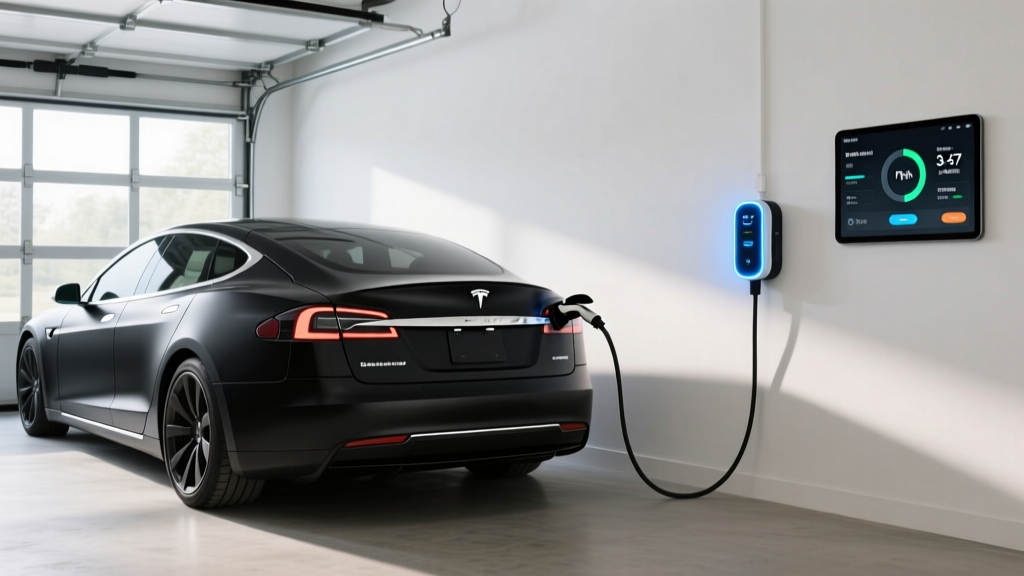
Tesla Wall Connector
Power: Up to 11.5 kW (48A)
Connector: NACS (requires J1772 adapter for Prime)
Cable: 24 ft
Smart Features: Wi-Fi, OTA updates, power sharing (dual units on one circuit)
Price: ~$450 + $30 adapter
Verdict: Excellent build quality and price, but the NACS plug means an adapter for the Prime. Worth it if your next car will be a Tesla or NACS-equipped BEV.
Emporia Level 2 Charger
Power: Up to 11.5 kW (48A)
Connector: J1772
Cable: 24 ft
Smart Features: Energy monitoring, solar integration, load management
Price: ~$400
Verdict: Budget pick with surprisingly good smart features. Pairs well with the Emporia Vue energy monitor to track your whole panel's load.
Safety, Code, and Installation Best Practices
EV charging is a continuous high-draw load — it stresses circuits for hours at a time. Cutting corners here is a fire risk. Non-negotiable requirements:
- Dedicated circuit: Your EV charger must be on its own breaker, not shared with other appliances.
- GFCI protection: The 2023 NEC (and most 2026 local adoptions) requires GFCI protection for 240V EV charging outlets. Hardwired units may have GFCI built in; confirm with your electrician.
- NEMA 14-50 vs hardwire: A NEMA 14-50 outlet gives you portability (take the charger when you move), but hardwired installs avoid the GFCI breaker requirement in some jurisdictions and eliminate a failure point. Many electricians now recommend hardwire for dedicated EV circuits.
- Outdoor rating: If your charger is mounted outside or in an unenclosed carport, ensure it carries a NEMA 4 or IP65 weather rating. All three picks above are outdoor-rated.
- Permit and inspection: Most jurisdictions require an electrical permit for a new 240V circuit. Skipping this can void your homeowner's insurance in the event of an electrical fire. Budget $50-$300 and 1-2 weeks for inspection.
Frequently Asked Questions
How much does it cost to install a home EV charger for the RAV4 Prime?
Expect $900-$2,550 for a standard installation (equipment, electrician labor, permit) if your home already has a 200-amp panel. Older homes needing a panel upgrade should budget $2,400-$6,050 total. The IRS §30C credit may cover up to 30% (max $1,000) if you're in an eligible census tract.
How fast will each charging level add range to the RAV4 Prime?
Level 1 (120V) adds roughly 4-5 miles of electric range per hour. Level 2 (240V, 32A) adds about 25-28 miles per hour — enough to fully replenish the Prime's 42-mile battery in about 2.5 hours. The Prime does not support DC fast charging.
Which connector is compatible with the RAV4 Prime?
The RAV4 Prime uses the J1772 connector for all AC charging. Any J1772 Level 2 charger works natively. If you install a Tesla Wall Connector (NACS plug), you'll need a J1772 adapter. The Prime has no DC fast-charge inlet, so CCS1 and CHAdeMO connectors are irrelevant for this vehicle.
How much does charging the RAV4 Prime cost per mile versus gas?
At the national average residential electricity rate of $0.16/kWh, the Prime costs about $0.057 per mile in EV mode. The standard RAV4 Hybrid at 41 MPG and $3.40/gallon costs $0.083 per mile. Charging at home off-peak widens that gap further. The Prime only saves money if you actually plug in daily — driven solely as a hybrid, it's slightly less efficient than the standard RAV4 Hybrid due to its heavier battery pack.
What electrical upgrades might I need for a Level 2 charger?
Homes with a 200-amp panel and available breaker slots typically need no upgrades — just a new 40A or 50A dedicated circuit. Homes with a 100-amp panel, a panel already near capacity, or no physical space for a new breaker may need a panel upgrade ($1,500-$3,500) or a sub-panel installation. A load calculation by a licensed electrician is the only way to know for certain.