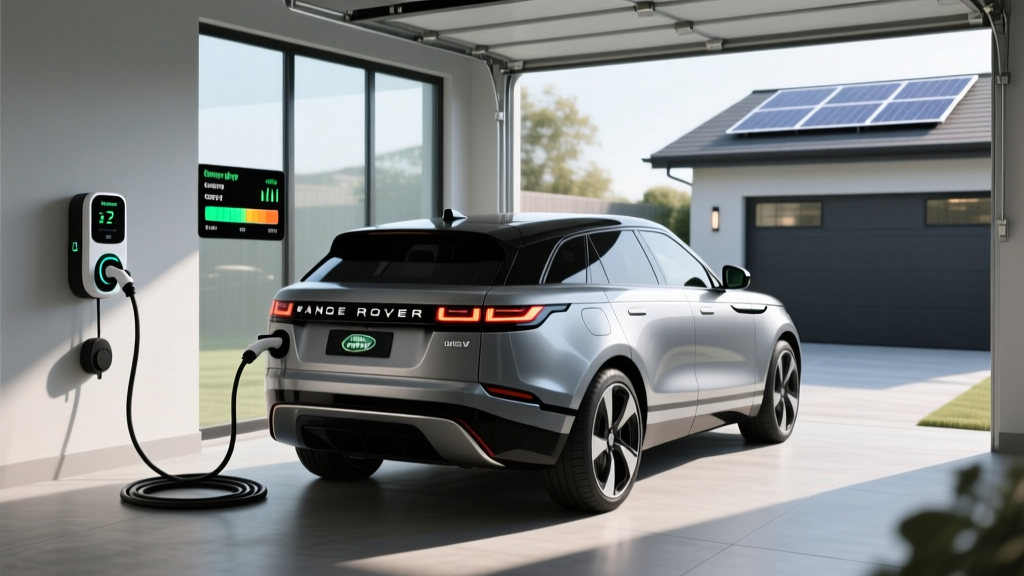
The Range Rover Velar is entering its electric era. As Land Rover transitions the Velar nameplate to a battery-electric platform built on the modular EMA (Electric Modular Architecture), prospective buyers and reservation holders face the same practical question every new EV adopter asks: how exactly will I charge this thing, and what will it cost?
This guide covers the full charging picture for the Range Rover Velar EV — from Level 1 trickle charging on a standard household outlet to DC fast-charging on road trips, plus a realistic breakdown of home Level 2 installation costs, electrical panel considerations, and the equipment we recommend for a luxury SUV in this price class.
kW (kilowatts) = power, or how fast energy flows into your battery — like water pressure from a hose.
kWh (kilowatt-hours) = energy, or how much your battery holds — like the size of the tank.
A 100 kWh battery charged at 10 kW takes roughly 10 hours. The same battery at 150 kW (DC fast) can reach 80% in under 30 minutes. Never confuse the two.
Understanding Charging Levels: What Speeds to Expect
Every EV owner interacts with three tiers of charging. Here's how each applies to a large-battery luxury SUV like the Velar EV, which Land Rover has indicated will carry a battery pack in the 100–117 kWh range (usable capacity; final specs pending EMA platform confirmation for the Velar-specific application).
| Level | Voltage / Amperage | Power (kW) | Miles of Range Added per Hour | 10–80% Time (~100 kWh pack) |
|---|---|---|---|---|
| Level 1 Standard 120V outlet |
120V / 12A | ~1.4 kW | 3–5 mi/hr | ~50+ hours (impractical) |
| Level 2 Home / workplace 240V |
240V / 32–48A | 7.7–11.5 kW | 22–38 mi/hr | ~8–11 hours (overnight) |
| DC Fast Charging Public stations |
400–800V DC | 50–350 kW (peak) | 150–400+ mi/hr (at peak) | ~20–35 minutes |
Real-world context for Velar EV owners: Level 1 is essentially an emergency trickle — useful only if you're parked for days and need a small top-up. Level 2 at home is where 90%+ of your charging will happen. DC fast charging is for road trips; you won't use it daily because frequent high-power DC sessions can accelerate battery degradation over the long term.
On the EMA platform's expected 800V architecture, the Velar EV should support peak DC fast-charge rates potentially up to 200–250 kW, meaning a 10–80% session could complete in approximately 20–28 minutes at a compatible 350 kW station. However, remember that peak kW is not sustained kW — charging curves taper significantly above 80% State of Charge to protect battery health. Expect the average rate across a 10–80% session to be roughly 60–70% of the advertised peak.
Home Level 2 Installation: Electrical Requirements and Real Costs
A Level 2 home charger is the single most impactful upgrade for daily EV ownership. For a vehicle with a ~100 kWh battery, you want a charger capable of delivering at least 11.5 kW (48A on a 60A circuit) to fully replenish overnight.
Electrical Specifications
- Circuit requirement: Dedicated 60A breaker (for 48A continuous charging) or 50A breaker (for 40A continuous)
- Voltage: 240V single-phase (standard US residential split-phase)
- Wire gauge: 6 AWG copper (for 60A) or 8 AWG (for 50A), run in conduit where required
- Outlet vs. hardwired: NEMA 14-50 outlet offers portability; hardwired is preferred for 48A+ chargers and avoids GFCI breaker nuisance trips that some jurisdictions require on receptacles
Panel Capacity: The Hidden Cost
Most modern homes have a 200A main electrical panel. Adding a 60A EV circuit consumes a significant portion of available capacity. Your electrician will perform a load calculation per NEC Article 220 to determine if your panel can handle the additional draw alongside existing loads (HVAC, electric oven, dryer, etc.).
If your home has a 100A panel — common in houses built before the 1990s — a panel upgrade to 200A is almost certainly required. This is the single largest variable in installation cost.
| Component | Simple Install (Panel has capacity, short run) |
Complex Install (Long wire run, conduit) |
Panel Upgrade Required (100A → 200A) |
|---|---|---|---|
| EV charger (Level 2, 40–48A) | $400–$750 | $400–$750 | $400–$750 |
| Electrician labor + materials | $600–$1,200 | $1,500–$3,000 | $1,500–$3,000 |
| Permit & inspection | $100–$300 | $150–$400 | $200–$500 |
| Panel upgrade (if needed) | — | — | $2,000–$4,500 |
| Total Range | $1,100–$2,250 | $2,050–$4,150 | $4,100–$8,750 |
Federal incentive note: The §30D alternative fuel vehicle refueling property credit (IRS Form 8911) offers up to $1,000 for home EV charger installation, covering 30% of equipment and labor costs. This credit has income limits and must be installed at your primary residence in a qualifying census tract. Consult a tax professional or the IRS directly for current eligibility.
Connector Compatibility: NACS, CCS, and the Adapter Question
The North American charging connector landscape has shifted dramatically. Tesla's NACS (North American Charging Standard, now SAE J3400) has been adopted by nearly every major automaker for new vehicles sold from 2025 onward. Land Rover, as part of JLR, has signaled alignment with NACS for its EMA-platform vehicles in the North American market.
| Connector | Description | Networks Supported | Velar EV Status |
|---|---|---|---|
| NACS (J3400) | Compact, no locking pins; AC + DC on single connector | Tesla Supercharger, Electrify America (new stalls), EVgo, many new networks | Expected native port on NA-spec Velar EV |
| CCS1 | Combined Charging System; J1772 + DC pins below | Electrify America, EVgo, ChargePoint (legacy stalls) | Adapter may be needed for legacy CCS stations |
| CHAdeMO | Legacy DC standard; round connector | Declining; some older Electrify America and independent stations | Not supported; no adapter available |
| J1772 (AC only) | Standard Level 1/2 AC connector | All public Level 2 stations, home chargers (non-NACS) | NACS port accepts J1772 via included adapter, or native on some chargers |
Adapter reality check: If the Velar EV ships with a native NACS port, you'll gain access to Tesla's Supercharger network (over 25,000 stalls in North America) without an adapter. For older CCS-only public chargers, JLR will likely include or sell a CCS-to-NACS adapter (typically $200–$300). Always confirm adapter compatibility with your specific model year before purchasing third-party adapters, as high-power DC charging places extreme demands on adapter connections.
Charging Cost: Per-Mile Economics vs. Gasoline
One of the strongest ownership arguments for the Velar EV over its gasoline predecessor is fuel cost savings — but the math depends heavily on where and when you charge.
| Scenario | Rate / Price | Cost per Mile | Annual Cost (12,000 mi) |
|---|---|---|---|
| Home charging (off-peak) | $0.12/kWh | $0.036 | $432 |
| Home charging (standard rate) | $0.18/kWh | $0.054 | $648 |
| Public Level 2 (workplace/mall) | $0.25/kWh | $0.075 | $900 |
| DC fast charging (road trips) | $0.45/kWh | $0.135 | $1,620 (if used exclusively) |
| Gasoline Velar (25 MPG combined, premium) | $4.20/gallon | $0.168 | $2,016 |
Assumptions: EV efficiency estimated at ~3.0 mi/kWh (approximately 112 MPGe) based on EMA platform targets and comparable luxury EV SUVs. Gasoline Velar comparison uses the prior-generation 2.0L P250 powertrain EPA combined rating. Actual efficiency varies with driving style, temperature, and terrain. Check fueleconomy.gov for finalized EPA ratings once published.
The takeaway: home charging at off-peak rates delivers a 78% cost reduction per mile compared to premium gasoline. Even exclusive DC fast charging — the most expensive EV scenario — still undercuts gas by roughly 20%. Most owners who charge at home 80%+ of the time and use DC fast only for road trips will see annual "fuel" costs around $500–$700, versus $2,000+ for gas.
Recommended Level 2 Home Chargers for the Velar EV
For a vehicle in the Velar EV's expected price range ($70,000–$95,000+), you want equipment that matches the ownership experience: reliable, smart-enabled, aesthetically appropriate for a premium garage, and capable of maximizing overnight charge speed.
ChargePoint Home Flex
- Power: Up to 11.5 kW (48A) on 60A circuit; configurable down to 16A
- Connector: NACS (J3400) native; J1772 version also available
- Cable length: 23 feet
- Smart features: Wi-Fi, app scheduling, Alexa/Google Home integration, energy reports, automatic software updates
- Price: ~$650 (NACS version)
- Best for: Owners who want flexible amperage settings and robust app control
Tesla Wall Connector (J3400)
- Power: Up to 11.5 kW (48A) on 60A circuit
- Connector: NACS native
- Cable length: 24 feet
- Smart features: Wi-Fi, over-the-air updates, Power-Share (load balancing between two units), Tesla app integration
- Price: ~$475
- Best for: Best value at full 48A; works with any NACS-equipped EV, not just Teslas
Emporia Vue EV Charger
- Power: Up to 11.5 kW (48A) on 60A circuit
- Connector: J1772 (NACS adapter available separately)
- Cable length: 24 feet
- Smart features: Real-time energy monitoring (pairs with Emporia Vue home energy monitor), solar integration, scheduled charging, load management
- Price: ~$400 (charger only)
- Best for: Solar-panel owners who want to charge exclusively from excess solar production
Our pick for Velar EV owners: The Tesla Wall Connector at $475 offers the best combination of price, cable length, and full 48A output. If the Velar EV ships with a native NACS port, it's plug-and-play with no adapter. The ChargePoint Home Flex is a close second if you value third-party app ecosystems and granular energy reporting.
Safety, Code Compliance, and Installation Best Practices
EV charging involves sustained high-current draw over many hours — far more demanding than typical household appliances. Cutting corners here risks fire, equipment damage, and voided insurance claims.
- Dedicated circuit: Your Level 2 charger must be on its own dedicated breaker. Never share the circuit with other major appliances.
- GFCI protection: NEC 2020/2023 requires GFCI protection for receptacle-based EV charging installations in garages. Hardwired chargers may be exempt in some jurisdictions — ask your electrician. Note: some GFCI breakers are prone to nuisance tripping with certain EVs; hardwiring eliminates this issue entirely.
- Outdoor rating: If your charger is installed outdoors (carport, driveway), ensure the unit carries a NEMA 4 or IP55+ rating. All three chargers recommended above are outdoor-rated.
- Permit and inspection: Most jurisdictions require an electrical permit for new 240V circuits. The inspection ensures wire gauge, breaker sizing, and grounding meet code. Do not skip this — unpermitted work can invalidate homeowner's insurance claims.
- Load management: If your panel is near capacity but you want to avoid a full upgrade, consider a smart load-management system (e.g., Emporia Smart Load Center or ChargePoint Load Sharing) that dynamically reduces charger draw when other appliances activate.
Homes built before 1990 with 100A service will almost certainly need a panel upgrade for 48A Level 2 charging alongside existing electric appliances. Budget $2,000–$4,500 for this work and factor in 1–3 additional days of electrician time. Some utilities offer rebates for panel upgrades tied to EV adoption — check with your local provider.
Public Charging and Road Trip Planning
With its expected NACS port, the Velar EV should enjoy the broadest public charging access of any new luxury EV: Tesla Superchargers (now open to non-Tesla NACS vehicles), Electrify America's expanding 350 kW network, and EVgo's metro-area fast chargers.
For road trip planning, expect the following at DC fast chargers:
- At a 350 kW station (with compatible vehicle architecture): 10–80% in approximately 20–25 minutes, adding roughly 200+ miles of range
- At a 150 kW station: 10–80% in approximately 35–45 minutes
- At a 50 kW legacy station: 10–80% in approximately 90+ minutes — avoid these for road trips
Preconditioning matters: If the Velar EV supports battery preconditioning (navigating to a charger in the vehicle's infotainment typically triggers this), the battery management system will warm or cool the pack to optimal temperature before arrival, enabling faster charge acceptance. In cold weather (below 40°F), a non-preconditioned battery may accept charge at only 50–60% of its peak rate until the pack warms up.
For real-time station availability and trip planning, apps like A Better Routeplanner (ABRP) and PlugShare remain essential tools. We recommend testing your first DC fast-charge session on a short trip before committing to a long road trip — familiarize yourself with the payment process, connector handling, and your vehicle's charge curve behavior.
Frequently Asked Questions
How much does it cost to install a home EV charger for the Range Rover Velar EV?
Expect $1,100–$2,250 for a straightforward installation where your electrical panel has sufficient capacity and the charger is near the panel. If you need a long wire run, conduit, or a panel upgrade from 100A to 200A, costs can reach $4,100–$8,750. The federal alternative fuel refueling property credit can offset up to $1,000 of this cost. Always get 2–3 quotes from licensed electricians.
How fast will each charging level add range to the Velar EV?
Level 1 (120V standard outlet): approximately 3–5 miles of range per hour — adequate only for overnight trickle charging or emergencies. Level 2 (240V home charger, 48A): approximately 30–38 miles per hour, fully replenishing a ~100 kWh pack overnight in 8–11 hours. DC fast charging (150–250 kW peak): 150–400+ miles per hour at peak, but tapering above 80% SoC.
Which connector and charger are compatible with the Range Rover Velar EV?
The Velar EV is expected to use a native NACS (J3400) port in North America, granting access to Tesla Superchargers and the growing NACS-equipped public network. For legacy CCS1 public chargers, a CCS-to-NACS adapter (likely available from JLR) will be needed. CHAdeMO is not supported. For home Level 2 charging, any NACS-equipped charger (Tesla Wall Connector, ChargePoint Home Flex NACS) will work directly.
How much does charging the Velar EV cost per mile compared to gasoline?
At home off-peak rates ($0.12/kWh), expect approximately $0.036 per mile — a 78% savings over premium gasoline at $4.20/gallon in a comparably sized gas Velar ($0.168/mile). Even public DC fast charging at $0.45/kWh ($0.135/mile) undercuts gasoline. Most owners charging primarily at home will spend $500–$700 annually on electricity versus $2,000+ on gas.
What electrical upgrades might I need for a home Level 2 charger?
The most common upgrade is a panel capacity increase from 100A to 200A, required in older homes that lack headroom for a 60A dedicated EV circuit. Your electrician will perform a NEC Article 220 load calculation. Other potential upgrades include: replacing a Federal Pacific or Zinsco panel (known safety hazards, mandatory replacement), upgrading service entrance wiring, or adding a smart load-management device to avoid a full panel upgrade. Budget an extra $2,000–$4,500 if a panel upgrade is needed.
Can I charge the Velar EV at Tesla Superchargers?
Yes — assuming the Velar EV ships with a native NACS port as expected, it will be compatible with Tesla Superchargers that have been opened to non-Tesla vehicles (the majority of the network as of 2025–2026). You'll use the Tesla app or your vehicle's built-in navigation to initiate and pay for sessions. No adapter is required for NACS-to-NACS connections.
Sources: EPA Fuel Economy, IRS Alternative Fuel Refueling Credit, JLR/Land Rover official EMA platform announcements. Final Velar EV specifications, EPA range, and pricing are subject to confirmation upon the vehicle's official launch. Always verify current tax credit and incentive eligibility with the IRS and a qualified tax professional.