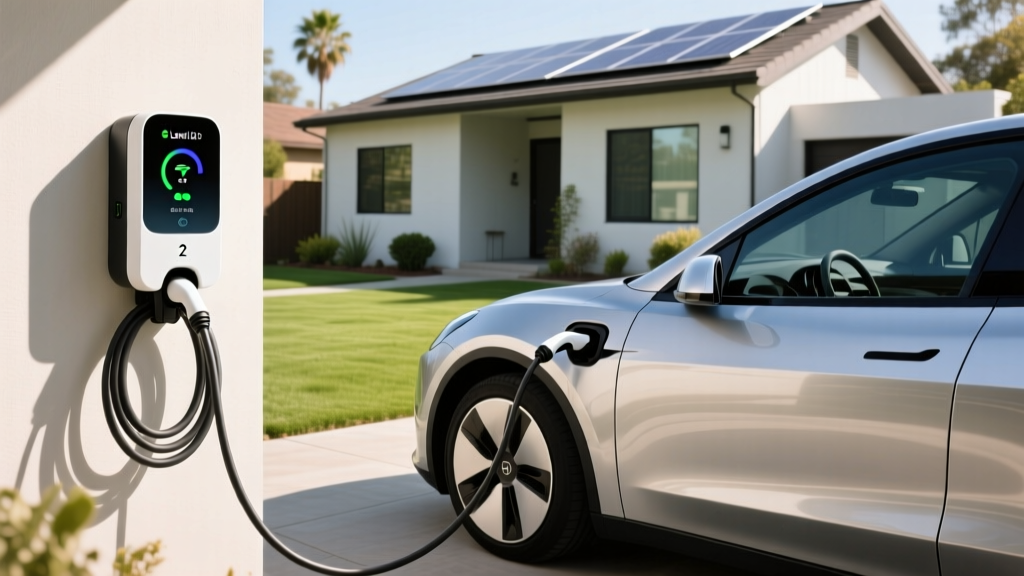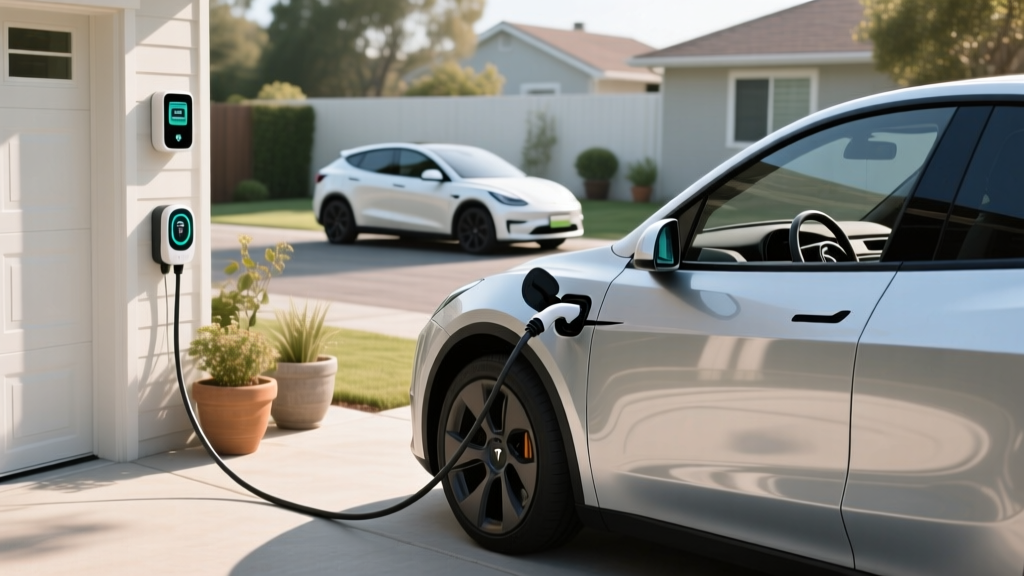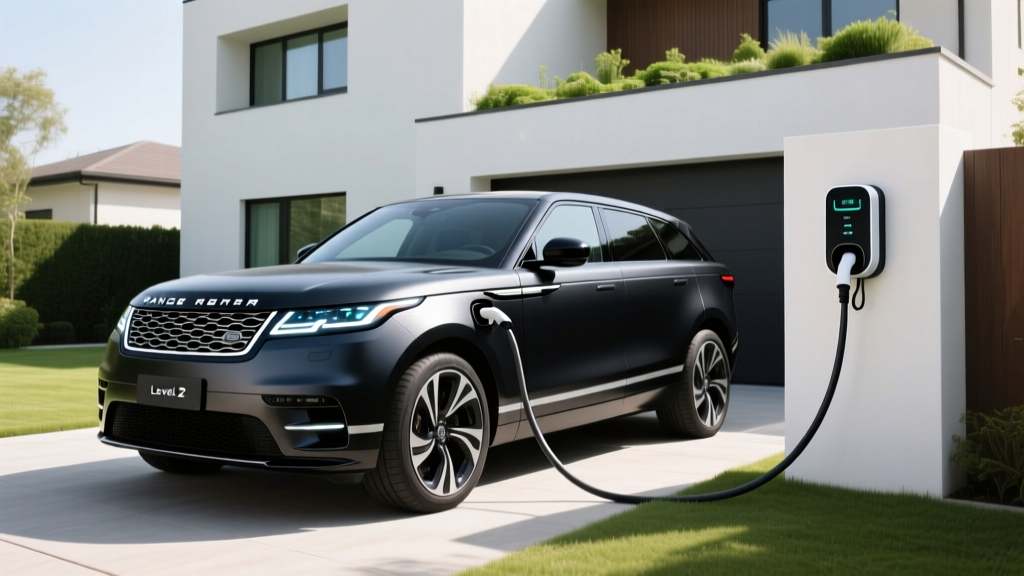
The 2026 Range Rover Velar Electric marks Jaguar Land Rover's entry into the luxury midsize electric SUV segment, built on the flexible EMA (Electric Modular Architecture) platform. With an estimated 100+ kWh usable battery pack and 800-volt electrical architecture, the Velar Electric promises competitive range and fast DC charging. But owning a luxury EV means planning your charging infrastructure carefully — especially when home installation costs, connector compatibility, and electrical panel capacity all factor into total ownership cost.
This guide covers everything you need to charge a Range Rover Velar Electric at home and on the road, with exact numbers for installation, charging speed, and per-mile costs.
Velar Electric Charging Levels Explained: How Fast Does Each Add Range?
Before comparing equipment, it's essential to distinguish kW (kilowatts — the rate of power flow, like water pressure in a hose) from kWh (kilowatt-hours — total energy stored, like gallons in a tank). The Velar Electric's battery capacity is measured in kWh; charging speed is measured in kW. Here's how each level performs with a ~105 kWh usable battery:
| Level | Power (kW) | Voltage / Amperage | Miles of Range Added per Hour | Full Charge Time (0–100%) |
|---|---|---|---|---|
| Level 1 (Standard outlet) | ~1.4 kW | 120V / 12A | ~4–5 mi/hr | ~72+ hours |
| Level 2 (Home / public AC) | 7.7–19.2 kW | 240V / 32–80A | ~25–60 mi/hr | ~6–14 hours |
| DC Fast Charging | Up to ~250 kW (peak) | 800V architecture | ~600+ mi/hr (peak) | 10–80% in ~20–25 min |
Home Charger Installation: Electrical Requirements and Costs
Most Velar Electric owners will want a dedicated Level 2 home charger for overnight charging. Here's what the electrical setup requires:
Electrical Specifications
- Circuit: Dedicated 240V circuit, typically 40A or 60A breaker
- Continuous draw: EV chargers run at 80% of breaker rating (a 60A breaker delivers up to 48A continuous / ~11.5 kW)
- Wire gauge: 6 AWG copper for 60A circuits; 8 AWG for 40A circuits
- Hardwired vs. plug: Hardwired units are preferred for outdoor installs and higher amperages; NEMA 14-50 outlets work for 40A or lower with GFCI protection
- Permit: Most jurisdictions require an electrical permit and inspection — typically $50–$200
Panel Upgrade Considerations
This is where costs can spike. If your home has a 100A or older electrical panel, adding a 60A EV circuit may exceed your panel's capacity — especially if you're running central AC, an electric range, and a dryer simultaneously. A panel upgrade to 200A costs $1,500–$3,500 and may be required. Even homes with 200A panels may need a load calculation performed by a licensed electrician to confirm available headroom.
Some homeowners opt for a smart panel load-management device (like the Emporia VUE or SPAN panel) to avoid a full upgrade — these throttle the charger when household demand is high.
| Component | Typical Cost Range | Notes |
|---|---|---|
| Level 2 Charger (hardware) | $400–$1,200 | Varies by brand, amperage, smart features |
| Electrician labor (standard install) | $500–$2,000 | Depends on run length from panel, wall type |
| Electrical permit & inspection | $50–$200 | Required in most jurisdictions |
| Panel upgrade (if needed) | $1,500–$3,500 | Not always required; load calculation first |
| Conduit, wire, mounting hardware | $100–$500 | Longer runs from panel = higher cost |
| Total (no panel upgrade) | $1,050–$3,900 | Most typical range for newer homes |
| Total (with panel upgrade) | $2,550–$7,400 | Older homes with 100A service |
Some utilities offer rebates of $200–$500 for home charger installation — check your local provider. Additionally, certain states offer EV infrastructure tax credits, though these vary widely by jurisdiction.
Connector Compatibility: NACS, CCS, and the Velar Electric
The North American EV charging connector landscape has consolidated rapidly around the NACS (North American Charging Standard), originally developed by Tesla. For the 2026 model year, Land Rover is expected to equip the Velar Electric with a NACS charge port, aligning with most major automakers who have adopted the standard.
| Connector Type | Use Case | Velar Electric Compatibility |
|---|---|---|
| NACS (J3400) | AC Level 2 + DC Fast Charging | Native port (expected 2026) |
| CCS1 | DC Fast Charging (legacy networks) | Adapter required (available from Land Rover or third-party) |
| CHAdeMO | DC Fast Charging (Nissan/Mitsubishi legacy) | Not recommended; adapters rare and expensive |
| J1772 | AC Level 1 & Level 2 (public AC stations) | Adapter included with NACS-equipped vehicles |
Practical implication: With a native NACS port, the Velar Electric gains direct access to Tesla Supercharger stations — the most reliable and extensive DC fast-charging network in the US. For Electrify America or other CCS-only stations, you'll need a CCS1-to-NACS adapter. Most new NACS-equipped vehicles ship with a J1772 adapter for public Level 2 charging.
Level 2 Home Charger Recommendations for the Velar Electric
For a luxury EV with a large battery pack, you want a charger that delivers maximum practical Level 2 speed, robust build quality, and smart features. Here are our top picks:
Best Overall: ChargePoint Home Flex
- Power: Up to 12 kW (50A) on 240V
- Connector: NACS (J3400) native, J1772 adapter included
- Cable: 23-foot premium cable
- Smart features: Wi-Fi, app scheduling, utility demand-response integration, Alexa
- Price: ~$549
Best for Fast Home Charging: Wallbox Pulsar Max
- Power: Up to 11.5 kW (48A) on 240V
- Connector: NACS native
- Cable: 25-foot cable
- Smart features: Wi-Fi + Bluetooth, load balancing, solar integration, Power Sharing for dual chargers
- Price: ~$649
Best Value: Emporia Level 2 EV Charger
- Power: Up to 11.5 kW (48A) on 240V
- Connector: J1772 (NACS adapter available)
- Cable: 24-foot cable
- Smart features: Wi-Fi, energy monitoring via Emporia app, solar-aware scheduling
- Price: ~$399
For the Velar Electric's ~105 kWh battery, a 48A/11.5 kW charger will add roughly 30–35 miles of range per hour, fully recharging overnight in about 9–10 hours from empty. A 50A/12 kW unit like the ChargePoint Home Flex shaves about 30 minutes off that time.
Cost to Charge: Home vs. Public vs. Gas Comparison
One of the strongest ownership arguments for the Velar Electric is reduced fuel cost. Here's how charging costs compare to gasoline for a similarly sized luxury SUV averaging 20 MPG combined:
| Scenario | Rate | Cost per Mile (Velar Electric at ~3.0 mi/kWh) | Cost per Mile (Gas SUV at 20 MPG) |
|---|---|---|---|
| Home charging (off-peak utility rate) | $0.12/kWh | $0.04/mi | $0.19/mi (at $3.80/gal) |
| Home charging (average US rate) | $0.17/kWh | $0.06/mi | $0.19/mi |
| Public Level 2 (network pricing) | $0.30/kWh | $0.10/mi | $0.19/mi |
| DC Fast Charging ( Electrify America / Tesla) | $0.48/kWh | $0.16/mi | $0.19/mi |
Annual savings estimate: At 12,000 miles per year and primarily home charging at $0.17/kWh, the Velar Electric costs roughly $720/year in electricity vs. $2,280/year in gasoline — a $1,560 annual fuel savings. Even frequent DC fast charging at $0.48/kWh yields only $1,920/year, still below gasoline.
Note: Electricity rates vary significantly by state. California averages ~$0.30/kWh residential; Washington State averages ~$0.11/kWh. Check your utility's EV-specific time-of-use (TOU) rate plans for the lowest off-peak pricing.
Safety, Code, and Installation Best Practices
EV chargers draw sustained high current — often for 8+ hours continuously. This is fundamentally different from typical household loads and requires code-compliant installation:
- Dedicated circuit: NEC Article 625 requires EV chargers to be on a dedicated circuit — it cannot share with other outlets or appliances
- GFCI protection: If using a NEMA 14-50 receptacle (rather than hardwired), NEC 2020+ requires GFCI breaker protection for outdoor installations. Hardwired units avoid this requirement and are generally preferred
- Outdoor rating: If your charger is mounted outside or in an open carport, ensure it carries a NEMA 4 (weatherproof) rating. All recommended units above are outdoor-rated
- Surge protection: Consider a whole-home surge protector or a charger with built-in surge suppression — a lightning strike or grid surge can damage expensive EVSE electronics
- Professional installation only: Do not attempt DIY installation of a 240V/40A+ circuit. Hire a licensed electrician familiar with NEC Article 625 (EV charging systems). The National Electrical Code governs all requirements
Frequently Asked Questions
How much does it cost to install a home EV charger for the Range Rover Velar Electric?
Expect $1,050–$3,900 total for a typical installation (equipment, electrician, permit) in a home with adequate 200A panel capacity. If a panel upgrade is required, costs can reach $2,550–$7,400. A 48A Level 2 charger on a 60A circuit is the sweet spot for the Velar Electric's large battery.
How fast will each charging level add range to the Velar Electric?
Level 1 (120V) adds roughly 4–5 miles per hour — impractical for a 105 kWh battery. Level 2 (240V, 48A) adds approximately 30–35 miles per hour, sufficient for overnight charging. DC fast charging at peak ~250 kW can add 150+ miles in roughly 10 minutes, with a 10–80% charge taking about 20–25 minutes.
Which connector is compatible with the Range Rover Velar Electric?
The 2026 Velar Electric is expected to use a native NACS (J3400) port, providing direct access to Tesla Superchargers and other NACS-equipped networks. For CCS-only stations, an adapter will be available. A J1772 adapter (typically included) is needed for legacy public Level 2 chargers.
How much does charging cost per mile compared to gasoline?
At the US average residential electricity rate of ~$0.17/kWh, home charging costs roughly $0.06 per mile. A comparable gas SUV at 20 MPG with fuel at $3.80/gallon costs $0.19 per mile. Home charging saves approximately $1,500+ annually at 12,000 miles/year.
What electrical upgrades might I need for a home charger?
If your home has a 100A electrical panel, you'll likely need a 200A panel upgrade ($1,500–$3,500) to accommodate a dedicated 40A–60A EV charging circuit alongside existing loads. Homes with 200A panels usually have sufficient capacity, but a licensed electrician should perform a load calculation. Smart load-management devices can sometimes avoid a panel upgrade.
Can I use a Tesla Supercharger with the Range Rover Velar Electric?
Yes — with a native NACS port, the Velar Electric can charge at Tesla Supercharger V3 (250 kW) and V4 stations without an adapter. Check the Tesla app or Tesla Supercharger map for stations open to non-Tesla vehicles.
Does the Velar Electric qualify for the federal EV tax credit?
Federal §30D tax credit eligibility depends on MSRP caps ($80,000 for SUVs), buyer income limits ($300,000 joint / $150,000 individual AGI), and battery critical-mineral and component sourcing requirements. The Velar Electric's starting MSRP and JLR's battery supply chain will determine eligibility. Check the latest rules at IRS.gov before purchasing. The credit can be transferred to the dealer at point of sale if eligible.
The 2026 Range Rover Velar Electric specs referenced in this guide are based on Land Rover's preliminary EMA platform announcements and industry estimates. Final EPA range, battery capacity, charging speeds, and pricing will be confirmed closer to the on-sale date. Always verify current specifications with your local Land Rover retailer.