The 2015 Land Rover Range Rover Sport Supercharged remains a benchmark luxury SUV — a 5.0L supercharged V8 pushing 510 horsepower, 0-60 mph in 5.0 seconds, and an EPA-rated 14 MPG city / 19 MPG highway. But with fuel prices fluctuating and EV infrastructure maturing, owners and prospective buyers are running the math: what does it actually cost to keep this V8 alive versus switching to a modern electric SUV? This guide breaks down the real fueling economics of the 2015 Range Rover Sport Supercharged, then provides a complete EV charging primer for anyone considering the jump — from home Level 2 installation costs to public DC fast charging, connector compatibility, and equipment picks for 2026.
The 2015 Range Rover Sport Supercharged: Fuel Cost Baseline
Before comparing to EVs, let's lock in what the 2015 Range Rover Sport Supercharged actually costs to fuel. The 5.0L AJ-V8 supercharged engine requires premium unleaded (91 octane or higher) and delivers an EPA combined 16 MPG. The 27.7-gallon fuel tank gives a theoretical range of roughly 443 miles, though real-world mixed driving — especially with the Sport's 5,000+ lb curb weight and aggressive throttle mapping — often lands closer to 350-380 miles between fill-ups.
| Spec | Value |
|---|---|
| Engine | 5.0L Supercharged V8 |
| Horsepower | 510 hp @ 6,000 rpm |
| 0-60 mph | 5.0 seconds |
| EPA MPG (City / Hwy / Combined) | 14 / 19 / 16 |
| Fuel Tank | 27.7 gal |
| Fuel Requirement | Premium (91+ octane) |
| Real-World Range | ~350-380 mi |
| Cost Per Mile (at $4.20/gal premium) | ~$0.26/mi |
At a national average of roughly $4.20/gallon for premium in early 2026, that works out to approximately $0.26 per mile in fuel alone. Drive 12,000 miles annually, and you're spending around $3,120/year on gas. Over five years: $15,600. That's the number EVs need to beat — and as we'll see, they do, by a wide margin.
EV Charging Levels Explained: Speed, Power, and Range Added
EV charging operates across three tiers. Understanding the difference between kW (kilowatts — the rate of power delivery) and kWh (kilowatt-hours — the energy stored in the battery) is essential. Think of kW as how fast water flows from a hose, and kWh as the size of the bucket you're filling.
| Level | Voltage | Max Power (kW) | Miles of Range Added/Hour | Typical Use Case |
|---|---|---|---|---|
| Level 1 | 120V AC | 1.4-1.9 kW | 3-5 mi/hr | Overnight top-up, PHEVs |
| Level 2 | 240V AC | 7.2-19.2 kW | 20-60+ mi/hr | Home daily charging, workplace |
| DC Fast Charge | 400-800V DC | 50-350 kW | 150-1,000+ mi/hr (peak) | Road trips, highway corridors |
Level 1 uses a standard 120V household outlet. It's universally accessible but painfully slow — adding maybe 4 miles of range per hour. For a 100 kWh battery (like a Rivian R1S or large Tesla), a full charge from empty would take over 50 hours. Level 1 works fine for plug-in hybrids with small batteries (15-40 kWh) but is impractical as a primary charging method for any full-size BEV.
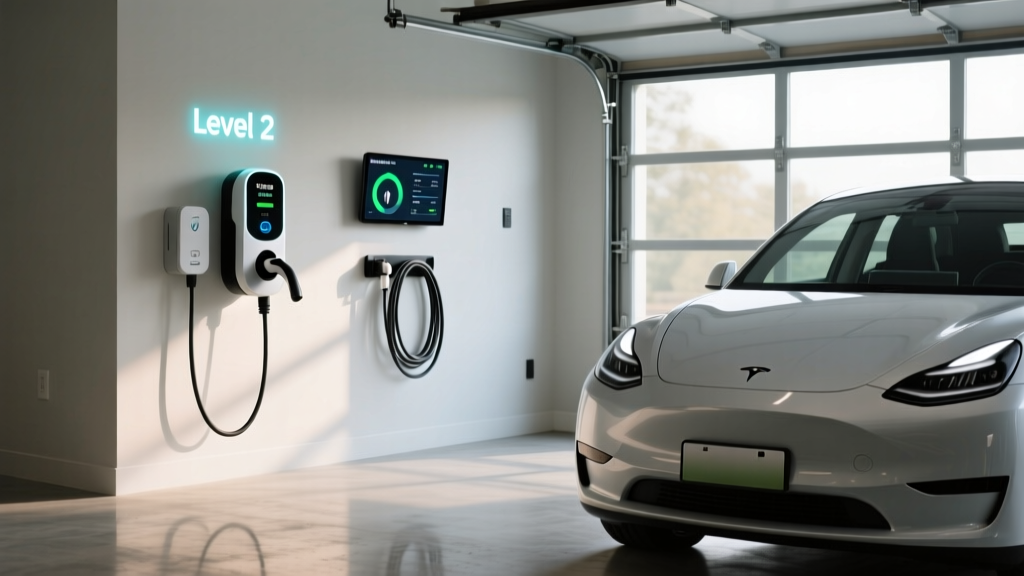
Level 2 is the home-charging standard. A 240V circuit — the same voltage your electric dryer uses — delivers between 7.2 kW and 19.2 kW depending on the circuit amperage and the vehicle's onboard charger capacity. Most EVs accept 11.5 kW (48A) on Level 2, adding roughly 35-45 miles of range per hour. An overnight session (8-10 hours) easily replenishes 250-400 miles, covering virtually any daily driving need.
DC Fast Charging bypasses the vehicle's onboard charger entirely, sending direct current straight to the battery at 50-350 kW. Peak speeds are impressive — a 350 kW-capable vehicle like the Hyundai Ioniq 5 or Porsche Taycan can add 10-80% in roughly 18 minutes. However, charging curves taper significantly above 80% State of Charge (SoC) to protect battery health, so the last 20% can take as long as the first 80%.
Home EV Charger Installation: Requirements, Costs, and Panel Upgrades
Installing a Level 2 home charger is the single most impactful upgrade an EV owner can make. Here's what's involved electrically and financially.
Electrical Requirements
A typical Level 2 charger requires a dedicated 240V circuit at 40A to 60A. The National Electrical Code (NEC) mandates that continuous loads (like EV charging, which runs for 3+ hours) cannot exceed 80% of the circuit's rated capacity. So a 50A breaker supports a maximum continuous draw of 40A (9.6 kW), while a 60A breaker supports 48A (11.5 kW).
Key installation considerations:
- Dedicated circuit: The charger must have its own breaker — no sharing with other appliances.
- Wire gauge: 6 AWG copper for 50A circuits; 4 AWG for 60A circuits (varies by run length and local code).
- GFCI protection: NEC 2020 and later require GFCI breakers for EV outlets in garages and all outdoor installations.
- NEMA 14-50 outlet vs. hardwired: A 14-50 receptacle offers portability (take the charger when you move), while hardwired units allow higher amperage (60A/48A continuous) and avoid the GFCI breaker requirement in some jurisdictions.
- Outdoor rating: If installing outside, the charger must carry a NEMA 4 or NEMA 4X rating for weather resistance.
Panel Upgrade: The Hidden Cost
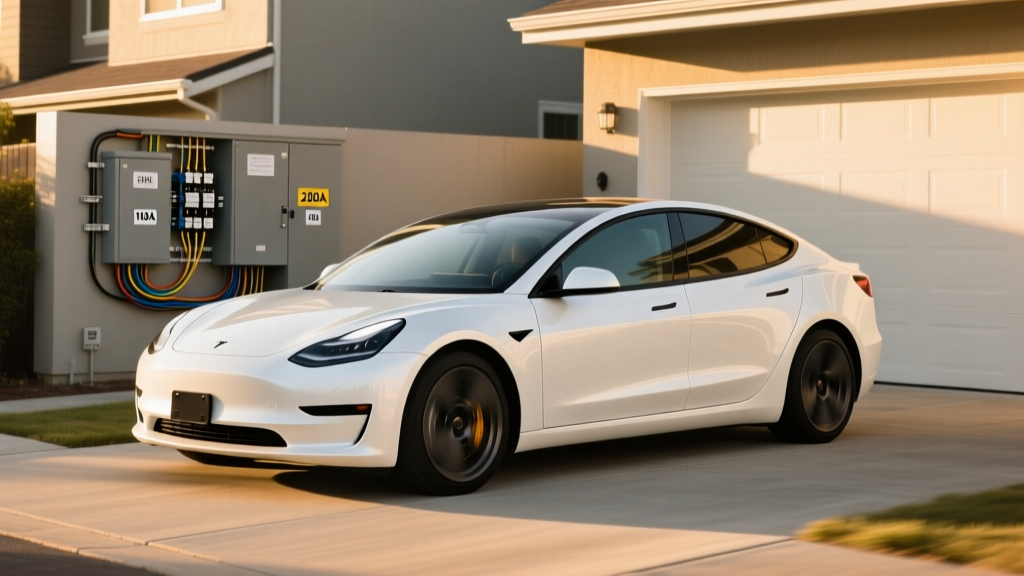
Many homes built before 2000 have 100A or 125A main electrical panels. Adding a 50-60A EV circuit may exceed the panel's remaining capacity, especially if you're already running electric heat, a dryer, an oven, and central A/C. A licensed electrician will perform a load calculation (NEC Article 220) to determine whether your panel can absorb the new circuit.
If an upgrade is needed, moving from a 100A to a 200A panel typically costs $1,500-$3,500 depending on your utility's requirements, local labor rates, and whether a new meter base or service drop is involved. Homes with modern 200A panels usually have sufficient headroom for a Level 2 charger without upgrades.
| Component | Cost Range |
|---|---|
| Level 2 Charger Equipment (smart, 40-48A) | $350 - $700 |
| Electrician Labor (2-6 hours) | $400 - $1,500 |
| Electrical Materials (wire, conduit, breaker) | $100 - $400 |
| Permit & Inspection | $50 - $250 |
| Panel Upgrade (if needed, 100A→200A) | $1,500 - $3,500 |
| Total (no panel upgrade) | $900 - $2,850 |
| Total (with panel upgrade) | $2,400 - $6,350 |
Some utilities offer rebates of $200-$500 for Level 2 installations, and certain states provide additional incentives. Check with your local utility and consult AFDC's state incentive database for current programs. The federal residential clean energy credit (IRC §25C) may also apply to certain energy-related home improvements, though EV charger eligibility varies by tax year — consult a tax professional.
Connector Compatibility: NACS, CCS1, CHAdeMO, and Adapters
The EV charging connector landscape has consolidated significantly since 2024, when Ford, GM, Rivian, Volvo, and most other automakers committed to adopting Tesla's North American Charging Standard (NACS). Here's where things stand in 2026:
| Connector | Brands Using It (2026) | DC Fast Charge Max | Notes |
|---|---|---|---|
| NACS (Tesla) | Tesla, Ford, GM, Rivian, Volvo, Polestar, Mercedes, Hyundai/Kia (new models) | Up to 350 kW | Now the dominant North American standard |
| CCS1 | Legacy models (pre-2025 VW ID.4, BMW iX, older Hyundai/Kia) | Up to 350 kW | Being phased out on new models; adapters available |
| CHAdeMO | Nissan Leaf (discontinued), Mitsubishi Outlander PHEV | Up to 100 kW | Essentially obsolete; infrastructure declining |
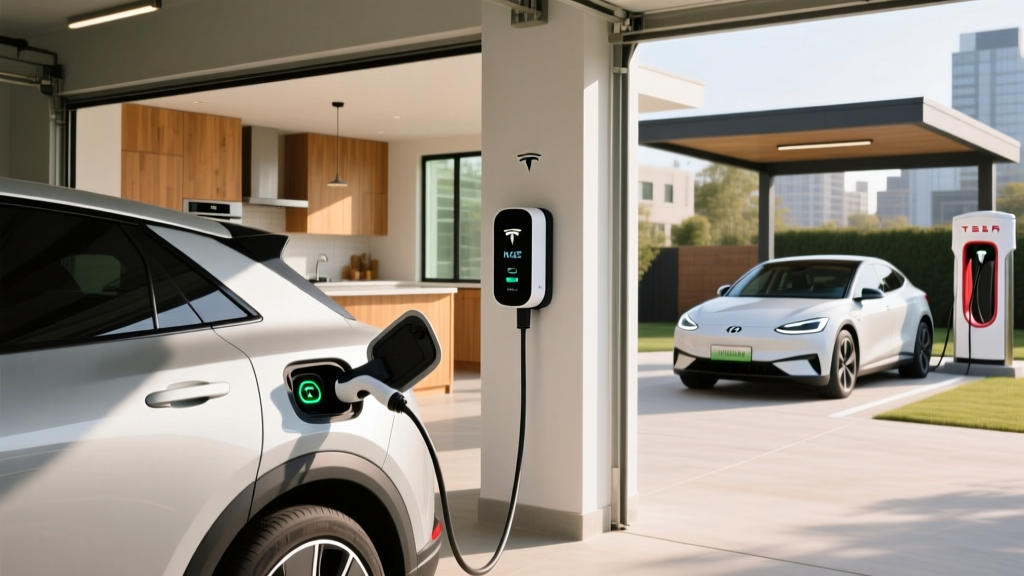
If you own or are considering a CCS1-equipped EV, NACS-to-CCS adapters (such as those from Lectron, A2Z, or Tesla's official CCS adapter for non-Tesla Supercharger access) are widely available for $150-$250. These unlock the Tesla Supercharger network — over 25,000 stalls in North America — for CCS vehicles. The reverse (CCS adapter for a NACS vehicle) is less commonly needed, as most public non-Tesla networks now include NACS cables or are retrofitting them.
For home Level 2 charging, all modern chargers ship with either a NACS or CCS1 plug. If your home charger's connector doesn't match your vehicle, a simple adapter solves the issue — Level 2 adapters are less expensive and carry no meaningful charging-speed penalty.
Charging Cost Per Mile: EV vs the Range Rover Sport's V8
This is where the comparison gets stark. Let's model charging costs for a representative large EV — say, a 2026 Rivian R1S (Dual-Motor, ~105 kWh usable battery, EPA 352 miles) — against the 2015 Range Rover Sport Supercharged.
| Scenario | Cost/kWh or gal | Efficiency | Cost/Mile | Annual Cost (12k mi) |
|---|---|---|---|---|
| Range Rover Sport SC (premium gas) | $4.20/gal | 16 MPG | $0.263 | $3,150 |
| EV — Home Level 2 (off-peak utility rate) | $0.12/kWh | 2.2 mi/kWh | $0.055 | $655 |
| EV — Home Level 2 (average utility rate) | $0.17/kWh | 2.2 mi/kWh | $0.077 | $927 |
| EV — Public Level 2 (network pricing) | $0.30/kWh | 2.2 mi/kWh | $0.136 | $1,636 |
| EV — DC Fast Charge ( Electrify America/EA) | $0.48/kWh | 2.2 mi/kWh | $0.218 | $2,618 |
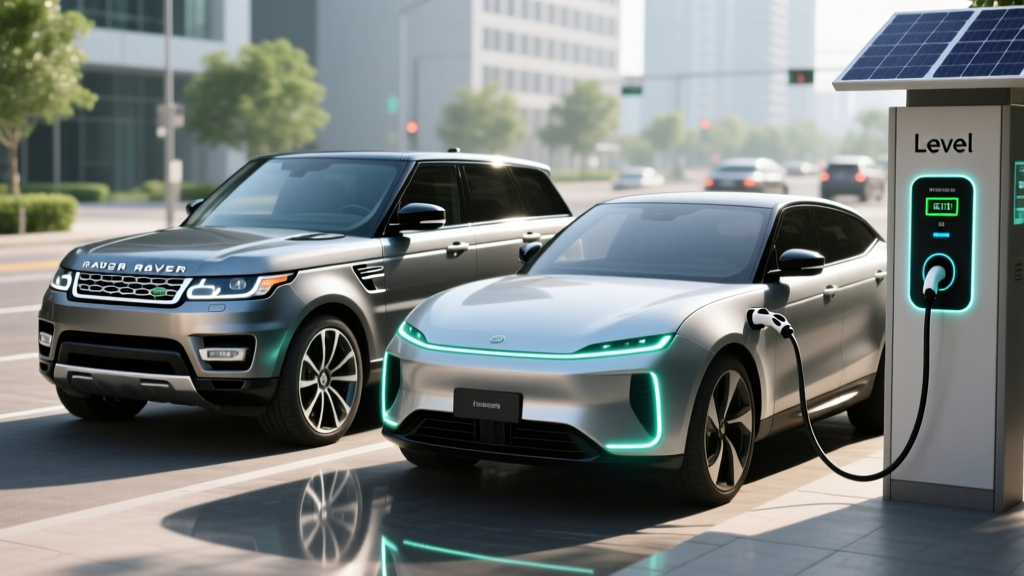
Even at the most expensive scenario — exclusive DC fast charging at $0.48/kWh — the EV costs less per mile than the Range Rover Sport Supercharged on premium gas. Most EV owners who charge at home (which is 80-90% of all charging, per DOE data) spend between $650-$950/year on electricity — roughly $2,200-$2,500 less than fueling the V8 Range Rover annually.
Over a five-year ownership period, home-charging an EV saves approximately $11,000-$12,500 in fuel costs alone compared to the 2015 Range Rover Sport Supercharged. Factor in the V8's higher maintenance burden (supercharger belt service, timing chain tensioner recalls, air suspension compressor failures, ZF 8HP transmission fluid changes) and the total cost gap widens further.
Charging Time Examples: What to Expect by Battery Size
Charging time depends on three variables: battery capacity (kWh), the charger's power output (kW), and the vehicle's charge acceptance curve. Here are realistic 10-80% charge times for common battery sizes:
- 40 kWh battery (Nissan Leaf-size): ~25 minutes at 50 kW DCFC; ~4 hours at 7.2 kW Level 2
- 75 kWh battery (Tesla Model Y RWD-size): ~22 minutes at 170 kW DCFC; ~7.5 hours at 7.2 kW Level 2; ~5 hours at 11.5 kW Level 2
- 100 kWh battery (Rivian R1S/Large SUV): ~28 minutes at 200 kW DCFC; ~10 hours at 7.2 kW Level 2; ~7 hours at 11.5 kW Level 2
- 115 kWh battery (GMC Hummer EV-class): ~35 minutes at 300 kW DCFC; ~12 hours at 7.2 kW Level 2
Real-world charging curve reality: Advertised peak charge rates (e.g., "250 kW max") are sustained only between roughly 10-40% SoC under optimal battery temperature conditions. Above 60% SoC, the rate typically drops to 50-100 kW, and above 80% it may fall below 25 kW. This is why 10-80% time is the standard metric — charging past 80% is inefficient on road trips unless you need the extra range to reach your destination or next charger.
Preconditioning matters: Vehicles with active thermal management (Tesla, Hyundai E-GMP, Rivian, GM Ultium) will warm or cool the battery to optimal temperature when you navigate to a DC fast charger. Without preconditioning — common in cold weather — a battery that should accept 250 kW might be limited to 50-80 kW until it warms up, adding 15-25 minutes to your charge stop.
Equipment Picks: Recommended Home Level 2 Chargers for 2026
Not all Level 2 chargers are equal. Here are four proven units across price points, each with clear specs:
ChargePoint Home Flex (NACS or CCS1)
- Power: Up to 11.5 kW (48A) on a 60A circuit; adjustable down to 16A
- Cable Length: 23 feet
- Smart Features: Wi-Fi, app scheduling, Alexa integration, energy tracking
- Connector: Available in NACS or CCS1
- Price: ~$550-$650
- Best For: Flexibility across circuit sizes; robust app ecosystem
Tesla Wall Connector (NACS)
- Power: Up to 11.5 kW (48A) on a 60A circuit
- Cable Length: 24 feet
- Smart Features: Wi-Fi, over-the-air updates, load sharing (pair two units on one circuit), power sharing with Powerwall
- Connector: NACS (CCS adapter included for non-Tesla vehicles)
- Price: ~$420-$475
- Best For: Tesla owners; best value in smart chargers
Emporia Vue Level 2 (NACS or CCS1)
- Power: Up to 11.5 kW (48A)
- Cable Length: 24 feet
- Smart Features: Integration with Emporia whole-home energy monitor, solar-aware charging, time-of-use scheduling
- Connector: NACS or CCS1
- Price: ~$400-$500
- Best For: Solar owners; budget-conscious smart charging
Grizzl-E Smart (NACS or CCS1)
- Power: Up to 10 kW (40A) on a 50A circuit
- Cable Length: 24 feet
- Smart Features: OCPP-compatible, works with multiple apps, adjustable amperage via dip switches
- Connector: NACS or CCS1
- Price: ~$450-$550
- Best For: Durability (NEMA 4 outdoor rated, -40°C rated); Canadian-made; no-frills reliability
For the 2015 Range Rover Sport Supercharged owner transitioning to an EV, the Tesla Wall Connector (if moving to a Tesla) or the ChargePoint Home Flex (for any NACS or CCS vehicle) are the strongest all-around picks. Both support 48A continuous on a 60A circuit, delivering roughly 35-45 miles of range per hour — enough to fully replenish a 100 kWh battery overnight.
Safety, Code, and Common Installation Mistakes
EV charging draws sustained high current for hours — a fundamentally different load profile than most household appliances. Cutting corners here creates fire risk. Non-negotiable safety requirements:
- Permit and inspection: Nearly all jurisdictions require an electrical permit for a new 240V circuit. The inspection verifies wire gauge, breaker sizing, grounding, and GFCI compliance. Unpermitted work can void homeowner's insurance claims.
- No extension cords: Never use an extension cord with an EV charger. If the cable doesn't reach, relocate the outlet or choose a charger with a longer cable.
- Dedicated circuit only: Sharing a 240V circuit between the EV charger and another appliance (dryer, welder) is a code violation and a fire hazard.
- GFCI protection: Required for all outdoor receptacles and for NEMA 14-50 outlets in garages per NEC 2020+. Hardwired chargers avoid this requirement in most jurisdictions.
- Proper torque: All terminal connections must be torqued to spec. Loose connections under sustained high-amperage load generate heat and are a leading cause of receptacle failures.
- Load calculation first: Always have the electrician perform an NEC Article 220 load calculation before energizing the circuit. This is the single most important step to prevent overloading your panel.
The most common installation mistakes we see: using undersized wire (8 AWG on a 50A breaker instead of 6 AWG), skipping the permit to save $100, and installing a NEMA 14-50 outlet upside-down (ground pin up — which is correct for EV use but confuses some inspectors unfamiliar with EV installations). Hire an electrician experienced with EV charger installs; ask for references from other EV owners in your area.
Frequently Asked Questions
How much does it cost to install a home EV charger?
A typical Level 2 home installation (equipment, electrician, permit) runs $900-$2,850 if your electrical panel has capacity. If a panel upgrade from 100A to 200A is needed, add $1,500-$3,500, bringing the total to $2,400-$6,350. Utility rebates and state incentives can offset $200-$500+ of this cost.
How fast will each charging level add range?
Level 1 (120V): 3-5 miles per hour. Level 2 (240V, 48A): 35-45 miles per hour for most EVs. DC Fast Charging (150-350 kW): 150-1,000+ miles per hour at peak, though sustained rates taper above 60% SoC. For practical purposes, Level 2 overnight charging handles daily needs, while DCFC covers road trips.
Which connector/charger is compatible with my EV?
In 2026, most new EVs use NACS (Tesla's connector, now the North American standard). Older CCS1 vehicles (pre-2025 VW, BMW, Hyundai/Kia) can use NACS-to-CCS adapters for Supercharger access. CHAdeMO is essentially obsolete outside legacy Nissan Leaf owners. Check your vehicle's charge port or the manufacturer's spec sheet to confirm.
How much does charging cost per mile vs gas?
Home charging at average utility rates ($0.12-$0.17/kWh) costs $0.05-$0.08 per mile — roughly 70-80% less than the 2015 Range Rover Sport Supercharged on premium gas at $0.26/mile. Even exclusive DC fast charging at $0.48/kWh costs around $0.22/mile, still below the V8 Range Rover. See the cost comparison table above for detailed scenarios.
What electrical upgrades might I need?
If your home has a 200A panel with available breaker spaces and passing load calculation, you likely need only the new circuit. Homes with 100A or 125A panels, or those running multiple high-draw electric appliances, may require a panel upgrade to 200A ($1,500-$3,500). Older homes with 60A service almost certainly need a full panel upgrade. A licensed electrician's load calculation is the definitive answer.
Is switching from a 2015 Range Rover Sport Supercharged to an EV worth it?
Financially, the fuel savings alone ($2,200-$2,500/year) are substantial, and EVs generally require less maintenance (no oil changes, fewer moving parts, regenerative braking extends pad life). However, the Range Rover Sport Supercharged offers something no current EV perfectly replicates: a supercharged V8 character, genuine off-road capability with Terrain Response, and a luxury presence that's specific to that era of Land Rover. If you're keeping the Range Rover as a weekend/collector vehicle and adding an EV for daily commuting, that's a compelling split. If you're replacing it outright, test-drive the 2026 Range Rover Sport PHEV (P460e), the BMW iX, or the Rivian R1S to compare what modern electrified luxury SUVs deliver.
Sources: EPA fuel economy data via fueleconomy.gov; IRS residential energy credits via irs.gov; DOE home charging guidance via energy.gov.