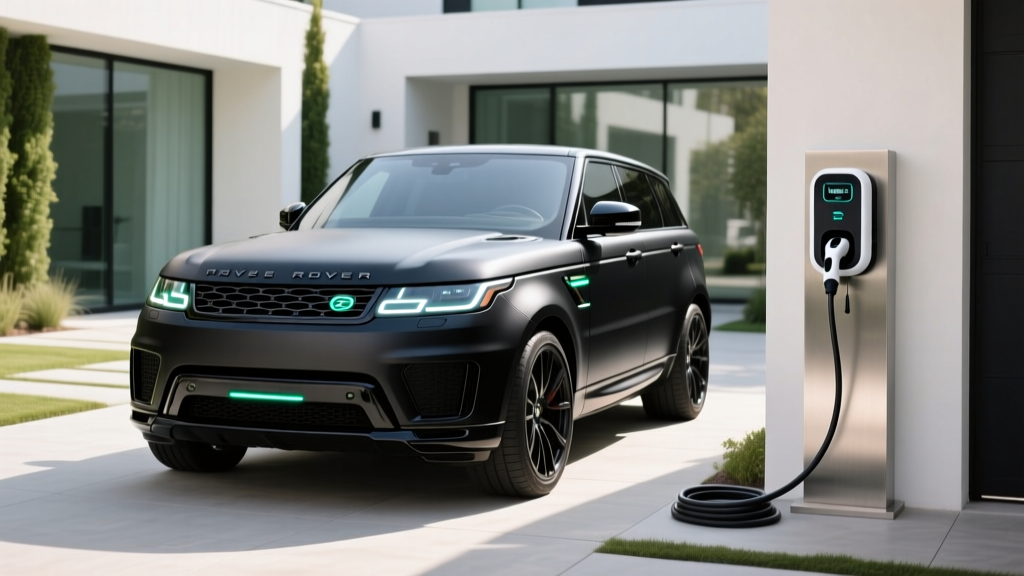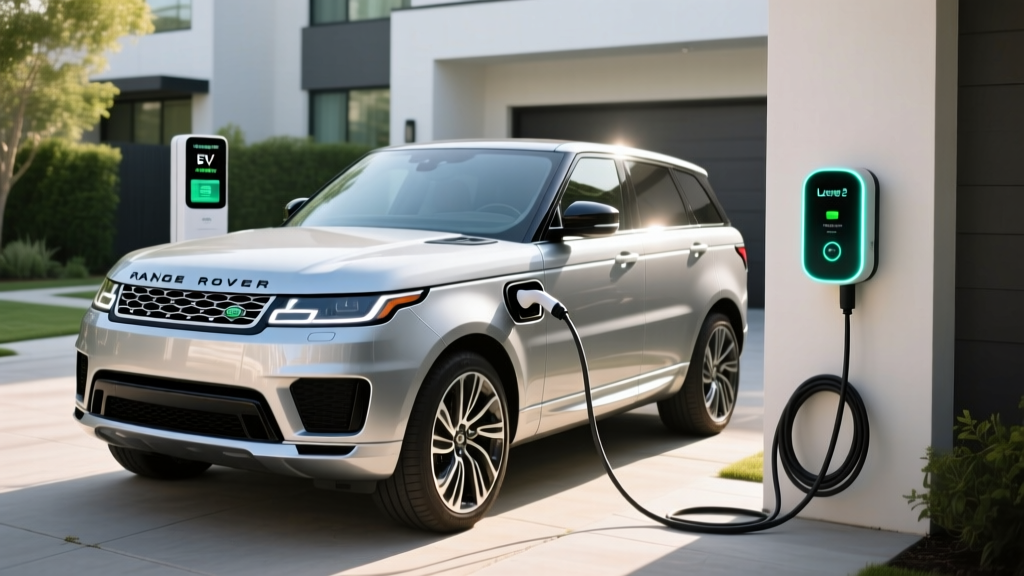
The Range Rover Sport plug-in hybrid (PHEV) pairs a turbocharged inline-six with a substantial traction battery, delivering up to 51 miles of EPA-rated electric-only range in its current-generation form. But that electric range is only useful if you can reliably recharge the 38.2 kWh battery pack (usable capacity) at home or on the road. Unlike pure BEVs, the PHEV's smaller battery and lower DC fast-charge ceiling change the charging calculus significantly.
This guide covers everything a Range Rover Sport PHEV owner needs to know about charging — from Level 1 trickle charging on a standard outlet to Level 2 home installation costs, public charging logistics, and real-world cost-per-mile calculations.
Range Rover Sport PHEV Battery and Charging Specs
Before evaluating chargers, you need the vehicle-side numbers. The current-generation Range Rover Sport PHEV (P460e/P550e variants) uses an NMC (nickel-manganese-cobalt) lithium-ion battery pack positioned beneath the rear floor. Here are the key specifications based on Land Rover's official specs and EPA data:
| Specification | Value |
|---|---|
| Battery chemistry | NMC lithium-ion |
| Total battery capacity | 38.2 kWh |
| Usable capacity | ~31.6 kWh |
| EPA electric-only range | 51 miles |
| Real-world electric range (highway/cold) | ~35–45 miles |
| Onboard AC charger (Level 2 max) | 7.2 kW |
| DC fast-charge capability | ~50 kW peak |
| Level 2 charge time (0–100%) | ~5 hours |
| DC fast charge (10–80%) | ~30 minutes |
| Charge port / connector | CCS1 (J1772 AC + CCS DC) |
| Combined MPGe (electric + gas) | 47 MPGe |
| Gas-only combined MPG | 20 MPG |
| Battery warranty | 8 years / 100,000 miles (hybrid components) |
Charging Levels Explained: Level 1, Level 2, and DC Fast
Three charging tiers apply to your Range Rover Sport PHEV. Because the battery is relatively small (38.2 kWh total, ~31.6 kWh usable), even Level 1 charging is viable for daily top-ups — a significant advantage over full BEVs with 80+ kWh packs.
| Level | Voltage / Amperage | Power (kW) | Miles of Range Added Per Hour | 0–100% Time (Range Rover Sport PHEV) |
|---|---|---|---|---|
| Level 1 (standard outlet) | 120V / 12A | ~1.4 kW | ~4–5 mi/hr | ~22–24 hours |
| Level 2 (home/public AC) | 240V / 32A | 7.2 kW (vehicle-limited) | ~20–24 mi/hr | ~5 hours |
| DC Fast Charging | 400V+ DC | ~50 kW peak | ~150+ mi/hr equivalent | ~30 min (10–80%) |
Level 1 uses a standard 120V household outlet and the portable charging cord included with the vehicle. At 1.4 kW, it adds roughly 4–5 miles of electric range per hour. Plug in overnight (say, 10 hours) and you'll recover 40–50 miles — nearly the full EPA electric range. For owners with short commutes who can charge every night, Level 1 alone may suffice.
Level 2 is the practical standard for PHEV ownership. A 240V circuit delivering 32 amps matches the Range Rover Sport PHEV's 7.2 kW onboard charger exactly. There is no benefit to installing a 48A or 80A charger for this vehicle — the car cannot accept more than 7.2 kW on AC power. However, installing a higher-amperage circuit (e.g., 48A) future-proofs for a BEV later.
DC fast charging at ~50 kW peak means a 10–80% charge in approximately 30 minutes. This is modest compared to BEVs that charge at 200+ kW, but given the small battery, 50 kW is a reasonable C-rate. DC fast charging is useful on road trips but unnecessary for daily use. Note that the charge curve tapers significantly above 80% SoC — charging from 80–100% on DC may take as long as 10–80%.
Home Charger Installation: Requirements, Costs, and Electrical Upgrades
Installing a Level 2 home charger for your Range Rover Sport PHEV involves four cost components: the charger hardware, electrical labor, permits, and potentially a panel upgrade. Here is a realistic breakdown based on national averages in 2025–2026:
| Component | Low-End Estimate | High-End Estimate | Notes |
|---|---|---|---|
| Level 2 charger (hardware) | $350 | $700 | 32A–48A smart charger, 18–25 ft cable |
| Electrician labor | $500 | $1,500 | Depends on run length, conduit, wall type |
| Electrical permit | $50 | $200 | Varies by municipality |
| Panel upgrade (if needed) | $1,500 | $3,500 | Required if panel lacks capacity for a new 40A–50A circuit |
| Total (no panel upgrade) | $900 | $2,400 | Typical for homes with 200A service |
| Total (with panel upgrade) | $2,400 | $5,900 | Older homes with 100A–125A service |
Electrical Requirements for the Range Rover Sport PHEV
Since the vehicle's onboard charger maxes out at 7.2 kW, you need a 240V circuit rated for at least 40 amps (NEC code requires circuits to be rated at 125% of continuous load, so a 32A continuous draw requires a 40A breaker). A NEMA 14-50 outlet or hardwired connection both work.
Panel capacity check: A licensed electrician will perform a load calculation on your existing panel. If you have a 200-amp service panel with available headroom, adding a 40A circuit is straightforward. If you have a 100A or 125A panel — common in homes built before 1990 — you may need a panel upgrade to 200A, which adds $1,500–$3,500. This is the single largest variable in home charger installation cost.
Code and safety requirements:
- Dedicated 40A circuit (minimum) with appropriate gauge wiring (8 AWG copper for 40A, 6 AWG for 50A)
- GFCI protection required for outdoor installations (NEC 2020+); many modern chargers have built-in GFCI
- Outdoor-rated (NEMA 4) enclosure if the charger is installed outside or in an unsealed garage
- Permit and inspection required in most jurisdictions — do not skip this; unpermitted work can void insurance claims
- Consider a smart charger with load management if your panel is near capacity — these devices dynamically reduce charge rate when other appliances draw power
Connector Compatibility: CCS1, NACS, and Adapter Options
The Range Rover Sport PHEV uses a CCS1 (Combined Charging System) connector for both AC Level 2 and DC fast charging. This is the standard for most non-Tesla EVs sold in North America, though the industry is rapidly shifting toward NACS (North American Charging Standard, i.e., Tesla's connector).
| Connector Type | Compatibility with Range Rover Sport PHEV | Adapter Needed? |
|---|---|---|
| J1772 (AC Level 1/2) | Native — direct plug-in | No |
| CCS1 (DC fast) | Native — direct plug-in | No |
| NACS / Tesla (AC) | Requires NACS-to-J1772 adapter | Yes (~$200–$300) |
| NACS / Tesla Supercharger (DC) | Requires CCS-to-NACS adapter; access depends on Tesla's open network policy | Yes (~$200–$250) |
| CHAdeMO | Not compatible; adapter not available for CCS vehicles | N/A |
As of 2025–2026, Tesla has opened portions of its Supercharger network to non-Tesla CCS-equipped vehicles via the Tesla app and a built-in CCS-to-NACS adapter at select stalls. However, coverage is not universal. For reliable public DC fast charging, Electrify America, EVgo, and ChargePoint networks all support CCS1 natively.
Home charger connector: All Level 2 home chargers sold in North America come with a J1772 connector, which plugs directly into your Range Rover Sport PHEV. No adapter is needed for home charging.
Charging Cost Per Mile: PHEV Electricity vs. Gasoline
One of the strongest ownership arguments for the Range Rover Sport PHEV is the per-mile cost advantage when driving on electricity. Here is a comparison using national average energy prices:
| Scenario | Energy Cost | Cost Per Mile (Electric Mode) | Cost Per Mile (Gas Mode, 20 MPG) |
|---|---|---|---|
| Home charging (national avg. $0.16/kWh) | $0.16/kWh | $0.062 | $0.175 (at $3.50/gal) |
| Home off-peak (time-of-use, $0.09/kWh) | $0.09/kWh | $0.035 | $0.175 |
| Public Level 2 ($0.30/kWh avg.) | $0.30/kWh | $0.117 | $0.175 |
| DC fast charging ($0.45/kWh avg.) | $0.45/kWh | $0.175 | $0.175 |
Key takeaway: Charging at home — especially on an off-peak time-of-use plan — costs roughly one-third to one-fifth per mile compared to gasoline. At $0.09/kWh off-peak, the electric cost is $0.035/mile versus $0.175/mile on premium unleaded (the Range Rover Sport requires premium fuel). That's a $0.14/mile savings, or roughly $1,680 saved over 12,000 miles of electric driving.
However, DC fast charging at $0.45/kWh erases the cost advantage entirely, matching gasoline per-mile costs. This reinforces the importance of home charging for PHEV economics. Public Level 2 charging at $0.30/kWh still saves money, but the margin narrows.
The Range Rover Sport PHEV's efficiency in electric mode is approximately 2.6 kWh/mile (based on the ~31.6 kWh usable battery divided by ~51 miles EPA range, adjusted for real-world consumption of ~2.6 kWh/mile including losses). This is less efficient than compact EVs but competitive for a 5,500-lb luxury SUV.
Recommended Level 2 Home Chargers for the Range Rover Sport PHEV
Since the vehicle accepts a maximum of 7.2 kW (32A at 240V), any quality 32A or 40A Level 2 charger will fully utilize the onboard charger. Here are three recommended options with specific specs:
ChargePoint Home Flex
- Power output: Up to 12 kW (50A) — configurable down to 32A/40A to match your circuit
- Connector: J1772 (23-foot cable)
- Smart features: Wi-Fi, app scheduling, Alexa integration, energy reports, load sharing
- Price: ~$599
- Why it works: Future-proof amperage settings, excellent app, ENERGY STAR certified. Set to 32A for a 40A circuit to match the PHEV's 7.2 kW ceiling.
Emporia Level 2 EV Charger
- Power output: Up to 11.5 kW (48A)
- Connector: J1772 (24-foot cable)
- Smart features: Wi-Fi, app with real-time energy monitoring, solar integration, load management
- Price: ~$399
- Why it works: Best value smart charger; pairs well with Emporia's whole-home energy monitor. Overkill amperage for the PHEV but future-proofs for a BEV.
Grizzl-E Smart
- Power output: Up to 10 kW (40A)
- Connector: J1772 (24-foot cable)
- Smart features: Wi-Fi, app scheduling, OCPP compatibility, outdoor-rated (NEMA 4)
- Price: ~$499
- Why it works: Rugged Canadian-built unit rated for extreme temperatures (-40°F). Ideal for outdoor installations in cold climates. 40A output aligns well with the PHEV's needs.
What you do NOT need: A 48A or 80A charger will not charge your Range Rover Sport PHEV any faster than a 32A unit. The car's 7.2 kW onboard charger is the bottleneck. However, if you plan to add a BEV to your household in the future, installing a higher-amperage circuit and charger now avoids a second electrical upgrade.
Public Charging Strategy for the Range Rover Sport PHEV
PHEV owners face a unique public charging dilemma: the battery is small enough that DC fast charging sessions are short (~30 minutes to 80%), but the charge rate is modest enough that the time investment may not justify the cost. Here's a practical framework:
When to use public DC fast charging:
- Road trips exceeding the combined electric + gas range (~460 miles total)
- When you want to maximize electric miles on a multi-leg trip and have 30 minutes to spare
- When destination Level 2 charging is unavailable overnight
When to skip public charging and burn gas:
- DC fast-charging rates above $0.40/kWh — the per-mile cost matches or exceeds premium gasoline
- Short trips where the gas engine is more convenient and the battery will recharge overnight at home
- Cold weather below 20°F — the battery's charge acceptance rate drops, extending DC charge times and reducing recovered range
Public Level 2 opportunity charging: If your workplace, gym, or shopping center offers free or low-cost Level 2 charging (under $0.20/kWh), plugging in for 1–2 hours can recover 20–48 miles of electric range — enough to cover most daily commutes. Use apps like PlugShare or ChargePoint to locate nearby Level 2 stations.
Always precondition the battery before a DC fast-charging session if your vehicle's navigation system supports it. Preconditioning warms the battery to optimal temperature (~77°F/25°C), which can improve peak charge rates by 15–25% in cold weather. The Range Rover Sport PHEV's thermal management system handles this automatically when you navigate to a charger via the infotainment system.
Federal Tax Credits and Incentives for PHEV Charging Equipment
Under current IRS rules, the Alternative Fuel Vehicle Refueling Property Credit (IRC §30C) covers 30% of the cost of home EV charging equipment and installation, up to $1,000 per year. This applies to both the charger hardware and electrician labor for your Range Rover Sport PHEV's Level 2 setup.
Eligibility requirements include:
- The charger must be installed at your primary residence
- The property must be located in an eligible census tract (low-income or non-urban area, per IRA provisions) — check the IRS eligibility tool
- Equipment must be new and placed in service during the tax year
- The credit is non-refundable — it reduces your tax liability but does not generate a refund beyond what you owe
For the Range Rover Sport PHEV itself, federal §30D new clean vehicle credit eligibility is complex and depends on MSRP caps (SUVs capped at $80,000), buyer income limits ($300,000 joint / $150,000 single), and battery component / critical mineral sourcing requirements. Given that the Range Rover Sport PHEV's MSRP typically exceeds $83,000, it likely does not qualify for the §30D credit. Always verify current eligibility on the IRS website or consult a tax professional before making a purchase decision.
Frequently Asked Questions
How much does it cost to install a home EV charger for the Range Rover Sport PHEV?
Expect $900–$2,400 for a standard installation with a 200A panel (charger + electrician + permit). If your home requires a panel upgrade from 100A to 200A, total costs range from $2,400–$5,900. Since the PHEV only needs 32A/7.2 kW, you can use a moderately priced charger ($350–$500) and a 40A circuit.
How fast will each charging level add range to the Range Rover Sport PHEV?
Level 1 (120V) adds ~4–5 miles per hour. Level 2 (240V, 32A) adds ~20–24 miles per hour. DC fast charging at 50 kW adds roughly 150+ miles per hour equivalent, reaching 10–80% in about 30 minutes. Given the 51-mile EPA electric range, a full Level 2 charge takes about 5 hours from empty.
Which connector and charger is compatible with my Range Rover Sport PHEV?
The vehicle uses a CCS1 connector (J1772 for AC, CCS combo for DC). Any J1772 Level 2 home charger is directly compatible. For Tesla Supercharger access, you'll need a CCS-to-NACS adapter (~$200–$250) and must confirm station availability via the Tesla app. CHAdeMO is not compatible.
How much does charging cost per mile vs. gas?
Home charging at the national average of $0.16/kWh costs about $0.062/mile in electric mode. Off-peak home charging at $0.09/kWh drops to $0.035/mile. Gasoline at $3.50/gallon with the PHEV's 20 MPG combined costs $0.175/mile. DC fast charging at $0.45/kWh matches gas costs at $0.175/mile. Home charging is where the savings live.
What electrical upgrades might I need?
The most common upgrade is a panel capacity increase from 100A/125A to 200A ($1,500–$3,500). Your electrician will also need to install a dedicated 40A 240V circuit with 8 AWG copper wire. If your garage is far from the panel, longer wire runs increase labor costs. Outdoor installations require a NEMA 4-rated charger and GFCI protection per NEC code.
Can I just use the included Level 1 charger and skip installing Level 2?
Yes — for many PHEV owners, Level 1 is sufficient. Plugging in for 10 hours overnight recovers 40–50 miles, nearly the full EPA electric range. If your daily commute is under 40 miles and you charge every night, Level 1 alone may cover your electric driving needs. Level 2 becomes worthwhile if you need faster turnaround between trips, want to precondition the cabin on grid power, or plan to own a BEV in the future.