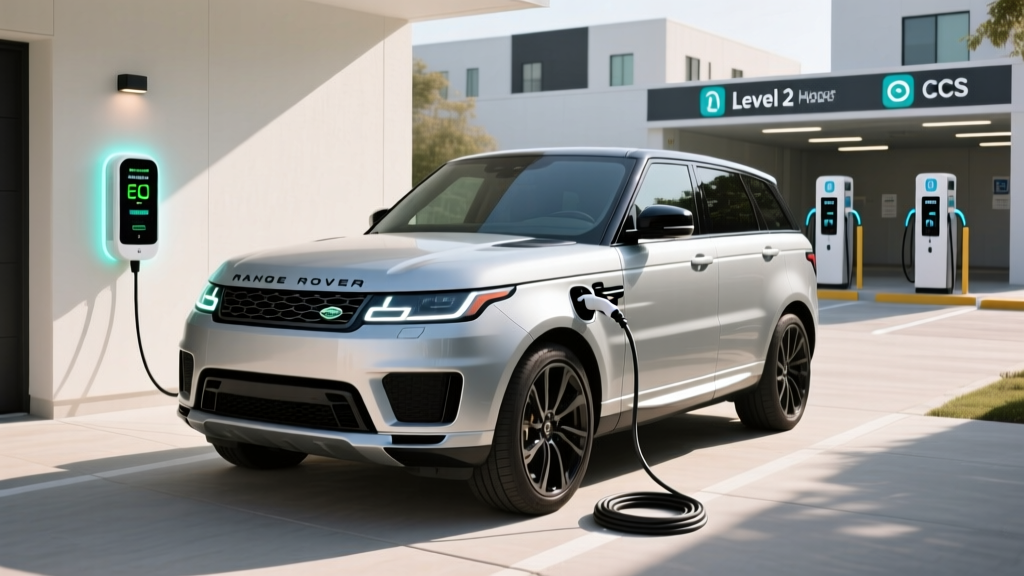
Charging Your Range Rover Sport Hybrid: What You Need to Know
If you've recently purchased or are considering a Range Rover Sport Hybrid (PHEV), understanding how to charge it efficiently is critical to maximizing its electric-only range and fuel savings. The 2026 Range Rover Sport P460e and P550e plug-in hybrids feature a 38.2 kWh lithium-ion battery pack, delivering an EPA-estimated 51 miles of electric-only range and up to 46 MPGe when operating in EV mode.
But here's the reality many new PHEV owners face: without a proper Level 2 home charging setup, you're leaving performance and savings on the table. This guide covers everything from installation costs to public charging logistics, connector compatibility, and real-world cost comparisons.
| Spec | 2026 Range Rover Sport PHEV |
|---|---|
| Battery Capacity | 38.2 kWh (usable) |
| EPA Electric Range | 51 miles |
| MPGe (EV Mode) | 46 MPGe |
| Level 2 AC Charge Rate | 7.2 kW max |
| Level 2 Charge Time (0-100%) | ~5 hours |
| DC Fast Charging | Not supported |
| Connector Type | J1772 (Level 1/2) |
| Starting MSRP | $85,500 (P460e) |
Understanding Charging Levels: Speeds and Real-World Expectations
Before installing a charger or plugging in at a public station, you need to understand the three charging levels and how they translate to actual range added per hour. This is where confusion often creeps in—many people mix up kW (power, or charge rate) with kWh (energy, or battery capacity). Think of kW as the speed of water flowing into a tank, and kWh as the total volume the tank holds.
| Level | Power Output | Voltage/Amperage | Miles Added Per Hour | Use Case |
|---|---|---|---|---|
| Level 1 | 1.4 kW | 120V / 12A | ~4 miles | Overnight trickle, emergencies |
| Level 2 | 3.3 - 19.2 kW | 240V / 16-80A | 12-60 miles | Home daily charging, workplaces |
| DC Fast | 50 - 350+ kW | 400-800V DC | 180-1000+ miles | Road trips, quick top-ups (BEVs only) |
For the Range Rover Sport Hybrid, Level 2 is your primary charging method. The vehicle's onboard charger accepts up to 7.2 kW, meaning a 40-amp Level 2 charger (which delivers ~9.6 kW) will charge at the vehicle's maximum rate of 7.2 kW. Level 1 charging via a standard 120V outlet is possible but painfully slow—expect roughly 4 miles of range per hour, or about 13 hours to fully replenish the 38.2 kWh battery.
Important note: The Range Rover Sport PHEV does not support DC fast charging. This is typical for plug-in hybrids, which prioritize smaller batteries and AC charging infrastructure. If you need rapid charging capability, you're looking at a full BEV like the Range Rover Electric (announced for late 2026).
Home Charging Installation: Costs, Electrical Requirements, and Permits
Installing a Level 2 home charger for your Range Rover Sport Hybrid requires a dedicated 240V circuit, typically 40-50 amps. Here's what that involves and what you should budget:
Electrical Requirements
- Voltage: 240V (same as a dryer or electric oven)
- Amperage: 40A circuit recommended for 32A continuous charging (EVs draw 80% of circuit capacity for safety)
- Wire Gauge: 6 AWG copper for 40A circuits (may vary by run length)
- Breaker: 40A double-pole breaker
- Outlet Type: NEMA 14-50 (most common) or hardwired connection
Panel Upgrade Considerations
Many homes built before 2000 have 100-amp electrical panels, which may not have capacity for a 40A EV circuit. A licensed electrician will perform a load calculation to determine if your panel can handle the additional draw. If you're already running central AC, an electric dryer, and an electric oven, you may need a panel upgrade to 200 amps—a significant cost factor.
| Component | Cost Range | Notes |
|---|---|---|
| Level 2 Charger (Equipment) | $400 - $800 | 32A-40A smart chargers |
| Electrician Labor | $500 - $2,000 | Depends on panel distance, wall type |
| Permit Fees | $50 - $300 | Varies by municipality |
| Panel Upgrade (if needed) | $1,500 - $4,000 | 100A to 200A service upgrade |
| Total (no panel upgrade) | $950 - $3,100 | Typical scenario |
| Total (with panel upgrade) | $2,450 - $7,100 | Older homes |
Pro tip: Get at least three quotes from licensed electricians. Ask specifically about their experience with EV charger installations and whether they'll handle the permit process. Some utilities offer rebates of $250-$500 for Level 2 installations—check with your local provider before scheduling work.
Connector Compatibility: What Plugs Into Your Range Rover Sport Hybrid?
The Range Rover Sport PHEV uses the J1772 connector for all Level 1 and Level 2 AC charging. This is the standard connector for virtually all non-Tesla EVs and PHEVs sold in North America. However, the EV landscape is shifting rapidly toward the NACS (North American Charging Standard) connector, which Tesla pioneered and is now being adopted by Ford, GM, Rivian, and others starting in 2025-2026.
| Connector | Used By | Range Rover Sport PHEV Compatible? |
|---|---|---|
| J1772 | All non-Tesla EVs/PHEVs (Level 1/2) | Yes (native) |
| NACS (Tesla) | Tesla, Ford, GM, Rivian (2025+) | No (adapter needed for public Level 2) |
| CCS1 | Most non-Tesla BEVs (DC fast) | N/A (PHEV doesn't support DC fast) |
| CHAdeMO | Nissan Leaf, Mitsubishi (legacy) | N/A |
For home charging, any J1772 Level 2 charger will work perfectly. If you encounter public charging stations with NACS connectors (increasingly common at Tesla Destination Chargers opened to other brands), you'll need a NACS-to-J1772 adapter (~$150-$250). However, most public Level 2 stations at shopping centers, hotels, and workplaces still use J1772.
Cost to Charge: Home vs. Public vs. Gas
One of the biggest advantages of a plug-in hybrid like the Range Rover Sport is the ability to run on electricity for daily commutes, then switch to gas for longer trips. But how much does charging actually cost, and how does it compare to gasoline?
| Scenario | Cost per kWh | Cost to Fill 38.2 kWh | Cost per Mile (EV) |
|---|---|---|---|
| Home Off-Peak (utility rate) | $0.12 | $4.58 | $0.09 |
| Home Peak (utility rate) | $0.25 | $9.55 | $0.19 |
| Public Level 2 (ChargePoint, etc.) | $0.30 - $0.50 | $11.46 - $19.10 | $0.22 - $0.37 |
| Gasoline (premium, $4.50/gal, 22 MPG combined) | N/A | N/A | $0.20 |
At home with off-peak electricity rates, charging your Range Rover Sport Hybrid costs roughly $0.09 per mile—less than half the cost of gasoline. Even at peak rates or public Level 2 stations, EV mode is competitive with or cheaper than gas. However, public DC fast charging (which this PHEV doesn't support) can be more expensive than gas due to higher per-kWh pricing.
Real-world scenario: If you commute 30 miles round-trip and charge at home overnight, you'll use about $2.70 in electricity per day vs. $6.00 in premium gasoline. Over a year (assuming 250 workdays), that's $675 in electricity vs. $1,500 in gas—a savings of $825 annually just on your commute.
Recommended Level 2 Chargers for Range Rover Sport Hybrid
Since the Range Rover Sport PHEV maxes out at 7.2 kW, you don't need the most powerful charger on the market. A 32A or 40A unit (7.7 kW or 9.6 kW output) will charge at the vehicle's maximum rate. Here are three excellent options:
ChargePoint Home Flex
- Power Output: Up to 12 kW (50A circuit) - adjustable
- Connector: J1772 (NACS adapter available)
- Cable Length: 23 feet
- Smart Features: Wi-Fi, app scheduling, Alexa integration, energy tracking
- Price: ~$699
- Best For: Flexibility, future-proofing for higher-power EVs
Emporia Level 2 EV Charger
- Power Output: Up to 11.5 kW (48A circuit)
- Connector: J1772
- Cable Length: 24 feet
- Smart Features: Wi-Fi, app control, solar integration, load balancing
- Price: ~$399
- Best For: Budget-conscious buyers, solar panel owners
Wallbox Pulsar Plus
- Power Output: Up to 11.5 kW (48A circuit)
- Connector: J1772
- Cable Length: 25 feet
- Smart Features: Wi-Fi/Bluetooth, app scheduling, power sharing (multi-charger setups)
- Price: ~$649
- Best For: Compact design, multi-EV households
All three chargers are UL-listed (safety certified), support NEMA 14-50 plug-in or hardwired installation, and offer smart scheduling to take advantage of off-peak electricity rates. For the Range Rover Sport Hybrid's 7.2 kW max charge rate, even the 32A versions of these chargers will deliver full-speed charging.
Safety, Code Compliance, and Installation Best Practices
EV charger installation is not a DIY project. Electrical work requires permits, inspections, and compliance with the National Electrical Code (NEC). Here's what you need to know:
- Dedicated Circuit: Your Level 2 charger must have its own dedicated circuit—no sharing with other appliances.
- GFCI Protection: NEC 2020 and later require GFCI (Ground Fault Circuit Interrupter) protection for EV chargers. Most modern chargers have built-in GFCI, but your electrician will verify compliance.
- Outdoor Rating: If installing outdoors, ensure the charger is rated for outdoor use (NEMA 4 or IP54 minimum) and the outlet has a weatherproof cover.
- Cable Management: Avoid running charging cables across walkways or driveways where they pose a trip hazard or can be damaged by vehicles.
- Permit and Inspection: Most jurisdictions require an electrical permit and post-installation inspection. Your electrician should handle this—never skip it, as unpermitted work can void insurance coverage.
Frequently Asked Questions
How much does it cost to install a home EV charger for my Range Rover Sport Hybrid?
Expect to pay $950-$3,100 for a typical Level 2 installation (equipment + electrician + permit) if your electrical panel has sufficient capacity. If you need a panel upgrade from 100A to 200A, total costs can reach $2,450-$7,100. Always get multiple quotes from licensed electricians.
How fast will each charging level add range to my Range Rover Sport PHEV?
Level 1 (120V) adds roughly 4 miles per hour. Level 2 (240V, 7.2 kW) adds approximately 20-25 miles per hour, fully charging the 38.2 kWh battery in about 5 hours. DC fast charging is not supported on this PHEV.
Which connector is compatible with my Range Rover Sport Hybrid?
Your vehicle uses the J1772 connector for all AC charging (Level 1 and Level 2). This is the standard for non-Tesla EVs in North America. If you encounter NACS (Tesla-style) connectors at public stations, you'll need a NACS-to-J1772 adapter.
How much does charging cost per mile compared to gas?
At home with off-peak electricity ($0.12/kWh), charging costs about $0.09 per mile in EV mode. Premium gasoline at $4.50/gallon and 22 MPG combined costs roughly $0.20 per mile. Home charging is typically 50-60% cheaper than gas.
What electrical upgrades might I need for a Level 2 charger?
You'll need a dedicated 240V, 40A circuit with 6 AWG wire and a 40A double-pole breaker. If your home has a 100A electrical panel and you're already running high-draw appliances (central AC, electric dryer, electric oven), you may need a panel upgrade to 200A—a $1,500-$4,000 investment.
Can I use a Tesla Supercharger with my Range Rover Sport Hybrid?
No. Tesla Superchargers provide DC fast charging, which the Range Rover Sport PHEV does not support. Additionally, Superchargers use the NACS connector, which is incompatible with your vehicle's J1772 inlet. Stick to Level 2 public chargers at shopping centers, hotels, and workplaces.
Does the Range Rover Sport Hybrid qualify for federal tax credits?
The 2026 Range Rover Sport PHEV may qualify for up to $7,500 under IRS §30D, but eligibility depends on battery sourcing, critical minerals requirements, your income (phase-out above $150K single / $300K joint), and the vehicle's MSRP (must be under $80K for SUVs—note that higher trims may exceed this cap). Consult a tax professional and check IRS guidelines for current-year rules.
Final Thoughts: Maximizing Your Range Rover Sport Hybrid's Electric Potential
The Range Rover Sport Hybrid offers genuine luxury with the flexibility of electric commuting and gas-powered road trips. To get the most from its 51-mile electric range, invest in a proper Level 2 home charging setup. Budget $1,000-$3,000 for installation, choose a smart charger like the ChargePoint Home Flex or Emporia for scheduling and energy tracking, and take advantage of off-peak electricity rates to cut your fuel costs in half.
For more information on PHEV ownership, check the EPA's fuel economy data at fueleconomy.gov and review Land Rover's official specifications at Land Rover USA.