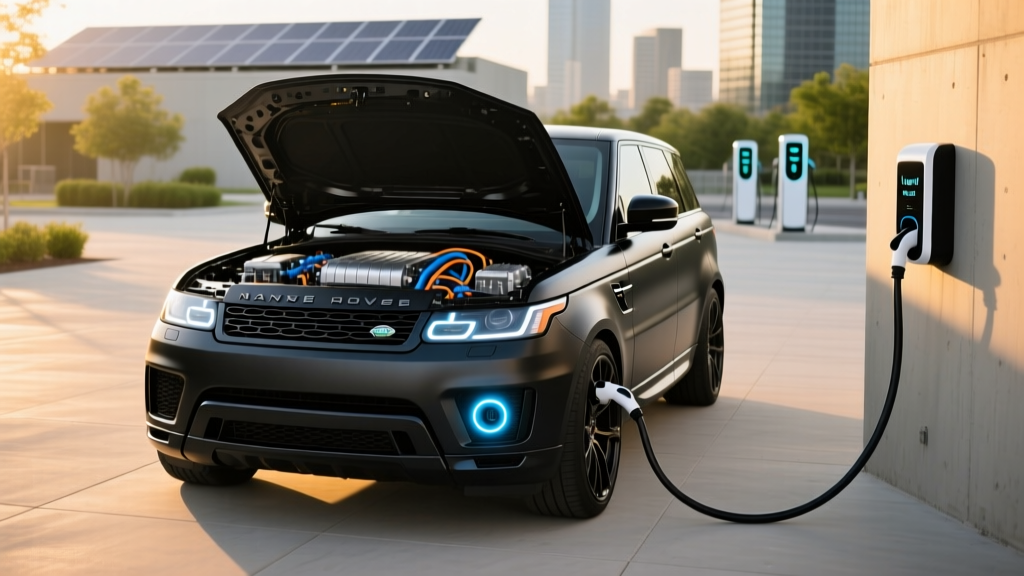
The 2014 Range Rover Sport HSE Supercharged left the factory with a 510-hp, 5.0-liter supercharged V8 that returned an EPA-rated 14 MPG combined and burned through roughly $3,800 in fuel annually. Fast-forward to 2026, and a growing niche of specialty shops is pulling that AJ133 V8, dropping in a Tesla Large Drive Unit or Cascadia Motion powertrain, and packing the chassis with 60–100 kWh of NMC modules. The result: a luxury SUV with 200–280 miles of electric range, 400+ hp, and a charging profile that looks nothing like a purpose-built EV. If you own one of these conversions — or are commissioning one — this guide covers exactly how you'll charge it, what it will cost, and the electrical realities of plugging a 5,000-pound British classic into a modern grid.
Charging Levels Explained: What a Converted Range Rover Actually Accepts
Most EV conversions built on the 2014 Range Rover Sport platform use an aftermarket onboard charger (OBC) rated between 6.6 kW and 11.5 kW for AC charging, paired with a CCS1 or NACS inlet wired directly to the BMS. DC fast charging capability varies enormously depending on whether the conversion shop installed a standalone DC charge controller and what the battery pack's C-rate tolerance allows.
| Level | Voltage / Amperage | Power (kW) | Miles of Range Added per Hour | Full Charge Time (10–80%) |
|---|---|---|---|---|
| Level 1 (120V household) | 120V / 12A | 1.4 kW | ~4–5 mi/hr | ~45+ hours |
| Level 2 (240V home/public) | 240V / 32A | 7.7 kW | ~25–28 mi/hr | ~7–8 hours |
| Level 2 (240V, 48A circuit) | 240V / 48A | 11.5 kW* | ~37–40 mi/hr | ~5 hours |
| DC Fast (CCS/NACS) | 400V architecture | 50–80 kW peak** | ~150–220 mi/hr | ~45–65 min |
*Requires an 11.5 kW-capable onboard charger; many conversions cap at 7.7 kW.
**Peak rate depends on pack configuration, BMS limits, and thermal management. Sustained rate typically 40–55 kW above 50% SoC.
A critical distinction: kW (kilowatts) measures the rate of energy flow — think of it as how wide the hose is. kWh (kilowatt-hours) measures total energy stored — the size of the tank. A 7.7 kW Level 2 charger delivering power for 10 hours adds 77 kWh to your battery. Confusing these two is the single most common EV literacy mistake, and it matters when you're sizing a home circuit or reading a charger's spec sheet.
Home Charger Installation: Electrical Requirements and Real Costs
The 2014 Range Rover Sport conversion is a heavy vehicle with a large battery. Relying on Level 1 (a standard 120V outlet) is impractical — you'd need nearly two full days to charge from 10% to 80%. A Level 2 home station is effectively mandatory for daily usability.
What Your Electrician Will Evaluate
- Panel capacity: Most homes built before 2010 have 100A or 150A main service. A 48A EV circuit (requiring a 60A breaker per NEC 80% continuous-load rule) draws significant headroom. If your panel is already near capacity — common in homes with electric ranges, dryers, and HVAC — a panel upgrade to 200A may be required.
- Dedicated circuit: NEC Article 625 requires a dedicated branch circuit for EV charging. Sharing with other appliances is a code violation and a fire risk.
- Wire gauge: A 60A breaker requires 6 AWG copper (THHN in conduit) or 4 AWG NM-B. Longer runs (over 100 feet from panel to charger) may need upsizing to compensate for voltage drop.
- GFCI protection: The 2020 NEC and later require GFCI protection for receptacles used for EV charging in garages. Hardwired chargers avoid this requirement and are generally preferred for reliability.
- Permit: Nearly all jurisdictions require an electrical permit for a new 240V circuit. Inspections verify wire gauge, breaker sizing, grounding, and bonding.
| Item | Low End | High End | Notes |
|---|---|---|---|
| Level 2 charger (hardware) | $350 | $750 | 32A–48A, NACS or J1772/CCS |
| Electrician labor (standard install) | $600 | $1,500 | Short run, same wall as panel = cheaper |
| Electrical permit | $50 | $250 | Varies by municipality |
| Panel upgrade (if needed) | $1,500 | $4,500 | 100A → 200A service upgrade |
| Conduit/wire (long runs 100+ ft) | $200 | $800 | Underground or attic runs add cost |
| Total (no panel upgrade) | $1,000 | $2,500 | Most common scenario |
| Total (with panel upgrade) | $2,500 | $7,050 | Older homes with 100A service |
The 2014 Range Rover Sport is often kept in homes built in the 2000–2015 era where 200A panels are common, which works in your favor. But if you're in an older property, budget realistically for the panel upgrade — it's the single biggest variable and the most commonly underestimated cost. A licensed electrician should perform a load calculation per NEC Article 220 before quoting.
Connector Compatibility: NACS, CCS1, and Adapter Realities
The connector landscape in 2026 has consolidated significantly, but conversion vehicles sit in an awkward middle ground. The shop that built your Range Rover Sport conversion chose your inlet — and that choice determines where you can charge.
| Connector | Used By | DC Fast Network Access | Adapter Available? |
|---|---|---|---|
| NACS (Tesla standard) | Tesla, Ford, GM, Rivian, Hyundai, most new 2025+ EVs | Tesla Supercharger (17,000+ stalls), plus growing third-party | CCS→NACS adapters ($150–$300) |
| CCS1 | Legacy non-Tesla EVs, many conversions | Electrify America, EVgo, ChargePoint DC | NACS→CCS adapters available |
| CHAdeMO | Nissan Leaf (legacy), Mitsubishi | Declining network; mostly Electrify America | Limited; not recommended for new installs |
| J1772 (AC only) | All non-Tesla EVs for Level 1/2 | N/A — AC charging only | Tesla Mobile Connector includes J1772 adapter |
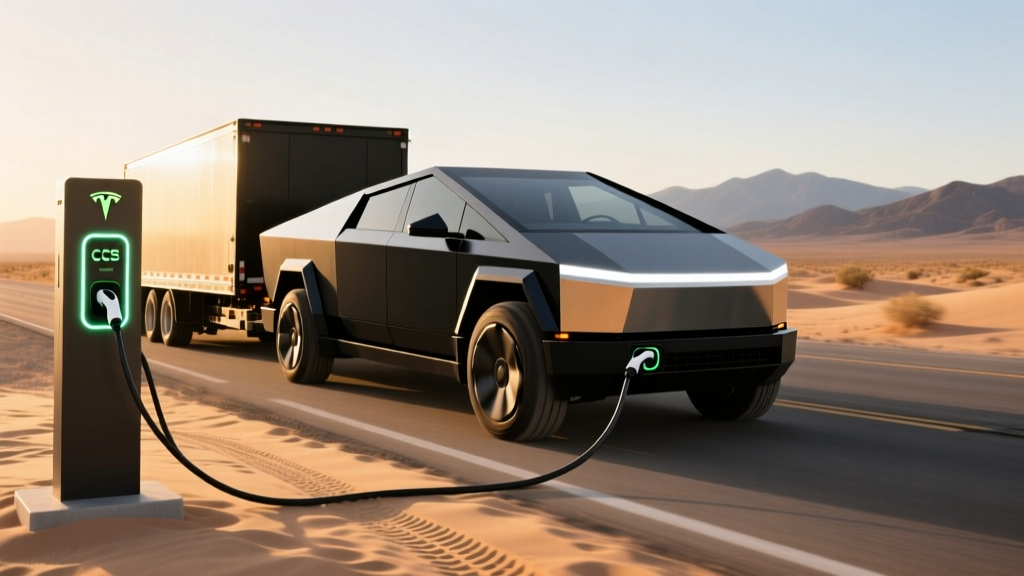
For a conversion Range Rover Sport: If your shop installed a CCS1 inlet, you have access to Electrify America and most non-Tesla DC networks. If they installed NACS, you can use Tesla Superchargers — the largest and most reliable DC network in the US. If your conversion only has J1772 (AC-only, no DC fast charge capability), you're limited to Level 2 speeds everywhere. Confirm your inlet type before planning road trips.
Adapters exist for most combinations, but every adapter introduces a failure point and adds 2–4 lbs to your charging kit. For a vehicle that already weighs over 5,300 lbs post-conversion, and given that some adapters restrict charge rates to 50 kW, it's better to spec the right inlet from the start.
Cost to Charge: Per-Mile Economics vs the Original Supercharged V8
The factory 2014 Range Rover Sport HSE Supercharged returned 14 MPG combined on premium fuel. At $4.50/gallon (national average for premium in early 2026), that's $0.32 per mile in fuel alone. Here's how an EV conversion compares across charging scenarios, assuming an efficiency of 2.8 kWh/mile (realistic for a 5,300-lb SUV with the aerodynamics of a brick):
| Scenario | Rate | Cost per kWh | Cost per Mile | Annual Savings (12,000 mi) |
|---|---|---|---|---|
| Stock V8 (14 MPG, premium $4.50/gal) | — | — | $0.321 | Baseline |
| Home Level 2 (off-peak utility rate) | $0.09/kWh | $0.09 | $0.252 | $828 |
| Home Level 2 (standard residential) | $0.16/kWh | $0.16 | $0.448 | -$1,524 (costs more) |
| Home Level 2 (with solar, net metered) | ~$0.04/kWh | $0.04 | $0.112 | $2,508 |
| Public Level 2 (ChargePoint, EVgo) | $0.35/kWh | $0.35 | $0.98 | -$7,908 |
| DC Fast (Electrify America) | $0.48/kWh | $0.48 | $1.34 | -$12,228 |
The economics only work if you charge at home on a favorable rate. Public DC fast charging a heavy, inefficient conversion SUV is dramatically more expensive than the original V8. This is why home Level 2 installation isn't optional — it's the entire financial thesis of the conversion. If you can't charge at home, the conversion saves you nothing on fuel.
Also factor in maintenance savings: the EV conversion eliminates oil changes ($120–$180 each, 2x/year on the V8), supercharger belt service, transmission fluid, spark plugs, and O2 sensors. Realistic annual maintenance savings: $800–$1,200, per fueleconomy.gov EV ownership data.
Charging Time Examples: What to Expect With an 80 kWh Pack
Assuming a typical conversion pack of 80 kWh usable (NMC chemistry, liquid-cooled), here are realistic charge times. Note that the charge curve — the rate at which a battery accepts power — is not linear. Batteries accept peak power only between roughly 10–50% State of Charge (SoC), then taper significantly to protect cell health. A charger rated at 80 kW peak may average only 45 kW over a full 10–80% session.
- Level 1 (120V, 1.4 kW): 10% to 80% = ~45 hours. Only viable as emergency trickle charging. Plan overnight stops accordingly on road trips.
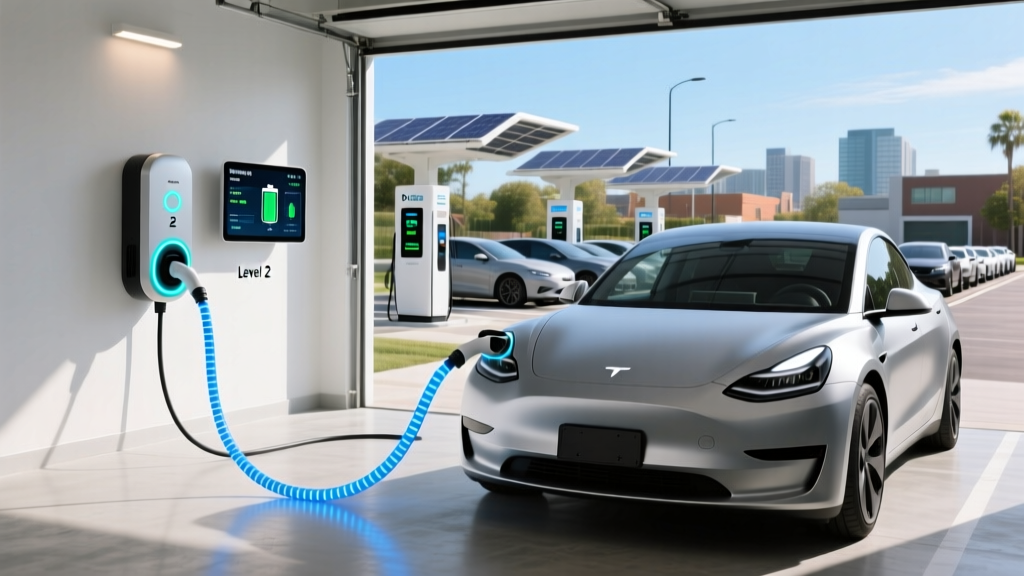
- Level 2 (240V, 32A, 7.7 kW): 10% to 80% = ~7.2 hours. Plug in when you get home; wake up full. This is the daily-use sweet spot.
- Level 2 (240V, 48A, 11.5 kW): 10% to 80% = ~4.8 hours. Requires an 11.5 kW-capable onboard charger — verify with your conversion shop.
- DC Fast (50 kW sustained average): 10% to 80% = ~65 minutes. Adequate for road-trip stops; plan meals around it.
- DC Fast (80 kW peak, ~55 kW average): 10% to 80% = ~45 minutes. The best-case scenario for most conversions. Requires robust thermal management in the pack.
Preconditioning matters. If your conversion's BMS supports battery preconditioning (warming the pack to ~30–35°C before a DC fast charge), you'll see significantly faster charge rates, especially in cold weather. Without preconditioning, a cold pack may accept only 20–30 kW even at a 150 kW station. Ask your conversion builder whether this feature is implemented — it's the difference between a 45-minute and a 90-minute road-trip stop in January.
Recommended Home Charging Equipment
For a heavy, large-battery conversion like the Range Rover Sport, you want a charger that delivers maximum Level 2 power reliably. Here are three proven units suitable for this application:
ChargePoint Home Flex (NACS or J1772)
- Power output: Up to 12 kW (50A, hardwired) or 9.6 kW (40A, NEMA 14-50 plug)
- Cable length: 23 feet
- Smart features: Wi-Fi, app scheduling, utility demand-response integration, energy tracking
- Connector options: NACS or J1772 (order the right one for your inlet)
- Price: ~$550–$650
- Best for: Conversions with NACS inlets; users who want detailed app data
Wallbox Pulsar Plus (J1772)
- Power output: Up to 11.5 kW (48A, hardwired)
- Cable length: 25 feet
- Smart features: Wi-Fi + Bluetooth, Power Sharing (two units on one circuit), Eco-Smart solar integration
- Connector: J1772 (use adapter for NACS inlet vehicles)
- Price: ~$450–$550
- Best for: Homes with solar panels; dual-EV households
Tesla Wall Connector (NACS)
- Power output: Up to 11.5 kW (48A, hardwired)
- Cable length: 24 feet
- Smart features: Wi-Fi, over-the-air updates, Power Sharing, integrated cable management
- Connector: NACS only
- Price: ~$425–$475
- Best for: NACS-inlet conversions; cleanest installation aesthetic
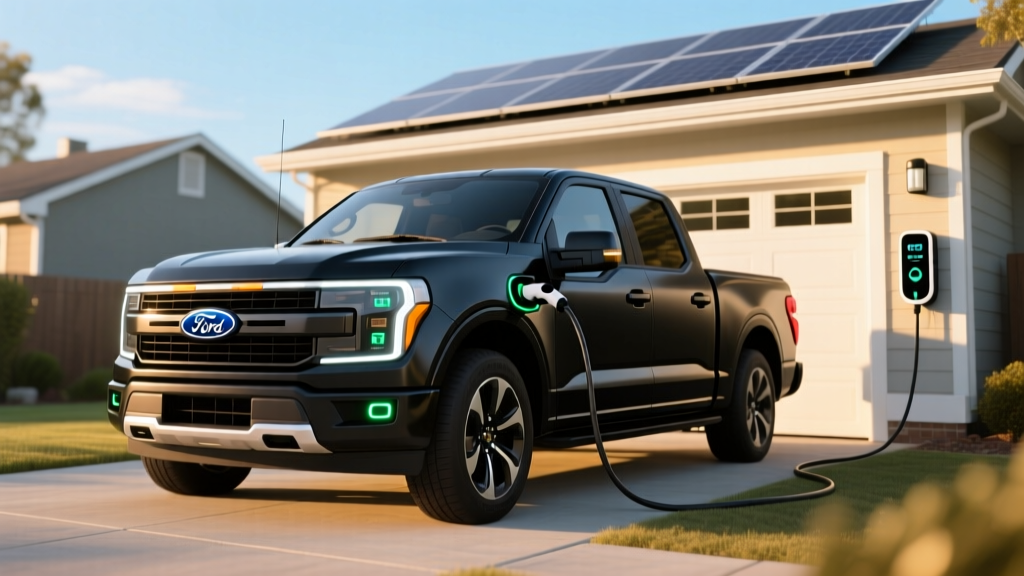
All three require a hardwired 60A breaker for maximum output. The Tesla Wall Connector is the most affordable but only works with NACS inlets. If your conversion has a CCS1 inlet, the ChargePoint Home Flex in J1772 configuration (with a CCS adapter for DC charging elsewhere) is the most versatile choice.
Safety and Code Considerations for Conversion Vehicles
EV conversions are not federally regulated the way production EVs are under FMVSS. That places extra responsibility on the owner to ensure the charging system is safe and code-compliant:
- Dedicated circuit: Never share the EV charger circuit with other loads. NEC 625.40 requires a dedicated branch circuit.
- Hardwired vs. receptacle: Hardwired installations are preferred for 48A+ chargers. NEMA 14-50 receptacles are acceptable up to 40A continuous (50A breaker) but have been linked to overheating in some installations if not torqued to spec. If using a receptacle, have your electrician use a commercial-grade unit (Hubbell or Bryant) rather than a residential Leviton.
- Outdoor rating: If your charger is mounted outside, verify it carries a NEMA 4 (weatherproof) rating. All three recommended units above are rated for outdoor use.
- Ground fault protection: For receptacle-based installations in garages, GFCI breakers are required by NEC 2020+. Hardwired chargers with integrated ground-fault protection satisfy this without a GFCI breaker (which can nuisance-trip on some EV chargers).
- Conversion-specific: Verify that your conversion shop used properly rated high-voltage cabling (orange-jacketed, per SAE J1673), that the charge inlet is bonded to the chassis, and that the BMS has overcurrent, overvoltage, and thermal cutoff protections documented. Request the wiring diagram and BMS configuration file for your records.
Frequently Asked Questions
How much does it cost to install a home EV charger for a converted Range Rover Sport?
Between $1,000 and $2,500 for a standard installation (panel has capacity, short wire run). If your home needs a panel upgrade from 100A to 200A service, add $1,500–$4,500. Total worst-case: up to $7,050. Get a load calculation from a licensed electrician before committing.
How fast will each charging level add range?
Level 1 (120V) adds roughly 4–5 miles per hour — useless for daily driving of a heavy SUV. Level 2 (240V, 32A) adds 25–28 miles per hour, which is the practical daily standard. Level 2 at 48A adds 37–40 miles per hour. DC fast charging adds 150–220 miles per hour at peak, but tapers significantly above 50% SoC.
Which connector and charger is compatible with my EV conversion?
It depends entirely on what inlet your conversion shop installed. Check the physical port on your vehicle: NACS (smaller, Tesla-style), CCS1 (larger, with two DC pins below), or J1772 (AC-only, five-pin). Order a home charger with the matching connector. Most 2025–2026 conversions are being built with NACS for Supercharger access.
How much does charging cost per mile vs the original supercharged V8?
The stock 5.0L V8 costs about $0.32/mile in premium fuel. Home charging at off-peak rates ($0.09/kWh) brings that down to ~$0.25/mile — a modest savings. With rooftop solar, you can drop to ~$0.11/mile. However, public DC fast charging at $0.48/kWh costs over $1.30/mile — far more than gas. The conversion only saves money if you charge at home.
What electrical upgrades might I need?
The most common upgrade is a panel increase from 100A to 200A service ($1,500–$4,500). You may also need a new conduit run if the charger location is far from the panel, or a sub-panel if you're adding the charger in a detached garage. Homes built after 2010 with 200A service usually need nothing beyond the dedicated 60A circuit. Always get a professional load calculation per NEC Article 220.
Can I use a Tesla Supercharger with my CCS-inlet conversion?
Only with a CCS-to-NACS adapter (approximately $150–$300 from brands like Lectron or A2Z). However, some Supercharger stalls may not recognize non-Tesla vehicles even with an adapter unless the vehicle is enrolled in Tesla's NACS adoption program. Verify compatibility before relying on this for road trips. The alternative: spec NACS at the time of conversion.