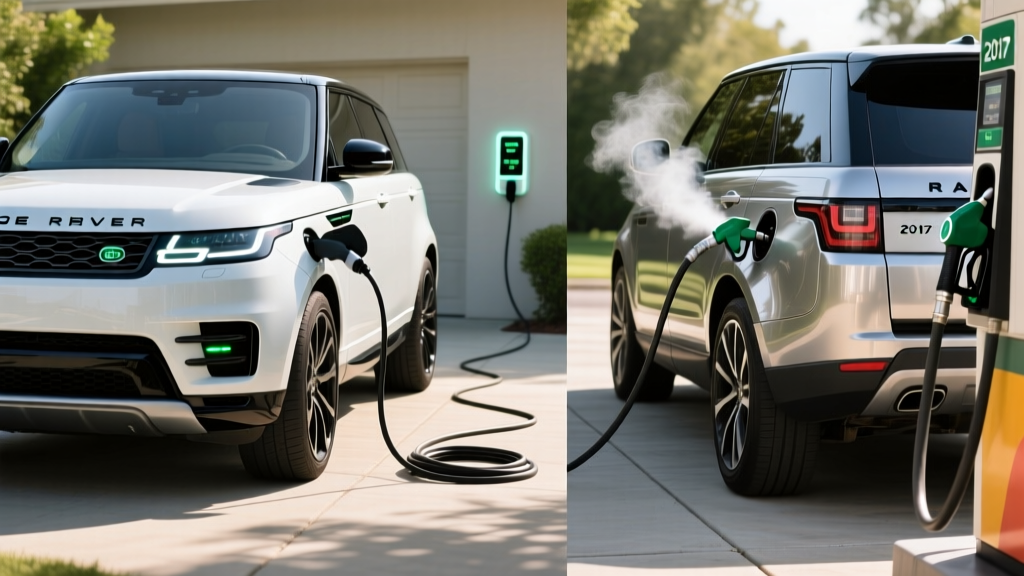
If you have owned or considered a 2017 Range Rover Sport Supercharged, you already know its 5.0-liter supercharged V8 delivers thrilling performance — along with fuel economy that hovers around 14 mpg city and 19 mpg highway per EPA estimates. Fast-forward to today, and Land Rover now offers the Range Rover Sport as a plug-in hybrid (PHEV) and, in select markets, a fully electric variant. This guide breaks down what it takes to charge a modern electrified Range Rover Sport at home and on the road, and how those costs stack up against filling up the thirsty 2017 Supercharged V8.
Why Charging an Electrified Range Rover Sport Is a Different World From the 2017 V8
The 2017 Range Rover Sport Supercharged carries a 27.7-gallon fuel tank. At current national averages of roughly $3.40 per gallon, a fill-up costs around $94 and yields approximately 388 combined miles. The modern Range Rover Sport P550e PHEV, by contrast, pairs a 31.8 kWh battery pack (usable capacity approximately 25.9 kWh) with a turbocharged inline-six, delivering an EPA-estimated 48 miles of electric-only range and a combined MPGe of 54. Fully electric variants in the lineup push battery capacity past 100 kWh.
Transitioning from a purely gasoline vehicle to one you plug in means learning a new vocabulary: kW (kilowatts) measures power — how fast energy flows — while kWh (kilowatt-hours) measures energy capacity, like the size of the tank. Understanding this distinction is essential before you invest in home charging equipment.
Charging Levels Explained: Speeds, Power, and Range Added Per Hour
There are three tiers of EV charging available to Range Rover Sport PHEV and BEV owners. Here is how they compare in real-world throughput:
| Level | Voltage / Amps | Max Power (kW) | Miles of Range Added Per Hour | Best For |
|---|---|---|---|---|
| Level 1 (120V) | 120V / 12A | 1.4 kW | 3–5 miles | Overnight top-offs, PHEVs with small batteries |
| Level 2 (240V) | 240V / 32–48A | 7.7–11.5 kW | 20–35 miles | Daily home charging, full overnight fills |
| DC Fast Charge | 400–800V DC | 50–250+ kW | 150–500+ miles | Road trips, rapid top-ups (BEV models) |
The P550e PHEV accepts Level 2 AC charging at up to 7.2 kW, meaning a full 0–100% charge takes roughly 3.5 hours. Its DC fast-charge capability is limited or unavailable depending on market, since most PHEVs rely on AC charging. The fully electric Range Rover Sport BEV variant, however, supports DC fast charging at up to 140 kW on an 800V architecture, enabling a 10–80% charge in approximately 28 minutes under optimal conditions.
How Much Does It Cost to Install a Home EV Charger?
Home charging is the backbone of convenient EV ownership, but installation costs vary dramatically depending on your home's electrical infrastructure. A Level 2 charger requires a dedicated 240V circuit — the same voltage your electric dryer uses — typically rated at 40A or 50A.
| Cost Component | Low Estimate | High Estimate | Notes |
|---|---|---|---|
| Level 2 Charger Equipment | $350 | $750 | Varies by brand, power output, smart features |
| Electrician Labor (2–6 hours) | $400 | $1,500 | Depends on run length, wall type, accessibility |
| Electrical Panel Upgrade (if needed) | $1,500 | $3,500 | Required if panel is 100A or near capacity |
| Permit and Inspection | $50 | $250 | Varies by municipality |
| Total (no panel upgrade) | $800 | $2,500 | Most homes with 200A panels fall here |
| Total (with panel upgrade) | $2,300 | $6,000 | Older homes with 100A service |
Homes built before 1990 often have 100-amp electrical panels that cannot safely accommodate a new 40A or 50A circuit alongside existing loads. An electrician will perform a load calculation per NEC Article 220 to determine if an upgrade is necessary. Do not skip this step — overloading a panel creates a fire hazard and may void your homeowner's insurance.
What Electrical Upgrades Might I Need?
Beyond a panel upgrade, you may need:
- Conduit runs: If your garage is far from the panel, conduit and wire costs increase at $5–$15 per foot.
- GFCI breaker: The 2023 NEC requires ground-fault circuit interrupter protection for EV circuits in garages, adding $50–$100 in parts.
- NEMA 14-50 outlet vs. hardwired: A hardwired installation eliminates the outlet failure point and allows higher amperage, but a 14-50 outlet gives you portability if you move or upgrade chargers.
- Outdoor-rated installation: If charging outside, you will need a weatherproof enclosure and an outdoor-rated charger (NEMA 4 rating minimum).
Which Connector and Charger Is Compatible With My EV?
The connector landscape has shifted significantly. The North American Charging Standard (NACS), originally developed by Tesla, is now the dominant connector for new EVs sold in North America. CCS1 (Combined Charging System) remains on many vehicles sold between 2018 and 2024, while CHAdeMO has been largely phased out.
| Connector Type | AC Level 2 | DC Fast Charge | Common Brands Using It | Adapter Availability |
|---|---|---|---|---|
| NACS (Tesla) | Yes | Yes | Tesla (all), Ford, GM, Rivian, Volvo, Polestar (2025+) | CCS-to-NACS adapters ~$200–$300 |
| CCS1 | Yes (J1772 AC portion) | Yes | VW, BMW, Hyundai, Kia (pre-2025), Land Rover PHEV | NACS-to-CCS adapters available |
| CHAdeMO | No | Yes | Nissan Leaf (legacy), Mitsubishi Outlander PHEV | Limited adapter options; phasing out |
The current-generation Range Rover Sport PHEV uses a CCS1/J1772 inlet for AC and DC charging in North America. If you are purchasing a home charger, select one with a J1772 connector for AC Level 2 compatibility. For access to Tesla Supercharger networks, many automakers now include or sell NACS adapters — check with your Land Rover dealer for the latest adapter availability and Supercharger network access agreements.
Recommended Home Charging Equipment for Range Rover Sport Owners
Here are three Level 2 chargers well-suited to Range Rover Sport PHEV and BEV owners, selected for reliability, output, and smart features:
ChargePoint Home Flex
- Power Output: Up to 11.5 kW (48A) on a 60A circuit
- Connector: J1772 (compatible with all non-Tesla EVs)
- Cable Length: 23 feet
- Smart Features: Wi-Fi, app scheduling, Alexa integration, energy tracking
- Price: ~$550
- Best For: Flexible amperage settings, excellent app
Emporia Level 2 EV Charger
- Power Output: Up to 11.5 kW (48A)
- Connector: J1772
- Cable Length: 24 feet
- Smart Features: Real-time energy monitoring, solar integration, app control
- Price: ~$400
- Best For: Budget-conscious buyers who want detailed energy data
Wallbox Pulsar Plus
- Power Output: Up to 11.5 kW (48A)
- Connector: J1772
- Cable Length: 25 feet
- Smart Features: Wi-Fi + Bluetooth, Power Sharing (two chargers on one circuit), compact design
- Price: ~$500
- Best For: Multi-EV households, tight garage spaces
For PHEV owners charging a ~26 kWh usable battery, even a 32A (7.7 kW) charger will fully replenish the pack in roughly 3.5 hours. BEV owners with 100+ kWh packs should opt for 48A chargers to minimize overnight charge times.
Charging Cost Per Mile vs. Gassing Up the 2017 Supercharged V8
This is where the comparison becomes stark. Let's run the numbers for the 2017 Range Rover Sport Supercharged against a modern Range Rover Sport P550e PHEV operating in electric mode:
| Scenario | Fuel/Energy Cost | Efficiency | Cost Per Mile |
|---|---|---|---|
| 2017 RR Sport Supercharged (Gas) | $3.40/gallon | 16 mpg combined | $0.213/mile |
| P550e PHEV — Home Off-Peak (0.13/kWh) | $0.13/kWh | 2.0 kWh/mile (50 MPGe equiv.) | $0.052/mile |
| P550e PHEV — Home Peak ($0.25/kWh) | $0.25/kWh | 2.0 kWh/mile | $0.065/mile |
| P550e PHEV — Public DC Fast ($0.40/kWh) | $0.40/kWh | 2.0 kWh/mile | $0.080/mile |
Even at peak residential electricity rates, charging the PHEV at home costs roughly one-third per mile compared to fueling the 2017 V8. Over 15,000 annual miles driven on electricity, the home-charged PHEV saves approximately $2,400–$2,600 per year in energy costs alone. However, once the PHEV's battery depletes and the gasoline engine takes over, fuel economy drops to approximately 20 mpg combined — still an improvement over the 2017 Supercharged, but the savings narrow considerably.
- Choose home Level 2 charging if: You can install a 240V circuit and want the lowest per-mile cost ($0.04–$0.07/mile).
- Choose a PHEV if: Your daily commute is under 50 miles and you want electric-only commuting with gas backup for road trips.
- Choose a full BEV if: You want to eliminate gas entirely and your daily driving stays within 250–300 miles with access to DC fast charging for longer trips.
Charging Time Examples for Common Range Rover Battery Sizes
Charge times depend on battery capacity and the power output of your charger. Here are practical examples:
| Battery Size (Usable kWh) | Level 1 (1.4 kW) | Level 2 (7.7 kW) | Level 2 (11.5 kW) | DC Fast (10–80%) |
|---|---|---|---|---|
| 25.9 kWh (P550e PHEV) | ~18.5 hours | ~3.4 hours | ~2.3 hours | N/A (most PHEVs lack DCFC) |
| 75 kWh (mid-size BEV) | ~54 hours | ~9.7 hours | ~6.5 hours | ~32 min at 150 kW |
| 100 kWh (large BEV) | ~71 hours | ~13 hours | ~8.7 hours | ~28 min at 140 kW |
Level 1 charging from a standard 120V outlet is viable only for PHEVs with smaller batteries or as an emergency trickle charge for BEVs. For any battery above 30 kWh, a Level 2 installation is strongly recommended.
Safety, Electrical Code, and Installation Best Practices
EV charging draws sustained high current for hours — far longer than most household appliances. This places specific demands on your electrical system:
- Dedicated circuit: Your EV charger must be on its own dedicated breaker. Sharing a circuit with other appliances risks tripping or overheating.
- 80% continuous load rule: The NEC requires that continuous loads (defined as 3+ hours) not exceed 80% of the breaker rating. A 50A breaker supports a 40A continuous charger draw; a 60A breaker supports 48A.
- GFCI protection: Required for garage receptacles under current NEC. Hardwired chargers may be exempt in some jurisdictions — consult your local inspector.
- Outdoor rating: For exterior installations, the charger must carry a NEMA 4 (splash-resistant) or NEMA 4X (corrosion-resistant) rating.
- Permit and inspection: Most jurisdictions require an electrical permit for new 240V circuits. Skipping this can invalidate insurance claims and create resale issues.
Always hire a licensed electrician experienced with EV charger installations. Ask for a load calculation before committing to a charger amperage, and get at least two quotes — pricing varies significantly by region and contractor.
Frequently Asked Questions
How much does it cost to install a home EV charger for a Range Rover Sport?
Expect to pay between $800 and $2,500 for a standard Level 2 installation in a home with a 200A electrical panel. If your home requires a panel upgrade from 100A to 200A, total costs can reach $2,300–$6,000. Equipment alone runs $350–$750 for a quality smart charger.
How fast will each charging level add range to my Range Rover?
Level 1 (120V) adds 3–5 miles per hour — suitable only for topping off a PHEV overnight. Level 2 (240V) adds 20–35 miles per hour, fully recharging a PHEV in 2–4 hours. DC fast charging can add 150+ miles in 20–30 minutes on compatible BEV models, but most PHEVs do not support DC fast charging.
Which connector does the Range Rover Sport use?
Current North American Range Rover Sport PHEV models use the CCS1/J1772 connector for AC charging. Any J1772-equipped Level 2 home charger will work. For Tesla Supercharger access, check with Land Rover for approved NACS adapter availability.
How much does charging cost per mile vs. my 2017 Range Rover Sport Supercharged?
The 2017 Supercharged V8 costs approximately $0.21 per mile at current gas prices and 16 mpg combined. Home-charged electric driving in a PHEV costs $0.05–$0.07 per mile — roughly a 70% reduction in energy cost per mile when driving on electricity.
What electrical upgrades might my older home need for a charger?
Homes with 100A electrical panels typically require a panel upgrade to 200A ($1,500–$3,500). You may also need new conduit runs, a GFCI breaker, and an electrical permit. A licensed electrician will perform a load calculation to determine exact requirements per the National Electrical Code.
Can I use a standard 120V outlet to charge my Range Rover Sport PHEV?
Yes, but it will be slow. Level 1 charging at 1.4 kW will fully replenish the P550e's ~26 kWh usable battery in approximately 18–19 hours. For daily use, a Level 2 installation is strongly recommended to achieve a full overnight charge in 3–4 hours.
Is there a federal tax credit for installing a home EV charger?
The Alternative Fuel Vehicle Refueling Property Credit (IRC §30C) offers up to $1,000 for home charging equipment installation, subject to income limits and census-tract eligibility. The credit applies to both the charger hardware and installation labor. Consult a tax professional for your specific eligibility, as rules and qualifying areas are updated annually.
Transitioning from a fuel-hungry 2017 Range Rover Sport Supercharged to an electrified successor is as much about infrastructure as it is about the vehicle itself. The per-mile energy savings are substantial, but realizing them requires a proper home charging setup. Budget for the installation, get a professional load calculation, and choose a charger matched to your battery size — and you will find that plugging in beats pumping gas in both cost and convenience.