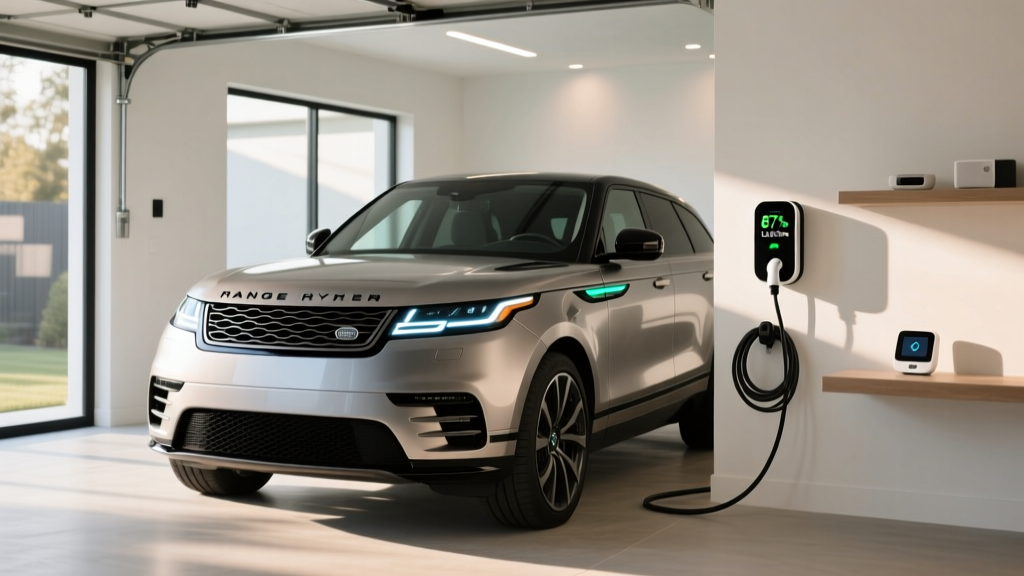
The Range Rover plug in hybrid (PHEV) pairs a turbocharged inline-six engine with a 31.8 kWh lithium-ion battery to deliver up to 48 miles of EPA-rated electric-only range. That electric buffer is only useful if you can recharge it regularly — and that means understanding what charging hardware you need, what it costs to install, and how fast each method replenishes the battery.
This guide covers the current-generation Range Rover P440e and P460e plug-in hybrids, with specific charging times, home installation requirements, equipment picks, and a cost-per-mile breakdown versus the gas-only Range Rover.
Range Rover PHEV Battery and Charging Specs at a Glance
Before selecting a charger, you need the numbers that define how the Range Rover PHEV accepts energy. The current model uses a 31.8 kWh gross battery (approximately 28.6 kWh usable) and supports AC charging only — there is no DC fast-charge port on this vehicle.
| Specification | Value |
|---|---|
| Battery (gross / usable) | 31.8 kWh / ~28.6 kWh |
| EPA electric-only range | 48 miles |
| Onboard AC charger | 7.2 kW (single-phase) |
| DC fast charging | Not supported |
| Charge port connector | J1772 (Level 1 & Level 2 AC) |
| Level 2 charge time (0–100%) | ~4.5 hours at 7.2 kW |
| Level 1 charge time (0–100%) | ~17 hours at 1.4 kW |
| Combined system output | 434–453 hp (P440e/P460e) |
| Base MSRP (2026) | ~$109,000 |
Charging Levels Explained: Speeds and Range Added Per Hour
EV and PHEV charging is measured in kW (kilowatts), which represents the rate of power delivery. The battery capacity is measured in kWh (kilowatt-hours), which represents total energy stored. Think of kW as the speed of water flowing from a hose, and kWh as the total volume in the bucket. The Range Rover PHEV's 7.2 kW onboard charger caps how fast it can accept AC power, regardless of how powerful the wall unit is.
| Level | Voltage | Max Power (kW) | Miles of Range Added/Hour | Full Charge Time (31.8 kWh) |
|---|---|---|---|---|
| Level 1 | 120V / 12A | 1.4 kW | ~3–4 mi/hr | ~17 hours |
| Level 2 (vehicle-limited) | 240V / 32A | 7.2 kW | ~18–20 mi/hr | ~4.5 hours |
| Level 2 (48A charger) | 240V / 48A | 11.5 kW (limited to 7.2 kW by vehicle) | ~18–20 mi/hr | ~4.5 hours |
| DC Fast Charging | — | Not available | — | — |
The critical takeaway: installing a 48A or 80A Level 2 charger will not charge the Range Rover PHEV faster than a 32A unit, because the vehicle's onboard charger caps intake at 7.2 kW. However, a higher-amperage charger gives you flexibility for a future full-electric vehicle that may accept 11.5 kW or 19.2 kW.
Home Charger Installation: Electrical Requirements and Costs
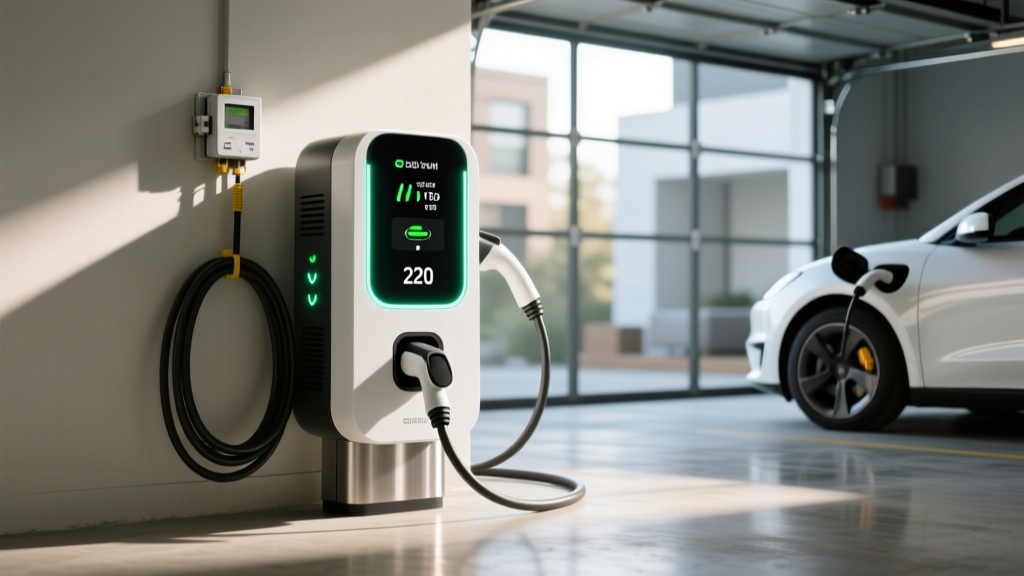
Most Range Rover PHEV owners will want a Level 2 home charger for overnight replenishment. A 32A Level 2 station on a 240V circuit delivers the full 7.2 kW the vehicle can accept. Here is what the installation involves.
Electrical Requirements
- Circuit: Dedicated 40A breaker (for a 32A continuous-load charger) or 50A breaker (for a 40A charger). NEC code requires continuous loads to use no more than 80% of breaker capacity.
- Wiring: 8 AWG copper (40A circuit) or 6 AWG copper (50A circuit), run in conduit where exposed.
- Outlet vs. hardwired: A NEMA 14-50 outlet offers portability; a hardwired unit avoids the ~$80–$150 receptacle cost and eliminates a GFCI breaker requirement in some jurisdictions.
- Panel capacity: Your electrical panel must have spare amperage headroom. A 200A panel serving a large home may need a load calculation to confirm a 40A addition is permissible.
Panel Upgrade Considerations
Homes built before 2000 often have 100A or 150A panels. Adding a 40A EV circuit to a fully loaded 100A panel can exceed safe capacity, requiring a panel upgrade to 200A. This is the single largest variable in installation cost and is frequently overlooked in online estimates.
| Component | Low Estimate | High Estimate | Notes |
|---|---|---|---|
| Level 2 charger (32A–48A) | $350 | $700 | Smart Wi-Fi units cost more |
| Electrician labor (standard install) | $500 | $1,500 | Depends on panel-to-garage distance |
| Materials (wire, conduit, breaker) | $150 | $500 | Longer runs = more wire cost |
| NEMA 14-50 receptacle (if not hardwired) | $80 | $150 | Includes industrial-grade outlet |
| Permit and inspection | $50 | $300 | Varies by municipality |
| Panel upgrade (100A → 200A, if needed) | $1,500 | $3,500 | Major cost — not always required |
| Total (no panel upgrade) | $1,130 | $3,150 | Most homes with 200A panels |
| Total (with panel upgrade) | $2,630 | $6,650 | Older homes with 100A service |
Always hire a licensed electrician and pull a permit. Unpermitted EV charger installations can void home insurance coverage and create fire risk. Per the National Electrical Code, EV charging circuits require proper overcurrent protection and, in many jurisdictions, GFCI protection for outdoor receptacles.
Which Connector and Charger Is Compatible with the Range Rover PHEV?
The Range Rover plug in hybrid uses the J1772 connector for all AC charging. This is the standard plug for every non-Tesla EV and PHEV sold in North America. You do not need a NACS (Tesla) adapter, because the Range Rover PHEV cannot use DC fast chargers where the NACS/CCS distinction matters most.
| Connector | Type | Range Rover PHEV Compatible? | Notes |
|---|---|---|---|
| J1772 | AC (Level 1 & 2) | Yes — native | Standard plug on all Level 2 home chargers |
| NACS (Tesla) | AC/DC | No (not needed) | Tesla Superchargers are DC — PHEV cannot use them |
| CCS1 | DC Fast | No (not needed) | Vehicle does not support DC fast charging |
| CHAdeMO | DC Fast | No (not needed) | Largely deprecated in the US |
Any quality Level 2 home charger with a J1772 plug will work. If you also own a Tesla, consider a charger with a J1772 plug plus a Tesla-to-J1772 adapter, or install a Tesla Wall Connector with the included J1772 adapter cable (Gen 3).
Recommended Home Chargers for the Range Rover PHEV
Since the Range Rover PHEV caps at 7.2 kW (32A), you can choose a 32A charger to match perfectly, or a 48A unit for future-proofing. Here are three proven options.
ChargePoint Home Flex (up to 50A)
- Power output: Up to 12 kW (50A) — vehicle will draw 7.2 kW max
- Connector: J1772, 23-foot cable
- Smart features: Wi-Fi, app scheduling, Alexa integration, energy tracking
- Price: ~$550 (unit only)
- Best for: Owners who want detailed app data and may upgrade to a full EV later
Emporia Level 2 EV Charger (48A)
- Power output: Up to 11.5 kW (48A) — vehicle will draw 7.2 kW max
- Connector: J1772, 24-foot cable
- Smart features: Wi-Fi, real-time energy monitoring, solar integration, load management
- Price: ~$400 (unit only)
- Best for: Budget-conscious buyers who want smart load management on older panels
Grizzl-E Smart (40A)
- Power output: Up to 9.6 kW (40A) — vehicle will draw 7.2 kW max
- Connector: J1772, 24-foot cable
- Smart features: Wi-Fi, OCPP-compatible, adjustable amperage via DIP switches
- Price: ~$450 (unit only)
- Best for: Cold-climate owners — rated to -40°F, built in Canada with a rugged aluminum case
Charging Cost: Range Rover PHEV vs. Gas Per Mile
The economic case for the Range Rover plug in hybrid depends on how often you drive within its 48-mile electric envelope and what you pay for electricity versus premium gasoline. The P440e/P460e requires premium 91+ octane fuel.
| Scenario | Rate | Cost for Full 28.6 kWh Usable Charge | Cost Per Electric Mile (48 mi) | Equivalent Gas Cost Per Mile |
|---|---|---|---|---|
| Home off-peak (utility TOU rate) | $0.12/kWh | $3.43 | $0.07/mi | — |
| Home average (national residential) | $0.17/kWh | $4.86 | $0.10/mi | — |
| Public Level 2 (ChargePoint, etc.) | $0.25/kWh | $7.15 | $0.15/mi | — |
| Gas-only Range Rover (19 MPG combined, $4.20/gal premium) | — | — | — | $0.22/mi |
At home off-peak rates, the Range Rover PHEV costs roughly $0.07 per electric mile — about one-third the cost of the gas-only Range Rover at $0.22/mile. Over 12,000 miles per year with 70% electric driving, that translates to approximately $1,100–$1,400 in annual fuel savings versus the gas model, according to fueleconomy.gov comparative data.
On longer trips where the battery is depleted, the PHEV operates as a conventional hybrid, returning an EPA-rated 20–21 MPG combined — only marginally better than the mild-hybrid gas Range Rover. The savings come from daily electric commuting, not highway road trips.
Public Charging: What to Expect with the Range Rover PHEV
Public Level 2 chargers (at shopping centers, workplaces, and parking garages) are the only public infrastructure relevant to the Range Rover PHEV. Since the vehicle does not support DC fast charging, Tesla Superchargers, Electrify America, and EVgo DC stations are not usable.
- Public Level 2 speed: Typically 6.6–7.2 kW, adding ~18–20 miles of range per hour — identical to home Level 2.
- Cost: $0.20–$0.35/kWh at networked stations; some workplaces and municipalities offer free Level 2 charging.
- Practical use case: A 2-hour stop at a grocery store with Level 2 charging can add ~36–40 miles — nearly a full electric tank for the Range Rover PHEV.
- Apps to find chargers: PlugShare, ChargePoint, and the Land Rover InControl app all show nearby J1772 Level 2 stations.
For PHEV owners, the public charging network is less critical than for full-electric vehicles. Your home Level 2 charger handles daily needs, and the gas engine covers long trips without any charging dependency.
Safety, Code, and Best Practices
Installing and operating a Level 2 charger safely requires attention to electrical code and practical habits:
- Dedicated circuit: Never share the EV charger circuit with other high-draw appliances (dryer, oven, HVAC). NEC Article 625 requires a dedicated branch circuit for EV supply equipment.
- GFCI protection: Outdoor NEMA 14-50 receptacles require GFCI breakers in most jurisdictions (2023 NEC and later). Hardwired installations may be exempt — confirm with your local inspector.
- Outdoor rating: If your charger is mounted outside or in an open carport, ensure the unit carries a NEMA 4 (weatherproof) rating. All three recommended chargers above are rated for outdoor use.
- Cable management: A 23–24 foot cable is standard. Avoid extension cords entirely — they introduce resistance, heat, and code violations.
- Scheduled charging: Use your charger's app or the Range Rover's onboard timer to charge during off-peak utility hours (typically 10 PM – 6 AM), reducing cost by 30–50%.
Frequently Asked Questions
How much does it cost to install a home EV charger for the Range Rover PHEV?
A standard Level 2 installation on an existing 200A panel typically costs $1,100–$3,150 including the charger, electrician labor, materials, and permit. If your home needs a panel upgrade from 100A to 200A, add $1,500–$3,500. Always get a site visit and written quote from a licensed electrician before committing.
How fast will each charging level add range to the Range Rover PHEV?
Level 1 (120V standard outlet) adds approximately 3–4 miles of electric range per hour — enough to recover ~35 miles overnight in 10 hours. Level 2 (240V, 32A) adds approximately 18–20 miles per hour and fully recharges the 31.8 kWh battery in about 4.5 hours. The vehicle does not support DC fast charging.
Which connector and charger is compatible with the Range Rover plug in hybrid?
The Range Rover PHEV uses the J1772 connector, the North American standard for AC charging. Any Level 2 home charger with a J1772 plug is compatible. You do not need a NACS/Tesla adapter or CCS connector, as the vehicle cannot use DC fast chargers.
How much does charging the Range Rover PHEV cost per mile versus gas?
At the national average residential rate of $0.17/kWh, a full charge costs approximately $4.86 and delivers ~48 electric miles, or $0.10 per mile. The gas-only Range Rover at 19 MPG with $4.20/gallon premium fuel costs about $0.22 per mile. Home off-peak rates can drop electric cost to $0.07 per mile — roughly one-third the gas cost.
What electrical upgrades might I need for a home Level 2 charger?
You need a dedicated 240V circuit with a 40A or 50A breaker. Homes with 200A panels usually have sufficient capacity. Homes with 100A or 150A panels may require a panel upgrade ($1,500–$3,500) or a smart load-management device that throttles the charger when household demand is high. A licensed electrician can perform a load calculation to determine your specific requirements, per NEC Article 220.
Does the Range Rover PHEV qualify for the federal EV tax credit?
Under IRS §30D rules, PHEVs must meet battery capacity (at least 7 kWh), MSRP caps ($80,000 for SUVs), critical-mineral sourcing, and buyer income limits to qualify. The Range Rover PHEV exceeds the $80,000 MSRP cap at ~$109,000 base, making it ineligible for the federal clean vehicle credit regardless of battery sourcing. Consult a tax professional for your specific situation, and check whether your state offers separate PHEV incentives.