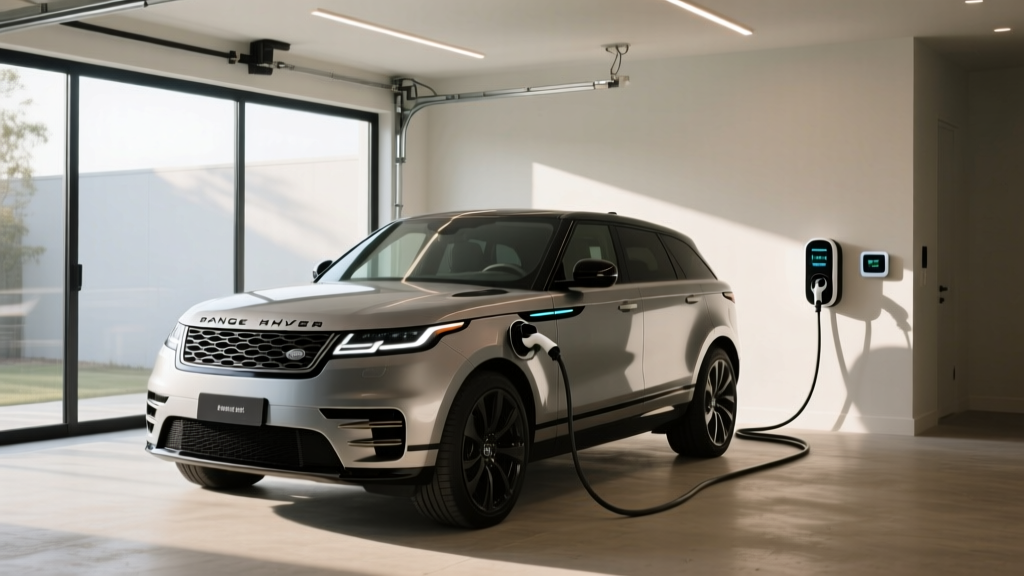
Owners searching for ways to maximize their Range Rover PHEV range quickly discover that how you charge matters as much as how you drive. The 2026 Range Rover Sport PHEV and the full-size Range Rover P460e/P550e models pack substantial battery packs — up to 38.2 kWh usable — delivering an EPA-estimated 48 to 58 miles of electric-only driving. But extracting every one of those electric miles, and doing it affordably, requires understanding the charging infrastructure you plug into each night.
This guide covers the three charging levels available to Range Rover PHEV owners, the real-world cost of a Level 2 home installation, connector compatibility, equipment picks, and exactly how much you'll save per mile versus burning petrol.
Understanding the Range Rover PHEV Battery and Electric Range
Before sizing a charger, you need to know what you're filling. The current-generation Land Rover models use an advanced plug-in hybrid architecture:
- 2026 Range Rover P460e (full-size): 38.2 kWh usable lithium-ion battery, EPA-estimated 58 miles electric-only range, 3.0L inline-6 turbo + electric motor producing 456 combined horsepower.
- 2026 Range Rover Sport P460e: 38.2 kWh usable battery, EPA-estimated 48 miles electric-only range, same powertrain family.
- Onboard AC charger: 7.2 kW maximum (single-phase). This is the ceiling for how fast the vehicle can accept AC power at home or at public Level 2 stations.
With a 38.2 kWh battery to refill nightly, your charging level determines whether you wake up to a full battery or a partially charged one. Here's the breakdown.
Charging Levels Explained: Speeds, kW, and Miles Per Hour
There are three ways to put electrons into your Range Rover PHEV. Power is measured in kW (kilowatts) — the rate of energy flow — while battery capacity is measured in kWh (kilowatt-hours) — the total energy stored. Confusing these two is the most common EV literacy mistake. Think of kW as the width of the pipe and kWh as the size of the tank.
| Level | Voltage / Amperage | Max Power (kW) | Miles of Range Added Per Hour | 0–100% Time (38.2 kWh) |
|---|---|---|---|---|
| Level 1 (120V outlet) | 120V / 12A | 1.4 kW | ~3–4 mi/hr | ~27 hours |
| Level 2 (240V home charger) | 240V / 32A | 7.2 kW (vehicle limit) | ~18–22 mi/hr | ~5.5 hours |
| DC Fast Charging | N/A (DC direct) | ~50 kW peak | ~100+ mi/hr (theoretical) | ~45 min (10–80%) |
Key insight for Range Rover PHEV owners: Because the onboard AC charger caps at 7.2 kW, installing a 48-amp (11.5 kW) home charger will not charge the vehicle any faster. A 32-amp Level 2 circuit delivering 7.7 kW is perfectly matched to the vehicle's capability. Paying extra for a higher-amperage charger only makes sense if you plan to also charge a full BEV (like a future all-electric Land Rover) in the same garage.
How Much Does It Cost to Install a Home EV Charger?
Home Level 2 charging is the cheapest and most convenient way to keep your Range Rover PHEV topped up. But installation costs vary dramatically based on your home's electrical panel and the distance from the panel to your garage or parking spot.
| Component | Simple Install (panel nearby, no upgrade) | Complex Install (long run, panel upgrade) |
|---|---|---|
| Level 2 charger (hardware) | $350 – $700 | $350 – $700 |
| Electrician labor (240V/40A circuit) | $400 – $800 | $1,200 – $2,500 |
| Electrical panel upgrade (100A → 200A) | $0 (not needed) | $1,500 – $3,500 |
| Permit & inspection | $50 – $200 | $100 – $350 |
| Total estimated cost | $800 – $1,700 | $3,150 – $7,050 |
Electrical Requirements for Range Rover PHEV Home Charging
For a dedicated Level 2 circuit matched to the Range Rover's 7.2 kW onboard charger, you need:
- Voltage: 240V (standard US split-phase, same as a dryer or oven)
- Amperage: 40A breaker (which delivers a continuous 32A to the vehicle — the National Electrical Code requires breakers rated at 125% of continuous load)
- Wire gauge: 8 AWG copper (for runs up to ~50 feet; 6 AWG for longer runs to minimize voltage drop)
- Dedicated circuit: The charger must be on its own breaker, not shared with other appliances
Panel upgrade gotcha: Homes built before the 1990s often have 100-amp electrical panels. Adding a 40A EV circuit to an already-loaded 100A panel may exceed safe capacity, especially if you also run central AC, an electric oven, and a dryer. A licensed electrician will perform a load calculation per NEC Article 220. If you need a panel upgrade to 200A, budget an additional $1,500–$3,500 and factor in potential utility coordination time.
Connector Compatibility: What Plugs Into a Range Rover PHEV?
The 2026 Range Rover PHEV sold in North America uses a J1772 connector for AC Level 2 charging and a CCS1 (Combined Charging System) port for DC fast charging. This is the standard shared by most non-Tesla electrified vehicles in the US.
| Connector | Used For | Range Rover PHEV Compatible? | Adapter Needed? |
|---|---|---|---|
| J1772 | Level 1 & Level 2 AC | ✅ Native | None |
| CCS1 | DC Fast Charging | ✅ Native | None |
| NACS (Tesla) | Level 2 & DC Fast (Superchargers) | ⚠️ With adapter | CCS1-to-NACS adapter (~$150–$250) |
| CHAdeMO | DC Fast (legacy) | ❌ Not compatible | N/A |
With Tesla opening its Supercharger network to non-Tesla vehicles via adapters and the broader industry shifting toward NACS, Range Rover PHEV owners may want a CCS1-to-NACS adapter for road trips. However, for daily home charging, a standard J1772 Level 2 charger is all you need — every home charger sold in the US (except Tesla Wall Connectors) ships with a J1772 plug.
Cost to Charge: Home vs. Public vs. Gas
One of the strongest arguments for plugging in nightly is cost. Here's how Range Rover PHEV charging costs compare across scenarios, based on a full 38.2 kWh battery refill:
| Scenario | Rate ($/kWh) | Full Charge Cost | Cost Per Mile (50 mi EV range) |
|---|---|---|---|
| Home (off-peak utility rate) | $0.12/kWh | $4.58 | $0.09/mi |
| Home (national average) | $0.17/kWh | $6.49 | $0.13/mi |
| Public Level 2 (ChargePoint, etc.) | $0.25–$0.40/kWh | $9.55–$15.28 | $0.19–$0.31/mi |
| DC Fast Charging (Electrify America) | $0.35–$0.55/kWh | $13.37–$21.01 | $0.27–$0.42/mi |
| Gasoline comparison (19 MPG combined, $3.60/gal) | — | — | $0.19/mi |
At home off-peak rates, driving on electricity in a Range Rover PHEV costs roughly half what gasoline costs per mile. Even at the national average electricity rate, you're saving meaningfully. The math flips if you rely exclusively on expensive DC fast chargers — which is why home Level 2 charging is the economic foundation of PHEV ownership.
According to fueleconomy.gov, the Range Rover Sport PHEV achieves an EPA-rated MPGe that makes electric-mode driving significantly cheaper than gas-only mode, which drops to roughly 19–20 MPG combined for a vehicle of this weight and capability.
Best Home Chargers for the Range Rover PHEV (2026 Picks)
Since the Range Rover caps at 7.2 kW AC charging, the ideal home charger delivers 32 amps on a 40-amp circuit. Here are three proven options across price points:
Emporia Level 2 EV Charger
- Power output: Up to 48A (11.5 kW) — set to 32A for the Range Rover
- Connector: J1772 (NACS version also available)
- Cable length: 24 feet
- Smart features: Wi-Fi connected, app-based scheduling, energy monitoring, solar integration, utility TOU optimization
- Price: ~$399
- Best for: Budget-conscious owners who want granular energy data and solar-aware charging
ChargePoint Home Flex
- Power output: Up to 50A (12 kW) — adjustable via DIP switch
- Connector: J1772 (NACS adapter available separately)
- Cable length: 23 feet
- Smart features: Wi-Fi, Alexa integration, scheduled charging, ChargePoint network account for public charging
- Price: ~$649
- Best for: Owners who want a proven brand with excellent app and public-network integration
Tesla Universal Wall Connector
- Power output: Up to 48A (11.5 kW)
- Connector: Built-in NACS + included J1772 adapter (Magic Dock style)
- Cable length: 24 feet
- Smart features: Wi-Fi, Tesla app integration, Power Sharing for multi-charger installs, over-the-air updates
- Price: ~$599
- Best for: Multi-EV households with both Tesla and non-Tesla vehicles (like a Range Rover PHEV + Tesla)
All three units are UL-listed, suitable for indoor or outdoor installation (NEMA 4 rated), and hardwired for maximum reliability. For the Range Rover PHEV specifically, the ChargePoint Home Flex or Emporia at a 32A setting is the most cost-effective match.
Safety, Electrical Code, and Installation Best Practices
EV charging is a continuous high-load electrical operation — it runs at maximum draw for hours at a time, similar to an electric oven but for longer durations. Safety and code compliance are non-negotiable.
- Dedicated circuit: NEC Article 625 requires EV chargers to be on a dedicated branch circuit. Never share the circuit with a dryer, HVAC, or other appliance.
- GFCI protection: The 2020 NEC and later require GFCI (Ground Fault Circuit Interrupter) protection for outdoor receptacles and in many jurisdictions for hardwired EV chargers as well. Your electrician will specify the correct breaker type.
- Outdoor rating: If your charger is mounted outside or in an open carport, ensure the unit carries a NEMA 4 (weatherproof) rating. All three chargers recommended above meet this standard.
- Permit and inspection: Most US jurisdictions require an electrical permit for a new 240V circuit. The permit fee is typically $50–$200, and an inspector will verify the installation meets code. Skipping the permit risks voiding your homeowner's insurance in the event of an electrical fire.
- Hardwired vs. plug: Hardwired installations (no plug, direct connection to junction box) are more reliable and avoid the potential for a 14-50 or 6-50 receptacle to loosen over time. Most EV charger manufacturers recommend hardwiring for permanent installations.
Always hire a licensed electrician familiar with NEC Article 625 (Electric Vehicle Charging System Equipment). Land Rover's official charging guide also recommends using certified installers for warranty compliance.
Charging Times: What to Expect With Your Range Rover PHEV
Here are realistic charging time estimates for the 38.2 kWh battery, accounting for typical charging inefficiencies (~10% energy loss as heat during AC charging):
- Level 1 (120V, 1.4 kW): A full 0–100% charge takes approximately 27–30 hours. This is impractical for daily use but works as a trickle-charge supplement if you only drive 10–15 miles per day.
- Level 2 (240V, 7.2 kW): A full 0–100% charge takes approximately 5.5–6 hours. Plug in when you get home at 7 PM, and the battery is full by midnight. This is the sweet spot for PHEV ownership.
- DC Fast Charging (~50 kW): A 10–80% charge takes roughly 40–50 minutes. Note that the Range Rover PHEV's DC fast charge rate is modest compared to full BEVs — it's useful for topping up on road trips but not a primary charging strategy.
Frequently Asked Questions
How much does it cost to install a home EV charger for my Range Rover PHEV?
A straightforward Level 2 installation with a nearby 200A electrical panel typically costs $800–$1,700 (charger hardware + electrician + permit). If your home needs a panel upgrade from 100A to 200A, total costs can reach $3,150–$7,050. Always get a quote from a licensed electrician who will perform a load calculation first.
How fast will each charging level add range to my Range Rover PHEV?
Level 1 (120V) adds roughly 3–4 miles of electric range per hour. Level 2 (240V at 32A) adds roughly 18–22 miles per hour. DC fast charging can add 100+ miles per hour in theory, but the PHEV's smaller battery and ~50 kW DC cap means practical top-ups take 40–50 minutes for a 10–80% fill.
Which connector and charger are compatible with the Range Rover PHEV?
The Range Rover PHEV uses a J1772 connector for Level 1 and Level 2 AC charging, and a CCS1 port for DC fast charging. Any J1772 home charger will work. For Tesla Supercharger access, you'll need a CCS1-to-NACS adapter.
How much does charging cost per mile versus gasoline?
At the US average residential electricity rate of ~$0.17/kWh, home charging costs approximately $0.13 per electric mile. Gasoline at $3.60/gallon with the Range Rover's ~19 MPG combined costs about $0.19 per mile. That's a roughly 32% savings per mile when driving on electricity — and up to 53% with off-peak utility rates.
What electrical upgrades might I need for a Level 2 charger?
You may need a panel upgrade (100A to 200A, ~$1,500–$3,500) if your existing panel lacks capacity. You'll definitely need a dedicated 40A/240V breaker and appropriate wiring (8 AWG or 6 AWG copper). Homes with existing 200A panels and available breaker slots usually need no panel upgrade. Check with the IRS regarding potential energy-efficient home improvement credits that may offset some installation costs.
Can I use a Tesla Wall Connector to charge my Range Rover PHEV?
Yes, with the Tesla Universal Wall Connector, which includes a built-in J1772 adapter alongside its native NACS plug. The standard Tesla Wall Connector (NACS only) requires a separate NACS-to-J1772 adapter, which adds complexity. The Universal model is the cleaner solution for mixed-EV garages.
Is it safe to leave the Range Rover PHEV plugged in overnight?
Absolutely. Modern PHEVs have battery management systems that stop charging at 100% and manage thermal conditions automatically. Leaving it plugged in is actually recommended — it allows the vehicle to precondition the cabin and battery using grid power rather than battery charge, preserving your electric range for driving.