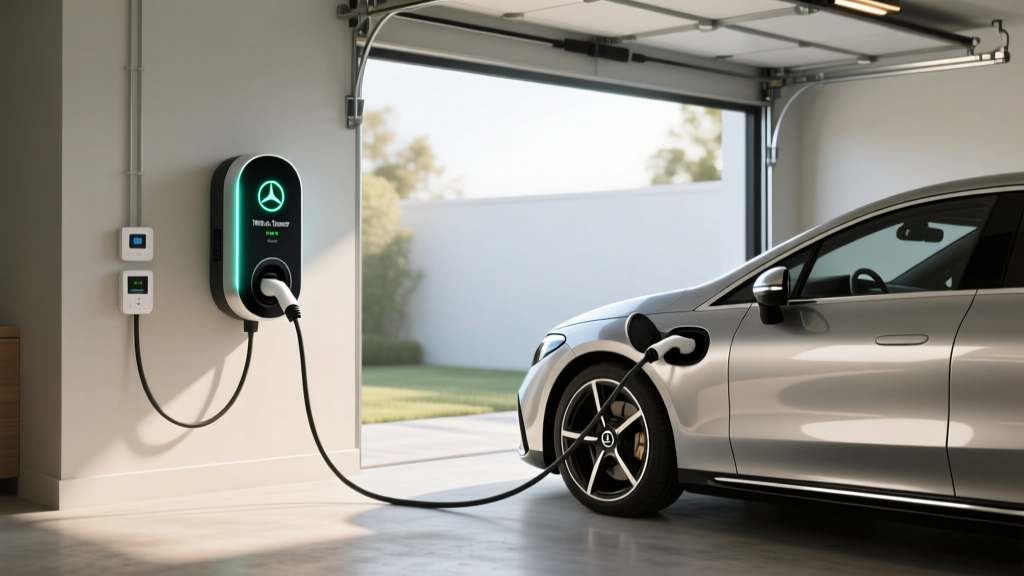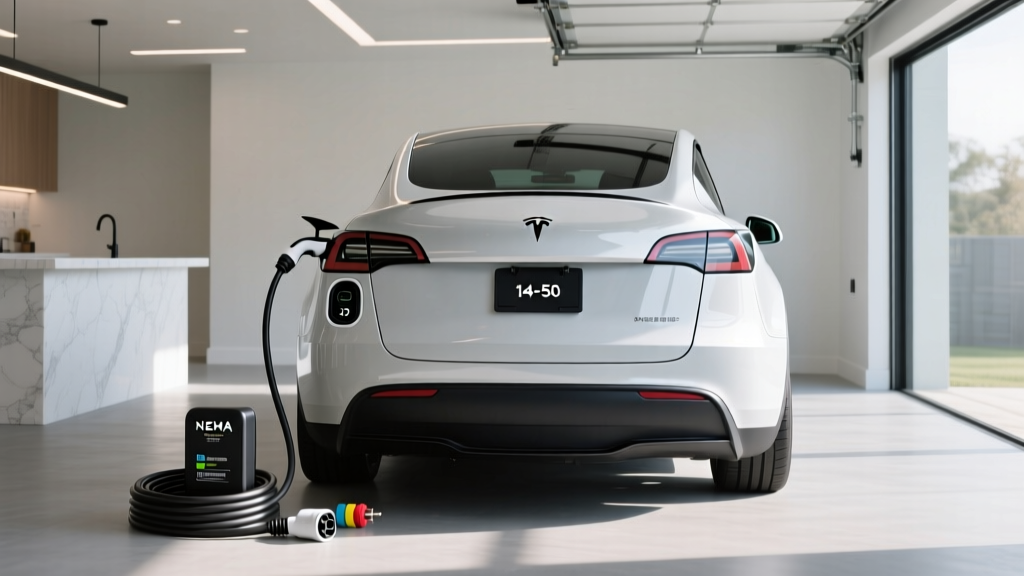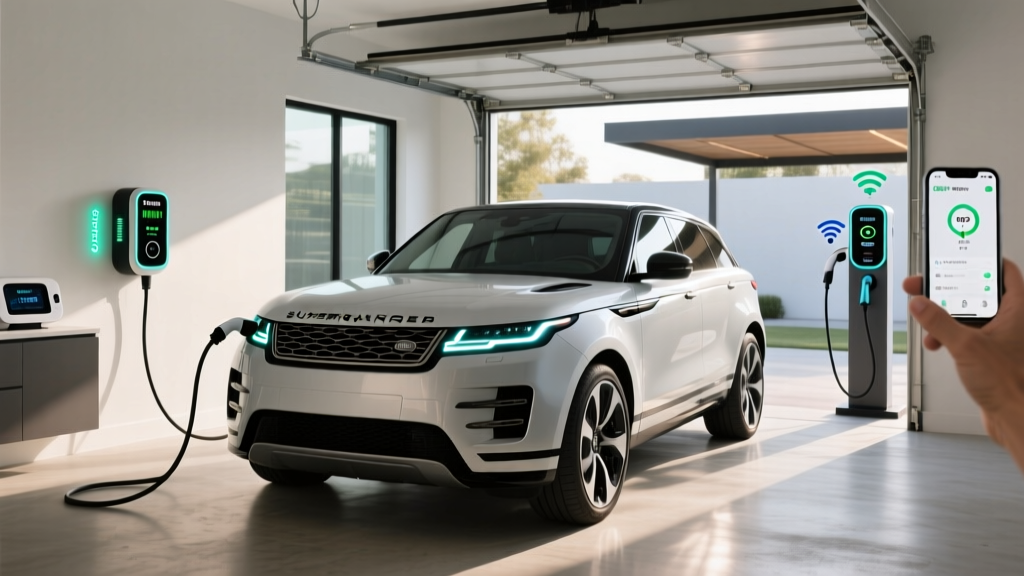
If you've been searching for a supercharged Range Rover and stumbled onto the brand's electrified lineup, you're not alone. Land Rover has offered plug-in hybrid (PHEV) Range Rover models since 2019, and by the 2025–2026 model years the flagship Range Rover and Range Rover Sport are available with PHEV powertrains pairing a turbocharged or supercharged inline-six with a sizable traction battery. What many new owners discover after signing the papers is that charging logistics—home wiring, connector types, public-network quirks—are a whole new vocabulary.
This guide walks through exactly how to charge an electrified Range Rover (PHEV today, battery-electric when it arrives) at home and on the road, with the numbers, costs, and hardware picks you need to plan a real installation.
What "Supercharged Range Rover" Means in an Electrified Lineup
The phrase "supercharged Range Rover" traditionally referred to the 5.0L supercharged V8 (and later the P530/P400 mild-hybrid inline-six) in the Range Rover and Range Rover Sport. For the 2025–2026 model years, the electrified options are:
- Range Rover P550e PHEV — turbocharged 3.0L inline-six + electric motor, 23.1 kWh usable battery (out of ~31.8 kWh gross), EPA-estimated 48 miles of electric-only range, J1772/CCS1 inlet on US-spec models.
- Range Rover Sport P550e PHEV — same powertrain, slightly lower EPA electric range (~46 miles) due to weight and aero.
- Range Rover Electric — announced on the MLA-Flex architecture; final US EPA range, battery size, and charge rate are preliminary. Expect CCS1/NACS compatibility via adapter at launch.
The PHEVs can be driven on electricity alone for short commutes and on blended power for longer trips. The all-electric model will behave like any other BEV when it reaches US showrooms. Charging fundamentals below apply to both.
Charging Levels Explained: kW, Miles per Hour, and Real Times
The single most important distinction in EV charging is between kW (power, the rate of flow) and kWh (energy, the battery's capacity). Think of kW as the hose diameter and kWh as the size of the tank. A higher kW charger fills the tank faster, but the tank size is fixed.
| Level | Power (kW) | Voltage / Amps | Miles of range per hour | PHEV 10–100% | BEV 10–80% |
|---|---|---|---|---|---|
| Level 1 (120V) | 1.4–1.9 kW | 120V / 12–16A | ~3–5 mi/hr | ~10–14 hr | 40+ hr (impractical) |
| Level 2 (240V) | 7.2–19.2 kW | 240V / 30–80A | ~20–55 mi/hr | ~2.5–4 hr | 5–12 hr (overnight) |
| DC Fast (public) | 50–350 kW | 400–800V DC | ~150–1,000 mi/hr | N/A (PHEVs rarely DC-charge) | 18–45 min |
Two real-world caveats. First, the Range Rover P550e PHEV's onboard charger is rated at 7.2 kW AC, so even if you plug into a 19.2 kW Level 2 wall connector, the car will only accept 7.2 kW—plan your equipment accordingly. Second, DC fast charging follows a charge curve: a 250 kW peak rate is sustained only from roughly 10–40% state of charge, then tapers steeply above 80% to protect the battery. The "10–80%" time is the honest metric to compare.
Home Installation: What Your Electric Panel Actually Needs
Home Level 2 charging is where 80%+ of electrified Range Rover miles will be added. The electrical requirements depend on the circuit you install:
- 240V / 40A circuit → 32A continuous draw → ~7.7 kW. This is the sweet spot for the P550e PHEV (matches its 7.2 kW onboard cap with overhead).
- 240V / 60A circuit → 48A continuous → ~11.5 kW. Recommended if you plan to own a future BEV Range Rover.
- 240V / 80A circuit → 64A continuous → ~15.3 kW. Overkill for the PHEV, but future-proofs for BEVs and supports 800V-architecture vehicles.
Per the NEC, continuous EV loads must be sized at 125% of the rated draw, so a 48A charger needs a 60A breaker. A licensed electrician will verify your panel's spare capacity before committing to a circuit.
Install Cost Breakdown
| Item | Low | Typical | High |
|---|---|---|---|
| Level 2 charger hardware | $400 | $650 | $1,200 |
| Electrician labor (run + terminate) | $500 | $1,100 | $2,200 |
| Permit & inspection | $75 | $175 | $400 |
| Panel upgrade (200A service, if needed) | $1,800 | $3,200 | $5,500 |
| Total (no panel upgrade) | $975 | $1,925 | $3,800 |
| Total (with panel upgrade) | $2,775 | $5,125 | $9,300 |
Homes built before 2000 with 100A or 150A service often need a panel upgrade to safely add a 60A EV circuit alongside HVAC, dryer, and range loads. The electrician will perform a NEC Article 220 load calculation. If you're in that situation, consider a smart load-management charger (Emporia, Wallbox Pulsar) that clamps to your mains and throttles the EV when other loads spike—often avoiding a $3k+ panel upgrade.
Connector Compatibility: NACS, CCS1, and Adapters
As of the 2025–2026 model years, the North American connector landscape is mid-migration. Ford, GM, Rivian, Volvo, and others have moved to NACS (Tesla's connector), while most legacy and European brands still ship with CCS1. JLR has not announced a NACS-native Range Rover for the US market, so expect CCS1 on the P550e PHEV and the upcoming Range Rover Electric.
| Network / Source | Native Plug | Works with Range Rover CCS1 inlet? | Adapter needed? |
|---|---|---|---|
| Home Level 2 (J1772) | J1772 | Yes (CCS1 includes J1772 pins) | None |
| Electrify America, EVgo, ChargePoint DC | CCS1 | Yes, direct | None |
| Tesla Supercharger (NACS) | NACS | No, without adapter | CCS1-to-NACS (Tesla-approved or Lectron/Autel) |
| CHAdeMO (Nissan Leaf legacy) | CHAdeMO | No | Not recommended — network is sunsetting |
If you want Supercharger access for a future BEV Range Rover, budget $200–$350 for a quality CCS1-to-NACS adapter with the correct signal pins. For PHEVs, public DC fast charging is rarely relevant—the onboard DC-charge capability on the P550e is limited or absent depending on market, so plan around Level 2.
Charging Cost per Mile vs. Gasoline
A common Range Rover Supercharged V8 (pre-electrification) returned roughly 16–18 MPG combined. The P550e PHEV, when charged regularly, can run the majority of commuting miles on electricity. Here's the per-mile cost comparison at typical US rates:
| Scenario | Energy cost | Efficiency | Cost per mile |
|---|---|---|---|
| Home Level 2, off-peak (utility avg) | $0.14/kWh | 2.7 mi/kWh (~91 MPGe) | $0.052 |
| Home Level 2, peak summer | $0.28/kWh | 2.7 mi/kWh | $0.104 |
| Public Level 2 (mall/workplace) | $0.35/kWh | 2.7 mi/kWh | $0.130 |
| DC fast charging (EA, EVgo) | $0.52/kWh | 2.7 mi/kWh | $0.193 |
| Range Rover Supercharged V8 (gas) | $3.40/gal | 17 MPG | $0.200 |
Charging at home off-peak is roughly 4x cheaper per mile than fueling the old supercharged V8. Even public DC fast charging approaches gasoline parity—which is why the economics only make sense if you can install Level 2 at home or use a subsidized workplace charger. The EPA's fueleconomy.gov lists the P550e's combined MPGe at 46 MPGe in blended operation; pure electric efficiency is significantly higher when you stay within the 48-mile EV window.
Equipment Picks for a Range Rover PHEV or BEV
Because the P550e caps at 7.2 kW AC, you don't need a 48A charger today—but installing one future-proofs for the Range Rover Electric or a second EV. Three picks that match the use case:
Emporia Vue + EV Charger (48A, hardwired)
- Output: 11.5 kW @ 48A, 240V
- Cable: 24 ft
- Smart features: load management, solar integration, app scheduling
- Price: ~$599 (charger) + $150 (Vue panel monitor)
- Best for: homes needing load management to avoid a panel upgrade
ChargePoint Home Flex (up to 50A, NEMA 14-50 or hardwired)
- Output: up to 12 kW @ 50A
- Cable: 23 ft
- Smart features: Alexa/Google, scheduling, energy reports
- Price: ~$699
- Best for: plug-in flexibility (take it when you move)
Wallbox Pulsar Plus (48A, hardwired)
- Output: 11.5 kW @ 48A
- Cable: 25 ft
- Smart features: Power Sharing for two EVs on one circuit, app control
- Price: ~$649
- Best for: compact size, dual-EV households
For a NACS-native future BEV, Tesla's Universal Wall Connector ($599, 48A) ships with both J1772 and NACS pigtails and is the simplest dual-connector solution.
Safety, Code, and Outdoor Considerations
A Level 2 EV circuit is a continuous load and must be treated accordingly under NEC Article 625:
- Dedicated circuit: no sharing with dryers, HVAC, or workshop outlets.
- Breaker sizing: 125% of the charger's rated continuous draw (48A charger → 60A breaker).
- GFCI protection: required for receptacle-based (NEMA 14-50) installs in garages and outdoors per 2020+ NEC; hardwired units generally exempt.
- Outdoor rating: chargers installed outside must be NEMA 4 (weatherproof). All three picks above carry that rating.
- Wire gauge: 6 AWG copper for 48A; 4 AWG for 64A runs over longer distances.
- Permit: required in nearly all US jurisdictions—skip it and you risk insurance denial on an electrical fire claim.
Always hire a licensed electrician; this is not a DIY project. Reference the NFPA NEC Article 625 if you want to verify your contractor's plan.
Frequently Asked Questions
How much does it cost to install a home EV charger for a Range Rover?
Expect $1,000–$3,800 for a typical 240V/48A hardwired install without a panel upgrade, and $3,000–$9,000+ if your home needs a 200A service upgrade. The electrician's load calculation determines which camp you fall into.
How fast will each charging level add range to the P550e PHEV?
Level 1 (120V): ~3–5 miles of EV range per hour. Level 2 at 7.2 kW (the car's onboard cap): ~22 miles of EV range per hour, or a full 0–100% charge in roughly 3.5 hours. DC fast charging is not the primary path for PHEVs.
Which connector is compatible with my Range Rover?
The 2025–2026 Range Rover P550e PHEV uses a CCS1/J1772 inlet. Any J1772 home charger or CCS1 public DC station works natively. Tesla Superchargers require a CCS1-to-NACS adapter. The upcoming Range Rover Electric is expected to follow the same CCS1 pattern in the US.
How much does charging cost per mile versus gas?
Home off-peak Level 2 charging costs roughly $0.05/mile; a comparable Range Rover Supercharged V8 on gas costs ~$0.20/mile. Public DC fast charging narrows the gap to ~$0.19/mile, which is why home charging is the economic linchpin.
What electrical upgrades might I need?
Homes with 100A or 150A service, older fuse panels, or panels already near capacity (dual HVAC, pool, workshop) typically need a 200A service upgrade or a smart load-managing charger. A licensed electrician will perform a NEC Article 220 load calculation to confirm.
Can I claim a tax credit for the charger install?
The federal Alternative Fuel Vehicle Refueling Property Credit (IRC §30C) covers up to 30% of home charger hardware and install cost, capped at $1,000, but only in eligible census tracts. Confirm eligibility on irs.gov before filing.