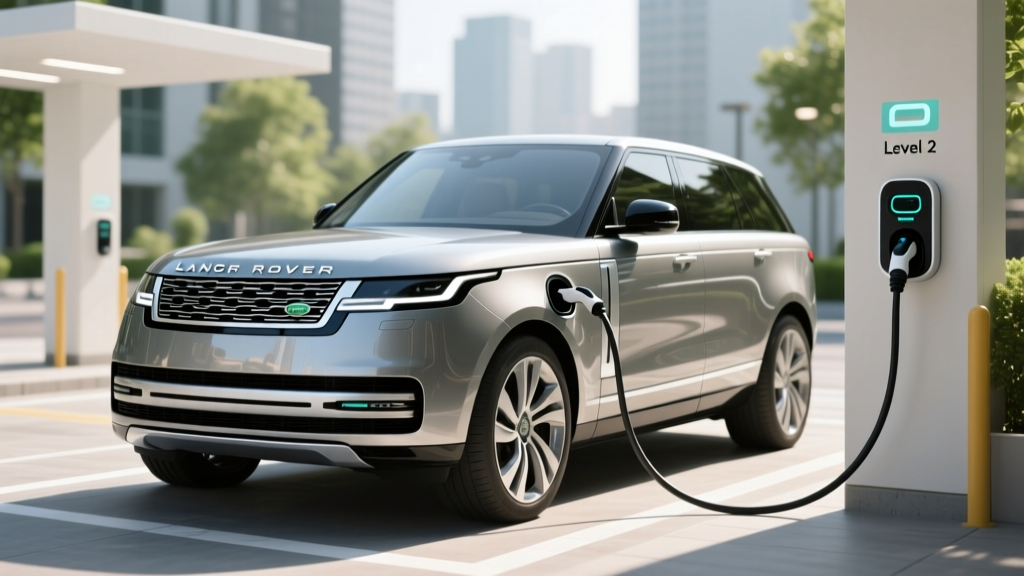
The 2025–2026 Land Rover Range Rover plug-in hybrid (PHEV) pairs a turbocharged inline-six with a 23.1 kWh lithium-ion battery, delivering an EPA-estimated 48 miles of electric-only range in the P460e and up to 51 miles in the updated P550e variant. That battery is large enough to matter for daily commuting, but it also means that plugging into a standard 120V wall outlet (Level 1) will take roughly 20 hours to fully replenish. For most Range Rover PHEV owners, a home Level 2 charger is not optional — it is the baseline for practical ownership.
This guide covers exactly what you need to charge a Range Rover plug-in hybrid at home and on the road: charging speeds at each level, home electrical requirements and costs, connector compatibility, per-mile charging costs versus gasoline, and specific equipment recommendations.
Charging Levels Explained: Speeds in kW and Miles Per Hour
Before evaluating equipment, it is essential to distinguish between kW (kilowatts — the rate of power delivery, like water pressure from a hose) and kWh (kilowatt-hours — the total energy stored or delivered, like gallons in a tank). The Range Rover PHEV's battery holds approximately 23.1 kWh of usable energy. How fast that battery fills depends on the kW rating of your charger — and the vehicle's onboard charger, which caps AC intake at 7.2 kW.
| Level | Voltage | Power (kW) | Miles of Range Added/Hour | Full Charge Time (23.1 kWh) |
|---|---|---|---|---|
| Level 1 (Standard Outlet) | 120V | 1.2–1.4 kW | ~3–4 mi/hr | ~18–22 hours |
| Level 2 (Home/Public AC) | 240V | 3.3–7.2 kW | ~12–22 mi/hr | ~3.5–5 hours |
| DC Fast Charging | 400V+ | Up to 50 kW* | ~80–120 mi/hr* | 10–80% in ~25 min* |
*Note: The current-generation Range Rover PHEV (P460e/P550e) does not support DC fast charging on most U.S. trims. AC Level 2 at 7.2 kW is the maximum charge rate. Always confirm DC capability with your specific model year and trim at Land Rover's official site.
At 7.2 kW (Level 2), you can expect roughly 3.5 to 4 hours to charge from empty to full. That means a nightly plug-in easily restores the full 48–51 miles of electric range by morning. Level 1, by contrast, would only add about 30–40 miles of range overnight — insufficient for a full battery top-up if you deplete it during the day.
Home Charger Installation: Electrical Requirements and Costs
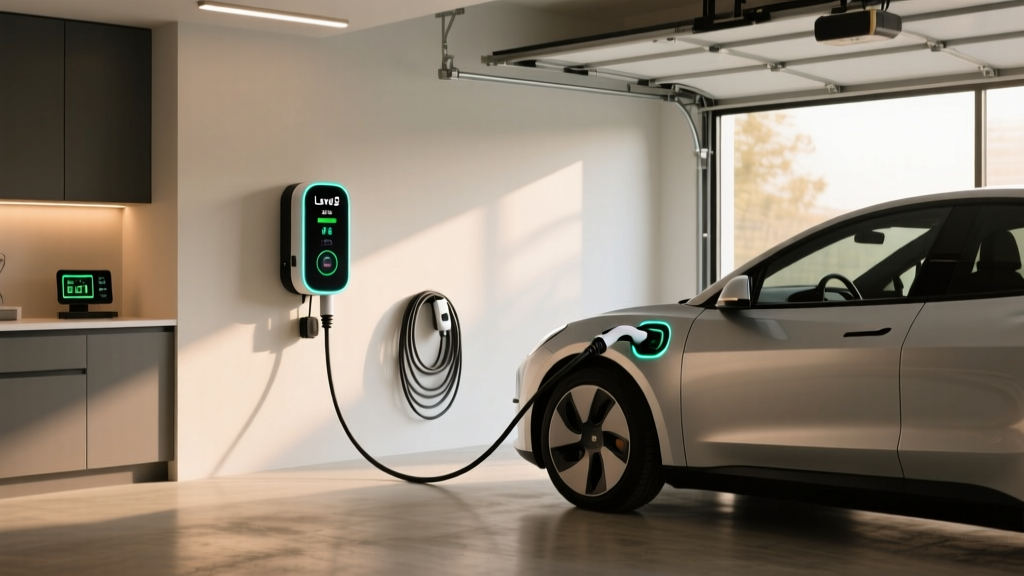
Installing a Level 2 charger for your Range Rover PHEV requires a dedicated 240V circuit. Because the vehicle's onboard charger maxes out at 7.2 kW (30 amps), a 40-amp circuit with a charger rated at 32A continuous is the practical sweet spot. You do not need the 48A or 80A circuits that full-size BEVs like the Ford F-150 Lightning or Rivian R1S require.
Typical Electrical Specifications
- Circuit amperage: 40A dedicated breaker (supports 32A continuous draw per the 80% NEC rule)
- Voltage: 240V (NEMA 14-50 outlet or hardwired connection)
- Wire gauge: 6 AWG copper (THHN in conduit) for a 40A circuit
- Outlet type: NEMA 14-50 (if using a plug-in charger) or direct hardwire
Panel Capacity and Upgrade Considerations
Most modern homes with a 200-amp electrical panel can accommodate a 40A EV circuit without a panel upgrade. However, if your home has a 100-amp panel (common in homes built before 1980), or if your panel is already near capacity with electric heating, a hot tub, or an electric range, a licensed electrician will need to perform a load calculation per NEC Article 220. If the calculation exceeds your panel's rating, a panel upgrade to 200A will add $1,500–$3,000 to the project.
Some homes may benefit from a smart load management device (such as the Emporia VUE with automatic load shedding), which avoids a full panel upgrade by throttling the charger when other high-draw appliances are running. This typically adds $300–$500 to the installation but can save thousands versus a panel swap.
| Cost Component | Typical Range | Notes |
|---|---|---|
| Level 2 Charger (Equipment) | $350–$700 | 32A–40A, J1772 connector, 25 ft cable |
| Electrician Labor (Standard Install) | $500–$1,200 | Assumes panel within 20–40 ft of garage |
| Permit and Inspection | $50–$200 | Varies by municipality |
| Electrical Materials (Wire, Conduit, Breaker) | $100–$300 | 6 AWG copper, 40A breaker |
| Panel Upgrade (If Needed) | $1,500–$3,000 | 100A → 200A service upgrade |
| Total (No Panel Upgrade) | $1,000–$2,400 | Most common scenario |
| Total (With Panel Upgrade) | $2,500–$5,400 | Older homes or maxed-out panels |
Always hire a licensed electrician and pull a permit. Unpermitted electrical work can void your homeowner's insurance and create fire hazards. The National Electrical Code (NEC) requires GFCI protection for outdoor outlets and specific bonding for garage installations. Refer to NFPA's NEC resources for code details in your jurisdiction.
Connector Compatibility: What Fits the Range Rover PHEV?
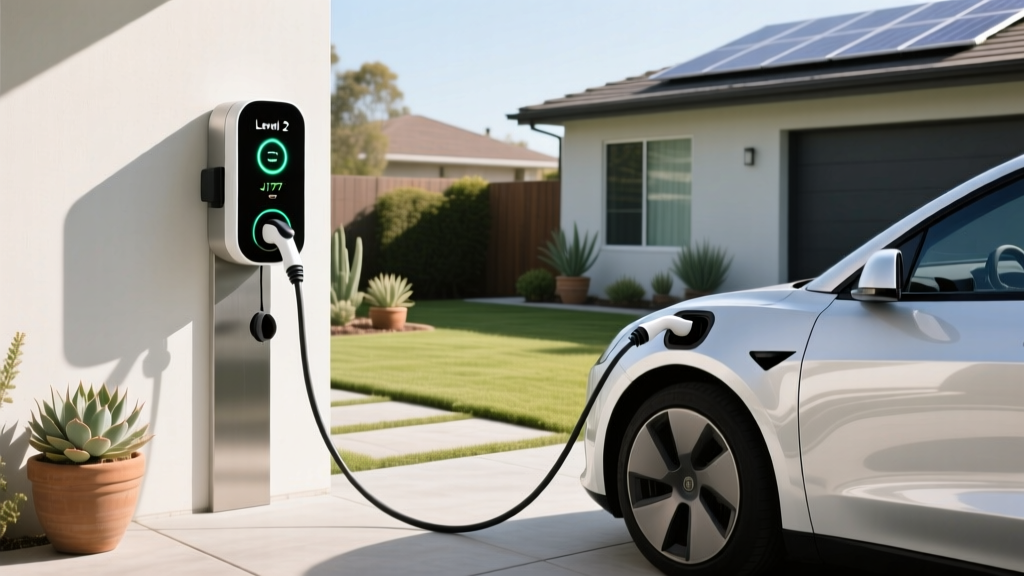
The Land Rover Range Rover plug-in hybrid sold in the United States uses the J1772 connector for AC Level 1 and Level 2 charging. This is the standard connector shared by virtually every non-Tesla EV and PHEV in North America. You do not need a proprietary cable — any J1772 Level 2 charger will work directly.
| Connector | Used For | Range Rover PHEV Compatible? | Adapter Needed? |
|---|---|---|---|
| J1772 | AC Level 1 & Level 2 | Yes — native port | No |
| NACS (Tesla) | AC & DC (Tesla Supercharger) | No native port | Tesla J1772 adapter for destination chargers |
| CCS1 | DC Fast Charging | N/A — PHEV lacks DC port | N/A |
| CHAdeMO | DC Fast Charging (legacy) | N/A — PHEV lacks DC port | N/A |
If you have a Tesla Wall Connector at home (which uses NACS natively), you will need Tesla's J1772 adapter (~$45–$55 from Tesla) to plug into the Range Rover. Conversely, if you install a J1772 charger and later buy a Tesla, the Tesla vehicle ships with a J1772-to-NACS adapter.
Charging Cost Per Mile vs. Gasoline
One of the strongest ownership arguments for the Range Rover PHEV is the cost advantage of electric miles over gasoline. The P550e achieves an EPA-estimated 42 MPGe in electric mode and approximately 19 MPG combined when running on gasoline alone (per fueleconomy.gov). Let's translate that into real cost per mile.
| Scenario | Energy Cost | Cost Per Mile | Annual Cost (12,000 mi) |
|---|---|---|---|
| Home Charging (Off-Peak, $0.12/kWh) | $0.12/kWh | $0.05 | $600 |
| Home Charging (Peak, $0.22/kWh) | $0.22/kWh | $0.09 | $1,080 |
| Public Level 2 ($0.30/kWh avg) | $0.30/kWh | $0.12 | $1,440 |
| Gasoline Only ($3.70/gal, 19 MPG) | $3.70/gal | $0.19 | $2,280 |
At off-peak home electricity rates, driving on battery power costs roughly 74% less per mile than gasoline. Even at peak rates or public charging, the per-mile cost is still meaningfully lower. Over a year, a Range Rover PHEV owner who charges at home and drives primarily within the 48-mile electric range could save $1,200–$1,680 compared to running on gasoline alone.
The Range Rover PHEV's battery consumes approximately 2.3–2.5 kWh per 10 miles of electric driving (roughly 4.0–4.3 mi/kWh). This efficiency figure is what you should use to calculate your personal costs based on your local utility rate.
Recommended Home Chargers for the Range Rover PHEV
Because the Range Rover PHEV's onboard charger caps at 7.2 kW, you do not need a 48A or 80A charger. A 32A or 40A Level 2 unit is the right match. Here are three proven options:
Emporia Level 2 EV Charger
- Power Output: 40A / 9.6 kW (more than enough headroom)
- Connector: J1772 (NACS version also available)
- Cable Length: 24 ft
- Smart Features: Wi-Fi scheduling, energy monitoring via Emporia app, solar integration, load management
- Price: ~$399
- Best For: Budget-conscious buyers who want smart scheduling and energy tracking
ChargePoint Home Flex
- Power Output: Configurable 16A–50A (set to 32A or 40A for the Range Rover)
- Connector: J1772
- Cable Length: 23 ft
- Smart Features: Wi-Fi, Alexa integration, scheduled charging, detailed session history, flexible amperage
- Price: ~$549–$649
- Best For: Owners who want adjustable amperage to match their circuit and a mature app ecosystem
Grizzl-E Smart
- Power Output: 40A / 9.6 kW
- Connector: J1772
- Cable Length: 24 ft
- Smart Features: OCPP-compatible, over-the-air updates, extreme cold rated (-40°F), rugged aluminum enclosure
- Price: ~$449
- Best For: Cold-climate garages and outdoor installations where durability matters
All three chargers deliver far more than the 7.2 kW the Range Rover can accept, which means they will comfortably max out the vehicle's onboard charger while leaving room for a future BEV upgrade without replacing the unit.
Safety, Code Compliance, and Installation Best Practices
A Level 2 charger draws sustained high current for hours — similar to an electric dryer or range. Proper installation is not optional. Key safety requirements include:
- Dedicated circuit: The EV charger must have its own breaker — never share a circuit with other appliances.
- GFCI protection: NEC 2023 (Article 625.54) requires GFCI protection for all EV receptacles rated 150V to ground or less and 60A or less. If you install a NEMA 14-50 outlet, your electrician must use a GFCI breaker (approximately $60–$90 additional).
- Outdoor rating: If your charger is mounted outside, it must carry a NEMA 4 or NEMA 4X rating for weather resistance. All three chargers recommended above are rated for outdoor use.
- Hardwire vs. plug: Hardwired installations (no plug) avoid the GFCI breaker requirement on the receptacle and reduce the risk of loose-connection arcing. Many electricians now recommend hardwiring for circuits above 40A.
- Permit and inspection: Most jurisdictions require a permit for new 240V circuits. An inspector will verify wire gauge, breaker sizing, grounding, and bonding. Skipping this step risks insurance denial in the event of a fire.
Range Rover PHEV Charging FAQ
How much does it cost to install a home EV charger for the Range Rover PHEV?
A standard Level 2 installation with a 40A circuit, no panel upgrade, and a charger within 30 feet of the panel typically costs $1,000–$2,400 total (equipment + electrician + permit + materials). If your home requires a panel upgrade from 100A to 200A service, expect the total to reach $2,500–$5,400. Get at least two quotes from licensed electricians and confirm they pull a permit.
How fast will each charging level add range to my Range Rover PHEV?
Level 1 (120V) adds approximately 3–4 miles of range per hour — adequate only for occasional top-ups. Level 2 at 7.2 kW (240V) adds roughly 20–22 miles per hour, fully replenishing the 48–51 mile battery in about 3.5 hours. The current U.S.-spec Range Rover PHEV does not support DC fast charging on most trims.
Which connector and charger are compatible with the Range Rover PHEV?
The Range Rover PHEV uses the J1772 connector for all AC charging. Any J1772 Level 2 home charger will work without an adapter. If you own a Tesla Wall Connector (NACS), you will need a Tesla-to-J1772 adapter.
How much does charging cost per mile versus gasoline?
At a typical off-peak home electricity rate of $0.12/kWh, the Range Rover PHEV costs approximately $0.05 per mile on electric power — compared to $0.19 per mile on gasoline at $3.70/gallon and 19 MPG. That is roughly a 74% per-mile savings when driving in electric mode.
What electrical upgrades might I need?
If your home has a 200-amp panel with available capacity, you likely need only a new 40A breaker and a wire run to the garage. Homes with 100-amp panels, or panels already near their load limit, may require a panel upgrade ($1,500–$3,000) or a smart load management device ($300–$500) to avoid overloading the service. Your electrician will perform a NEC Article 220 load calculation to determine the right path.
Can I use a Level 1 charger instead of installing Level 2?
Technically yes, but Level 1 adds only 3–4 miles per hour. A full charge from empty would take approximately 18–22 hours. If your daily driving stays under 15 miles and you can plug in every night for 8+ hours, Level 1 may suffice. For anyone driving closer to the vehicle's 48-mile electric range daily, Level 2 is strongly recommended.
Does the Range Rover PHEV qualify for the federal EV tax credit?
Under current IRS §30D rules, PHEVs must meet battery capacity (≥7 kWh), critical-mineral sourcing, and battery-component manufacturing requirements to qualify for up to $7,500. The Range Rover PHEV's eligibility varies by model year and sourcing compliance — and the vehicle's MSRP must fall under the $80,000 SUV cap. Buyer income limits also apply ($300K joint / $150K single). Always verify current eligibility at IRS.gov and consult a tax professional.