Why Charging Setup Matters for Range Rover Hybrid Cars
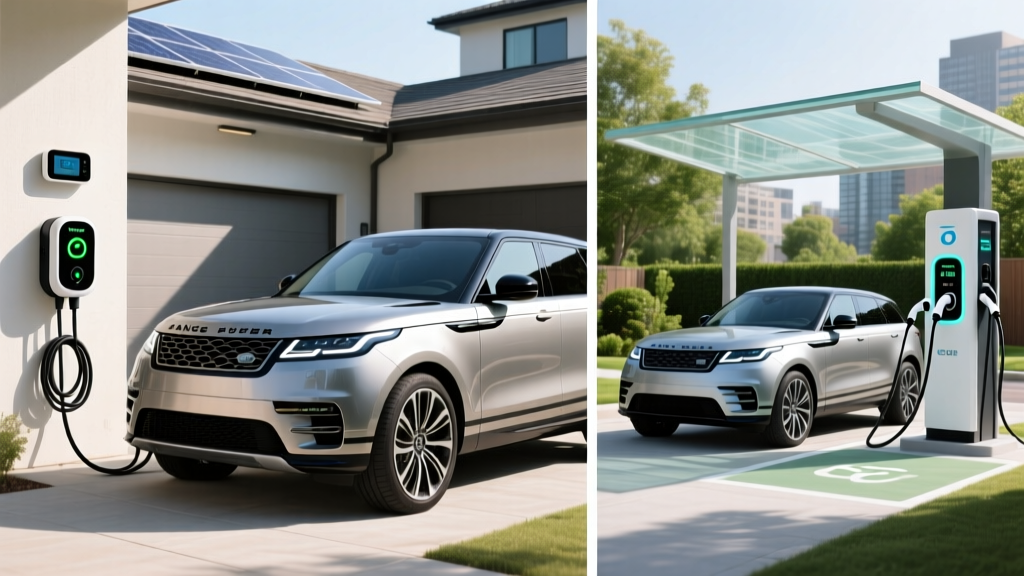
If you own or are shopping for Range Rover hybrid cars — the plug-in hybrid (PHEV) versions of the Range Rover, Range Rover Sport, or Range Rover Velar — your daily experience hinges on one thing: how you charge at home. These luxury PHEVs pair a turbocharged inline-six or V8 with a sizable lithium-ion battery pack, delivering between 48 and 51 miles of EPA-estimated electric-only range in the latest 2026 models. That's enough to cover most daily commutes without burning a drop of fuel, but only if you can reliably plug in overnight.
Without a home Level 2 charger, you're stuck on Level 1 (a standard 120V outlet), which can take 10+ hours to refill a Range Rover PHEV battery. For a vehicle with a battery around 31.8 kWh (usable), that's the difference between waking up to a full charge and waking up to a half-empty battery. This guide breaks down exactly what Range Rover PHEV owners need to know about charging levels, home installation costs, connectors, and real-world cost-per-mile math.
Charging Levels Explained: Speeds and Range Added Per Hour
Before choosing equipment, you need to understand the three charging tiers available to Range Rover hybrid cars. The critical distinction: kW (kilowatts) measures power — the rate of energy flow — while kWh (kilowatt-hours) measures energy capacity, the size of the battery itself. Think of kW as the width of a hose and kWh as the size of the bucket.
| Level | Voltage / Amps | Max Power (kW) | Miles of Range Added Per Hour | Full Charge Time (31.8 kWh Battery) |
|---|---|---|---|---|
| Level 1 (120V) | 120V / 12A | ~1.4 kW | ~4–5 miles | ~22–24 hours |
| Level 2 (240V) | 240V / 32–48A | 7.2–11.5 kW | ~20–32 miles | ~3–5 hours |
| DC Fast Charging | 400V+ DC | Up to 50 kW (PHEV limited) | ~100+ miles (theoretical) | 10–80% in ~35–40 min |
Real-world caveat: Range Rover PHEVs like the 2026 Range Rover P550e accept Level 2 AC charging at up to 7.2 kW via their onboard charger. That means even if you install a 48A Level 2 wallbox capable of 11.5 kW, the vehicle will only draw 7.2 kW. DC fast charging on PHEVs is far less common than on full BEVs; most Range Rover PHEVs support DC charging at roughly 50 kW, which is modest by BEV standards but adequate for a 31.8 kWh pack.
EPA vs. Real-World Electric Range: The 2026 Range Rover P550e carries an EPA-estimated 51 miles of electric-only range. In real-world mixed driving (highway speeds above 70 mph, HVAC use, cold weather), expect 38–45 miles before the gas engine engages. In winter conditions below freezing, that can drop to 30–35 miles.
Home Charger Installation: Electrical Requirements and Costs
The single biggest question from new PHEV owners: How much does it cost to install a home EV charger? The answer depends on your home's electrical panel, the distance from panel to garage or driveway, and local permit fees.
Electrical Requirements for Range Rover PHEVs
For optimal Level 2 charging of a Range Rover hybrid, you need:
- Circuit: Dedicated 240V / 40A circuit (NEMA 14-50 outlet or hardwired)
- Breaker: 50A breaker (EVSE draws 40A continuous; NEC requires 125% overhead)
- Wire gauge: 6 AWG copper (for runs up to ~50 feet); 4 AWG for longer runs
- Panel capacity: Minimum 100A service; 200A preferred for homes with other high-draw appliances
Panel Upgrade Reality
Older homes (pre-1990s) often have 100A or even 60A main panels. Adding a 50A breaker for EV charging may exceed the panel's capacity, especially if you run electric HVAC, a dryer, and an electric range simultaneously. A panel upgrade to 200A typically costs $1,500–$3,500 and requires utility coordination. Some homeowners can avoid this with a smart load-management device (like the Emporia Smart Load Center or Span panel), which throttles charger amperage when other circuits are under heavy use.
| Component | Cost Range | Notes |
|---|---|---|
| Level 2 EVSE (wall charger) | $350–$750 | 32A–48A smart chargers; see equipment picks below |
| Electrician labor (standard install) | $500–$1,500 | Varies by run distance, wall type, conduit needs |
| Electrical permit | $50–$250 | Required in most jurisdictions; inspection included |
| Panel upgrade (if needed) | $1,500–$3,500 | 100A → 200A; not needed in most newer homes |
| Total (no panel upgrade) | $900–$2,500 | Average: ~$1,400 for a 20-foot run with NEMA 14-50 |
| Total (with panel upgrade) | $2,400–$6,000 | Common in homes built before 1990 |
Pro tip: Get at least three quotes from licensed electricians. Ask specifically whether the quote includes the permit and post-installation inspection. Some utilities (like PG&E, ConEdison, or Xcel Energy) offer rebates of $250–$1,000 for Level 2 installations — check your local utility before committing.
Connector Compatibility: What Plug Does a Range Rover PHEV Use?
Range Rover hybrid cars sold in North America use the J1772 connector for AC Level 1 and Level 2 charging. For DC fast charging (available on newer PHEV models), they use CCS1 (Combined Charging System). As of 2026, Land Rover has not adopted the Tesla NACS connector for its PHEV lineup, though the industry shift toward NACS means adapter availability is expanding.
| Connector Type | Charging Level | Compatible? | Adapter Needed? |
|---|---|---|---|
| J1772 | Level 1 / Level 2 AC | ✅ Native | No — plug directly |
| CCS1 | DC Fast Charging | ✅ Native (newer models) | No — plug directly |
| NACS (Tesla) | Level 2 / DC (Supercharger) | ⚠️ Via adapter | Yes — J1772-to-NACS adapter (~$150–$250) for AC; CCS-to-NACS for DC |
| CHAdeMO | DC Fast Charging | ❌ Not compatible | No adapter available for this vehicle |
Adapter note: If you want to use Tesla destination chargers (Level 2, J1772-based at most locations) or Tesla Wall Connectors with your Range Rover PHEV, you'll need a Tesla-to-J1772 adapter. The reverse — plugging a J1772 charger into a NACS vehicle — is more commonly discussed in 2026, but PHEV owners with J1772 ports benefit from the widest public charging compatibility already.
Cost to Charge: Per-Mile Economics vs. Gasoline
One of the strongest arguments for Range Rover hybrid cars is the per-mile cost savings when operating in electric mode. Here's how the math breaks down using the 2026 Range Rover P550e as a reference point (31.8 kWh usable battery, ~51 mi EPA electric range, ~22 MPG combined on gas).
| Scenario | Rate | Cost for Full Charge (31.8 kWh) | Cost Per Mile (Electric) | Cost Per Mile (Gas, 22 MPG @ $3.60/gal) |
|---|---|---|---|---|
| Home — off-peak utility rate | $0.12/kWh | $3.82 | $0.075 | $0.164 |
| Home — average US rate | $0.17/kWh | $5.41 | $0.106 | $0.164 |
| Public Level 2 (ChargePoint, etc.) | $0.25–$0.35/kWh | $7.95–$11.13 | $0.156–$0.218 | $0.164 |
| DC Fast Charging (Electrify America) | $0.40–$0.55/kWh | $12.72–$17.49 | $0.250–$0.343 | $0.164 |
The bottom line: Charging at home on off-peak rates saves roughly 55% per mile compared to premium gasoline (which the Range Rover P550e requires). At 12,000 miles per year with 70% electric driving, that translates to approximately $800–$1,100 in annual fuel savings. However, relying exclusively on DC fast charging actually costs more than gas — a critical point for apartment dwellers without home charging access.
Recommended Level 2 Chargers for Range Rover PHEVs
Since the Range Rover PHEV onboard charger maxes out at 7.2 kW (32A at 240V), you don't strictly need a 48A charger. However, installing a higher-capacity unit future-proofs your setup for a potential BEV purchase down the road. Here are three proven options for 2026:
Best Overall: ChargePoint Home Flex
- Power output: Up to 12 kW (50A) — adjustable via DIP switches
- Connector: J1772 (native for Range Rover PHEV)
- Cable length: 23 feet
- Smart features: Wi-Fi, app scheduling, Alexa integration, energy tracking
- Price: ~$549 (frequently on sale for $399–$449)
- Why it works: Adjustable amperage means you can set it to 40A for a 50A circuit, or dial it down for older panels. UL-listed, NEMA 4 outdoor rated.
Best Value: Emporia Level 2 EV Charger
- Power output: Up to 11.5 kW (48A)
- Connector: J1772
- Cable length: 24 feet
- Smart features: Wi-Fi, app with real-time energy monitoring, solar integration, load management
- Price: ~$399
- Why it works: Best energy-monitoring app in the segment. Ideal if you have solar panels and want to charge only on excess production. Works with Emporia Vue panel monitor for load balancing.
Premium Pick: Tesla Wall Connector (with J1772 adapter)
- Power output: Up to 11.5 kW (48A)
- Connector: NACS native; requires J1772 adapter for Range Rover (~$150–$200 third-party)
- Cable length: 24 feet
- Smart features: Wi-Fi, OTA updates, power sharing between multiple units, sleek design
- Price: ~$475 (charger) + ~$175 (adapter) = ~$650 total
- Why it works: If your household includes a Tesla or you plan to go NACS in the future, this is a smart long-term investment. The power-sharing feature lets two Wall Connectors share one circuit.
Safety, Code, and Permit Considerations
EV charger installation is electrical work governed by the National Electrical Code (NEC) and local building codes. Cutting corners here risks fire, voided insurance, and failed home inspections. Here's what matters:
- Dedicated circuit: Your Level 2 charger must be on its own dedicated breaker — not shared with a dryer, HVAC, or other appliance. The NEC requires continuous loads (like EV charging, which runs for 3+ hours) to be derated to 80% of breaker capacity. A 50A breaker supports 40A continuous draw.
- GFCI protection: The 2020 NEC (and subsequent 2023/2026 updates adopted by most states) requires GFCI protection for all receptacles used for EV charging, including NEMA 14-50 outlets. Hardwired installations may be exempt in some jurisdictions — ask your electrician.
- Outdoor rating: If your charger is mounted outside or in an open carport, it must carry a NEMA 4 (weatherproof) rating. All three chargers recommended above meet this standard.
- Permit and inspection: Most municipalities require an electrical permit for new 240V circuits. The permit fee is typically $50–$250, and a post-installation inspection ensures the work meets code. Skipping the permit can cause problems during a future home sale.
- Load management: If your panel is near capacity, consider a load-management device rather than a full panel upgrade. Devices like the Emporia Smart Load Center can dynamically throttle charger amperage based on real-time household draw.
Public Charging Options for Range Rover PHEVs
While home charging handles 90%+ of PHEV needs, public charging fills gaps on road trips or for those without garage access. Range Rover PHEVs with CCS1 ports can use networks like Electrify America, EVgo, and ChargePoint. Those with J1772-only access are limited to Level 2 public stations, which add roughly 20–25 miles of range per hour — enough for a top-up during a shopping trip but not practical for a full recharge on the go.
For 2026, the expanding NACS adapter ecosystem means Range Rover PHEV owners with a CCS-to-NACS adapter (once certified versions become widely available) may gain access to Tesla Supercharger stations. However, Land Rover has not officially confirmed NACS compatibility for current PHEV models, so proceed with caution on third-party adapters for DC charging.
Charging time example: At a 50 kW DC fast charger, a Range Rover P550e (31.8 kWh battery) will charge from 10–80% in approximately 35–40 minutes. Expect the charge curve to taper significantly above 80% SoC — charging from 80–100% on DC can take nearly as long as the 10–80% portion. For battery longevity, it's generally best to DC-charge to 80% and finish the last 20% on Level 2 at home.
How much does it cost to install a home EV charger for a Range Rover hybrid?
A standard Level 2 installation (40A circuit, 20-foot run, NEMA 14-50 outlet) costs between $900 and $2,500 including the charger, electrician labor, and permit. If your home needs a panel upgrade from 100A to 200A, add $1,500–$3,500. Most homes built after 2000 with 200A service won't need a panel upgrade.
How fast will each charging level add range to my Range Rover PHEV?
Level 1 (120V) adds roughly 4–5 miles of electric range per hour. Level 2 (240V, 32A) adds approximately 20–25 miles per hour — enough to fully recharge the 51-mile battery in about 3–4 hours. DC fast charging at 50 kW can take the battery from 10–80% in roughly 35–40 minutes.
Which connector is compatible with Range Rover hybrid cars?
All Range Rover PHEVs use J1772 for AC charging (Level 1 and Level 2). Newer models with DC fast charging capability use CCS1. NACS (Tesla) adapters are available for AC charging but DC NACS compatibility is not officially confirmed by Land Rover as of 2026.
How much does charging a Range Rover PHEV cost per mile vs. gas?
Charging at home on average US electricity rates ($0.17/kWh) costs approximately $0.11 per mile in electric mode. Driving on premium gasoline (required) at 22 MPG combined and $3.60/gallon costs $0.16 per mile. Home charging saves roughly 30–55% depending on your utility rate. Public DC fast charging, however, often exceeds the per-mile cost of gas.
What electrical upgrades might I need for a home charger?
You'll need a dedicated 240V / 40A circuit with a 50A breaker. If your electrical panel is at or near capacity (common in older homes with 100A service), you may need a panel upgrade to 200A ($1,500–$3,500) or a smart load-management device to avoid overloading the system. Your electrician will perform a load calculation during the initial assessment to determine whether an upgrade is necessary.
Can I use a regular outlet to charge my Range Rover hybrid?
Yes — every Range Rover PHEV comes with a Level 1 charging cable that plugs into a standard 120V household outlet. However, at ~1.4 kW, it will take 22–24 hours for a full charge. This works as a trickle-charge supplement but is impractical as a primary charging strategy if you drive more than 15–20 miles daily.
Sources: EPA range and efficiency data from fueleconomy.gov; IRS §30D tax credit rules from irs.gov; Land Rover PHEV specifications from Land Rover USA press materials.