Land Rover's plug-in hybrid lineup — including the Range Rover PHEV (P460e/P550e), Range Rover Sport PHEV, and the Defender P400e — pairs a turbocharged inline-six or V8 with a high-voltage traction battery to deliver genuine electric-only commuting. But the real-world utility of that electric range depends entirely on how you charge. A PHEV with an uncharged battery is just a heavy gas car.
This guide breaks down exactly how to charge a Range Rover hybrid at home and in public, what electrical work your house might need, which connectors apply, and what it actually costs per mile compared to filling up with premium gasoline.
Range Rover PHEV Battery Specs: What You're Charging
Before plugging in, you need to know what's behind the charge port. The current-generation Range Rover (L460, 2022-present) and Range Rover Sport PHEVs use significantly larger batteries than earlier P400e models, which changes the charging calculus entirely.
| Model | Battery (Usable kWh) | Chemistry | EPA Electric Range | Onboard AC Charger | DC Fast Charge Capable |
|---|---|---|---|---|---|
| Range Rover P550e (2024-2026) | ~31.8 kWh usable | NMC (Nickel Manganese Cobalt) | 51 miles | 7.2 kW (single-phase) | No (AC only on most markets) |
| Range Rover Sport P460e (2023-2026) | ~31.8 kWh usable | NMC | 48 miles | 7.2 kW | No |
| Defender P400e (2022-2026) | ~19.2 kWh usable | NMC | 29 miles | 7.2 kW | No |
| Range Rover P400e (2019-2021, previous gen) | ~11.3 kWh usable | NMC | 19 miles | 3.3 kW | No |
Key takeaway: The current L460-generation Range Rover PHEVs carry roughly 31.8 kWh of usable battery — nearly triple the older P400e. That's enough for a genuine daily commute on electrons alone, but it also means Level 1 (120V) charging is painfully slow. A home Level 2 charger is effectively mandatory to unlock the PHEV's value proposition.
According to fueleconomy.gov, the 2025 Range Rover P550e achieves 51 miles of electric range and a combined 21 MPG once the battery depletes — strong numbers for a 5,800-pound luxury SUV, but only if you charge regularly.
Charging Levels Explained: kW, Miles Per Hour, and What Each Means for Your PHEV
A critical distinction every PHEV owner must internalize: kW (kilowatts) measures power — the rate at which electricity flows into your battery. kWh (kilowatt-hours) measures energy — the total capacity of the battery itself. Think of kW as the width of a hose and kWh as the size of the bucket.
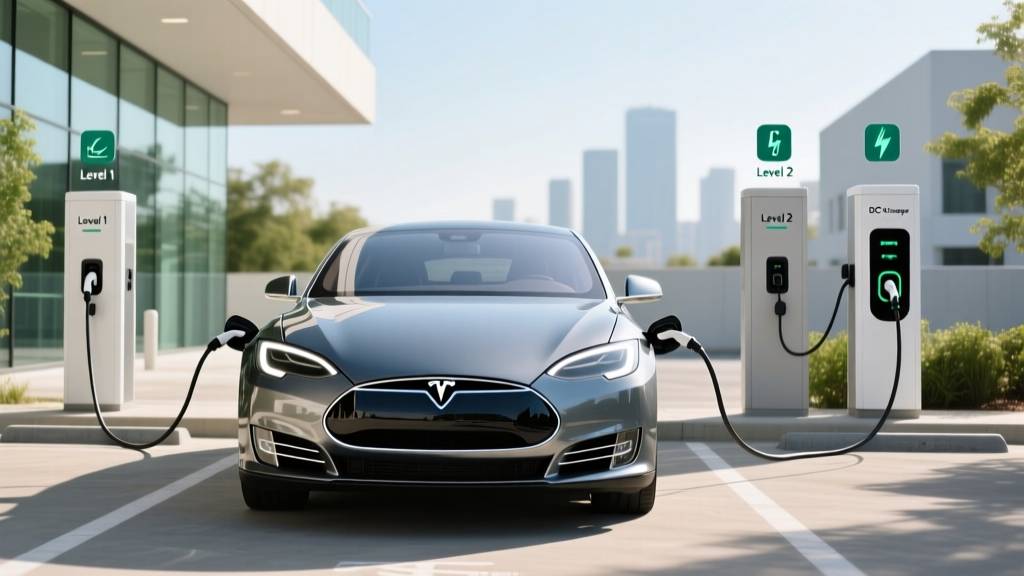
| Level | Voltage / Amperage | Max Power (kW) | Miles of Electric Range Added Per Hour | 0-100% Time (31.8 kWh Battery) | Best Use Case |
|---|---|---|---|---|---|
| Level 1 (Standard Outlet) | 120V / 12A | ~1.4 kW | ~3-4 miles/hr | ~22+ hours | Overnight top-up only; emergency |
| Level 2 (Home / Public AC) | 240V / 32-48A | 7.2 kW (PHEV limited) | ~18-22 miles/hr | ~4.5 hours | Daily home charging; ideal |
| DC Fast Charging | 400V+ DC | N/A — not supported | N/A | N/A | Not applicable to RR PHEVs |
Why no DC fast charging? Range Rover PHEVs (unlike the all-electric Range Rover Electric, expected 2025-2026) are equipped with J1772/Type 2 AC charge ports only. The onboard charger maxes at 7.2 kW, meaning even if you plug into a 48A Level 2 station delivering 11.5 kW, the vehicle will only accept 7.2 kW. This is a hard ceiling set by the car's power electronics, not the charger.
For the older P400e (2019-2021) with its 3.3 kW onboard charger, a full charge on Level 2 takes roughly 3.5 hours — and a Level 1 outlet takes 8-10 hours. That smaller battery makes Level 1 marginally more viable, but Level 2 remains strongly recommended.
Home Charger Installation: Electrical Requirements, Costs, and Panel Upgrades
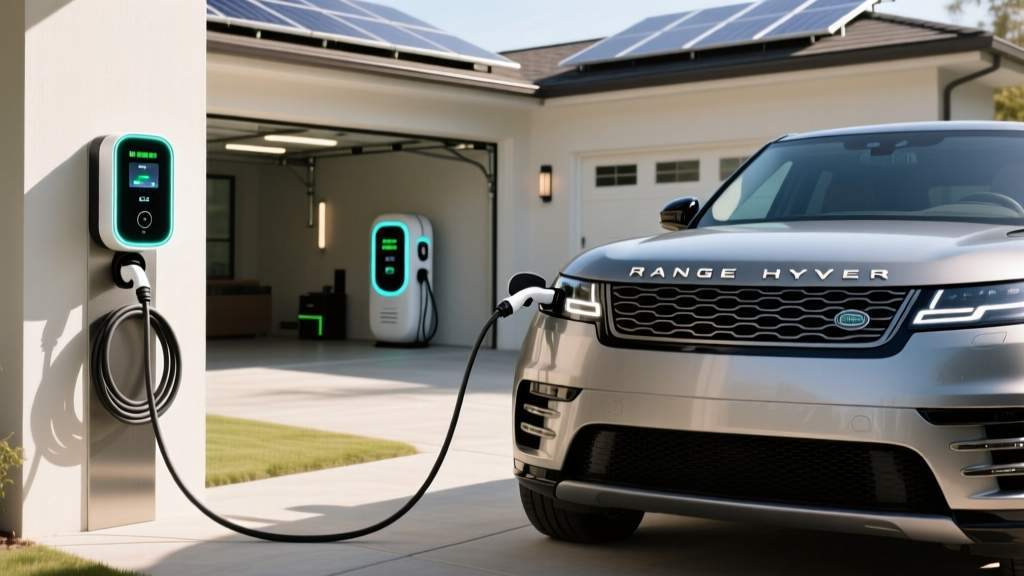
Installing a dedicated Level 2 home charger is the single most impactful upgrade a Range Rover PHEV owner can make. Here's what the project actually involves.
Electrical Requirements
A Level 2 charger for your Range Rover PHEV requires a 240-volt dedicated circuit. Since the PHEV's onboard charger caps at 7.2 kW (30 amps at 240V), you need a minimum 40-amp circuit breaker (NEC code requires circuits to be rated at 125% of continuous load, so 30A continuous × 1.25 = 37.5A, rounded to a 40A breaker).
However, many electricians recommend installing a 50A or 60A circuit with 6-gauge wire even if your current PHEV only needs 40A. This future-proofs for a potential BEV purchase down the road, when you'll want 48A continuous charging (11.5 kW). The incremental wire cost is modest compared to a second service call later.
Installation Cost Breakdown
| Component | Low Estimate | High Estimate | Notes |
|---|---|---|---|
| Level 2 Charger (Hardware) | $350 | $700 | 32A-48A smart charger, J1772 connector |
| Electrician Labor | $400 | $1,200 | Depends on run length from panel to garage |
| Permit & Inspection | $50 | $250 | Required in most jurisdictions; varies by municipality |
| Conduit, Wire, Breaker | $100 | $400 | 6 AWG copper for 50A circuit; longer runs cost more |
| Panel Upgrade (if needed) | $1,500 | $3,500 | 100A → 200A service upgrade for older homes |
| Total (No Panel Upgrade) | $900 | $2,550 | Most homes with 200A service |
| Total (With Panel Upgrade) | $2,400 | $6,050 | Homes with original 100A panels |
Do You Need a Panel Upgrade?
This is the question that catches many homeowners off guard. If your home has a 200-amp electrical service (standard in most homes built after 1990), you likely have sufficient capacity for a 40A EV circuit. If your home has an older 100-amp service, adding a 40A continuous load may exceed safe capacity — especially if you're also running electric HVAC, a dryer, an oven, and an electric water heater simultaneously.
A licensed electrician will perform a load calculation (per NEC Article 220) to determine if your panel can handle the additional draw. If not, a service upgrade to 200A (or occasionally 400A for large luxury homes with multiple EVs) is required. This is non-negotiable and non-negotiable for safety — never skip the load calculation.
Which Connector Does the Range Rover PHEV Use?
All Range Rover PHEVs sold in North America use the J1772 connector for AC charging — the universal standard for non-Tesla plug-in vehicles. There is no DC fast charge port on current PHEV models.
| Connector Type | Used For | Range Rover PHEV Compatible? | Adapter Needed? |
|---|---|---|---|
| J1772 (Type 1 AC) | Level 1 & Level 2 AC charging | Yes — native port | None |
| NACS (Tesla / North American Charging Standard) | Tesla AC & DC charging | AC only with adapter; DC N/A | Tesla-to-J1772 adapter (~$100-150) for Tesla Destination chargers |
| CCS1 (Combined Charging System) | DC fast charging | No — PHEV has no DC port | N/A |
| CHAdeMO | Legacy DC fast charging | No — PHEV has no DC port | N/A |
Practical note: If you have a Tesla Wall Connector at home (increasingly common in mixed-fleet households), you'll need a Tesla-to-J1772 adapter such as the Lectron or JDapter Stub (~$100-150) to charge your Range Rover PHEV. Tesla's Universal Wall Connector, which has a built-in J1772 plug alongside NACS, eliminates this need entirely.
Equipment Recommendations: Best Home Chargers for the Range Rover PHEV
Since your PHEV caps at 7.2 kW (30A), you don't technically need a 48A charger — but buying one provides headroom for future vehicles. Here are three proven options:
Best Overall: ChargePoint Home Flex
- Power Output: Up to 12 kW (50A) — adjustable via DIP switches
- Connector: J1772 (native)
- Cable Length: 23 feet
- Smart Features: Wi-Fi, scheduling, energy tracking, Alexa integration
- Price: ~$550 (hardware only)
- Why for RR PHEV: Set to 32A for your PHEV today; reconfigure to 48A for a future BEV. NEMA 14-50 plug option allows portability.
Best Value: Emporia Level 2 EV Charger
- Power Output: Up to 11.5 kW (48A)
- Connector: J1772
- Cable Length: 24 feet
- Smart Features: Wi-Fi, solar integration, load management with Emporia Vue energy monitor
- Price: ~$400
- Why for RR PHEV: Budget-friendly smart charger with excellent energy monitoring. Ideal if you want to track exactly how much your PHEV costs to charge.
Best for Mixed Fleets: Tesla Universal Wall Connector
- Power Output: Up to 11.5 kW (48A)
- Connector: Integrated J1772 plug + NACS (auto-switching)
- Cable Length: 24 feet
- Smart Features: Wi-Fi, power sharing between two units, OTA updates
- Price: ~$600
- Why for RR PHEV: If your household also has a Tesla, this single unit charges both vehicles without adapters. The J1772 plug connects directly to your Range Rover.
Cost to Charge vs. Gasoline: The Real Math
The Range Rover P550e requires premium gasoline (91+ octane), which makes the economics of electric charging particularly favorable. Let's compare the cost per mile on electrons vs. premium fuel.
| Scenario | Rate | Energy Used | Cost Per Mile |
|---|---|---|---|
| Home Charging (off-peak utility rate) | $0.12/kWh | ~0.35 kWh/mile (electric mode) | $0.042/mile |
| Home Charging (average US rate) | $0.17/kWh | ~0.35 kWh/mile | $0.060/mile |
| Home Charging (high-cost state, e.g. CA) | $0.30/kWh | ~0.35 kWh/mile | $0.105/mile |
| Public Level 2 (typical network pricing) | $0.25-$0.40/kWh | ~0.35 kWh/mile | $0.088-$0.140/mile |
| Premium Gasoline (21 MPG combined, $4.50/gal) | $4.50/gallon | ~0.048 gal/mile | $0.214/mile |
| Premium Gasoline ($5.50/gal, high-cost market) | $5.50/gallon | ~0.048 gal/mile | $0.262/mile |
The verdict: Charging at home on an average US electricity rate ($0.17/kWh), your Range Rover PHEV costs roughly $0.06 per mile on electricity vs. $0.21 per mile on premium gas — a 71% savings. Over 10,000 miles of electric driving per year, that's roughly $1,500 in annual fuel savings. Even in high-cost California ($0.30/kWh), you still save about 60% per mile.
The savings shrink if you rely exclusively on public Level 2 charging at $0.35+/kWh, which is why home charging is the economic linchpin of PHEV ownership.
Public Charging: Where and How to Charge a Range Rover PHEV on the Go
Since Range Rover PHEVs are AC-only (no DC fast charge capability), public charging means finding Level 2 public stations — typically at shopping centers, workplaces, hotels, and parking garages. Networks like ChargePoint, EVgo (Level 2 units), Blink, and Tesla Destination Chargers (with adapter) are your primary options.
Practical realities of public Level 2 charging for a PHEV:
- Time commitment: A full 0-100% charge on a 7.2 kW public Level 2 station takes about 4.5 hours. This works well for workplace charging (plug in at 9 AM, full by lunch) or long shopping/dining outings, but is impractical as a "quick stop."
- Cost variability: Public Level 2 ranges from free (some workplaces, malls) to $0.35-$0.49/kWh on paid networks. Some stations charge by the hour rather than the kWh — avoid these, as they penalize slower-charging vehicles.
- Availability: Use apps like PlugShare, ChargePoint, or EVgo to locate nearby J1772 stations. Filter by "Level 2" and check recent user reviews for reliability.
- No DC fast charge workaround: Unlike some PHEVs (e.g., the Mitsubishi Outlander PHEV, which supports CHAdeMO DC fast charging), the Range Rover PHEV cannot accept DC power at all. Plan accordingly for road trips — the gasoline engine is your long-distance solution.
Safety, Code Compliance, and Installation Best Practices
EV charging circuits carry significant continuous current, making code compliance non-negotiable for safety and insurance purposes.
- Dedicated circuit: Your Level 2 charger must be on its own dedicated breaker — not shared with other outlets or appliances. Per NEC 625, EV charging is classified as a continuous load.
- GFCI protection: NEC 2020 and later require GFCI protection for all 14-50 receptacles used for EV charging. Some EVSE manufacturers recommend hardwiring (which may not require a GFCI breaker depending on jurisdiction) to avoid nuisance trips. Discuss with your electrician.
- Outdoor rating: If your charger is installed outside (e.g., a driveway without a garage), ensure the unit carries a NEMA 4 or NEMA 4X rating for weather resistance. All chargers recommended above meet this standard.
- Permit and inspection: Most jurisdictions require an electrical permit for a new 240V circuit. The inspection ensures proper wire gauge, breaker sizing, grounding, and conduit. Skipping the permit risks insurance denial in the event of an electrical fire.
- Cable management: A 23-25 foot cable is sufficient for most single-car garages. If your charge port is on the driver's side (it is on the Range Rover PHEV — located on the rear quarter panel), plan your charger placement to minimize cable stretch across the driveway.
Frequently Asked Questions
How much does it cost to install a home EV charger for my Range Rover PHEV?
Expect $900-$2,550 for a standard installation (charger + electrician + permit + materials) if your home already has 200A electrical service. If a panel upgrade from 100A to 200A is needed, total costs can reach $2,400-$6,050. Always get a load calculation from a licensed electrician before committing.
How fast will each charging level add range to my Range Rover PHEV?
Level 1 (120V standard outlet) adds roughly 3-4 miles of electric range per hour — barely enough to replenish a daily commute overnight. Level 2 (240V, 32A+) adds 18-22 miles per hour, fully recharging the ~31.8 kWh battery in about 4.5 hours. DC fast charging is not supported on any current Range Rover PHEV.
Which connector does the Range Rover hybrid use, and do I need an adapter?
All North American Range Rover PHEVs use the J1772 connector for AC Level 1 and Level 2 charging. No adapter is needed for standard public Level 2 stations or most home chargers. If you want to use a Tesla Wall Connector or Tesla Destination Charger, you'll need a Tesla-to-J1772 adapter (~$100-150), or you can choose the Tesla Universal Wall Connector, which has a built-in J1772 plug.
How much does charging cost per mile vs. premium gasoline?
At the US average electricity rate of $0.17/kWh, home charging costs approximately $0.06 per mile in electric mode. Premium gasoline at $4.50/gallon with the P550e's 21 MPG combined costs about $0.21 per mile. That's a roughly 71% per-mile savings when driving on electricity. Annual savings can exceed $1,500 if you charge daily and drive primarily within electric range.
What electrical upgrades might I need before installing a Level 2 charger?
The most common upgrade is a panel service increase from 100A to 200A, which costs $1,500-$3,500 and is required if your existing panel can't handle the additional 40A continuous load alongside your home's other electrical demands. Homes built after ~1990 with 200A service typically need no panel upgrade. Your electrician will perform a NEC Article 220 load calculation to determine your specific situation.
Can I use the included Range Rover PHEV charging cable for daily home charging?
Yes, but only on Level 1 (120V). The OEM "granny cable" included with your PHEV plugs into a standard household outlet and delivers ~1.4 kW — adding only 3-4 miles of range per hour. For the 31.8 kWh battery, a full charge takes 22+ hours. This is adequate only for very low-mileage drivers who can leave the car plugged in for extended periods. A dedicated Level 2 station is strongly recommended for daily use.
Does the Range Rover PHEV qualify for any federal charging equipment tax credits?
The federal Alternative Fuel Vehicle Refueling Property Credit (IRS Form 8911) covers up to 30% of home EV charger hardware and installation costs, capped at $1,000. However, eligibility depends on your census tract meeting specific low-income or non-urban criteria. Check the IRS guidelines or consult a tax professional to confirm eligibility for your address.
Sources: EPA range and efficiency data from fueleconomy.gov; Land Rover PHEV specifications from Land Rover USA; IRS tax credit rules from irs.gov; NEC electrical code requirements per NFPA 70.