What to Expect Charging the Range Rover Electric
The all-electric Range Rover (officially the Range Rover Electric, built on Jaguar Land Rover's MLA-Flex platform) brings full-size luxury SUV capability into the battery-electric era. With an estimated 117 kWh usable battery pack and an EPA-estimated range around 300+ miles (final EPA certification pending at launch), this is one of the largest battery packs in any production luxury SUV. That massive pack demands a serious charging strategy — especially if you plan to road-trip, tow, or live in a cold climate where real-world range can drop 20–30%.
This guide covers everything you need to charge a Range Rover Electric efficiently: home Level 2 installation costs and electrical requirements, public DC fast charging realities, connector compatibility, equipment picks, and the real cost per mile compared to a gasoline Range Rover.
Charging Levels Explained: Speeds, Power, and Range Added
Before evaluating chargers, it's essential to distinguish kW (kilowatts, a measure of power — how fast energy flows) from kWh (kilowatt-hours, a measure of energy — how much the battery stores). The Range Rover Electric's ~117 kWh battery is the tank size; the charger's kW rating determines how quickly you fill it.
| Level | Voltage | Max Power (kW) | Miles of Range Added per Hour | Typical Use Case |
|---|---|---|---|---|
| Level 1 | 120V AC | 1.4 kW | ~3–4 mi/hr | Emergency / trickle top-off |
| Level 2 (Home/Public AC) | 240V AC | 11–22 kW | ~25–55 mi/hr | Daily home charging, workplace |
| DC Fast Charging | 400V+ DC | Up to ~200+ kW (est.) | ~300+ mi/hr (peak) | Road trips, quick stops |
Real-world context: On Level 1 (a standard 120V household outlet), fully replenishing the Range Rover Electric's large battery from empty would take over 80 hours — impractical for daily use. Level 2 at 11 kW (48A) is the practical home standard, adding roughly 25–30 miles per hour of charging. An overnight session of 10 hours restores 250–300 miles, covering most daily needs.
For DC fast charging, Land Rover has indicated the Range Rover Electric supports high-rate DC charging (estimated peak around 200+ kW on compatible chargers). Expect a 10–80% charge in approximately 30–40 minutes under ideal conditions, though real-world charge curves taper significantly above 80% State of Charge (SoC) to protect battery health.
Home Charger Installation: Electrical Requirements and Costs
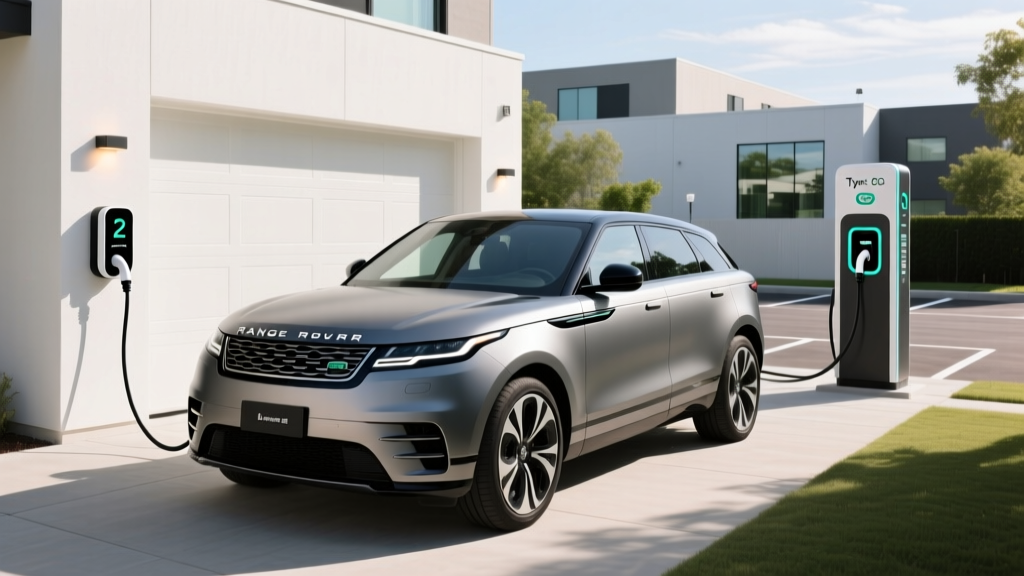
Most Range Rover Electric owners will install a hardwired Level 2 wallbox in their garage or driveway. Here's what that involves electrically and financially.
Electrical Requirements
The Range Rover Electric supports up to 11 kW AC charging (single-phase, 48A) in the U.S. market, with available 22 kW onboard charging (three-phase) in some markets. For a standard U.S. home:
- Circuit: Dedicated 60A breaker (for a continuous 48A load, NEC requires 125% overhead = 60A circuit)
- Wire: 6 AWG copper (or 4 AWG aluminum) THHN in conduit
- Voltage: 240V single-phase
- Outlet option: NEMA 14-50 receptacle (50A circuit max) or hardwired connection (preferred for 60A circuits)
Panel Upgrade Considerations
Older homes with 100A main service panels may not have capacity for an additional 60A circuit, especially if other high-draw appliances (electric range, dryer, HVAC) are already on the panel. A panel upgrade to 200A typically costs $1,500–$3,500 and may be required. Some homes may qualify for a load-management device (e.g., Emporia V2X or Span smart panel) as an alternative to a full upgrade.
| Item | Low Estimate | High Estimate |
|---|---|---|
| Level 2 charger unit (11.5 kW, hardwired) | $400 | $750 |
| Electrician labor (standard install, short run) | $500 | $1,200 |
| Electrical materials (wire, conduit, breaker) | $150 | $400 |
| Permit and inspection | $50 | $250 |
| Subtotal (no panel upgrade) | $1,100 | $2,600 |
| Panel upgrade (if needed, 100A → 200A) | $1,500 | $3,500 |
| Total with panel upgrade | $2,600 | $6,100 |
Key tip: Get at least two quotes from licensed electricians. Ask specifically about available amperage on your panel and whether a load calculation is needed. The National Electrical Contractors Association directory can help you find qualified installers. Some utilities offer rebates of $250–$1,000 for Level 2 installations — check with your local provider.
Connector Compatibility: NACS, CCS, and Adapters
The charging connector landscape has shifted dramatically. As of 2025–2026, nearly all automakers have adopted or committed to the North American Charging Standard (NACS), originally developed by Tesla. Here's where the Range Rover Electric fits:
| Connector Type | Standard? | Adapter Needed? | Network Access |
|---|---|---|---|
| NACS (Tesla-style) | Expected (2026+ models) | No (if native NACS port) | Tesla Superchargers, Electrify America (newer stalls) |
| CCS1 (Combo) | Possible on early models | NACS-to-CCS adapter for Superchargers | Electrify America, EVgo, ChargePoint DC |
| CHAdeMO | No | N/A | Largely deprecated in U.S. |
Land Rover has confirmed JLR vehicles will adopt NACS for North American models beginning with the Range Rover Electric. If your specific vehicle ships with a CCS1 port, a NACS adapter (typically $150–$250) will unlock access to Tesla's Supercharger network, which remains the most reliable DC fast-charging infrastructure in the U.S. with over 25,000 stalls.
For home Level 2 charging: All Level 2 chargers use a J1772 connector (or NACS for newer Tesla Wall Connectors). If your Range Rover Electric has a NACS port, choose a NACS-connector wallbox. If CCS, use a J1772 wallbox. Adapters are available in both directions but add a connection point.
Cost to Charge: Home vs. Public vs. Gas Comparison
One of the strongest ownership arguments for the Range Rover Electric is fuel cost savings, particularly against the gasoline Range Rover P400 (which averages around 19 MPG combined per fueleconomy.gov).
| Scenario | Rate ($/kWh) | Cost for Full Charge (0–100%) | Cost per Mile (est. 300 mi range) |
|---|---|---|---|
| Home off-peak (utility time-of-use) | $0.08–$0.12 | $9.36–$14.04 | $0.03–$0.05 |
| Home standard rate | $0.14–$0.18 | $16.38–$21.06 | $0.05–$0.07 |
| Public Level 2 (ChargePoint, etc.) | $0.25–$0.49 | $29.25–$57.33 | $0.10–$0.19 |
| DC Fast Charging (Electrify America, EVgo) | $0.35–$0.55 | $40.95–$64.35 | $0.14–$0.21 |
Gas comparison: A gasoline Range Rover P400 at 19 MPG combined, with gas at $3.50/gallon, costs approximately $0.18 per mile in fuel. Even at public DC fast-charging rates, the Range Rover Electric can match or beat that cost — and at home off-peak rates, it costs roughly 75–85% less per mile.
Over 15,000 miles per year, home charging at $0.12/kWh costs approximately $700 annually, compared to roughly $2,760 for gasoline. That's a $2,000+ annual fuel savings before factoring in reduced maintenance (no oil changes, fewer brake replacements due to regenerative braking).
Recommended Home Charging Equipment for the Range Rover Electric
Given the Range Rover Electric's large battery and 11 kW AC acceptance rate, you want a charger that can deliver at least 48 amps (11.5 kW) on a 60A circuit to maximize overnight charging speed.
ChargePoint Home Flex
- Power: Up to 12 kW (50A) on 60A circuit
- Connector: J1772 (NACS adapter available)
- Cable: 23 ft
- Smart features: Wi-Fi, app scheduling, utility integration, Alexa
- Price: ~$549
- Best for: Flexible amperage adjustment (dip-switch configurable from 16A–50A to match your panel)
Wallbox Pulsar Plus
- Power: Up to 11.5 kW (48A) on 60A circuit
- Connector: J1772 or NACS
- Cable: 25 ft
- Smart features: Wi-Fi + Bluetooth, app control, Power Sharing (daisy-chain two units on one circuit)
- Price: ~$599
- Best for: Compact form factor, NACS native option, dual-charger garages
Tesla Wall Connector (J1772 version)
- Power: Up to 11.5 kW (48A) on 60A circuit
- Connector: J1772 (NACS version also available)
- Cable: 24 ft
- Smart features: Wi-Fi, OTA updates, Power Sharing, integrated cable management
- Price: ~$475
- Best for: Value, clean design, seamless if you also own a Tesla
Important note: The Range Rover Electric's 11 kW onboard charger means that even a 48A (11.5 kW) charger won't exceed the vehicle's acceptance rate. You won't gain speed by installing a higher-amp charger beyond 48A unless you're planning for a future vehicle with a larger onboard charger.
Public DC Fast Charging: What to Expect on Road Trips
When traveling, the Range Rover Electric's estimated 200+ kW DC fast-charging capability means you can add significant range quickly — but real-world charging involves nuances that spec sheets don't always convey.
Charge Curve Reality
Peak charging rates (e.g., 200 kW) are typically sustained only between approximately 10–40% SoC. Above 50%, the rate begins tapering; above 80%, it drops sharply to protect battery longevity. A typical DC fast-charging session from 10–80% might look like this:
- 10–40% SoC: Sustained ~180–200 kW (~15 minutes)
- 40–60% SoC: Tapering to ~120–150 kW (~10 minutes)
- 60–80% SoC: Further taper to ~80–100 kW (~10 minutes)
- Total 10–80%: Approximately 35–40 minutes under good conditions
Preconditioning Matters
When you set a DC fast charger as your navigation destination, the Range Rover Electric's thermal management system will precondition the battery — warming it to optimal temperature for fast charging. This can shave 5–10 minutes off your session and increase peak charge rates, especially in cold weather. Always navigate to the charger rather than just pulling in cold.
Network Reliability
According to J.D. Power's EV charging satisfaction studies, Tesla Superchargers consistently rank highest for reliability. For non-Tesla networks, Electrify America and EVgo have expanded their high-power (350 kW-capable) stalls, but uptime remains variable. Apps like PlugShare and A Better Routeplanner are essential for trip planning.
Safety, Code, and Best Practices
Home EV charging is safe when installed correctly, but the electrical demands are significant. Key considerations:
- Dedicated circuit: Your Level 2 charger must have its own dedicated breaker — never share a circuit with other appliances.
- GFCI protection: NEC 2023+ requires GFCI protection for EV charging outlets. Hardwired installations may not require a separate GFCI breaker (the charger typically has internal ground-fault protection), but check local code.
- Outdoor rating: If installing outside, ensure the charger is rated NEMA 4 (weatherproof). All three recommended chargers above carry outdoor ratings.
- Permit and inspection: Most jurisdictions require an electrical permit for a new 240V circuit. Skipping this can void homeowner's insurance coverage for electrical fires.
- Cable management: Use a holster or cable organizer to keep the charging cable off the ground, preventing wear and tripping hazards.
Frequently Asked Questions
How much does it cost to install a home EV charger for the Range Rover Electric?
A standard Level 2 installation (charger + electrician + permit, no panel upgrade) typically costs $1,100–$2,600. If your home needs a panel upgrade from 100A to 200A service, add $1,500–$3,500, bringing the total to $2,600–$6,100. Utility rebates and some state incentive programs can offset $250–$1,000 of this cost.
How fast will each charging level add range to the Range Rover Electric?
Level 1 (120V) adds roughly 3–4 miles per hour — only useful for overnight trickle charging. Level 2 (240V, 48A) adds approximately 25–30 miles per hour, enough to fully replenish overnight. DC fast charging at 200+ kW can add 150–200 miles in 20–25 minutes at peak rates, though real-world sessions average slower due to charge-curve tapering.
Which connector does the Range Rover Electric use?
Land Rover has committed to NACS (the Tesla-style connector) for North American models. Early production units may ship with CCS1; confirm with your dealer. A NACS-to-CCS adapter ($150–$250) bridges either standard to the other network. For home Level 2 charging, match your wallbox connector to your vehicle's port.
How much does charging cost per mile compared to a gasoline Range Rover?
At home off-peak rates ($0.10–$0.12/kWh), the Range Rover Electric costs approximately $0.03–$0.05 per mile. A gasoline Range Rover P400 at 19 MPG combined and $3.50/gallon costs roughly $0.18 per mile. That's a 70–80% per-mile fuel savings when charging at home. Public DC fast charging ($0.35–$0.55/kWh) narrows the gap to roughly $0.14–$0.21/mile.
What electrical upgrades might my home need?
Homes with 100A main panels may need an upgrade to 200A service ($1,500–$3,500) to accommodate a 60A dedicated EV circuit. Homes with 200A panels usually have sufficient capacity, but a licensed electrician should perform a load calculation per NEC Article 220. In some cases, a smart load-management device can avoid a full panel upgrade by dynamically limiting charger draw when other appliances are active.
Can I use a Tesla Supercharger with the Range Rover Electric?
Yes, if your vehicle has a native NACS port. If it has a CCS1 port, you'll need a NACS adapter to access Tesla Superchargers. Tesla has opened its network to non-Tesla EVs with NACS connectors, and the Supercharger network remains the most extensive and reliable DC fast-charging option for U.S. road trips.