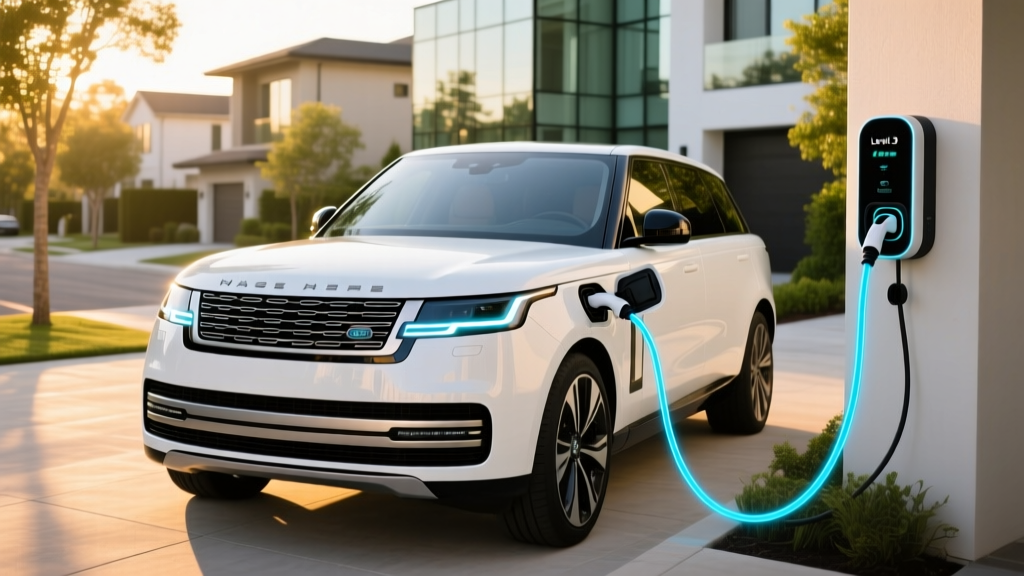
If you've been asking does Range Rover make an EV, the answer is finally yes. The 2026 Range Rover Electric (officially the Range Rover Electric, built on JLR's MLA-Flex architecture) marks the brand's first fully battery-electric vehicle. With an estimated 117 kWh usable battery pack, 800-volt electrical architecture, and a targeted EPA range near 300 miles, it's a serious luxury EV contender — but owning one means understanding how to charge a battery this large efficiently and cost-effectively.
This guide covers everything a current or prospective Range Rover Electric owner needs to know about charging at home, on the road, and what equipment to buy. We'll also address the broader question for JLR shoppers: how the plug-in hybrid Range Rover models (P460e, P550e) differ in charging needs from the full BEV.
The Range Rover Electric: What We Know About Charging Specs
Before planning your charging setup, here are the key numbers for the 2026 Range Rover Electric based on JLR's published preliminary specifications:
| Specification | 2026 Range Rover Electric (Preliminary) |
|---|---|
| Battery Capacity (usable) | ~117 kWh (NMC chemistry) |
| Electrical Architecture | 800-volt |
| Targeted EPA Range | ~300 miles (estimated, not yet EPA-certified) |
| Peak DC Fast Charge Rate | Up to ~250 kW (estimated) |
| 10–80% DC Fast Charge Time | ~30 minutes (estimated, with preconditioning) |
| Level 2 Onboard Charger | 11 kW (single-phase) / up to 22 kW (three-phase where available) |
| Charging Port / Connector | NACS (North America) / CCS2 (Europe) |
| Base MSRP (estimated) | ~$120,000+ (final pricing TBD) |
For comparison, the current Range Rover PHEV (P550e) uses a 23.1 kWh usable battery with a 19 kW onboard AC charger and up to 50 kW DC fast charging — achieving roughly 48 miles of EPA electric-only range. That's a fundamentally different charging scenario, and we'll address PHEV owners below.
Charging Levels Explained: Speeds, kW, and Miles Per Hour
Understanding the three charging levels is essential, especially with a battery as large as the Range Rover Electric's ~117 kWh pack. Here's how each level translates to real charging speed:
| Charging Level | Voltage / Phase | Power (kW) | Miles of Range Added Per Hour | Best For |
|---|---|---|---|---|
| Level 1 (Standard Outlet) | 120V / Single-phase | 1.0–1.4 kW | ~3–5 miles/hr | Emergency / overnight trickle only |
| Level 2 (Home / Workplace) | 240V / Single-phase | 7.2–19.2 kW | ~22–60 miles/hr | Daily home charging, overnight |
| DC Fast Charging | 400–800V DC | 50–350 kW | ~150–600+ miles/hr (peak) | Road trips, rapid top-ups |
What this means for a Range Rover Electric owner: At Level 1 (a standard 120V household outlet), charging the full 117 kWh battery from empty would take roughly 85–117 hours — essentially useless for daily needs. Level 2 is mandatory for practical ownership. At 11 kW (the vehicle's single-phase onboard charger limit), a 10–80% charge (~82 kWh) takes approximately 7.5 hours, making overnight charging ideal. At a 250 kW DC fast charger, that same 10–80% session drops to roughly 30 minutes, though real-world charge curves taper significantly above 80% SoC.
kW vs kWh — the critical distinction: kW (kilowatts) measures the rate of charging — like water flow from a hose. kWh (kilowatt-hours) measures the total energy stored — like the size of the bucket. The Range Rover Electric has a ~117 kWh bucket and can accept up to ~250 kW of flow rate at a DC fast charger.
How Much Does It Cost to Install a Home EV Charger?
For a vehicle in the $120,000+ range, budgeting $1,500–$4,000 for a proper home charging installation is a sensible investment. Here's a realistic cost breakdown for a Level 2, 240V/48A hardwired charger installation:
| Cost Component | Typical Range | Notes |
|---|---|---|
| Level 2 Charger (Equipment) | $400–$800 | 48A smart charger, 25-ft cable, NACS connector |
| Electrician Labor | $600–$2,000 | Depends on run length from panel to garage |
| Electrical Permit | $50–$250 | Varies by municipality |
| Panel Upgrade (if needed) | $1,500–$3,500 | Required if panel is 100A or near capacity |
| Total (No Panel Upgrade) | $1,050–$3,050 | Most common scenario for modern homes |
| Total (With Panel Upgrade) | $2,550–$6,550 | Older homes with 100A service |
Electrical Requirements for the Range Rover Electric
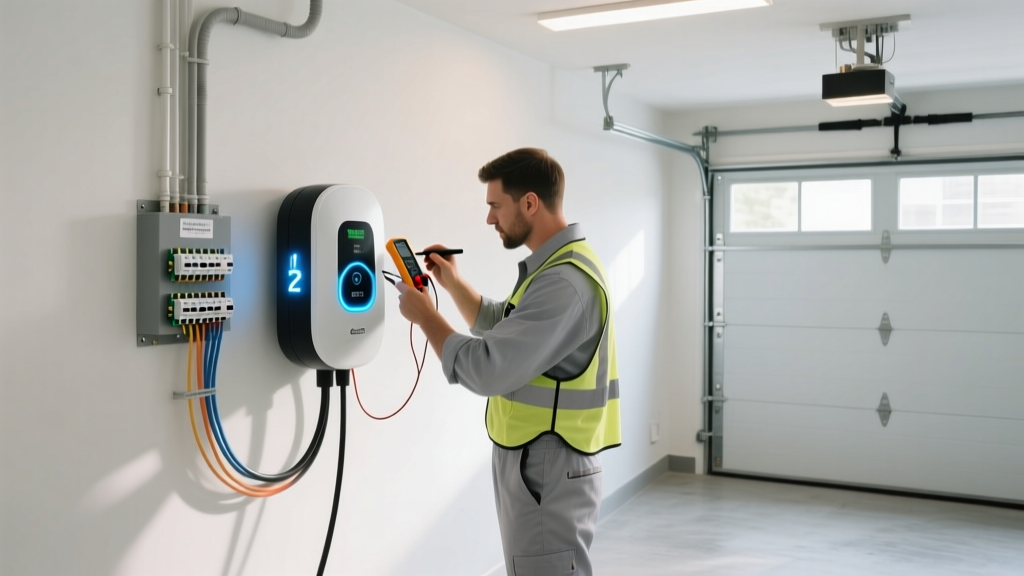
The Range Rover Electric's 11 kW onboard charger (single-phase) draws approximately 48 amps at 240V. Per the National Electrical Code (NEC), continuous loads must be on a circuit rated at 125% of the draw, meaning you need a 60-amp dedicated circuit with 6 AWG copper wire (or 4 AWG aluminum). Key considerations:
- Dedicated Circuit: The charger must have its own breaker — no sharing with other appliances.
- GFCI Protection: NEC 2020 and later requires GFCI protection for EV charging outlets; hardwired installations may bypass this requirement depending on local code interpretation.
- Outdoor Rating: If your parking spot is outside, the charger must carry a NEMA 4 (or IP65+) outdoor rating.
- Panel Capacity: A licensed electrician will perform a load calculation on your panel. Homes with 200A service typically handle a 60A EV circuit without upgrade. Homes with 100A service almost certainly need a panel upgrade to 200A.
Panel upgrade gotcha: Many homeowners discover their panel is already near capacity from HVAC, electric range, and dryer loads. Don't skip the load calculation — an overloaded panel is a fire risk, and your insurer may deny claims if unpermitted work is found. Always use a licensed electrician and pull permits. Refer to NFPA 70 (NEC) for code details.
Which Connector and Charger Is Compatible with the Range Rover Electric?
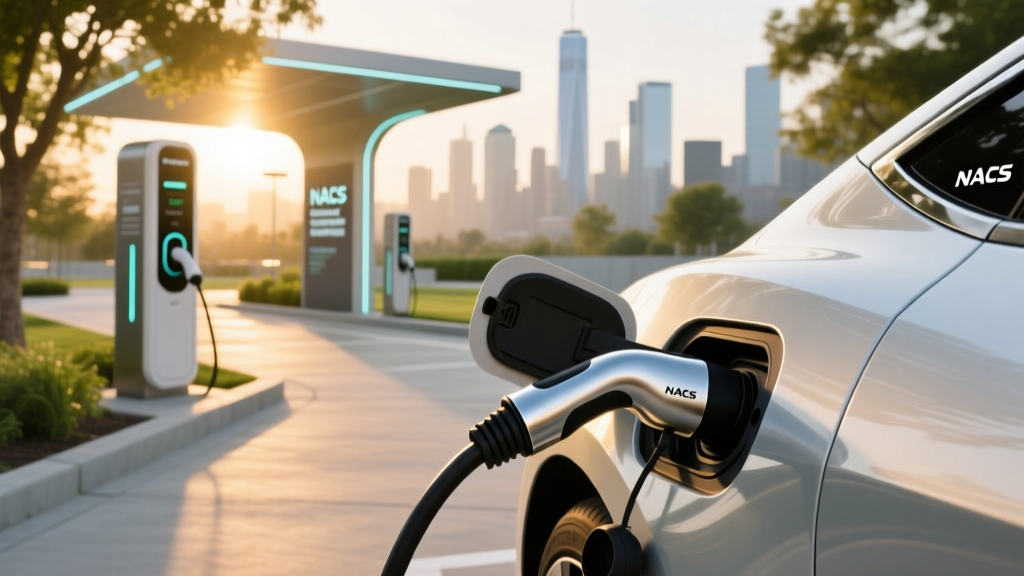
The 2026 Range Rover Electric uses the NACS (North American Charging Standard) connector in the US market, aligning with JLR's commitment to Tesla Supercharger network access. This is a significant advantage — NACS gives direct access to over 20,000 Tesla Supercharger stalls without an adapter.
| Connector Type | Range Rover Electric Compatibility | Network Access | Adapter Needed? |
|---|---|---|---|
| NACS (Tesla) | ✅ Native port | Tesla Supercharger, Electrify America (newer stalls), EVgo | No |
| CCS1 | ❌ Not native | Legacy Electrify America, ChargePoint, non-Tesla networks | Yes — NACS-to-CCS adapter (~$150–$250) |
| CHAdeMO | ❌ Not supported | Largely deprecated in North America | No reliable adapter exists |
| J1772 (Level 2) | ⚠️ Adapter needed | Public Level 2 stations, older home chargers | Yes — NACS-to-J1772 adapter (~$50–$100) |
Practical advice: If you're buying a NACS-native home charger (like the Tesla Wall Connector or Emporia Level 2), you plug directly in. If you already own a J1772 charger from a previous EV, a simple adapter handles it. Keep a NACS-to-CCS adapter in the frunk for non-Tesla DC fast charging networks that haven't transitioned to NACS yet — as of 2026, the transition is still underway at many Electrify America and ChargePoint locations.
Charging Cost Per Mile: Range Rover Electric vs Gas Range Rover
One of the strongest ownership arguments for the Range Rover Electric is fuel cost savings, especially given that a gas Range Rover V8 returns roughly 16–19 MPG combined. Here's a cost-per-mile breakdown across different charging scenarios:
| Charging Scenario | Cost per kWh | Cost for 10–80% (~82 kWh) | Cost Per Mile (est. 3.5 mi/kWh) |
|---|---|---|---|
| Home Off-Peak (utility TOU rate) | $0.08–$0.12 | $6.56–$9.84 | $0.023–$0.034 |
| Home Standard Rate | $0.14–$0.18 | $11.48–$14.76 | $0.040–$0.051 |
| Public Level 2 (ChargePoint, etc.) | $0.25–$0.39 | $20.50–$31.98 | $0.071–$0.111 |
| DC Fast Charging (Tesla Supercharger) | $0.28–$0.42 | $22.96–$34.44 | $0.080–$0.120 |
| DC Fast Charging (Electrify America) | $0.35–$0.55 | $28.70–$45.10 | $0.100–$0.157 |
Gas comparison: A 2025 Range Rover P530 (4.4L twin-turbo V8) averages ~17 MPG combined. At $3.80/gallon (national average, early 2026), that's $0.224 per mile. Even at the most expensive public DC fast charging rates, the Range Rover Electric costs roughly half as much per mile to "fuel." Home off-peak charging drops that to roughly one-seventh the cost.
Over 15,000 miles/year, a gas Range Rover costs ~$3,360 in fuel. The Range Rover Electric charged primarily at home (standard rate, $0.16/kWh) costs ~$686/year — a savings of roughly $2,674 annually.
Recommended Home Chargers for the Range Rover Electric
With an 11 kW onboard charger (48A at 240V), you want a Level 2 unit that can deliver the full 48 amps. Here are three chargers well-suited to the Range Rover Electric's needs:
1. Tesla Wall Connector (Gen 4) — Best Overall for NACS Vehicles
- Power Output: Up to 48A / 11.5 kW (hardwired, 240V)
- Connector: NACS native
- Cable Length: 24 feet
- Smart Features: Wi-Fi, OTA updates, load sharing (pair two units on one circuit), Tesla app integration, Powerwall integration
- Price: ~$475
- Why it works: Seamless NACS integration, reliable, and the load-sharing feature is ideal if you also own a PHEV Range Rover and want two chargers on a single 60A circuit.
2. Emporia Vue Level 2 EV Charger — Best Value with Energy Monitoring
- Power Output: Up to 48A / 11.5 kW (hardwired) or 40A (NEMA 14-50 plug)
- Connector: NACS or J1772 (configurable)
- Cable Length: 24 feet
- Smart Features: Whole-home energy monitoring (with Emporia Vue panel), scheduling, TOU rate optimization, solar integration
- Price: ~$399 (hardwired NACS model)
- Why it works: If you have solar panels or want granular energy-cost tracking, the Emporia ecosystem is unmatched. The TOU scheduling feature automatically charges during off-peak hours.
3. ChargePoint Home Flex (Gen 2) — Best for J1772 Flexibility
- Power Output: Up to 50A / 12 kW (hardwired, 240V)
- Connector: J1772 native (use NACS adapter for Range Rover Electric)
- Cable Length: 23 feet
- Smart Features: Wi-Fi, ChargePoint app, Alexa integration, flexible amperage dip-switch settings (16A–50A)
- Price: ~$649
- Why it works: If you have multiple EVs with different connectors or plan to keep this charger through a future vehicle swap, the adjustable amperage and J1772 native plug offer flexibility. The dip-switch lets you match the charger to your circuit capacity without buying a new unit.
DC Fast Charging on the Road: What to Expect
The Range Rover Electric's 800-volt architecture and estimated 250 kW peak DC charge rate place it in the top tier of luxury EV charging performance. However, real-world DC fast charging involves important nuances:
Charge curve taper: The ~250 kW peak rate is only sustained between roughly 10–40% State of Charge (SoC). Above 50%, the rate tapers to ~150 kW; above 80%, it drops sharply to ~50 kW or less. This is why manufacturers quote 10–80% times rather than 0–100%. Charging from 80–100% at a DC fast charger can add 20+ minutes — plan to unplug at 80% unless you absolutely need the full battery.
Preconditioning matters: The Range Rover Electric's thermal management system will precondition the battery when you navigate to a DC fast charger via the built-in nav. This warms the battery to optimal temperature (~77–95°F internally), enabling peak charge rates. Without preconditioning — for example, if you pull into a random charger without nav routing — expect peak rates 20–40% lower in cold weather.
Tesla Supercharger access: As a NACS-native vehicle, the Range Rover Electric can use Tesla Supercharger V3 (250 kW) and V4 stalls directly. Tesla's network remains the most reliable DC fast charging infrastructure in North America, with uptime consistently above 95% per PlugShare data. For non-Tesla networks, carry a NACS-to-CCS adapter.
Range Rover PHEV Owners: Your Charging Needs Are Different
If you own or are considering a Range Rover P550e or P460e plug-in hybrid, the charging calculus changes substantially. These models carry a ~23.1 kWh usable battery with:
- Level 2 Onboard Charger: 19 kW (significantly faster AC charging than most PHEVs)
- DC Fast Charging: Up to 50 kW (10–80% in ~20 minutes)
- Electric-Only Range: ~48 miles EPA
- Connector: CCS1 (US market) — note this differs from the BEV's NACS
For PHEV owners, a 40A/9.6 kW Level 2 home charger is more than sufficient — the 19 kW onboard charger can only utilize that full rate on three-phase power (rare in US homes). A standard 240V/40A circuit with a quality J1772 or CCS charger will fully charge the PHEV battery in roughly 2.5 hours. No panel upgrade is typically needed for PHEV charging.
Federal Tax Credits and Charging Installation Incentives
As of 2026, the federal §30D Clean Vehicle Credit offers up to $7,500 for qualifying new EVs, though the Range Rover Electric's MSRP (estimated $120,000+) exceeds the $80,000 SUV cap for §30D eligibility. JLR has not yet confirmed final battery sourcing compliance with critical-mineral requirements. Consult the IRS §30D guidelines and a tax professional for your specific eligibility.
For home charger installation, the §30C Alternative Fuel Vehicle Refueling Property Credit provides up to $1,000 (30% of equipment + installation costs, capped at $1,000) for residential EV charging equipment placed in service through 2032. This credit applies to the charger hardware and installation labor, but eligibility depends on your property being in a qualifying census tract (generally non-urban or low-income areas). Check the IRS §30C page for tract eligibility maps.
Many utilities also offer rebates of $250–$750 for Level 2 charger installation, and some provide free or discounted time-of-use (TOU) rate plans for EV owners. Contact your local utility before installation.
Frequently Asked Questions
Does Range Rover make a fully electric vehicle?
Yes. The 2026 Range Rover Electric is JLR's first battery-electric Range Rover, built on the MLA-Flex platform with an estimated 117 kWh battery, 800V architecture, and ~300 miles of targeted EPA range. It joins the existing Range Rover PHEV (P550e/P460e) models, which offer ~48 miles of electric-only range alongside a gasoline engine.
How much does it cost to install a home EV charger for the Range Rover Electric?
Expect $1,050–$3,050 for a standard Level 2 installation (equipment, electrician, and permit) if your electrical panel has sufficient capacity. If a 200A panel upgrade is required, total costs range from $2,550–$6,550. A 60A dedicated circuit with 240V is required for the full 48A/11 kW charge rate.
How fast will each charging level add range to the Range Rover Electric?
Level 1 (120V): ~3–5 miles/hour — impractical for a 117 kWh battery. Level 2 (240V, 48A): ~35–38 miles/hour, fully replenishing overnight. DC Fast Charging (250 kW peak): ~200+ miles in 15 minutes under optimal conditions, with a 10–80% session taking approximately 30 minutes.
Which connector does the Range Rover Electric use?
The 2026 Range Rover Electric uses the NACS (Tesla) connector in North America, providing direct access to the Tesla Supercharger network. For CCS1-equipped public chargers, a NACS-to-CCS adapter is required. The Range Rover PHEV models use CCS1 natively.
How much does charging cost per mile versus gas?
Charging at home on a standard rate (~$0.16/kWh) costs approximately $0.045/mile for the Range Rover Electric. A gasoline Range Rover V8 at 17 MPG and $3.80/gallon costs approximately $0.224/mile — roughly five times more. Annual fuel savings for 15,000 miles of driving approach $2,600–$2,800 with home charging.
What electrical upgrades might I need for a home charger?
The most common upgrade is a panel capacity increase from 100A to 200A service, costing $1,500–$3,500. You will definitely need a new 60A dedicated breaker and a circuit run with 6 AWG copper wire from the panel to the charger location. If the run exceeds 100 feet, wire gauge may need to increase to prevent voltage drop. A licensed electrician will perform a load calculation to determine your exact requirements.
Can I use a Tesla Supercharger with the Range Rover Electric?
Yes. Because the Range Rover Electric has a native NACS port, it can access Tesla Supercharger V3 (250 kW) and V4 stalls without an adapter. This provides access to over 20,000 Supercharger locations across North America, currently the most reliable DC fast charging network available.