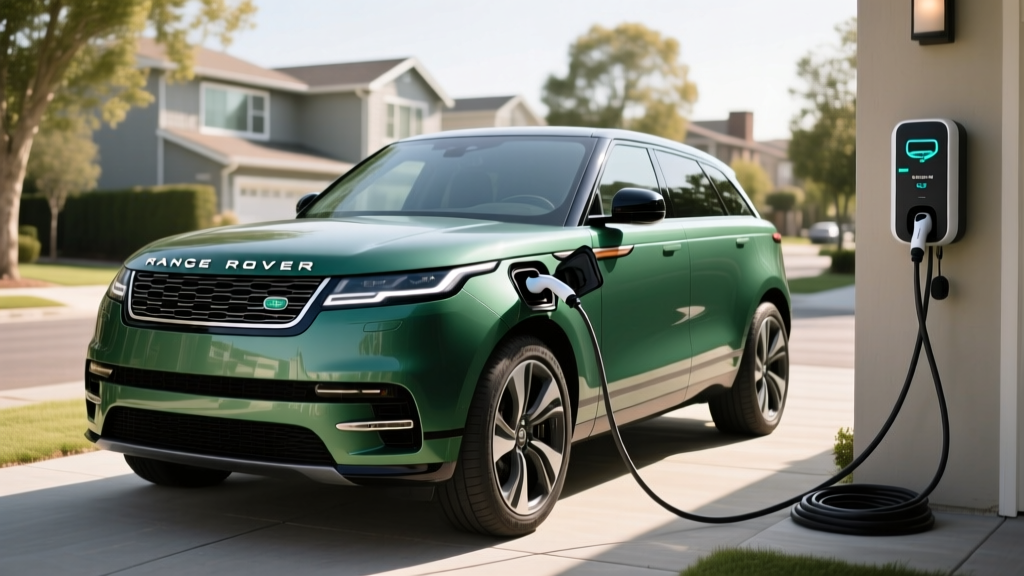
The 2026 Range Rover Electric marks the first fully battery-electric model in the luxury SUV's 50-plus-year history. Built on JLR's modular MLA-Flex architecture, it pairs a roughly 118 kWh (usable) battery with an 800-volt electrical system capable of accepting peak DC fast-charge rates above 200 kW. That spec sheet promises rapid road-trip replenishment, but extracting the full benefit requires matching the vehicle to the right home charger, understanding public-network compatibility, and budgeting for any electrical upgrades your property may need.
This guide walks through the charging ecosystem for the Range Rover Electric SUV with exact numbers — kilowatt charge rates, installation cost ranges, connector standards, and cost-per-mile math — so you can plan a setup that actually fits your garage and your budget.
Range Rover Electric SUV: Key Charging Specs at a Glance
| Specification | 2026 Range Rover Electric (Estimated) |
|---|---|
| Usable Battery Capacity | ~118 kWh (NMC chemistry) |
| EPA Range (Est.) | ~300–320 miles (real-world highway/cold: ~250–280 mi) |
| Max DC Fast-Charge Rate | ~200+ kW peak (800V architecture) |
| DC 10–80% Time (Est.) | ~25–30 minutes at a 350 kW station |
| Max AC Level 2 Acceptance | ~11–22 kW (onboard charger dependent on trim) |
| Charge Port Connector (US) | CCS1 (with NACS adapter expected or included) |
| Base MSRP (Est.) | ~$120,000+ (final trims TBD) |
| §30D Federal Tax Credit | Unlikely eligible (exceeds $80,000 SUV MSRP cap; verify at IRS.gov) |
Charging Levels Explained: Speeds, kW, and Miles per Hour
The three charging tiers differ fundamentally in power delivery. Remember: kW (kilowatts) measures the rate of power flow — think of it as the width of the hose — while kWh (kilowatt-hours) measures total energy stored in the battery, like the size of the tank. A charger rated at 11 kW adds 11 kWh of energy per hour under ideal conditions.
| Level | Voltage / Amps | Power (kW) | Miles Added/Hour (Est.) | Best Use Case |
|---|---|---|---|---|
| Level 1 | 120V / 12A | ~1.4 kW | ~3–5 mi/hr | Emergency top-up; overnight trickle |
| Level 2 (Home) | 240V / 40–48A | ~9.6–11.5 kW | ~28–38 mi/hr | Daily home charging; 8–10 hr full charge |
| Level 2 (High-Power) | 240V / 80A | ~19.2 kW | ~55–65 mi/hr | Fast home fill if vehicle accepts 22 kW onboard |
| DC Fast Charge | 400–800V DC | 50–350 kW | ~180–700+ mi/hr | Road trips; 10–80% in 25–30 min |
For a ~118 kWh battery, Level 1 is impractical as a primary source — a full charge would take roughly 85 hours. Level 2 at 11.5 kW refills the pack in about 10–11 hours, which is ideal for overnight charging. DC fast charging at a 350 kW station will deliver roughly 80% of the battery in 25–30 minutes, though the charge curve tapers significantly above 80% SoC (state of charge) to protect the cells.
How Much Does It Cost to Install a Home EV Charger?
Installation costs vary widely based on your electrical panel's capacity, the distance from the panel to the charger location, and local permitting requirements. Here's a realistic breakdown for a 240V / 48A (11.5 kW) Level 2 home charger installation:
| Item | Typical Cost Range | Notes |
|---|---|---|
| Level 2 Charger (Equipment) | $400 – $750 | Smart Wi-Fi charger, 48A, NEMA 14-50 or hardwired |
| Electrical Permit | $50 – $250 | Varies by municipality |
| Electrician Labor (Standard Install) | $500 – $1,500 | Panel to charger ≤30 ft, no panel upgrade |
| Panel Upgrade (200A service) | $1,500 – $3,500 | Required if existing panel is 100A or near capacity |
| Conduit / Trenching (Long Runs) | $300 – $1,200 | Detached garage or far driveway locations |
| Total (No Panel Upgrade) | $950 – $2,500 | Most homes with 200A service |
| Total (With Panel Upgrade) | $2,450 – $6,000 | Older homes with 100A service |
Panel-Upgrade Gotcha: Homes built before the 1990s often have 100-amp electrical panels. Adding a 48A continuous load (which the NEC requires sizing at 125%, or 60A breaker) may exceed your panel's capacity. A licensed electrician must perform a load calculation before installation. Budget for the upgrade if your panel is older or already near its limit with HVAC, electric range, and dryer circuits.
Connector Compatibility: NACS, CCS1, and Adapters
The North American charging landscape is mid-transition. Most legacy non-Tesla EVs use the CCS1 (Combined Charging System) connector, while Tesla's NACS (North American Charging Standard) is becoming the dominant plug as major automakers adopt it for 2025–2026 models. The Range Rover Electric SUV is expected to launch with a CCS1 port, though JLR has indicated NACS compatibility via adapter or future native adoption.
| Connector | Used By | DC Fast Networks | Adapter Needed for Range Rover Electric? |
|---|---|---|---|
| CCS1 | VW, Hyundai, BMW, GM (pre-2025), JLR (2026) | Electrify America, EVgo, ChargePoint | Native (no adapter) |
| NACS | Tesla, Ford, Rivian, GM (2025+), Volvo, many 2026+ models | Tesla Supercharger network | CCS-to-NACS adapter required (~$200–$250) |
| CHAdeMO | Nissan Leaf (legacy) | Limited; being phased out | Not compatible; no practical adapter |
Practical advice: If you plan to use Tesla Superchargers — the most reliable and widespread DC fast-charging network in the US — budget for a quality CCS-to-NACS adapter. Confirm adapter compatibility with JLR before purchase, as high-power 350 kW charging requires an adapter rated for the full voltage and amperage. As of 2026, Tesla has opened Supercharger access to non-Tesla EVs with CCS adapters at select stations via the Tesla app.
Cost to Charge: Home vs. Public vs. Gas Comparison
The Range Rover Electric SUV's ~118 kWh battery means each full charge represents meaningful energy cost. Here's how the scenarios break down:
| Scenario | $/kWh (Avg.) | Cost for 100 kWh | Cost per Mile (300 mi range) |
|---|---|---|---|
| Home Level 2 (Off-Peak TOU Rate) | $0.08 – $0.14 | $8 – $14 | $0.03 – $0.05 |
| Home Level 2 (Standard Rate) | $0.13 – $0.18 | $13 – $18 | $0.04 – $0.06 |
| Public Level 2 (Destination/Workplace) | $0.20 – $0.35 | $20 – $35 | $0.07 – $0.12 |
| DC Fast Charge (Electrify America, EVgo) | $0.35 – $0.55 | $35 – $55 | $0.12 – $0.18 |
| Gas Equivalent (Range Rover Sport, 19 MPG, $3.50/gal) | — | — | $0.18 – $0.22 |
At home on off-peak rates, the Range Rover Electric SUV costs roughly $0.03–$0.05 per mile to fuel — about one-quarter the per-mile cost of a gas Range Rover Sport. Even at public DC fast chargers, the electric model holds a cost advantage on a per-mile basis. However, frequent DC fast charging erodes that advantage and accelerates battery degradation. Home Level 2 charging is both the cheapest and battery-healthiest option.
For a driver covering 12,000 miles per year with 80% home charging at $0.13/kWh, annual fuel cost lands around $520–$620. A comparable gas Range Rover Sport at 19 MPG and $3.50/gallon would cost roughly $2,200 annually in fuel.
Recommended Home Level 2 Chargers for the Range Rover Electric
With a large ~118 kWh battery, you want a charger that can deliver meaningful overnight replenishment. A 48A unit on a 60A circuit provides up to 11.5 kW, adding roughly 30–35 miles of range per hour. Here are three proven options:
ChargePoint Home Flex
- Power Output: Up to 12 kW (50A) configurable
- Connector: J1772 (CCS compatible for AC charging)
- Cable Length: 23 feet
- Smart Features: Wi-Fi, app scheduling, Alexa, load sharing
- Price: ~$599
- Best For: Flexible amperage adjustment to match your panel capacity
Emporia Vue Level 2 Charger
- Power Output: Up to 11.5 kW (48A)
- Connector: J1772 (NACS version available)
- Cable Length: 24 feet
- Smart Features: Wi-Fi, energy monitoring, solar integration, time-of-use scheduling
- Price: ~$399
- Best For: Budget-conscious buyers who want energy tracking and solar pairing
Grizzl-E Smart
- Power Output: Up to 10 kW (40A)
- Connector: J1772 (NACS option available)
- Cable Length: 24 feet
- Smart Features: Wi-Fi, OCPP compatible, extreme cold rated (-40°F)
- Price: ~$449
- Best For: Cold-climate owners; rugged outdoor-rated build
All three chargers use the standard J1772 AC connector, which is compatible with the Range Rover Electric's CCS1 port for Level 2 charging (the CCS port incorporates the J1772 inlet for AC). If JLR offers a native NACS port or you use a NACS adapter for DC fast charging, confirm your AC charger compatibility — most home Level 2 units use J1772 regardless of the vehicle's DC port standard.
Safety, Code, and Electrical Requirements
A Level 2 charger installation is a permanent electrical modification governed by the National Electrical Code (NEC) and local amendments. Key requirements:
- Dedicated Circuit: The charger must be on its own dedicated breaker — no shared circuits with other appliances.
- NEC 125% Rule: A 48A continuous load requires a breaker rated at 60A (48 × 1.25 = 60). Wire gauge must match — typically 6 AWG copper for 60A.
- GFCI Protection: NEC 2020 and later require GFCI (Ground Fault Circuit Interrupter) protection for EV charging outlets in garages. Hardwired installations may have different GFCI requirements depending on jurisdiction.
- NEMA 14-50 vs. Hardwired: A NEMA 14-50 outlet offers portability but must be installed with proper torque specifications and a GFCI breaker in many jurisdictions. Hardwired connections eliminate the outlet failure risk and may not require GFCI in all areas.
- Outdoor Rating: If the charger is installed outside, the unit must carry a NEMA 4 or IP65+ weather rating. All three recommended chargers above meet outdoor-use standards.
- Permit and Inspection: Most jurisdictions require an electrical permit and post-installation inspection. Skipping this step can void homeowner's insurance coverage for electrical fires.
Always hire a licensed electrician who has experience with EV charger installations. The National Electrical Code (NFPA 70) Article 625 specifically governs EV charging system installations.
Charging Time Examples: What to Expect with a 118 kWh Battery
The Range Rover Electric's large battery means longer absolute charge times compared to smaller EVs. Here are realistic estimates based on common charging scenarios:
| Scenario | Starting SoC | Target SoC | Energy Added | Estimated Time |
|---|---|---|---|---|
| Home Level 2 (11.5 kW) | 20% | 80% | ~71 kWh | ~6–6.5 hours |
| Home Level 2 (11.5 kW) | 10% | 100% | ~106 kWh | ~9.5–10 hours |
| DC Fast (350 kW station) | 10% | 80% | ~83 kWh | ~25–30 minutes |
| DC Fast (150 kW station) | 10% | 80% | ~83 kWh | ~40–45 minutes |
| DC Fast (50 kW station) | 10% | 80% | ~83 kWh | ~1 hour 40 min |
Charge Curve Reality: The "200+ kW peak" rate applies only in a narrow SoC window, typically 10–35%. Above 50% SoC, the rate tapers to ~120–150 kW, and above 80% it drops below 50 kW to protect the battery. This is why 10–80% times are the industry-standard metric — charging beyond 80% on DC is slow and generally not worth the wait on road trips.
Preconditioning matters: The Range Rover Electric's thermal management system will warm or cool the battery to optimal charging temperature when you navigate to a DC fast charger. In cold weather, preconditioning can shave 5–10 minutes off your 10–80% time. Always use the vehicle's navigation to route to a charger so preconditioning activates automatically.
Frequently Asked Questions
How much does it cost to install a home EV charger for the Range Rover Electric SUV?
Expect $950–$2,500 for a standard installation on a home with a 200A electrical panel. If your home needs a panel upgrade from 100A to 200A, total costs can reach $2,450–$6,000. The charger unit itself runs $400–$750, with electrician labor and permits making up the remainder.
How fast will each charging level add range to the Range Rover Electric?
Level 1 (120V) adds roughly 3–5 miles per hour — too slow for daily use with a 118 kWh battery. Level 2 (240V, 48A) adds approximately 28–35 miles per hour, fully recharging overnight in about 10 hours. DC fast charging at a 350 kW station can add up to 200+ miles in 15 minutes under optimal conditions.
Which connector does the Range Rover Electric SUV use, and will I need an adapter?
The 2026 Range Rover Electric is expected to use a CCS1 connector. For home Level 2 charging, any J1772 charger is compatible (CCS1 incorporates the J1772 inlet). To use Tesla Superchargers, you'll need a CCS-to-NACS adapter, typically $200–$250. Confirm adapter compatibility with JLR for high-power DC charging before purchasing.
How much does charging the Range Rover Electric cost per mile vs. a gas Range Rover?
At home on average electricity rates ($0.13/kWh), the Range Rover Electric costs about $0.04–$0.06 per mile. A gas Range Rover Sport at 19 MPG and $3.50/gallon costs roughly $0.18–$0.22 per mile. Home charging saves approximately $1,500–$1,700 per year at 12,000 miles driven annually.
What electrical upgrades might I need before installing a home charger?
If your home has a 100A electrical panel, you will likely need a panel upgrade to 200A service ($1,500–$3,500). A licensed electrician must perform a load calculation to determine if your existing panel can accommodate a 60A dedicated breaker for the charger. Older homes with aluminum wiring or insufficient grounding may also need partial rewiring.
Is the Range Rover Electric SUV eligible for the federal EV tax credit?
Almost certainly not. The IRS §30D tax credit caps eligible SUVs at an $80,000 MSRP, and the Range Rover Electric is expected to start well above $120,000. Additionally, battery sourcing and critical mineral requirements, plus buyer income caps ($300,000 joint / $150,000 single), further limit eligibility. Consult a tax professional for your specific situation.
For the most current EPA range and efficiency data once official numbers are released, check fueleconomy.gov. Safety ratings will be published by NHTSA and the IIHS following crash testing.