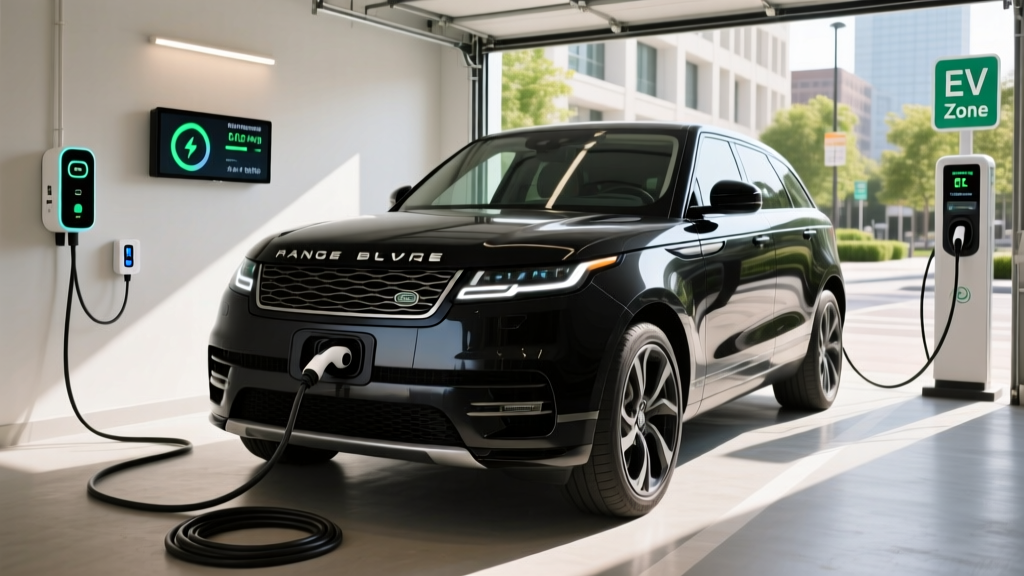
The upcoming Range Rover Electric represents Land Rover's first fully battery-electric flagship, built on the modular MLA-Flex architecture. While final EPA range and pricing remain preliminary ahead of its market launch, the vehicle is confirmed to use an 800V-capable electrical architecture, support DC fast charging at up to 200 kW (estimated), and ship with a CCS1 charge port for the North American market. For prospective buyers and reservation holders, understanding the charging ecosystem — from home installation to public network realities — is essential before this luxury EV arrives in driveways.
This guide breaks down every charging scenario you'll encounter with the Range Rover Electric, including exact installation costs, connector compatibility, equipment recommendations, and the math behind cost-per-mile compared to the supercharged V8 Range Rover it will likely cross-shop against.
Range Rover Electric: Confirmed and Estimated Charging Specs
Land Rover has confirmed the electric Range Rover will ride on the MLA-Flex platform, which supports both 400V and 800V battery architectures. Based on JLR's published technical briefings and comparable 800V luxury EVs (Porsche Taycan, Hyundai Ioniq 5, Kia EV9), here are the anticipated charging specifications:
| Specification | Value |
|---|---|
| Battery capacity (estimated) | ~100–117 kWh usable |
| Battery chemistry | NMC (nickel manganese cobalt) |
| Architecture voltage | 800V nominal |
| Max DC fast charge rate | ~200 kW (estimated peak) |
| 10–80% DC fast charge time | ~25–35 minutes (estimated) |
| Level 2 onboard charger | 11 kW (estimated, 3-phase capable) |
| Charge port (North America) | CCS1 (confirmed for launch) |
| Estimated EPA range | ~280–320 miles (preliminary) |
Charging Levels Explained: Speeds and Range Added Per Hour
Understanding the three charging tiers is critical for planning both daily routines and road trips. The key distinction: kW (kilowatts) measures the rate of power delivery — how fast energy flows into the battery. kWh (kilowatt-hours) measures total energy capacity — the size of the battery itself. Think of kW as the width of the hose and kWh as the size of the tank.
| Level | Voltage | Power (kW) | Miles of Range Added Per Hour | Best For |
|---|---|---|---|---|
| Level 1 (120V household) | 120V AC | 1.2–1.9 kW | 3–5 miles/hr | Emergency/overnight trickle (PHEVs, low-mileage drivers) |
| Level 2 (240V home/public) | 240V AC | 3.3–19.2 kW | 12–75 miles/hr | Daily home charging, workplace, destination charging |
| DC Fast Charging | 400–800V DC | 50–350 kW | 150–1,000+ miles/hr (peak) | Road trips, rapid top-ups on highways |
For the Range Rover Electric's estimated 100+ kWh battery, Level 1 charging is impractical as a primary strategy — a full charge would take 50+ hours. Level 2 at home (typically 7.7–11.5 kW in a residential setting) will replenish the battery overnight in roughly 10–14 hours from empty, which suits daily driving patterns perfectly. DC fast charging at 200 kW will handle the 10–80% session in approximately 25–35 minutes during road trips.
Home Charger Installation: Electrical Requirements and Cost Breakdown
Installing a dedicated Level 2 home charger for a large-battery luxury EV like the Range Rover Electric requires careful electrical planning. Here's what's involved:
Electrical Requirements
- Circuit: A dedicated 240V circuit, typically 40A to 60A, depending on the charger's amperage.
- Breaker sizing: NEC code requires the breaker to be rated at 125% of the continuous load. A 40A charger needs a 50A breaker; a 48A charger needs a 60A breaker.
- Wire gauge: 6 AWG copper for 50A circuits; 4 AWG for 60A circuits (varies by run length and local code).
- Panel capacity: Your home's main electrical panel must have sufficient spare capacity. A 200A panel with existing heavy loads (electric range, dryer, HVAC) may require a panel upgrade to 300–400A or the addition of a sub-panel.
Home Level 2 Charger Installation Cost Breakdown
| Component | Cost Range |
|---|---|
| Level 2 charger hardware (hardwired, 40A–48A) | $400–$750 |
| Electrician labor (standard install, 50ft run or less) | $500–$1,500 |
| Electrical permit and inspection | $50–$200 |
| Panel upgrade (if needed — 200A to 300/400A) | $1,500–$4,000 |
| Conduit, wiring, and miscellaneous materials | $100–$400 |
| Total (no panel upgrade) | $1,050–$2,850 |
| Total (with panel upgrade) | $2,550–$6,850 |
Older homes (pre-1990s) with 100A or 150A service are the most likely candidates for a panel upgrade. Get a load calculation from a licensed electrician before committing to a charger purchase. Many utility companies offer free or subsidized home energy assessments that include panel evaluations.
Safety and Code Considerations
- GFCI protection: NEC 2023 and later requires GFCI protection for all EV charging outlets (NEMA 14-50). Hardwired chargers may bypass this requirement in some jurisdictions — check local code.
- Outdoor rating: If installing outdoors (garage not available), select a charger rated NEMA 4 or NEMA 4X for weather resistance.
- Dedicated circuit: Never share the EV charger circuit with other appliances. This is a code violation and a fire hazard.
- Cable management: For a vehicle as large as the Range Rover Electric (over 196 inches long), choose a charger with at least a 24-foot cable to reach the charge port regardless of parking orientation.
Connector Compatibility: CCS1, NACS, and Adapter Options
The Range Rover Electric will launch in North America with a CCS1 (Combined Charging System) charge port. This is the standard used by most non-Tesla EVs and is supported by Electrify America, EVgo, and the majority of public DC fast-charging networks.
| Connector | Type | Used By | Range Rover Electric Compatible? |
|---|---|---|---|
| CCS1 | DC Fast + Level 2 AC | VW, GM, Hyundai, Kia, BMW, JLR, most non-Tesla | Yes — native port |
| NACS (Tesla) | DC Fast + Level 2 AC | Tesla, Ford, GM, Rivian, Volvo (2025+) | With adapter (when available) |
| CHAdeMO | DC Fast | Nissan Leaf, Mitsubishi (legacy) | No — not compatible |
| J1772 | Level 2 AC only | All EVs (via CCS adapter or native) | Yes — via CCS1 inlet |
Tesla Supercharger access: Tesla has opened its Supercharger network to non-Tesla EVs via the "Magic Dock" CCS adapter built into select V3 and V4 Supercharger stalls. Additionally, JLR may offer or approve a NACS adapter for the Range Rover Electric post-launch, similar to adapters offered by Ford and GM. Until then, CCS1 remains the primary connector for both home and public charging.
For home Level 2 charging, any J1772-connector charger will plug directly into the Range Rover Electric's CCS1 inlet (the CCS port incorporates the J1772 connector in its upper section). No adapter is needed for Level 2 home charging.
Charging Cost: Per-Mile Economics vs. Gas Range Rover
One of the most compelling ownership arguments for the Range Rover Electric is the fuel cost reduction. Here's how the math works across different charging scenarios, using an estimated efficiency of 2.2 kWh/mile (a reasonable figure for a heavy luxury AWD SUV — comparable to the BMW iX and Mercedes EQS SUV):
| Charging Scenario | Rate ($/kWh) | Cost Per Mile | Annual Cost (12,000 mi) |
|---|---|---|---|
| Home — off-peak utility rate | $0.12 | $0.26 | $3,168 |
| Home — standard residential rate | $0.17 | $0.37 | $4,488 |
| Public Level 2 (workplace/destination) | $0.25 | $0.55 | $6,600 |
| DC fast charging (Electrify America, EVgo) | $0.45 | $0.99 | $11,880 |
| DC fast charging (peak pricing) | $0.60 | $1.32 | $15,840 |
Gas comparison: A 2025 Range Rover P530 (4.4L twin-turbo V8, 523 hp) achieves approximately 16 MPG combined per the EPA. At $3.80/gallon (2025 national premium average), that's $0.24 per mile just in fuel, or roughly $2,850 annually for 12,000 miles. However, the gas Range Rover requires premium fuel, and real-world mixed driving often yields 13–15 MPG, pushing the cost closer to $0.27–$0.30/mile ($3,200–$3,600/year).
With predominantly home charging at off-peak rates, the Range Rover Electric's cost per mile is comparable to or slightly above the gas model. The savings become substantial if you have access to workplace Level 2 charging, solar-powered home charging, or utility EV-specific time-of-use plans with rates as low as $0.06–$0.08/kWh. The real financial advantage comes from reduced maintenance (no oil changes, no transmission fluid, fewer brake replacements due to regenerative braking) and potential federal/state incentives.
Recommended Home Level 2 Chargers for the Range Rover Electric
Given the Range Rover Electric's large battery and luxury positioning, you'll want a reliable, high-output Level 2 charger with smart features and a cable long enough to accommodate a full-size SUV. Here are top recommendations:
ChargePoint Home Flex
- Power output: Up to 12 kW (50A) on a 240V/50A circuit; configurable down to 16A
- Connector: J1772 (plugs into CCS1 inlet natively)
- Cable length: 23 feet
- Smart features: Wi-Fi connected, ChargePoint app scheduling, Alexa integration, energy tracking, utility demand-response compatible
- Installation: Hardwired or NEMA 14-50 plug
- Price: ~$550–$650 (hardware only)
- Best for: Flexible amperage configuration, robust app ecosystem, strong utility rebate compatibility
Emporia Level 2 EV Charger
- Power output: Up to 11.5 kW (48A) on a 240V/60A circuit
- Connector: J1772
- Cable length: 24 feet
- Smart features: Real-time energy monitoring via Emporia Vue integration, solar-aware charging, scheduling, load management
- Installation: Hardwired or NEMA 14-50 plug
- Price: ~$350–$450 (hardware only)
- Best for: Budget-conscious buyers who want energy monitoring and solar integration
Grizzl-E Smart
- Power output: Up to 10 kW (40A) on a 240V/50A circuit
- Connector: J1772
- Cable length: 24 feet
- Smart features: OCPP-compatible, app-based scheduling, works with multiple energy management platforms
- Installation: Hardwired or plug-in options
- Price: ~$450–$550
- Best for: Extreme cold climates (rated to -40°F), Canadian-built durability, outdoor installations
Wallbox Pulsar Plus
- Power output: Up to 11.5 kW (48A) on a 240V/60A circuit
- Connector: J1772
- Cable length: 25 feet
- Smart features: Wi-Fi + Bluetooth, myWallbox app, Power Sharing (multiple chargers on one circuit), Eco-Smart solar integration
- Installation: Hardwired recommended
- Price: ~$550–$700
- Best for: Multi-EV households needing load sharing, clean compact design
For the Range Rover Electric's estimated 11 kW onboard charger, any of these units at 48A will deliver near-maximum Level 2 speed. A 48A charger delivers approximately 11.5 kW, adding roughly 25–30 miles of range per hour — enough to fully replenish a day's driving in 2–3 hours and charge from 20% to 100% overnight in about 8–9 hours.
DC Fast Charging on the Road: What to Expect
On road trips, the Range Rover Electric's 800V architecture positions it to take advantage of the growing network of 150–350 kW DC fast chargers. Here's what real-world charging looks like:
Charge curve reality: No EV sustains its peak charge rate for the entire session. The "200 kW" peak rate applies only at low states of charge (typically 10–40% SoC). As the battery fills, the charge rate tapers to protect cell health. Expect the average rate across a 10–80% session to be closer to 130–160 kW, even if the peak hits 200 kW briefly. This is normal and applies to every EV on the market.
Estimated 10–80% charge times by charger type:
- 350 kW charger (e.g., Electrify America, Ionity): ~25–30 minutes (vehicle will be limited by its ~200 kW max acceptance)
- 150 kW charger (e.g., EVgo, older EA stations): ~35–45 minutes
- 50 kW CHAdeMO/CCS charger (legacy): ~90–120 minutes (not recommended for road trips)
Preconditioning: The Range Rover Electric's thermal management system will precondition the battery when a DC fast-charging station is set as your navigation destination. This warms the battery to optimal temperature for maximum charge acceptance, particularly important in cold weather where charge speeds can drop 30–50% without preconditioning. Always navigate to your charging stop rather than just driving there.
Federal Tax Credit and Charging Incentives
As of 2026, the federal EV tax credit under IRS §30D provides up to $7,500 for qualifying new EVs, subject to MSRP caps ($80,000 for SUVs), buyer income limits ($300,000 joint / $225,000 head of household / $150,000 single), and battery component and critical mineral sourcing requirements. The Range Rover Electric's anticipated MSRP (likely $120,000+) will almost certainly exceed the §30D MSRP cap, making it ineligible for the federal new-EV credit.
However, other incentives may apply:
- Home charger tax credit: The Alternative Fuel Vehicle Refueling Property Credit (§30C) offers up to $1,000 for residential charger installation, subject to income and census-tract eligibility. Check irs.gov for current rules.
- Utility rebates: Many utilities offer $250–$1,000 rebates for Level 2 charger purchase and installation, plus discounted time-of-use electricity rates for EV owners.
- State incentives: Several states offer additional rebates or tax credits for EV purchases and charger installations — check your state's energy office or afdc.energy.gov for local programs.
Frequently Asked Questions
How much does it cost to install a home EV charger for the Range Rover Electric?
Expect $1,050–$2,850 for a standard installation (charger hardware + electrician + permit) if your electrical panel has sufficient capacity. If a panel upgrade from 200A to 300A or 400A is needed, add $1,500–$4,000, bringing the total to $2,550–$6,850. Always get a load calculation from a licensed electrician first.
How fast will each charging level add range to the Range Rover Electric?
Level 1 (120V) adds approximately 3–5 miles per hour — impractical for a 100+ kWh battery. Level 2 (240V, 48A) adds roughly 25–30 miles per hour, fully charging overnight. DC fast charging at 200 kW peak adds approximately 150–180 miles in a 25–30 minute session (10–80% SoC).
Which connector and charger is compatible with the Range Rover Electric?
The Range Rover Electric uses a CCS1 charge port for North America. Any J1772 Level 2 charger will plug in natively (the CCS1 inlet incorporates J1772). For DC fast charging, use CCS1-equipped stations. Tesla Supercharger access requires a CCS adapter or a Tesla Magic Dock-equipped station. CHAdeMO is not compatible.
How much does charging cost per mile compared to a gas Range Rover?
With home charging at $0.12/kWh (off-peak), the Range Rover Electric costs roughly $0.26/mile. A gas Range Rover P530 at 15 MPG and $3.80/gallon premium costs approximately $0.25–$0.30/mile. Savings are modest on electricity cost alone but become significant with solar charging, workplace charging, or utility EV rates below $0.10/kWh — plus reduced maintenance costs.
What electrical upgrades might I need for a home charger?
The most common upgrade is a panel capacity increase if your home has a 100A or 150A main panel or if existing loads (electric heat, dryer, range, pool equipment) leave insufficient headroom. A licensed electrician will perform a load calculation per NEC Article 220. Other potential upgrades include adding a sub-panel closer to the garage, upgrading the service drop from the utility, or installing a smart load-management device that throttles the charger when other appliances draw power.
Can I use a NACS/Tesla adapter with the Range Rover Electric?
At launch, JLR has confirmed CCS1 as the native connector. A NACS adapter may become available post-launch (similar to Ford and GM offerings), which would enable access to Tesla Supercharger stalls without Magic Dock. Until such an adapter is announced and certified by JLR, plan to use CCS1-equipped networks (Electrify America, EVgo, and Tesla Magic Dock stations) for DC fast charging.