Trading 14 MPG for Electrons: What Changes When You Go Electric
If you've been driving a 2010 Range Rover Supercharged — with its 5.0-liter V8 producing 510 hp and returning roughly 12 city / 18 highway MPG (about 14 MPG combined in mixed driving, per fueleconomy.gov) — you're accustomed to $300–$400 monthly fuel bills and the rumble of a supercharged engine. Transitioning to a battery-electric vehicle (BEV) in 2026 means rethinking "refueling" entirely. Instead of gas stations, you'll be dealing with kilowatt-hours, charge curves, and home electrical upgrades.
The good news: most EV owners do 80% or more of their charging at home, waking up to a full "tank" every morning. The learning curve is manageable once you understand the three charging levels, connector types, and real costs. This guide breaks down everything you need to set up charging — whether you drive a Tesla Model Y, Ford F-150 Lightning, Hyundai Ioniq 5, or any other current BEV.
kW (kilowatts) = the rate of power delivery, like the flow rate of a gas pump hose. Higher kW means faster charging.
kWh (kilowatt-hours) = the total energy stored in your battery, like gallons in a fuel tank. A 82 kWh battery holds 82 kWh of energy.
Never use these interchangeably — it's the single most common EV mistake.
The Three Charging Levels: Speed, Cost, and Use Case
Every EV sold in the U.S. charges at one of three levels. Understanding these determines your daily routine and road-trip planning.
| Level | Voltage / Amps | Power (kW) | Miles of Range / Hour | Best For |
|---|---|---|---|---|
| Level 1 | 120V / 12A | ~1.4 kW | 3–5 mi/hr | PHEVs, overnight top-ups, emergencies |
| Level 2 | 240V / 32–48A | 7.7–11.5 kW | 25–44 mi/hr | Daily home charging, workplaces |
| DC Fast | 400–800V DC | 50–350 kW | 150–1,200+ mi/hr | Road trips, commercial fleets |
Real-world context: A 2010 supercharged Range Rover has a ~27.7-gallon tank. At 14 MPG combined, that's roughly 388 miles of range. Replacing that with an EV means you'll want a battery around 80–100 kWh (like the Rivian R1S or Tesla Model X). Charging that battery from 10–80% takes roughly:
- Level 1 (1.4 kW): ~40+ hours — impractical for a full BEV
- Level 2 (11.5 kW): ~5–6 hours — ideal overnight
- DC Fast (150–250 kW peak): 18–35 minutes (10–80%), depending on vehicle architecture
Note that DC fast charging follows a charge curve: the battery accepts peak power only at lower states of charge (typically 10–50% SoC), then tapers significantly above 80% to protect cell longevity. A "250 kW capable" vehicle may average 100–130 kW across the full 10–80% session.
Home Charger Installation: Electrical Requirements and Costs
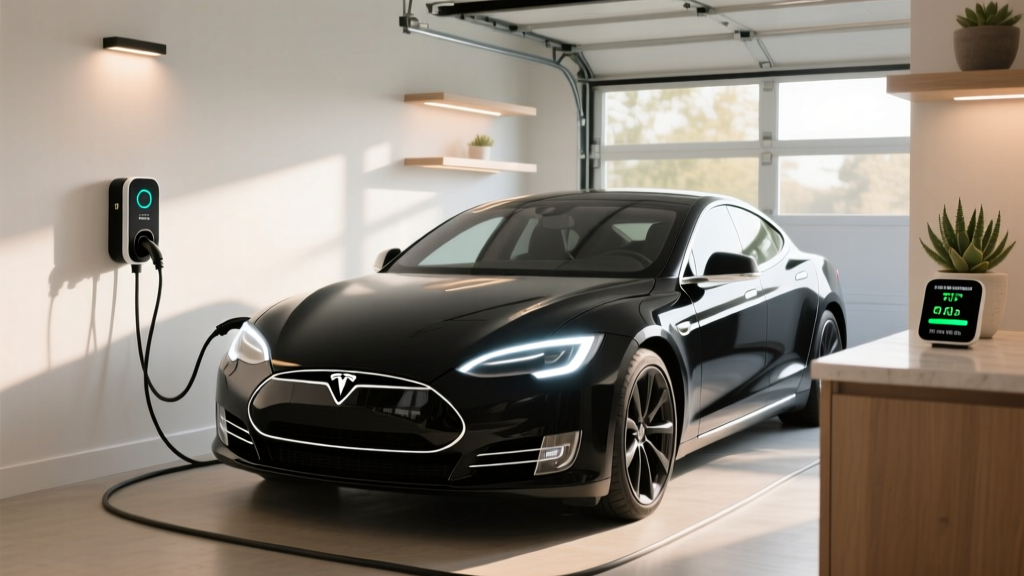
Installing a Level 2 home charger is the single most impactful upgrade for EV ownership. Here's what's involved electrically.
Electrical Specifications
A typical Level 2 charger requires:
- Voltage: 240V (same as your electric dryer or oven)
- Amperage: 40A circuit for a 32A charger, or 60A circuit for a 48A charger (the National Electrical Code requires circuits rated at 125% of continuous load)
- Wiring: 6 AWG copper for 40A; 4 AWG for 60A (varies by run length)
- Dedicated circuit: The charger must have its own breaker — no sharing with other appliances
Panel Upgrade Reality
If your home has a 100-amp main panel (common in pre-1990 construction), adding a 60A EV circuit may exceed your panel's capacity. A panel upgrade to 200A costs $1,500–$3,500 depending on your utility and local code. Some homeowners opt for a smart load-management device (like the Emporia V2 with load shedding) to avoid a panel upgrade — these devices throttle charger amperage when other high-draw appliances are running.
| Component | Basic Install (Short Run) | Complex Install (Long Run / Upgrade) |
|---|---|---|
| Level 2 Charger (hardware) | $350–$650 | $500–$750 |
| Electrician labor (2–6 hrs) | $400–$800 | $1,000–$2,500 |
| Permit & inspection | $50–$200 | $100–$350 |
| Panel upgrade (if needed) | $0 (not needed) | $1,500–$3,500 |
| Total | $800–$1,650 | $3,100–$7,100 |
Always hire a licensed electrician and pull a permit. Unpermitted EV charger installations can void home insurance claims and create fire risk. Many utilities offer rebates of $250–$1,000 for Level 2 installations — check with your local provider before starting work.
Connector Compatibility: NACS, CCS, and CHAdeMO in 2026
The North American charging connector landscape has consolidated significantly since 2023, when Ford, GM, Rivian, and others adopted Tesla's North American Charging Standard (NACS). Here's where things stand for the 2026 model year:
| Connector | Brands Using It | Notes |
|---|---|---|
| NACS (J3400) | Tesla, Ford, GM, Rivian, Volvo, Polestar, Mercedes, Nissan, Honda, Fisker, Lucid (2025+), Hyundai/Kia (2025+) | Now the dominant standard; access to Tesla Supercharger network |
| CCS1 | Legacy models pre-2025, some Stellantis vehicles, VW ID.4 (pre-2026) | Adapters available for Supercharger access; Electrify America still supports CCS |
| CHAdeMO | Nissan Leaf (legacy only) | Effectively discontinued for new vehicles; declining station availability |
Adapter needs: If you buy a 2024–2025 CCS-equipped EV, Tesla sells a CCS-to-NACS adapter (~$250) for Supercharger access. If you buy a NACS vehicle and need to use Electrify America or other CCS-only DC fast stations, a NACS-to-CCS adapter is available from several third-party manufacturers. For Level 2 home charging, virtually all chargers now ship with a NACS connector or include a J1772 adapter (J1772 was the prior Level 2 standard).
Charging Cost Per Mile vs. Your Old Supercharged Range Rover
The 2010 Range Rover Supercharged averaged about 14 MPG combined. With premium fuel (required) at roughly $4.50/gallon in 2026, that's approximately $0.32 per mile in fuel alone. Let's compare that to EV charging scenarios:
| Scenario | Rate | Cost / Mile* | Annual Cost (12k mi) |
|---|---|---|---|
| 2010 Range Rover SC (14 MPG, premium) | $4.50/gal | $0.321 | $3,857 |
| Home charging (off-peak rate) | $0.12/kWh | $0.036 | $432 |
| Home charging (standard rate) | $0.18/kWh | $0.054 | $648 |
| Public Level 2 (network pricing) | $0.30/kWh | $0.090 | $1,080 |
| DC Fast Charging (public) | $0.48/kWh | $0.144 | $1,728 |
*Based on an EV efficiency of 3.0 miles/kWh (≈33 kWh/100 mi), typical for a mid-size SUV like the Tesla Model Y or Hyundai Ioniq 5.
Even at the most expensive public DC fast-charging rate, the EV costs less than half per mile compared to the supercharged Range Rover. Home charging on off-peak rates delivers roughly 89% savings — the equivalent of paying $0.53 per gallon of gasoline. Over five years and 60,000 miles, the fuel savings alone can reach $14,000–$17,000.
Recommended Home Level 2 Chargers for 2026
Based on reliability, feature sets, and value, here are the top Level 2 home chargers for current EV owners:
Tesla Wall Connector (Gen 4)
- Power: 11.5 kW (48A on 60A circuit)
- Connector: NACS native
- Cable: 24 ft
- Smart features: Wi-Fi, OTA updates, load sharing, Powerwall integration
- Price: ~$475
- Best for: Tesla owners, NACS-equipped vehicles
ChargePoint Home Flex (2nd Gen)
- Power: Up to 12 kW (50A configurable)
- Connector: NACS or J1772 (configurable)
- Cable: 24 ft
- Smart features: App scheduling, Alexa, load management
- Price: ~$599
- Best for: Multi-EV households, flexible amperage
Emporia Level 2 EV Charger
- Power: 11.5 kW (48A)
- Connector: J1772 (NACS adapter included)
- Cable: 24 ft
- Smart features: Energy monitoring, solar integration, load management
- Price: ~$399
- Best for: Budget-conscious, solar-panel homes
Grizzl-E Smart
- Power: 10 kW (40A)
- Connector: J1772 or NACS
- Cable: 24 ft
- Smart features: OCPP compatible, adjustable amperage
- Price: ~$449
- Best for: Outdoor installs (IP67 rated), cold climates (-40°F rated)
Safety, Electrical Code, and Installation Best Practices
EV chargers draw sustained high current for hours — this is unlike any other household appliance. Follow these safety requirements:
- Dedicated circuit: Your charger must have its own breaker in the panel. Never share a circuit with a dryer, HVAC, or other load.
- GFCI protection: The 2023 NEC (National Electrical Code) requires GFCI protection for outdoor EV receptacles. Hardwired chargers (recommended) typically include built-in ground-fault protection and may not require a separate GFCI breaker — confirm with your electrician and local inspector.
- Outdoor rating: If installing outside, ensure the charger is rated at minimum IP54 (splash-resistant) or ideally IP65/IP67 (weatherproof). Most quality chargers meet this standard.
- Hardwired vs. plug: Hardwired installations (no NEMA 14-50 receptacle) are generally preferred for 48A+ chargers. They eliminate a potential failure point, avoid the NEC requirement for GFCI breakers on receptacles, and allow full 48A delivery. A NEMA 14-50 outlet limits you to 40A continuous (which means a 32A charger maximum).
- Cable management: Install a cable holster or retractor to keep the charging cable off the ground and protected from damage.
Many jurisdictions now require a permit and inspection for any EV charger installation. This protects you: if an electrical fire originates from an unpermitted install, your homeowner's insurance may deny the claim. The permit fee is typically $50–$200 — a small cost for peace of mind.
Charging Time Examples for Popular EV Battery Sizes
How long does it actually take to charge common EV batteries? Here are real-world estimates for 10–80% sessions:
| Vehicle | Battery (kWh usable) | Level 2 (11.5 kW) | DC Fast (peak kW) | 10–80% DC Time |
|---|---|---|---|---|
| Tesla Model Y LR | 75 kWh | ~4.5 hrs | 250 kW | ~18 min |
| Hyundai Ioniq 5 | 77.4 kWh | ~4.7 hrs | 240 kW (800V) | ~18 min |
| Ford F-150 Lightning ER | 131 kWh | ~8 hrs | 150 kW | ~41 min |
| Chevrolet Equinox EV | 85 kWh | ~5.2 hrs | 150 kW | ~28 min |
| Rivian R1S (Max Pack) | 141 kWh | ~8.6 hrs | 200 kW | ~42 min |
Cold-weather caveat: Battery temperatures below 50°F significantly slow DC fast charging. A session that takes 18 minutes in July may stretch to 30–40 minutes in January at 20°F unless the vehicle has preconditioned its battery (most modern EVs do this automatically when you navigate to a charger). Level 2 home charging speed is less affected because the extended duration allows the battery to warm gradually.
Frequently Asked Questions
How much does it cost to install a home EV charger?
A straightforward Level 2 installation (short wire run, no panel upgrade) typically costs $800–$1,650 including the charger hardware, electrician labor, and permit. If your home needs a 200A panel upgrade or a long conduit run, expect $3,100–$7,100. Always get 2–3 quotes from licensed electricians and verify they have EV charger installation experience.
How fast will each charging level add range?
Level 1 (120V) adds 3–5 miles per hour — only practical for plug-in hybrids or overnight trickle-charging. Level 2 (240V, 48A) adds 25–44 miles per hour and can fully replenish most EVs overnight. DC fast charging adds 150–1,200+ miles per hour at peak power, but sessions are typically limited to 10–80% to protect the battery and because the charge rate tapers at higher states of charge.
Which connector and charger is compatible with my EV?
For 2026 model-year vehicles, most new EVs use the NACS connector (Tesla, Ford, GM, Rivian, Hyundai/Kia, and others). Older CCS-equipped vehicles can use adapters for Supercharger access. Check your vehicle's charge port — if it's the smaller, single-pin design, it's NACS. If it has two larger DC pins below the J1772 AC pins, it's CCS1. CHAdeMO is limited to the discontinued Nissan Leaf. For home charging, match your charger's connector to your car's port or use the appropriate adapter.
How much does EV charging cost per mile compared to gasoline?
Charging at home on off-peak electricity ($0.12/kWh) costs roughly $0.036 per mile for a typical EV SUV — about 89% less than fueling a 2010 supercharged Range Rover at $0.32 per mile. Even public DC fast charging at $0.48/kWh ($0.144/mile) is still 55% cheaper per mile. Over 12,000 annual miles, home charging saves $3,200+ versus premium gasoline.
What electrical upgrades might I need for a home charger?
The most common upgrade is a panel capacity increase from 100A to 200A service, which costs $1,500–$3,500. You'll also need a dedicated 40A or 60A breaker and appropriately gauged wiring from the panel to the charger location. If your panel is on the opposite side of the house from your garage, the wire run cost increases significantly. Some homes can avoid panel upgrades by using a smart load-management system that dynamically reduces charger amperage when other large loads are active.
Can I use the federal tax credit for a home charger?
The IRS Residential Clean Energy Credit (IRC §25C) covers 30% of home EV charger equipment and installation costs, up to $1,000 per year. This is separate from the §30D new-vehicle credit. Eligibility depends on your tax liability and whether the equipment meets energy-efficiency standards — consult a tax professional for your specific situation, as rules are subject to legislative changes.
Sources: fueleconomy.gov (EPA efficiency data), irs.gov (tax credit rules), National Electrical Code 2023 (NFPA 70), manufacturer specification sheets for listed vehicles and chargers.