Why Charging a Range Extender EV Is Different (and Easier)
A range extender electric vehicle (REEV) — sometimes called an extended-range EV or EREV — pairs a battery-driven electric motor with a small onboard gasoline generator that recharges the battery when it runs low. Models like the BMW i3 REx (discontinued but widely owned), the Ram 1500 REV with range extender (announced for 2026), and several Chinese-market REEVs from Li Auto share a defining trait: smaller battery packs than pure BEVs, typically between 30 and 55 kWh usable, supplemented by a generator that adds 100–200+ miles of range.
That smaller battery fundamentally changes your charging calculus. A 40 kWh pack charges to full in roughly 5 hours on a 7.7 kW Level 2 circuit — versus 10+ hours for an 80 kWh BEV. DC fast charging from 10–80% might take just 20–25 minutes instead of 30–40. And because you carry a backup generator, the "range anxiety" that drives BEV owners toward expensive high-speed home chargers is dramatically reduced.
This guide covers exactly what you need to charge a range extender electric vehicle at home, on the road, and what it all costs — with real numbers for 2026 equipment and electricity rates.
Charging Levels Explained: Speeds in kW and Miles Per Hour
Before we get into equipment and costs, let's clarify the single most important distinction in EV charging: kW (kilowatts) measures power — how fast energy flows into your battery. kWh (kilowatt-hours) measures energy — how much your battery holds. A 50 kW charger delivers energy twice as fast as a 25 kW charger. A 40 kWh battery holds half the energy of an 80 kWh battery.
Here's how each level performs with a typical range extender EV battery (35–50 kWh):
| Level | Voltage / Amps | Power (kW) | Miles of Range Added Per Hour | 0–100% Time (40 kWh pack) |
|---|---|---|---|---|
| Level 1 (120V household) | 120V / 12A | ~1.4 kW | 3–5 mi/hr | ~28–30 hours |
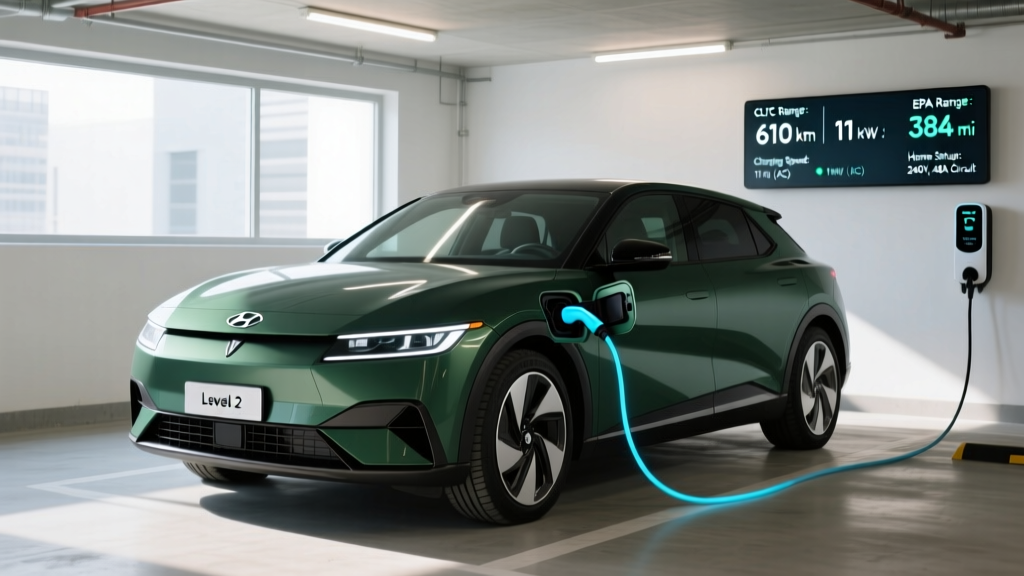
| Level 2 (240V home/public) | 240V / 32A | ~7.7 kW | 22–28 mi/hr | ~5–5.5 hours |
| Level 2 (240V, 48A circuit) | 240V / 48A | ~11.5 kW | 33–42 mi/hr | ~3.5–4 hours |
| DC Fast Charging | 400V+ / variable | 50–150 kW (peak) | 150–350 mi/hr | 10–80% in ~20–25 min |
Home Charger Installation: Electrical Requirements, Costs, and Gotchas
Most range extender EV owners find that a Level 2 home charger on a 240V/40A circuit (delivering ~7.7 kW continuous, which is 80% of the 40A breaker rating per NEC continuous-load rules) is the sweet spot. It fully replenishes a 40 kWh pack overnight in about 5 hours — plenty of margin even if you plug in at midnight.
Electrical Requirements
Here's what a standard Level 2 installation requires:
- Circuit: Dedicated 50A breaker (to deliver 40A continuous to the vehicle)
- Wire: 6 AWG copper (THHN in conduit or 6/2 NM-B Romex for short indoor runs)
- Outlet option: NEMA 14-50 receptacle (allows charger portability) or hardwired connection (no outlet required, often preferred by inspectors for outdoor installs)
- Panel capacity: Your main service panel must have spare amperage. A 200A panel serving a home already running electric range, dryer, and HVAC may be tight.
The Panel-Upgrade Gotcha
This is the cost that catches older-home buyers off guard. If your home has a 100A main panel (common in homes built before 1990), adding a 50A EV circuit may exceed your panel's capacity. An electrician will perform a load calculation per NEC Article 220. If you're over capacity, you'll need either:
- A panel upgrade to 200A ($1,800–$3,500 including permit and utility coordination), or
- A smart load-management device like the Emporia Load Management Center or Wallbox Power Management (~$300–$500 hardware) that dynamically throttles charger amperage when other loads spike.
Installation Cost Breakdown
| Component | Simple Install (panel nearby, no upgrade) | Complex Install (long run, panel upgrade) |
|---|---|---|
| Level 2 charger hardware | $350–$650 | $350–$650 |
| Electrician labor (2–4 hrs simple / 6–10 hrs complex) | $300–$600 | $900–$1,800 |
| Materials (wire, conduit, breaker, outlet) | $100–$250 | $300–$700 |
| Permit and inspection | $50–$200 | $50–$200 |
| Panel upgrade (if needed) | $0 | $1,800–$3,500 |
| Total | $800–$1,700 | $3,400–$6,850 |
Per the IRS §30D guidelines, the federal tax credit applies to the vehicle itself, not home charging equipment. However, some state and utility programs offer rebates of $250–$1,000 for Level 2 charger installation — check your local utility and state energy office.
Connector Compatibility: NACS, CCS, and What Your REEV Needs
As of 2026, the North American EV charging connector landscape has largely consolidated around NACS (North American Charging Standard, aka the Tesla connector), with most automakers having transitioned from CCS1. However, range extender EVs span multiple model years and origins, so your connector depends on your specific vehicle.
| Connector | Typical Vehicles | Home Charger Availability | Public Network Access |
|---|---|---|---|
| NACS (J3400) | Tesla models, 2025+ Ford, GM, Rivian, Hyundai, most new EVs | Tesla Wall Connector, ChargePoint Home Flex (NACS), Emporia V2 (NACS) | Tesla Superchargers (open to all NACS), Electrify America (NACS rollout), most new public stations |
| CCS1 | 2024 and older non-Tesla EVs, BMW i3 REx (CCS variant), Li Auto (if imported) | ChargePoint Home Flex (CCS), Emporia V2 (CCS), Wallbox Pulsar Plus (CCS) | Electrify America, EVgo, ChargePoint public network |
| CHAdeMO | Nissan Leaf (legacy), Mitsubishi Outlander PHEV | Limited home options (mostly adapters) | Declining availability; some Electrify America and EVgo stations retain CHAdeMO connectors |
Adapter note: If your range extender EV has a CCS1 port but you want access to Tesla Superchargers (now open to non-Tesla NACS vehicles), a CCS-to-NACS adapter ($150–$250 from Tesla, Lectron, or A2Z) is required. Confirm your vehicle's manufacturer has approved the adapter for DC fast charging — not all adapters handle sustained high-current DC safely.
Cost to Charge: Home, Public, and DC Fast Compared to Gas
One of the strongest ownership arguments for a range extender electric vehicle is fuel cost. When you're running on battery, your "fuel" is electricity — and the cost per mile is typically a fraction of gasoline. When the range extender generator kicks in, you're burning gas, but usually only on longer trips.
| Scenario | Rate | Cost for 40 kWh (full pack) | Cost Per Mile (at 3.5 mi/kWh efficiency) |
|---|---|---|---|
| Home, off-peak utility rate | $0.10/kWh | $4.00 | $0.029/mi |
| Home, average utility rate | $0.16/kWh | $6.40 | $0.046/mi |
| Public Level 2 (ChargePoint, etc.) | $0.25–$0.40/kWh | $10.00–$16.00 | $0.071–$0.114/mi |
| DC Fast Charging (Electrify America, EVgo) | $0.35–$0.55/kWh | $14.00–$22.00 | $0.100–$0.157/mi |
| Gasoline (range extender generator, 30 MPG) | $3.40/gal (2026 avg) | — | $0.113/mi |
Recommended Home Charging Equipment for Range Extender EVs
Because range extender EVs have smaller batteries, you don't necessarily need the highest-amperage charger on the market. A solid 32A–40A unit on a 50A circuit will fully charge a 40 kWh pack in 5 hours. That said, if you plan to eventually add a pure BEV to your garage, oversizing now saves a re-install later.
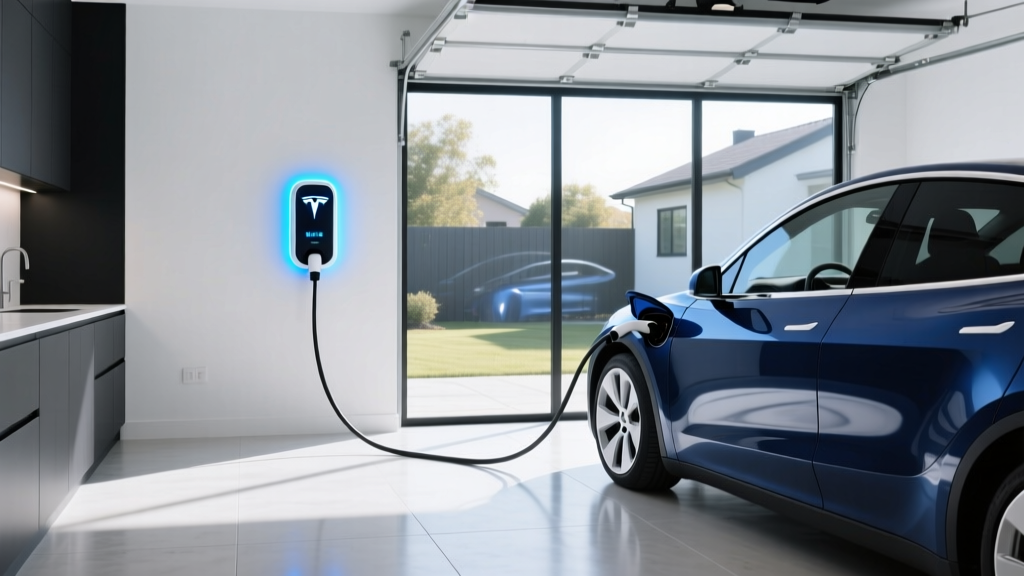
Tesla Wall Connector
- Power: Up to 11.5 kW (48A)
- Connector: NACS native
- Cable: 24 ft
- Smart features: Wi-Fi, OTA updates, power sharing (two units on one circuit), access control
- Price: ~$475
- Best for: NACS-equipped REEVs; cleanest install with no adapter needed
ChargePoint Home Flex
- Power: Up to 12 kW (50A, adjustable down to 16A)
- Connector: NACS or CCS1 (select at purchase)
- Cable: 23 ft
- Smart features: Wi-Fi, app scheduling, utility demand-response integration, Alexa
- Price: ~$550–$650
- Best for: Flexibility across connector types; utility rebate programs often list this model
Emporia V2
- Power: Up to 11.5 kW (48A)
- Connector: NACS or CCS1 (J1772 with adapter)
- Cable: 24 ft
- Smart features: Integrated energy monitoring (pairs with Emporia Vue home energy monitor), solar-aware charging, load management
- Price: ~$400–$500
- Best for: Budget-conscious buyers who want energy monitoring and solar integration
Wallbox Pulsar Plus
- Power: Up to 11.5 kW (48A)
- Connector: NACS or CCS1
- Cable: 25 ft
- Smart features: Wi-Fi + Bluetooth, Eco-Smart (solar), Power Sharing, compact form factor
- Price: ~$500–$600
- Best for: Tight garage spaces; one of the smallest full-power units available
Safety, Code, and Outdoor Installation Considerations
EV charging involves sustained high-current draw — hours at 32–48 amps. This is fundamentally different from a dryer or oven that cycles on and off. The National Electrical Code (NEC) treats EV chargers as continuous loads, meaning the circuit must be rated at 125% of the charger's maximum draw. A 40A charger requires a 50A breaker; a 48A charger requires a 60A breaker.
Key Code and Safety Requirements
- Dedicated circuit: Your EV charger must have its own breaker — no sharing with other appliances.
- GFCI protection: The 2020 NEC (and later editions adopted by most states by 2026) requires GFCI protection for outdoor receptacles used for EV charging. Many modern chargers have built-in GFCI, which can cause nuisance tripping when paired with a GFCI breaker. Solution: use a standard breaker with a hardwired charger (which has internal GFCI) or consult your electrician on local code interpretation.
- Outdoor rating: If mounting outdoors, ensure the charger carries a NEMA 4 or NEMA 4X rating (weatherproof). All four chargers recommended above carry outdoor ratings.
- Permit and inspection: Most jurisdictions require an electrical permit ($50–$200) and a post-install inspection. Skipping this can void home insurance coverage for electrical fires and may cause issues at resale.
- Cable management: A 24-ft cable draped across a garage floor is a trip hazard. Most manufacturers sell wall-mounted cable organizers ($20–$40) — use them.
DC Fast Charging on Road Trips: What Range Extender EV Owners Should Know
Here's where the range extender advantage becomes most apparent. On a pure BEV road trip, you're tethered to DC fast charger locations — miss one, and you risk stranding. With a range extender EV, your DC fast charging strategy is more relaxed because the gasoline generator provides a 100–200+ mile safety net.
Realistic DC Fast Charging Times for REEV Battery Sizes
- 30 kWh pack at 50 kW peak: 10–80% in approximately 22–28 minutes (real-world, accounting for taper above 60% SoC)
- 40 kWh pack at 95 kW peak: 10–80% in approximately 18–24 minutes (sustains high rate to ~55%, then tapers)
- 50 kWh pack at 120 kW peak: 10–80% in approximately 20–26 minutes
Preconditioning matters: If your REEV supports battery preconditioning (warming the battery to optimal charging temperature before arriving at a DC station), always use it. A cold battery may accept only 30–40 kW when it could take 90+ kW at 25°C. This is especially relevant in winter when battery temperatures drop below 10°C. Per fueleconomy.gov, cold weather can reduce EV range by 20–40% — and it similarly throttles charging speed.
Charging Strategy: When to Plug In and When to Let the Generator Run
The optimal ownership strategy for a range extender electric vehicle is fundamentally different from a pure BEV. Here's a practical decision framework:
- Your daily commute is within the battery's electric range (typically 30–80 miles EPA depending on model)
- You have access to off-peak electricity rates (often $0.08–$0.12/kWh overnight)
- You want the lowest possible cost per mile ($0.03–$0.05)
- You're on a road trip with sparse DC fast charging infrastructure
- DC fast charging rates exceed $0.45/kWh (at which point gasoline at 30 MPG and $3.40/gal becomes competitive at ~$0.11/mi)
- Temperatures are below 20°F and battery efficiency is significantly reduced
Frequently Asked Questions
How much does it cost to install a home EV charger?
A straightforward Level 2 installation (panel has capacity, short wire run, indoor garage) typically costs $800–$1,700 including equipment, electrician labor, materials, and permit. If your home needs a panel upgrade from 100A to 200A, total costs can reach $3,400–$6,850. Always get a load calculation from a licensed electrician before committing.
How fast will each charging level add range?
Level 1 (120V) adds about 3–5 miles per hour — too slow for daily use unless your commute is under 20 miles. Level 2 (240V, 40A) adds 22–28 miles per hour and can fully charge a 40 kWh REEV battery in ~5 hours. DC fast charging adds 150–350 miles per hour at peak rate, filling 10–80% in roughly 20–25 minutes for most range extender battery sizes.
Which connector/charger is compatible with my EV?
Check your vehicle's charge port. Most 2025–2026 models sold in North America use NACS. Older non-Tesla EVs and some imports use CCS1. Legacy Nissan and Mitsubishi models use CHAdeMO. For home chargers, buy the connector that matches your vehicle — or choose a model like the ChargePoint Home Flex that offers both options. CCS-to-NACS adapters ($150–$250) can bridge compatibility for public DC fast charging.
How much does charging cost per mile vs gas?
Home charging at average rates ($0.16/kWh) costs roughly $0.046/mile for a range extender EV achieving 3.5 miles per kWh. Off-peak home charging drops to $0.029/mile. Gasoline at $3.40/gal and 30 MPG (typical for a range extender generator) costs $0.113/mile. You save 60–75% per mile when running on battery vs. the generator.
What electrical upgrades might I need?
The most common upgrade is a panel capacity increase from 100A to 200A ($1,800–$3,500) if your existing panel can't support a new 50A circuit alongside existing loads. Less commonly, you may need a meter upgrade (if your utility requires it for the additional load) or a trench and conduit run for detached-garage installations ($500–$2,000+ depending on distance). A smart load-management device ($300–$500) can sometimes avoid a panel upgrade entirely by dynamically adjusting charger draw.