Range anxiety is the single most cited reason buyers hesitate before going electric. But after logging tens of thousands of miles in BEVs from Tesla, Hyundai, Ford, and Rivian — and installing chargers in three different homes — I can tell you the real issue isn't range. It's charging literacy.
A 2026 Hyundai Ioniq 5 with its 84 kWh (usable) battery and EPA-rated 318 miles of range doesn't strand you. What strands you is not knowing that your Level 2 home charger adds 32 miles per hour while a 350 kW DC fast charger can take you from 10% to 80% in roughly 18 minutes. Once you internalize the numbers, the anxiety evaporates.
This guide gives you every figure you need: charging speeds by level, real home-installation costs with panel-upgrade realities, connector compatibility for every major brand, cost-per-mile math against gasoline, and specific equipment picks available in 2026.
The Three Charging Levels: Speeds in kW and Miles Per Hour
Before buying equipment, you need to understand the three charging tiers. The critical distinction: kW (kilowatts) measures power — how fast energy flows into your car. kWh (kilowatt-hours) measures energy — the total capacity of your battery. Think of kW as the width of a hose and kWh as the size of the bucket. A wider hose fills the bucket faster, but the bucket size doesn't change.
| Level | Voltage | Power (kW) | Miles Added/Hour | Best For | Typical 10–80% Time (77 kWh Battery) |
|---|---|---|---|---|---|
| Level 1 | 120V AC | 1.0–1.4 kW | 3–5 mi/hr | Overnight top-ups, PHEVs | ~45–50 hours |
| Level 2 (Home/Public) | 240V AC | 3.3–19.2 kW | 12–75 mi/hr | Daily home charging, workplace | ~4–11 hours |
| DC Fast Charging | 400–800V DC | 50–350 kW | 150–1,000+ mi/hr | Road trips, rapid top-ups | ~18–45 minutes |
For context, the average American drives 37 miles per day according to FHWA data. A Level 2 charger delivering 7.7 kW (the most common home setup on a 40-amp circuit) replaces that daily driving in under one hour. Level 1 can work for plug-in hybrids with smaller batteries — a Toyota RAV4 Prime's 18.1 kWh battery fills overnight — but BEV owners will find Level 1 painfully slow for anything beyond emergency trickle charging.
How Much Does a Home Level 2 Charger Actually Cost to Install?
This is the question that generates the most sticker shock — and the most misinformation. Installation cost depends entirely on your electrical panel's capacity and the distance from panel to charger location. Here's the honest breakdown based on 2026 electrician rates and equipment pricing:
| Component | Simple Install (Panel Adjacent) | Standard Install (50–80 ft Run) | Complex Install (Panel Upgrade + Long Run) |
|---|---|---|---|
| Level 2 Charger Unit (40A–48A) | $400–$700 | $400–$700 | $400–$700 |
| Electrical Permit | $50–$150 | $50–$200 | $100–$300 |
| Electrician Labor (2–8 hrs @ $100–$175/hr) | $200–$500 | $500–$1,200 | $1,000–$2,500 |
| Wiring, Conduit, Breaker | $100–$250 | $200–$600 | $300–$800 |
| Panel Upgrade (100A → 200A, if needed) | $0 | $0 | $1,500–$3,500 |
| Total Range | $750–$1,600 | $1,150–$2,700 | $3,300–$7,800 |
Will You Need a Panel Upgrade?
Homes built before 1990 often have 100-amp service panels. Adding a 40-amp or 50-amp dedicated circuit for EV charging may push total household load beyond the panel's capacity — especially if you also run electric heat, a dryer, and an oven. A licensed electrician will perform a load calculation (per NEC Article 220) to determine if an upgrade is required. Don't skip this step; undersizing your panel risks tripped main breakers or, worse, a fire.
Newer homes with 200-amp panels usually accommodate a 40A–50A EV circuit without issue, provided there's physical space for a double-pole breaker. If your panel is full, a sub-panel or breaker slimming (using tandem breakers where code allows) may be a cheaper alternative to a full upgrade.
Connector Compatibility: NACS, CCS1, and CHAdeMO in 2026
The connector landscape has consolidated significantly since Ford, GM, Rivian, and most other automakers adopted the North American Charging Standard (NACS) originally developed by Tesla. Here's where each brand stands for 2026 model-year vehicles:
| Connector | Brands Using It (Native) | DC Fast Charge Networks | Adapter Needed? |
|---|---|---|---|
| NACS (Tesla) | Tesla, Ford, GM, Rivian, Volvo, Polestar, Fisker, Lucid (2025+), Honda (2026) | Tesla Supercharger, Electrify America (NACS stalls), many new networks | CCS→NACS adapter for legacy CCS vehicles (~$200–$250) |
| CCS1 | Hyundai, Kia, BMW, VW, Audi (legacy models), Stellantis | Electrify America, EVgo, ChargePoint | NACS→CCS adapter for Tesla Superchargers (varies by OEM, ~$200) |
| CHAdeMO | Nissan Leaf (discontinued), Mitsubishi Outlander PHEV | Limited; mostly legacy stations | No practical adapter; network shrinking |
If you're buying a new EV in 2026, NACS is the safest bet for future-proofing. The Tesla Supercharger network — now open to NACS-equipped vehicles from other brands — remains the most reliable DC fast-charging network in the U.S., with over 25,000 stalls. Hyundai and Kia still ship CCS1-equipped vehicles but offer official adapters for Supercharger access.
Cost Per Mile: EV Charging vs. Gasoline
This is where range anxiety meets wallet reality. Let's run the numbers using a 2026 Tesla Model Y Long Range (310 mi EPA, ~75 kWh usable battery, 3.5 mi/kWh efficiency) against a comparable Toyota RAV4 AWD (29 MPG combined) at $3.45/gallon gas:
| Charging Scenario | Rate ($/kWh) | Cost for Full 75 kWh Fill | Cost Per Mile (3.5 mi/kWh) | Savings vs. Gas (RAV4 @ $0.119/mi) |
|---|---|---|---|---|
| Home Off-Peak (utility TOU rate) | $0.08–$0.12 | $6.00–$9.00 | $0.023–$0.034 | 71–81% cheaper |
| Home Standard Residential | $0.14–$0.18 | $10.50–$13.50 | $0.040–$0.051 | 57–66% cheaper |
| Public Level 2 (ChargePoint, etc.) | $0.25–$0.49 | $18.75–$36.75 | $0.071–$0.140 | Comparable to slightly cheaper |
| DC Fast Charging (Electrify America, EVgo) | $0.35–$0.55 | $26.25–$41.25 | $0.100–$0.157 | -32% to +16% (sometimes costs more) |
| Tesla Supercharger (member pricing) | $0.25–$0.36 | $18.75–$27.00 | $0.071–$0.103 | 13–40% cheaper |
| Gasoline (RAV4 AWD, 29 MPG, $3.45/gal) | — | — | $0.119 | Baseline |
The takeaway: home charging is where EVs deliver massive savings. If you charge primarily at home on off-peak rates, you'll pay roughly $0.03/mile — a 75% reduction versus gasoline. Exclusive reliance on DC fast charging erases most of the cost advantage, which is why home Level 2 installation is the single highest-ROI upgrade an EV owner can make.
For the latest state-specific electricity rates, the U.S. Energy Information Administration publishes average retail prices by state, updated monthly.
Charging Time Examples: What to Expect With Common Battery Sizes
Charge times vary enormously based on battery capacity, charging hardware, and the vehicle's onboard charger rating. Here are realistic 10–80% times for popular 2026 EVs. Note that DC fast charging follows a charge curve — peak kW rates apply only between roughly 10–50% State of Charge (SoC). Above 80%, charging slows dramatically to protect battery health, which is why 10–80% is the standard benchmark rather than 0–100%.
| Vehicle | Battery (Usable kWh) | Level 2 @ 11.5 kW (48A) | DC Fast (Peak kW) | DC Fast 10–80% Time |
|---|---|---|---|---|
| Tesla Model Y Long Range | 75 kWh (NMC) | ~5.5 hours | 250 kW | ~25 minutes |
| Hyundai Ioniq 5 (Long Range) | 84 kWh (NMC) | ~7.5 hours | 350 kW (800V) | ~18 minutes |
| Ford F-150 Lightning (Extended) | 131 kWh (NMC) | ~11.5 hours | 150 kW | ~41 minutes |
| Chevrolet Equinox EV (3RS) | 85 kWh (NMC) | ~7.5 hours | 150 kW | ~30 minutes |
| BMW i4 eDrive40 | 81.5 kWh (NMC) | ~7.0 hours | 200 kW | ~31 minutes |
The Hyundai Ioniq 5 and Kia EV6, built on the E-GMP platform with 800-volt architecture, charge noticeably faster than 400V competitors. At a 350 kW Electrify America station, the Ioniq 5 sustains over 230 kW from 10–55% SoC before tapering — a meaningful advantage on road trips where every stop minute counts.
Home Charger Equipment Picks: 2026 Recommendations
Not all Level 2 chargers are equal. Key specs to evaluate: amperage (determines kW output — 40A = 9.6 kW, 48A = 11.5 kW), cable length (25 ft minimum for most garages), connector type (NACS or J1772 with adapter), and smart features (WiFi scheduling, load management, utility TOU integration).
Top Pick: Tesla Wall Connector (NACS)
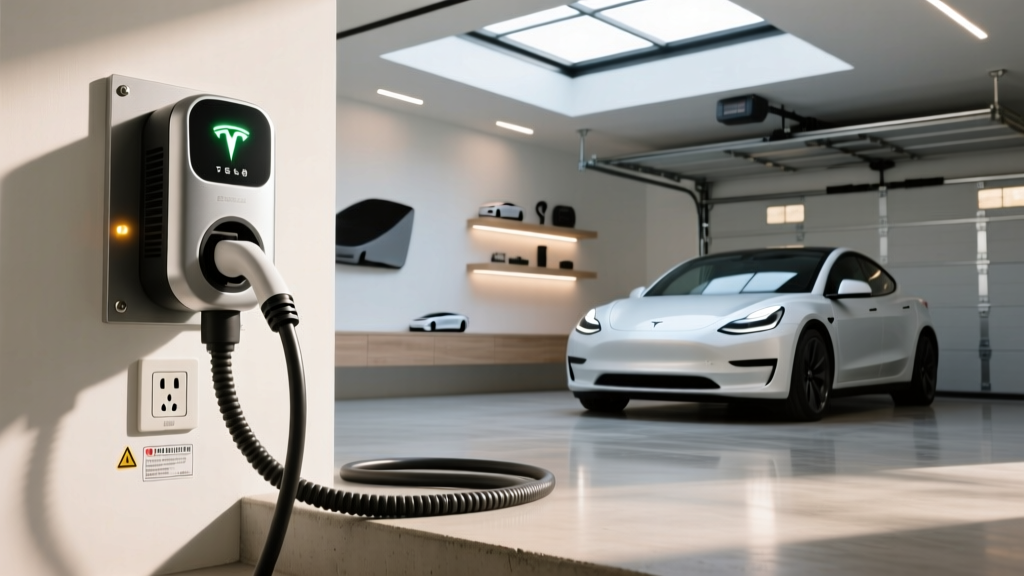
Power: Up to 11.5 kW (48A) on a 60A circuit | Cable: 24 ft | Connector: NACS native | Smart Features: WiFi, OTA updates, Power Sharing with multiple units | Price: ~$475
The best option for NACS-equipped vehicles. Power Sharing lets you install two connectors on a single 60A circuit, splitting amperage dynamically — ideal for two-EV households without a panel upgrade.
Best Universal: ChargePoint Home Flex (J1772/NACS)
Power: Up to 12 kW (50A) on a 65A circuit, adjustable down to 16A | Cable: 23 ft | Connector: J1772 standard, NACS adapter available | Smart Features: Alexa, app scheduling, utility TOU, load management | Price: ~$699
The adjustable amperage is the Flex's killer feature. If your panel can't spare 50A, you can dial it down to 32A or 40A without swapping hardware. Works with virtually every EV via J1772 or NACS adapter.
Budget Smart Option: Emporia Level 2 Charger
Power: Up to 11.5 kW (48A) on a 60A circuit | Cable: 24 ft | Connector: J1772 | Smart Features: Energy monitoring, solar integration, TOU scheduling | Price: ~$399
Pairs well with the Emporia Vue home energy monitor for whole-home load tracking. Best value for a feature-rich smart charger. Requires J1772-to-NACS adapter for Tesla and Ford/GM NACS vehicles.
Safety and Electrical Code: What You Cannot Skip
EV charging draws sustained high current for hours — more like an electric furnace than a phone charger. The National Electrical Code (NEC) treats EV charging circuits as continuous loads, meaning the circuit must be rated for 125% of the charger's maximum draw. A 48A charger requires a 60A breaker and 6 AWG copper wire minimum.
- Dedicated circuit: Your EV charger must have its own breaker — never share a circuit with outlets, lighting, or appliances.
- GFCI protection: NEC 2020 and later require GFCI protection for all EV charging outlets (receptacle-based installations). Hardwired chargers like the Tesla Wall Connector are exempt from the GFCI requirement but must still meet grounding standards.
- Outdoor rating: If installing outside, the charger must carry a NEMA 4 or NEMA 4X rating for weather resistance. The ChargePoint Home Flex and Tesla Wall Connector both qualify.
- Permit and inspection: Virtually every jurisdiction requires an electrical permit for EV charger installation. The inspection verifies wire gauge, breaker sizing, grounding, and bonding. Skipping this can void home insurance coverage in the event of a fire.
- Load management: If your panel is near capacity, consider a smart charger with built-in load management (like the Emporia or ChargePoint Flex) that dynamically reduces charge rate when household demand spikes, avoiding a costly panel upgrade.
Always hire a licensed electrician. The National Fire Protection Association publishes the NEC standards governing EV charging installations, and your local building department enforces the version adopted in your jurisdiction.
Eliminating Range Anxiety: The Practical Framework
Range anxiety isn't solved by bigger batteries alone — it's solved by understanding your specific driving pattern and matching it to the right charging setup. Here's the decision framework:
Choose Your Charging Strategy
Choose home Level 2 if: You drive under 80 miles daily, have a garage or driveway with panel access, and want the lowest cost per mile (~$0.03/mi). This covers 85%+ of American drivers.
Choose home Level 1 if: You own a PHEV with under 20 kWh of battery, drive under 30 miles daily, or are waiting on a panel upgrade. It's a viable stopgap, not a permanent BEV solution.
Rely on DC fast charging if: You lack home charging access, apartment-park, or take regular road trips. Budget for higher per-mile costs ($0.10–$0.16/mi) and plan stops using apps like PlugShare or A Better Routeplanner.
Consider a PHEV instead if: You can't install home charging, regularly drive in rural charging deserts, or frequently tow. A RAV4 Prime or Wrangler 4xe eliminates range anxiety entirely with a gas backup.
For EPA range and efficiency data on any specific model, fueleconomy.gov remains the authoritative source, listing official MPGe ratings and kWh/100mi consumption figures.
Frequently Asked Questions
How much does it cost to install a home EV charger?
A straightforward Level 2 installation on an existing 200-amp panel typically costs $1,150–$2,700 including the charger unit, electrician labor, wiring, and permit. If your home needs a panel upgrade from 100A to 200A service, add $1,500–$3,500, bringing the total to $3,300–$7,800. Get at least three quotes from licensed electricians — prices vary significantly by region and job complexity.
How fast will each charging level add range?
Level 1 (120V) adds 3–5 miles per hour. Level 2 (240V, 40A–48A) adds 25–40 miles per hour for most EVs. DC fast charging adds 150–300+ miles in 20–30 minutes depending on the vehicle's peak charge rate and battery architecture. Exact speeds depend on your EV's efficiency (mi/kWh) — a more efficient car like the Lucid Air gains more miles per kWh than a heavier truck like the F-150 Lightning.
Which connector is compatible with my EV?
For 2026 models: Tesla, Ford, GM, Rivian, Volvo, and Honda use NACS. Hyundai, Kia, BMW, and VW largely still use CCS1 (with adapters available for Supercharger access). The Nissan Leaf used CHAdeMO but has been discontinued. Check your vehicle's charge port — and if buying a CCS vehicle, confirm the manufacturer offers a NACS adapter for Tesla Supercharger compatibility.
How much does EV charging cost per mile vs gas?
Home charging on off-peak utility rates costs $0.02–$0.04 per mile — roughly 70–80% less than a 29 MPG gas car at $3.45/gallon ($0.119/mile). Public DC fast charging at $0.35–$0.55/kWh costs $0.10–$0.16/mile, which can approach or exceed gasoline costs. The financial case for EVs depends heavily on home charging access.
What electrical upgrades might I need for a home charger?
The most common upgrade is a panel capacity increase from 100A to 200A, needed in older homes where the existing panel can't handle the added continuous load of a 40A–50A EV circuit alongside existing appliances. Homes with 200A service usually need only a new double-pole breaker and a wire run. Alternatives to a full panel upgrade include smart load-management devices (like the Emporia or ChargePoint Flex) that throttle charge rate during peak household demand, or installing a lower-amperage 24A–32A circuit that still covers daily driving needs.