If you've been searching for RAN chargers or evaluating Level 2 home charging equipment, you've likely noticed the market is crowded. RAN (a newer entrant in the North American EVSE space) offers Wi-Fi-enabled Level 2 chargers at competitive prices, but how do they stack up against established brands like ChargePoint, Emporia, and Wallbox? This guide breaks down everything you need to know about RAN chargers — and the alternatives — including real installation costs, charging speeds, connector compatibility, and per-mile energy costs.
We'll also clarify the single most common EV confusion point: kW (kilowatts) is power — how fast energy flows into your car. kWh (kilowatt-hours) is energy — how much your battery holds. A 48-amp charger delivering 11.5 kW will refill a 75 kWh battery faster than a 32-amp unit at 7.7 kW. Keep that distinction in mind as we compare equipment below.
Charging Levels Explained: How Much Range Does Each Add?
Every EV owner needs to understand the three charging tiers. The miles-per-hour figures below assume an average efficiency of 3.0–3.5 miles per kWh (typical for a midsize crossover like the Hyundai Ioniq 5 or Tesla Model Y).
| Level | Voltage | Max Power (kW) | Miles of Range Added per Hour | Typical Use Case |
|---|---|---|---|---|
| Level 1 | 120V AC | 1.4–1.9 kW | 3–5 mi/hr | Overnight trickle; PHEVs; emergency |
| Level 2 | 240V AC | 3.8–19.2 kW | 14–65 mi/hr | Home daily charging; workplace; retail |
| DC Fast Charge | 400–800V DC | 50–350+ kW | 150–1,000+ mi/hr (peak) | Road trips; highway corridors |
Most EVs accept between 7.7 kW and 11.5 kW on Level 2 AC, limited by the car's onboard charger — not the wall unit. A RAN charger rated at 48 amps (11.5 kW) will only deliver what your EV can accept. For example, a base Tesla Model Y Long Range has an 11.5 kW onboard charger, so it'll use the full 48A. A Chevrolet Equinox EV caps at roughly 11.5 kW as well. But many PHEVs (like the Toyota RAV4 Prime) max out at just 3.3 kW or 6.6 kW — buying a 48A charger won't speed them up.
- Tesla Model Y (75 kWh usable, 10–80%): ~4.5 hours
- Hyundai Ioniq 5 (77.4 kWh usable, 10–80%): ~4.7 hours
- Ford F-150 Lightning Extended Range (131 kWh usable, 10–80%): ~8 hours
- Toyota RAV4 Prime (18.1 kWh usable, 10–80%): ~2 hours (limited by 6.6 kW onboard charger)
RAN Chargers: What They Offer and How They Compare
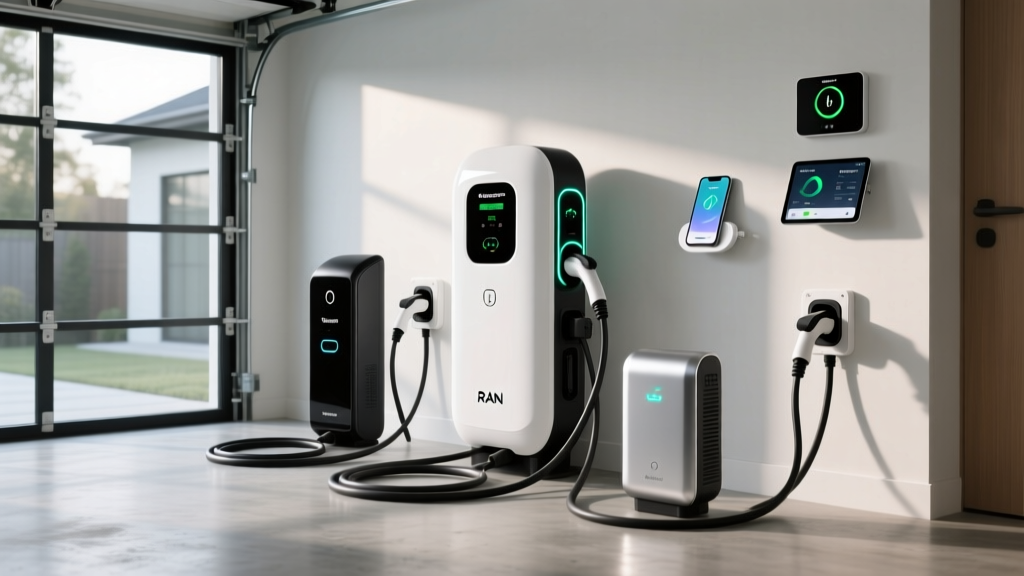
RAN chargers are Wi-Fi-connected Level 2 EVSEs (Electric Vehicle Supply Equipment) sold primarily through online retailers. Most RAN models are available in 32A (7.7 kW) and 48A (11.5 kW) configurations with either a NACS (Tesla-style) or J1772 connector, and some offer adjustable amperage via a companion app. Pricing typically falls between $250 and $450 depending on amperage and cable length.
Here's how RAN chargers stack up against three established competitors in 2026:
RAN 48A Smart Charger
- Power: 11.5 kW (48A, 240V)
- Connector: NACS or J1772
- Cable: 25 ft
- Smart features: Wi-Fi scheduling, energy monitoring app
- Price: ~$350
- Energy Star: Yes
ChargePoint Home Flex
- Power: Up to 12 kW (50A, 240V)
- Connector: NACS or J1772
- Cable: 23 ft
- Smart features: Wi-Fi, Alexa, scheduling, detailed app
- Price: ~$550
- Energy Star: Yes
Emporia Vue Level 2
- Power: 11.5 kW (48A, 240V)
- Connector: J1772 (NACS adapter available)
- Cable: 24 ft
- Smart features: Wi-Fi, solar integration, whole-home energy tracking
- Price: ~$400
- Energy Star: Yes
Wallbox Pulsar Plus
- Power: 11.5 kW (48A, 240V)
- Connector: NACS or J1772
- Cable: 25 ft
- Smart features: Wi-Fi + Bluetooth, Power Sharing, load balancing
- Price: ~$500
- Energy Star: Yes
RAN chargers compete primarily on price — roughly $150–$200 less than the ChargePoint Home Flex. However, established brands offer longer track records, more robust app ecosystems, and wider availability of replacement parts. If you prioritize budget and basic smart scheduling, RAN is a solid option. If you want solar integration or proven long-term firmware support, Emporia or Wallbox may justify the premium.
Home EV Charger Installation: Costs, Electrical Requirements, and Panel Upgrades
How much does it cost to install a home EV charger? The answer depends heavily on your home's electrical panel capacity, the distance from the panel to the charger location, and local permit fees. Here's a realistic 2026 breakdown:
| Cost Component | Simple Install (Same Wall as Panel) | Standard Install (20–50 ft Run) | Complex Install (Panel Upgrade Needed) |
|---|---|---|---|
| Charger Equipment (48A) | $300–$550 | $300–$550 | $300–$550 |
| Electrician Labor | $300–$600 | $600–$1,500 | $1,000–$2,000 |
| Permit & Inspection | $50–$200 | $50–$250 | $100–$300 |
| Panel Upgrade (100A → 200A) | N/A | N/A | $1,500–$3,500 |
| Conduit, Wire, Breaker | $50–$150 | $150–$500 | $200–$600 |
| Total Estimated Cost | $700–$1,500 | $1,100–$2,800 | $3,100–$6,950 |
What Electrical Upgrades Might I Need?
A 48A Level 2 charger requires a dedicated 60A, 240V circuit (the National Electrical Code requires circuits to be rated at 125% of continuous load: 48A × 1.25 = 60A). If your home has a 100A main panel that's already near capacity with HVAC, electric range, and dryer loads, adding a 60A EV circuit may push you over — triggering a panel upgrade to 200A.
Homes built after 2000 typically have 200A panels with adequate headroom. Older homes (pre-1990s) with 100A or even 60A service will likely need an upgrade. A licensed electrician can perform a load calculation per NEC Article 220 to determine your available capacity before you buy equipment.
Cost-saving alternative: If a panel upgrade is prohibitive, consider a 32A charger (requiring only a 40A circuit). You'll sacrifice about 35% in charging speed, but for overnight charging of most EVs, 7.7 kW is sufficient to fully replenish a 75 kWh battery in roughly 9–10 hours.
Connector Compatibility: NACS, CCS1, and CHAdeMO in 2026
The North American Charging Standard (NACS), originally developed by Tesla, has become the dominant connector for new EVs sold in the US. As of 2026, virtually every major automaker — Ford, GM, Hyundai, Kia, Rivian, BMW, and others — has adopted NACS on new vehicles. CCS1 (Combined Charging System) remains on many 2022–2025 models still on the road, and CHAdeMO is effectively limited to the legacy Nissan Leaf fleet.
| Connector | Brands Using It (New Vehicles) | Adapter Needed? |
|---|---|---|
| NACS (Tesla) | Tesla, Ford, GM, Hyundai, Kia, Rivian, BMW, Volvo, Polestar, Mercedes, Lucid | None for new vehicles; CCS→NACS adapters (~$150–$250) for older CCS cars |
| CCS1 | Remaining 2022–2025 model-year vehicles; Volkswagen ID.4 (through 2025) | NACS→CCS adapter for Tesla Supercharger access |
| CHAdeMO | Nissan Leaf (discontinued in US after 2025); no new models | Limited DC fast-charge network support |
| J1772 (AC only) | All EVs for Level 1/2 AC charging (universal) | Tesla Mobile Connector includes J1772 adapter |
Which connector/charger is compatible with my EV? If you bought a new EV in 2025 or 2026, it almost certainly has a NACS port. Buy a NACS-connector charger (RAN and most competitors offer this). If you own a 2023–2024 model with CCS1 (like an early Hyundai Ioniq 5 or Ford Mustang Mach-E), buy a J1772 charger and use your car's J1772 inlet, or purchase a NACS charger with a J1772-to-NACS adapter (~$100–$180). For Level 2 home charging, J1772 remains universally compatible with all EVs via adapters.
For the latest connector specifications, refer to SAE International's J3400 standard (the formalized NACS specification).
Cost to Charge: Per-Mile Comparison vs. Gasoline
How much does charging cost per mile vs gas? The answer varies dramatically between home and public charging. Here's a data-driven comparison using a midsize electric crossover averaging 3.2 miles per kWh (roughly equivalent to a Hyundai Ioniq 5 or Tesla Model Y):
| Charging Scenario | Cost per kWh | Cost per Mile | Equivalent Gas MPG Cost |
|---|---|---|---|
| Home Level 2 (national avg. electricity, 2026) | $0.16/kWh | $0.050/mi | $1.40/gal gas |
| Home Level 2 (off-peak TOU rate) | $0.09/kWh | $0.028/mi | $0.78/gal gas |
| Home Level 2 (California peak, PG&E) | $0.42/kWh | $0.131/mi | $3.67/gal gas |
| Public Level 2 (ChargePoint, EVgo avg.) | $0.25–$0.39/kWh | $0.078–$0.122/mi | $2.18–$3.42/gal gas |
| DC Fast Charge (Electrify America, Tesla) | $0.35–$0.55/kWh | $0.109–$0.172/mi | $3.05–$4.82/gal gas |
| Comparison: 2026 Toyota RAV4 gas (30 MPG combined) at $3.30/gal = $0.110/mi | |||
Home charging on an off-peak time-of-use (TOU) rate plan is the cheapest way to fuel any vehicle on the road — roughly 2.8 cents per mile, equivalent to gasoline at 78 cents per gallon. Even at national average electricity rates, home charging runs about 5 cents per mile, less than half the cost of a 30 MPG gas vehicle. Public DC fast charging, however, can approach or exceed the per-mile cost of gasoline — making it best reserved for road trips, not daily use.
For current average electricity rates by state, the US Energy Information Administration (EIA) publishes monthly data.
Safety, Code, and Installation Best Practices
EV chargers draw significant continuous current — often for 6–10 hours at a time. Proper installation isn't optional; it's a fire-safety requirement. Here's what the National Electrical Code (NEC) and best practices demand:
- Dedicated circuit: Your Level 2 charger must be on its own dedicated breaker — not shared with other outlets or appliances. A 48A charger requires a 60A breaker with 6 AWG copper wire (or 4 AWG aluminum).
- GFCI protection: NEC 2023 (and continued in 2026 code cycles) requires GFCI (Ground Fault Circuit Interrupter) protection for all EVSE outlets. Hardwired units have GFCI built into the charger itself. If you use a NEMA 14-50 receptacle, you'll need a GFCI breaker — which adds $50–$120 to the install cost.
- Hardwired vs. plug-in: Hardwired installations (no plug) are generally preferred for 48A+ chargers. They eliminate the NEMA 14-50 receptacle as a potential failure point and avoid the GFCI breaker requirement. Most RAN, ChargePoint, and Wallbox chargers support both hardwired and plug-in configurations.
- Outdoor rating: If your charger mounts outdoors, ensure it carries a NEMA 4 or NEMA 4X rating (weatherproof). Most major chargers, including RAN models, are rated for outdoor use, but verify before purchase.
- Permit and inspection: Virtually all jurisdictions require an electrical permit for a new 240V circuit. Your electrician pulls the permit; a city/county inspector verifies the work. Never skip this — it protects your home insurance coverage in the event of an electrical fire.
Federal Tax Credit for Home Charging Equipment (§30C)
The IRS §30C Alternative Fuel Vehicle Refueling Property Credit covers 30% of the cost of home EV charging equipment and installation, up to a maximum credit of $1,000 per year. Key 2026 rules:
- The charger must be installed at your primary residence.
- The credit covers both equipment and installation labor.
- Your home must be located in an eligible census tract (lower-income or rural areas, as defined by the IRS). Many suburban and urban tracts do not qualify — use the IRS census tract lookup tool before assuming eligibility.
- The credit is non-refundable: it can reduce your federal tax liability to zero but won't generate a refund beyond that.
- Point-of-sale transfer is not available for §30C (unlike the §30D vehicle credit). You claim it on your tax return using IRS Form 8911.
Consult a tax professional to confirm your eligibility — census tract qualification is the most common disqualifier.
Frequently Asked Questions
Are RAN chargers safe and reliable?
RAN chargers carry standard safety certifications (UL or ETL listed, depending on the model) and include built-in GFCI protection, overcurrent protection, and thermal monitoring. As with any EVSE, verify the specific model's certification mark before purchasing — avoid uncertified chargers sold on third-party marketplaces. In our assessment, RAN chargers are adequate for budget-conscious buyers, but established brands like ChargePoint and Wallbox have longer reliability track records and more responsive customer support.
Can I install a Level 2 charger myself?
If you're hardwiring or installing a new 240V circuit, you should hire a licensed electrician. The NEC requires permits and inspections for new circuits, and improper wiring at these amperages poses a serious fire risk. If you already have a properly installed NEMA 14-50 outlet (common for electric ranges or RV hookups), you can plug in a compatible charger yourself — but have an electrician verify the outlet is on a dedicated circuit with correct wire gauge and torque specifications.
How fast will a 32A vs. 48A charger charge my EV?
A 32A charger delivers 7.7 kW and adds roughly 25 miles of range per hour. A 48A charger delivers 11.5 kW and adds roughly 37 miles of range per hour. For a 75 kWh battery (10–80%), that's about 6.8 hours at 32A vs. 4.5 hours at 48A. If you charge overnight (8–10 hours available), a 32A unit fully replenishes most EV batteries — the speed advantage of 48A matters most if you need quick turnarounds between drives.
Do I need a smart charger, or is a basic (dumb) charger fine?
A basic charger without Wi-Fi or app features will charge your car just as fast as a smart charger at the same amperage. Smart features matter if you want: scheduled charging during off-peak TOU hours (saving money), energy usage tracking, remote start/stop, or utility demand-response program participation. If your utility offers TOU rates, a smart charger's scheduling feature typically pays for its price premium within 6–12 months through lower electricity costs.
What size breaker do I need for a 48A EV charger?
Per NEC 210.20, continuous loads (defined as operating for 3+ hours) must be on a circuit rated at 125% of the load. A 48A charger × 1.25 = 60A minimum circuit. You'll need a 60A double-pole breaker and 6 AWG copper conductors (or 4 AWG aluminum). Your electrician will confirm wire gauge based on run length — longer runs may require thicker wire to limit voltage drop.