Ram Charging at Home and on the Road: What 1500 REV Owners Need to Know
The Ram 1500 REV is a heavy-duty electric truck with a battery to match. Whether you spec the standard 168 kWh pack (EPA-estimated 350 miles) or the Max Range 229 kWh pack (EPA-estimated 500 miles), moving that much energy from the grid into your truck requires planning. Ram has adopted the NACS (North American Charging Standard) connector for the REV, giving owners access to Tesla's Supercharger network alongside third-party DC fast-charging stations.
This guide breaks down exactly what Ram charging looks like across all three charging levels, what a home Level 2 installation actually costs in 2026, which electrical upgrades you might face, and how per-mile charging costs compare to a gas-powered Ram 1500. We'll also recommend specific charger hardware that pairs well with the REV's large battery.
kW (kilowatts) measures power — how fast energy flows into your battery, like water pressure from a hose. kWh (kilowatt-hours) measures energy capacity — the total amount stored, like the size of the tank. A 168 kWh battery charged at 11.5 kW (Level 2) takes roughly 14.6 hours from 0–100%. A 350 kW DC fast charger delivers power far faster but tapers as the battery fills.
Ram 1500 REV Charging Levels Explained
The 1500 REV accepts charging at three levels. Because its battery is substantially larger than most EVs (roughly 2–3× the capacity of a mid-size sedan), charging times are proportionally longer at every level. Here's what each tier delivers in practice.
| Level | Voltage | Max Power (kW) | Miles of Range per Hour | Typical Use Case |
|---|---|---|---|---|
| Level 1 (120V) | 120V | ~1.4 kW | ~4–5 mi/hr | Emergency top-off, trickle |
| Level 2 (240V) | 240V | 11.5 kW (onboard limit) | ~35–42 mi/hr | Daily home charging |
| DC Fast Charge | 400V+ DC | ~150 kW peak | ~250–350 mi/hr (at peak) | Road trips, rapid fill |
Level 1 is essentially a maintenance trickle for a truck this size. Plugging into a standard 120V outlet adds about 4–5 miles of range per hour. Fully recharging the 168 kWh pack from empty would take over 100 hours — impractical for daily use but useful for preventing vampire drain during storage.
Level 2 is where the vast majority of Ram charging happens. The REV's onboard charger accepts up to 11.5 kW on a 240V/48A circuit. At that rate, you'll recover roughly 35–42 miles of range per hour depending on driving efficiency. An overnight session (10 hours) adds approximately 350–420 miles — enough to refill the standard pack completely or bring the Max Range pack to about 85%.
DC Fast Charging is your road-trip solution. Ram has quoted peak DC fast-charge capability around 150 kW for the 168 kWh pack. At that rate, a 10–80% session takes approximately 40–45 minutes. Expect the charge curve to taper significantly above 80% state of charge — this is normal battery-management behavior to protect cell health. Plan to charge to 80% on road trips and save the last 20% for overnight Level 2 sessions at home.
Peak kW is never sustained across the entire session. A charger rated at 150 kW may deliver that rate only between 10–40% SoC before tapering to 80–100 kW and eventually dropping below 40 kW above 85%. Ambient temperature also matters: cold batteries (below ~50°F) charge slower until the thermal management system warms them. Use the REV's navigation-based battery preconditioning when routing to a DC fast charger.
Home Level 2 Installation: Electrical Requirements and Costs
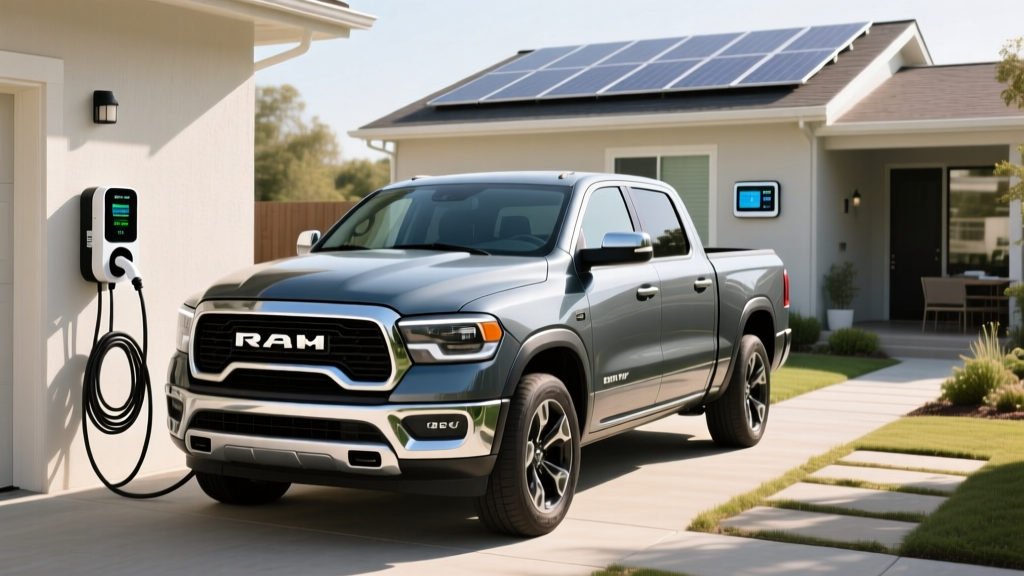
Installing a dedicated Level 2 charger at home is the single most impactful upgrade for Ram 1500 REV ownership. Because the truck's battery is so large, you want the fastest Level 2 connection your home's electrical system can support — ideally a 240V/60A circuit delivering a full 48A continuous to the vehicle.
Electrical Requirements
- Circuit: Dedicated 60A breaker (for 48A continuous charge rate) or 50A breaker (for 40A continuous)
- Voltage: 240V single-phase (standard residential split-phase)
- Wire gauge: 6 AWG copper for 60A; 8 AWG for 50A (may vary by run length and local code)
- Connector: NACS (native on the 1500 REV) or J1772 with NACS adapter
- Outlet vs. hardwired: NEMA 14-50 outlet offers portability; hardwired is preferred for 60A circuits and avoids GFCI nuisance tripping issues
Installation Cost Breakdown
Below is a realistic cost range based on 2026 national averages. Your actual quote depends on panel capacity, wiring distance, and local permit fees. Always get at least two quotes from licensed electricians.
| Item | Simple Install (Panel Nearby) | Complex Install (Panel Upgrade Needed) |
|---|---|---|
| Level 2 Charger Equipment | $500–$750 | $500–$750 |
| Electrician Labor (2–4 hrs) | $400–$800 | $800–$1,500 |
| Electrical Permit | $50–$200 | $50–$200 |
| Wiring / Conduit Materials | $100–$300 | $200–$600 |
| Panel Upgrade (100A → 200A) | — | $1,500–$3,500 |
| Total Estimated Cost | $1,050–$2,050 | $3,050–$6,550 |
The panel upgrade factor. Many homes built before 2000 have 100A or 150A main service panels. Adding a 60A EV circuit to an already loaded panel may exceed safe capacity — especially if you run electric HVAC, a dryer, and an oven simultaneously. A licensed electrician will perform a load calculation per NEC Article 220. If you need a panel upgrade to 200A, budget an additional $1,500–$3,500 and expect the project to take 1–2 days. Some utility companies offer rebates for panel upgrades tied to EV adoption — check with your local provider.
- NEC 2023/2026 requires GFCI protection for outlet-based EV charging circuits — hardwired installations may bypass this requirement in some jurisdictions.
- Outdoor-rated chargers (NEMA 4 rating) are essential for garage-less installations.
- Never use extension cords for EV charging — voltage drop over distance reduces charging speed and creates fire risk.
- A dedicated circuit means no other appliances share the breaker. Sharing can trip the circuit under load.
Connector Compatibility: NACS, CCS, and the Ram 1500 REV
Stellantis confirmed the Ram 1500 REV ships with a native NACS charge port. This is significant because it grants direct access to Tesla's Supercharger network (now open to NACS-equipped non-Tesla vehicles) without any adapter. Here's how connector compatibility breaks down for Ram charging across different networks.
| Connector Type | Native on REV? | Network Access | Adapter Needed? |
|---|---|---|---|
| NACS (Tesla-style) | Yes | Tesla Superchargers, Electrify America (newer stations), Rivian Adventure Network | No |
| CCS1 | No | Legacy Electrify America, EVgo, ChargePoint DC stations | Yes — NACS-to-CCS adapter (~$200–$300) |
| CHAdeMO | No | Limited legacy stations (being phased out) | Not recommended |
| J1772 (Level 2) | No | Public Level 2 stations, older home chargers | Yes — NACS-to-J1772 adapter (usually included with charger) |
For home charging, most Level 2 wall connectors now ship with either a NACS plug or a J1772 plug with an included adapter. Since the REV uses NACS natively, buying a NACS-terminated charger eliminates adapter clutter. On the road, carry a NACS-to-CCS adapter in the truck to ensure you can use any legacy CCS-equipped DC fast charger you encounter — especially in rural areas where CCS stations may still outnumber NACS.
For a full breakdown of the national charging infrastructure, see the U.S. Department of Energy's Alternative Fuels Data Center station locator.
Charging Cost Per Mile: Ram REV vs. Gas Ram 1500
One of the strongest ownership arguments for the 1500 REV is fuel cost savings. Let's compare real charging costs against a gas-powered Ram 1500 with the 5.7L HEMI V8 (EPA-rated at roughly 17 MPG combined).
| Scenario | Cost per kWh / Gallon | Cost per Mile (REV) | Cost per Mile (Gas 1500) |
|---|---|---|---|
| Home Charging (off-peak utility rate) | $0.13/kWh | $0.043 | — |
| Home Charging (peak rate) | $0.28/kWh | $0.093 | — |
| Public Level 2 (ChargePoint, etc.) | $0.35/kWh | $0.116 | — |
| DC Fast Charging (road trip) | $0.48/kWh | $0.159 | — |
| Gasoline (national avg. $3.60/gal) | $3.60/gal | — | $0.212 |
Assumptions: REV efficiency estimated at ~3.0 kWh/mile (real-world highway driving with a full-size truck). Gas Ram 1500 at 17 MPG combined. Actual efficiency varies with payload, towing, temperature, and driving style. Towing a trailer can increase REV energy consumption to 4.5+ kWh/mile, narrowing the cost gap.
At off-peak home rates, the REV costs roughly $0.04 per mile to "fuel" — about one-fifth the cost of the gas Ram 1500 at $0.21 per mile. Even at DC fast-charging prices on road trips ($0.16/mile), the REV still undercuts gasoline. The savings multiply with daily driving: a 30-mile daily commute costs $1.29 in electricity (off-peak home) versus $6.35 in gasoline.
For utility rate data and time-of-use plan comparisons, check your provider or the U.S. Energy Information Administration state-level electricity price tracker.
Recommended Level 2 Chargers for the Ram 1500 REV
With a 168 or 229 kWh battery, the REV demands a high-output Level 2 charger to keep overnight sessions practical. Here are three units well-suited to Ram charging in 2026, all available with NACS connectors or compatible adapters.
Tesla Wall Connector (Gen 4)
- Power Output: Up to 11.5 kW (48A on 60A circuit)
- Connector: Native NACS
- Cable Length: 24 ft
- Smart Features: Wi-Fi, OTA updates, power sharing with second unit, access control
- Price: ~$475
- Best For: REV owners wanting native NACS with no adapter; reliable, well-supported hardware
ChargePoint Home Flex
- Power Output: Up to 12 kW (50A on 60A circuit) — adjustable via DIP switches
- Connector: NACS or J1772 (configurable)
- Cable Length: 23 ft
- Smart Features: Wi-Fi, Alexa integration, scheduling, energy tracking, utility demand-response compatible
- Price: ~$649
- Best For: Owners who want flexible amperage settings and utility integration for time-of-use savings
Emporia Vue + EV Charger
- Power Output: Up to 11.5 kW (48A on 60A circuit)
- Connector: NACS or J1772
- Cable Length: 24 ft
- Smart Features: Whole-home energy monitoring integration, solar-aware charging, scheduling, load management
- Price: ~$599 (charger) + $399 (Vue panel monitor)
- Best For: Homes with solar panels or those wanting granular energy data across the entire household
All three units support the 11.5 kW maximum the REV's onboard charger can accept. The deciding factors come down to connector preference, smart-home ecosystem, and whether you want whole-home energy monitoring. For most Ram charging setups, the Tesla Wall Connector offers the best value with native NACS and proven reliability.
Ram 1500 REV Charging Times: 10–80% Scenarios
Here's how long a 10–80% session takes for both battery pack options across common charging scenarios. These estimates assume optimal battery temperature and a charger capable of delivering the REV's maximum acceptance rate.
| Charging Scenario | 168 kWh Pack | 229 kWh (Max Range) Pack |
|---|---|---|
| Level 1 (120V / 1.4 kW) | ~84 hours | ~115 hours |
| Level 2 (240V / 11.5 kW) | ~10.2 hours | ~13.9 hours |
| Level 2 (240V / 7.7 kW — 32A circuit) | ~15.3 hours | ~20.8 hours |
| DC Fast (~150 kW peak, tapered curve) | ~45 minutes | ~55–60 minutes |
The Max Range pack's larger capacity means proportionally longer Level 2 sessions. If you opt for the 229 kWh battery, a full overnight charge (12+ hours on 11.5 kW) will comfortably reach 100%. On road trips, plan DC fast stops around 45–60 minutes — pair them with meal breaks to minimize perceived downtime.
Federal Tax Credit and Charger Incentives
As of 2026, the IRS §30D Clean Vehicle Credit offers up to $7,500 for qualifying new EVs, though the Ram 1500 REV's eligibility depends on meeting battery component sourcing, critical minerals requirements, MSRP caps ($80,000 for trucks), and buyer income limits ($300,000 joint / $150,000 single). The credit can now be transferred to the dealer at point of sale, effectively reducing your purchase price. Consult a tax professional to confirm your specific eligibility — rules continue to evolve.
Separately, the Alternative Fuel Vehicle Refueling Property Credit (IRC §30C) offers up to $1,000 toward home EV charger installation for qualifying taxpayers in eligible census tracts. Combined with utility rebates (many offer $250–$500 for smart Level 2 chargers), your out-of-pocket installation cost can drop significantly.
Frequently Asked Questions About Ram Charging
How much does it cost to install a home EV charger for the Ram 1500 REV?
A straightforward installation with an adequate electrical panel typically costs $1,050–$2,050 including equipment, electrician labor, permits, and materials. If your home needs a panel upgrade from 100A to 200A service, total costs can reach $3,050–$6,550. Always get a load calculation from a licensed electrician before committing.
How fast will each charging level add range to the REV?
Level 1 (120V) adds roughly 4–5 miles per hour. Level 2 (240V at 11.5 kW) adds approximately 35–42 miles per hour. DC fast charging at peak rate (~150 kW) can add 250–350 miles per hour but tapers significantly above 80% SoC. These figures assume ~3.0 kWh/mile real-world efficiency.
Which connector does the Ram 1500 REV use?
The Ram 1500 REV uses a native NACS (North American Charging Standard) connector. This provides direct access to Tesla Superchargers and newer Electrify America stations without an adapter. For legacy CCS1 stations, you'll need a NACS-to-CCS adapter.
How much does charging the REV cost per mile compared to gas?
At off-peak home electricity rates (~$0.13/kWh), the REV costs about $0.04 per mile — roughly 80% less than a gas Ram 1500 at $0.21 per mile (17 MPG at $3.60/gallon). Even DC fast charging at $0.48/kWh yields a per-mile cost of ~$0.16, still below gasoline.
What electrical upgrades might my home need?
Homes with 100A or 150A main panels may need an upgrade to 200A service to safely support a 60A EV charging circuit alongside existing loads. Older wiring, insufficient breaker spaces, or long wire runs from panel to garage can also increase installation complexity and cost. A licensed electrician's load calculation will determine your specific needs.
Can I charge the Ram 1500 REV with solar panels?
Yes, but realistically. A typical 10 kW residential solar system produces roughly 40–50 kWh per day in good conditions — enough to add about 13–17 miles of REV range daily. Pairing solar with a smart charger like the Emporia system allows you to prioritize solar-generated electricity for charging, minimizing grid draw and maximizing cost savings.