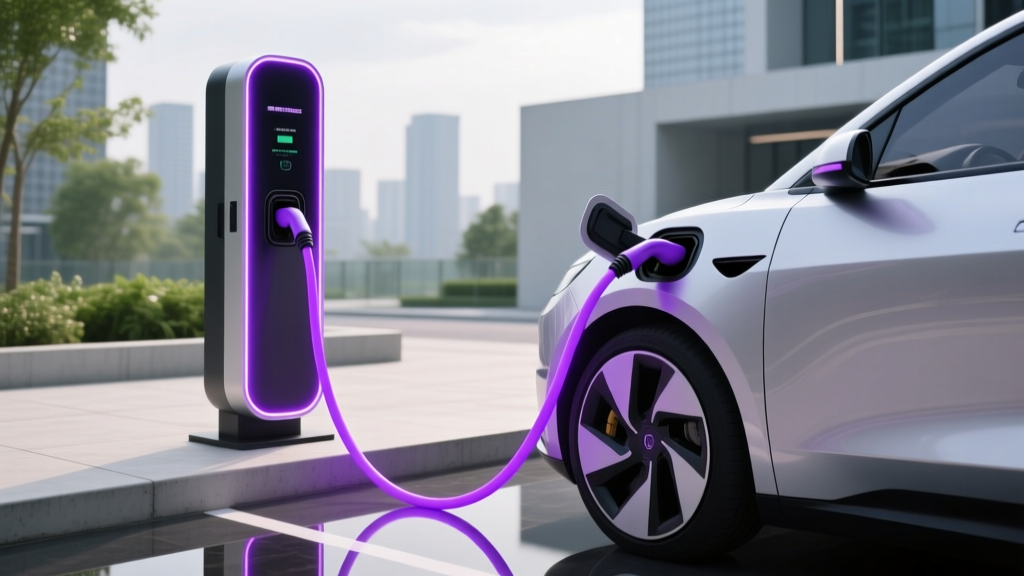
If you've noticed a purple charger car icon or indicator on your EV's dashboard, infotainment screen, or charging app, you're not alone — and you're not imagining things. Depending on your vehicle brand and charging network, purple or violet indicators often signal specific charging states: active Level 2 charging, a scheduled/preconditioning session, or a connector-lock confirmation. But the icon is just the starting point. Understanding what's actually happening with electrons flowing into your battery requires a clear picture of charging levels, speeds, costs, and home infrastructure.
This guide covers everything you need to know about EV charging in 2026 — from the three charging levels and their real-world speeds, to home installation costs, connector compatibility, and exactly what you'll pay per mile compared to gasoline.
The Purple Charger Car Indicator: What Your EV Is Telling You
Different manufacturers use different color schemes for their charging status indicators. A purple charger car symbol or purple-hued charging screen typically appears in the following contexts:
- Active charging session — Some brands (and third-party apps like ChargePoint or EVgo) use purple or violet to indicate that the vehicle is currently receiving a charge, distinguishing it from green (fully charged) or amber (fault/limited power).
- Scheduled or preconditioning mode — When your EV is set to begin charging at a future time or is warming/cooling the battery before a charge session, a purple indicator may appear on the dash or app.
- Connector lock confirmation — Certain networks use purple lighting at the charge point itself to confirm the connector is locked and the session has authenticated.
Regardless of what the purple indicator means on your specific vehicle, it points to one thing: power is flowing or scheduled to flow. Here's what that power looks like across the three main charging levels.
Charging Levels Explained: Level 1, Level 2, and DC Fast Charging
EV charging is categorized into three levels based on voltage, amperage, and power delivery. The distinction that matters most: kW (kilowatts) measures power — how fast energy is delivered — while kWh (kilowatt-hours) measures energy — the total capacity of your battery, like gallons in a fuel tank. Never confuse them.
| Level | Voltage | Max Power (kW) | Miles of Range Added per Hour | Best For |
|---|---|---|---|---|
| Level 1 | 120V AC | 1.2–1.9 kW | 3–5 mi/hr | Overnight top-ups, PHEVs, low-mileage drivers |
| Level 2 | 240V AC | 3.3–19.2 kW | 12–75 mi/hr | Daily home charging, most EV owners |
| DC Fast Charge | 400–900V DC | 50–400 kW | 150–1,200+ mi/hr (peak) | Road trips, quick top-ups on the go |
A few real-world caveats: Level 2 speeds depend on your home charger's amperage and your car's onboard charger limit. A 48-amp charger delivers up to 11.5 kW, but if your EV's onboard charger caps at 7.7 kW (like some base trims), that's your ceiling. DC fast charging speeds peak only between roughly 10–50% state of charge (SoC); above 80%, the charge curve tapers dramatically to protect the battery. A "250 kW" charger might sustain 180 kW average over a 10–80% session.
How Much Does It Cost to Install a Home EV Charger?
Home Level 2 charging is where most EV owners do 80–95% of their charging. The total installed cost depends on your electrical panel capacity, the distance from panel to charger location, and local permit fees. Here's a realistic 2026 breakdown:
| Component | Low Estimate | High Estimate | Notes |
|---|---|---|---|
| Level 2 charger (hardware) | $300 | $700 | Smart Wi-Fi-enabled 32–48A units |
| Electrician labor | $300 | $1,500 | Depends on run length, wall type, conduit |
| Permit & inspection | $50 | $300 | Varies by municipality |
| Electrical panel upgrade (if needed) | $1,500 | $4,000 | 100A → 200A service upgrade for older homes |
| Total (no panel upgrade) | $650 | $2,500 | Most homes with 200A panels |
| Total (with panel upgrade) | $2,150 | $6,500 | Older homes with 100A or degraded panels |
Panel upgrade reality check: If your home has a 100-amp service panel — common in homes built before 1990 — you likely need an upgrade before adding a 40–50A EV circuit. A licensed electrician will perform a load calculation per NEC Article 220 to determine if your existing panel can handle the added draw. Don't skip this step; overloading a panel is a fire risk.
The electrical requirements for a typical 48-amp Level 2 charger: a dedicated 60-amp breaker (NEC requires circuits be rated at 125% of continuous load, so 48A × 1.25 = 60A), 240V supply, and 6 AWG copper wire for runs up to ~50 feet. Longer runs may require 4 AWG to minimize voltage drop.
Which Connector and Charger Is Compatible with My EV?
The connector landscape in 2026 has consolidated significantly. Tesla's North American Charging Standard (NACS) has been adopted by nearly every major automaker, but CCS1-equipped vehicles remain on the road and in showrooms. Here's what fits what:
| Connector | Brands Using It (Native) | Adapter Needed? |
|---|---|---|
| NACS (Tesla) | Tesla, Ford, GM, Rivian, Volvo, Polestar, Mercedes-Benz, BMW, Hyundai, Kia (2025+ models) | CCS1→NACS adapter for CCS vehicles at Superchargers |
| CCS1 | Volkswagen, Audi (some), older Hyundai/Kia, Stellantis, Honda (2024–2025 models), legacy EVs | NACS→CCS adapter available for Tesla Supercharger access |
| CHAdeMO | Nissan Leaf (legacy only — discontinued for US market) | Adapters exist but limited; CHAdeMO infrastructure declining |
For home Level 2 charging, all vehicles use the J1772 connector (or NACS, which handles AC Level 2 natively on Teslas and NACS-equipped 2025+ vehicles). Most non-Tesla Level 2 home chargers ship with a J1772 plug; if you own a NACS-equipped vehicle, you'll either use a J1772-to-NACS adapter or purchase a NACS-terminated home charger like the Tesla Wall Connector.
Charging Time Examples: How Long Does 10–80% Take?
Charging time depends on battery size (kWh), charger power (kW), and the vehicle's charge curve. Here are realistic 10–80% times for common 2025–2026 EV battery sizes:
- 60 kWh battery (e.g., base Hyundai Ioniq 5 Standard Range): ~18 minutes on a 150 kW DC fast charger; ~5.5 hours on a 48A (11.5 kW) Level 2 home charger.
- 77 kWh battery (e.g., Ford Mustang Mach-E Extended Range): ~25 minutes on a 150 kW DC fast charger; ~7 hours on a 48A Level 2 home charger.
- 100 kWh battery (e.g., Tesla Model S, GMC Sierra EV): ~28 minutes on a 250 kW DC fast charger; ~9 hours on a 48A Level 2 home charger.
- 170 kWh battery (e.g., Chevy Silverado EV Max Range): ~40 minutes on a 350 kW DC fast charger; ~15+ hours on a 48A Level 2 home charger.
These figures assume optimal battery temperature (preconditioned) and a charge curve that peaks early and tapers above 80%. Cold batteries (below 50°F / 10°C) can increase DC fast charging times by 30–50% if the vehicle hasn't preconditioned. Most modern EVs precondition automatically when you navigate to a charger — use that feature.
How Much Does Charging Cost per Mile vs. Gasoline?
Electricity pricing varies enormously by location, time of day, and whether you're charging at home or in public. Here's a realistic cost-per-mile comparison using a 3.5 mi/kWh efficiency (typical for a midsize crossover EV like the Ioniq 5 or Model Y) versus a 28 MPG gas car on $3.45/gal regular:
| Scenario | Cost per kWh | Cost per Mile (EV at 3.5 mi/kWh) | Cost per Mile (Gas at 28 MPG, $3.45/gal) |
|---|---|---|---|
| Home — off-peak (utility TOU rate) | $0.08–$0.14 | $0.023–$0.040 | $0.123 |
| Home — standard rate | $0.15–$0.22 | $0.043–$0.063 | $0.123 |
| Public Level 2 (workplace, retail) | $0.20–$0.35 | $0.057–$0.100 | $0.123 |
| DC Fast Charging (Electrify America, EVgo, Tesla) | $0.32–$0.56 | $0.091–$0.160 | $0.123 |
The takeaway: home charging is almost always cheaper than gasoline, often by a factor of 3–5×. Public DC fast charging, however, can equal or exceed gasoline costs per mile — especially at networks charging $0.48+/kWh. The economics strongly favor home charging as your primary strategy, with DC fast charging reserved for road trips and occasional top-ups.
According to fueleconomy.gov, the average EV efficiency in 2025–2026 ranges from 2.5 mi/kWh (large trucks/SUVs) to 4.5 mi/kWh (efficient sedans). Your actual cost per mile scales directly with your vehicle's efficiency.
Recommended Home EV Chargers for 2026
Here are three proven Level 2 home chargers covering different needs and budgets. All support Wi-Fi connectivity, scheduling, and energy monitoring:
Emporia Level 2 EV Charger
- Power output: 48A / 11.5 kW (240V, hardwired) or 40A / 9.6 kW (NEMA 14-50 plug)
- Connector: J1772 (NACS adapter included)
- Cable length: 24 ft
- Smart features: Wi-Fi, solar integration, energy dashboard, scheduling, load management
- Price: ~$400 (hardwired) / ~$450 (plug-in)
- Best for: Budget-conscious buyers who want full smart features and solar pairing
ChargePoint Home Flex
- Power output: Up to 50A / 12 kW (240V, adjustable amperage)
- Connector: J1772 (NACS version available)
- Cable length: 23 ft
- Smart features: Wi-Fi, Alexa integration, scheduling, Alexa/Google Home, detailed app
- Price: ~$550–$650
- Best for: Users wanting adjustable amperage to match panel capacity
Tesla Wall Connector
- Power output: 48A / 11.5 kW (240V, hardwired, 60A breaker)
- Connector: NACS (native — no adapter needed for Tesla or NACS-equipped vehicles)
- Cable length: 24 ft
- Smart features: Wi-Fi, power sharing (link multiple units), OTA updates
- Price: ~$475
- Best for: Tesla owners and households with NACS-equipped vehicles
For homes with limited panel capacity, look for chargers with adjustable amperage (like the ChargePoint Home Flex) so your electrician can set the draw to match your available circuit headroom. The IRS §30D tax credit does not cover home charger equipment directly in 2026, but some utility companies offer rebates of $250–$500 for smart charger installations — check your local utility's EV program.
Safety, Code, and Electrical Requirements
EV charging draws sustained high current for hours — this is not like running a dryer for 45 minutes. The National Electrical Code (NEC) treats EV charging as a continuous load, requiring specific safety provisions:
- Dedicated circuit: Your Level 2 charger must be on its own dedicated breaker — no sharing with other appliances.
- 125% rule: A 48A charger requires a 60A breaker (48 × 1.25 = 60). A 32A charger requires a 40A breaker.
- GFCI protection: NEC 2020 and later requires GFCI protection for outdoor receptacles used for EV charging (NEMA 14-50 outlets). Hardwired installations may not require a separate GFCI breaker depending on local code interpretation — consult your electrician.
- Outdoor rating: If your charger is mounted outside, it must be rated NEMA 4 (weather-resistant). All recommended chargers above carry outdoor ratings.
- Permit required: Nearly all jurisdictions require an electrical permit for a new 240V circuit. The inspection ensures proper wire gauge, breaker sizing, and grounding. Unpermitted work can void home insurance claims.
If you see the purple charger car icon while charging outdoors in rain or snow, that's fine — properly rated equipment is designed for wet conditions. Just ensure the connector and vehicle inlet are free of debris and ice before plugging in.
Frequently Asked Questions
What does the purple charger car icon on my dashboard mean?
On most EVs and charging apps, a purple charging indicator means an active charging session is underway, a scheduled charge is pending, or the vehicle is preconditioning its battery. The exact meaning varies by manufacturer — check your owner's manual for brand-specific color codes.
How fast will each charging level add range to my EV?
Level 1 (120V) adds 3–5 miles per hour. Level 2 (240V, 48A) adds roughly 30–40 miles per hour for most EVs. DC fast charging can add 100–300+ miles in 15–30 minutes depending on peak kW and battery size. Actual speeds depend on your vehicle's efficiency (mi/kWh) and battery temperature.
Do I need an electrical panel upgrade for a home charger?
Possibly. Homes with 100-amp service almost always need a panel upgrade to 200A before adding a 48–50A EV circuit. Homes with 200A service usually have enough headroom, but your electrician must perform a NEC Article 220 load calculation to confirm. Panel upgrades cost $1,500–$4,000.
Is it cheaper to charge at home or use public DC fast chargers?
Home charging is dramatically cheaper. Off-peak home rates ($0.08–$0.14/kWh) cost $0.02–$0.04 per mile. Public DC fast chargers ($0.32–$0.56/kWh) cost $0.09–$0.16 per mile — sometimes more than gasoline. Use DC fast charging for road trips, not daily fueling.
Can I use a Tesla Supercharger with a non-Tesla EV?
Yes — Tesla has opened its Supercharger network to NACS-equipped vehicles from Ford, GM, Rivian, and others. If your EV has a CCS1 port, you'll need a CCS-to-NACS adapter (provided by your automaker or available separately). Check Tesla's Supercharger page for current vehicle eligibility.
What size breaker do I need for a 48-amp home EV charger?
A 60-amp breaker. The NEC requires continuous loads (defined as operating for 3+ hours) to use only 80% of a circuit's rated capacity. Since 48A ÷ 0.80 = 60A, you need a 60A breaker with appropriately sized wire (typically 6 AWG copper for runs under 50 feet).