The Ram ProMaster EV is Stellantis' entry into the electric commercial van segment, targeting last-mile delivery fleets and tradespeople looking to cut fuel and maintenance costs. With an EPA-estimated range of 162 miles and a 110 kWh battery pack, the ProMaster EV is designed for predictable urban routes rather than long-haul runs. But range is only half the equation — how you charge, what it costs to install a home or depot charger, and your per-mile operating cost determine whether this van pencils out for your business.
This guide covers the ProMaster EV's real-world range expectations, every charging level available to you, home and depot installation requirements with cost breakdowns, connector compatibility, and a direct cost-per-mile comparison against the gas ProMaster. Whether you're outfitting a single-van operation or a 20-vehicle fleet, the numbers below will tell you exactly what to expect.
ProMaster EV Range: EPA vs Real-World Expectations
Real-World Expectation: 120–145 miles (mixed highway/city loaded), 95–115 miles (cold weather, full payload, highway-dominant route)
Battery: 110 kWh usable, NMC chemistry
Efficiency: ~2.0 kWh/mile (varies with payload and speed)
The EPA's 162-mile figure assumes a mix of city and highway driving at moderate temperatures with minimal payload. For fleet operators, real-world range will almost always be lower. A fully loaded ProMaster EV (max payload ~2,040 lbs) running stop-and-go delivery routes in summer heat will typically return 130–145 miles before needing a charge. Highway-dominant routes at 65+ mph push aerodynamic drag higher — expect 115–135 miles.
Cold weather is the bigger range killer. Lithium-ion NMC batteries lose 20–30% of their effective capacity below freezing, and cabin heating in a van this size draws significant power. In sub-30°F conditions with a full payload, plan for 95–115 miles of usable range. Fleets operating in northern climates should spec routes conservatively and ensure mid-day charging access.
The ProMaster EV's regenerative braking system recovers energy during deceleration, which helps on urban delivery routes with frequent stops. However, unlike some competitors, it does not offer true one-pedal driving to a complete stop — you'll still use the friction brakes at low speeds.
Charging Levels Explained: How Fast Can You Add Range?
Understanding the three charging levels is essential for planning your ProMaster EV's daily operation. Note the critical distinction: kW (kilowatts) measures charging power — how fast energy flows into the battery. kWh (kilowatt-hours) measures energy capacity — the size of the battery itself. The ProMaster EV has a 110 kWh battery; how quickly you fill it depends on the kW rating of your charger.
| Level | Power (kW) | Voltage | Miles of Range Added per Hour | 10–80% Time |
|---|---|---|---|---|
| Level 1 (120V outlet) | 1.4 kW | 120V / 12A | ~3–4 mi/hr | ~55+ hours (impractical) |
| Level 2 (240V home/depot) | 11.5 kW (vehicle max) | 240V / 48A | ~22–25 mi/hr | ~7–8 hours |
| DC Fast Charging | 150 kW peak | 400V architecture | ~150–180 mi/hr (peak) | ~40–45 minutes |
Level 1 is a standard household 120V outlet. For a 110 kWh battery, this is essentially useless as a primary charging method — it would take over two days to fill from empty. It can serve as an emergency trickle if you park overnight and only used 20 miles of range that day.
Level 2 is the workhorse for fleet and home charging. The ProMaster EV accepts up to 11.5 kW on Level 2 (48 amps on a 240V circuit). Plugging in at the end of a shift with 40% remaining will get you to roughly 90% by the next morning in about 5–6 hours. This is the sweet spot for overnight depot or driveway charging.
DC Fast Charging at 150 kW peak is available via CCS1 connector. However, like all EVs, the ProMaster EV's charge curve tapers significantly above 80% state of charge to protect battery health. The 10–80% charge takes approximately 40–45 minutes under ideal thermal conditions. Preconditioning the battery (if available via the vehicle's navigation-routed charging system) can reduce this time by warming the pack to optimal temperature before arrival at the charger.
Home and Depot Charger Installation: Requirements and Costs
Installing a Level 2 charger for the ProMaster EV requires a dedicated 240V circuit rated for at least 60 amps (to support a 48A continuous charger load — electrical code requires circuits to be rated 125% above continuous draw). Here's what the full installation picture looks like:
| Component | Low Estimate | High Estimate | Notes |
|---|---|---|---|
| Level 2 EVSE (charger unit) | $500 | $1,200 | 48A hardwired, 25-ft cable, smart/Wi-Fi enabled |
| Electrical panel upgrade (if needed) | $1,500 | $4,000 | Required if current panel is 100A or maxed out; 200A service recommended |
| Electrician labor (wiring + mounting) | $800 | $2,500 | Depends on run distance from panel to charger location |
| Permit and inspection | $100 | $400 | Varies by municipality; required for code compliance |
| Total (no panel upgrade) | $1,400 | $4,100 | Most homes with 200A service |
| Total (with panel upgrade) | $2,900 | $8,100 | Older homes or those with 100A panels |
Panel upgrade reality check: Many older homes and small commercial properties have 100-amp electrical service. Adding a 60-amp dedicated EV circuit to a maxed-out 100A panel is a code violation and a fire risk. Upgrading to 200A service typically costs $1,500–$4,000 and requires utility coordination. Always have a licensed electrician perform a load calculation before assuming your panel can handle an EV charger.
For fleet depot installations with multiple ProMaster EVs, commercial-grade load management systems can share a single high-capacity circuit among several chargers, reducing per-station infrastructure cost. Consult a commercial electrician for multi-charger setups.
Connector Compatibility: What Plugs Into the ProMaster EV?
The Ram ProMaster EV uses the CCS1 (Combined Charging System) connector for both Level 2 AC and DC fast charging. This is the standard connector adopted by most non-Tesla EVs sold in North America. However, the industry is rapidly shifting toward NACS (North American Charging Standard, developed by Tesla), and adapter availability is an important consideration.
| Connector | Type | ProMaster EV Compatible? | Notes |
|---|---|---|---|
| CCS1 | AC Level 2 + DC Fast | Yes — native port | Standard on the ProMaster EV; works at Electrify America, EVgo, ChargePoint DC stations |
| NACS (Tesla) | AC + DC Fast | Adapter required | CCS1-to-NACS adapters available (~$200–$300) for Tesla Supercharger access; verify adapter UL listing |
| CHAdeMO | DC Fast | No | Largely discontinued in North America; no adapter available |
| J1772 | AC Level 1/2 | Yes (CCS1 includes J1772) | The upper portion of the CCS1 plug is J1772; compatible with all Level 2 public stations |
For fleet operators, the CCS1 native port gives access to the majority of public DC fast-charging networks. If your routes pass Tesla Supercharger locations, a CCS1-to-NACS adapter (such as those from Lectron or A2Z) can unlock that network, but confirm the adapter is rated for 150 kW and carries proper safety certifications before purchasing.
Cost to Charge: Per-Mile Economics vs the Gas ProMaster
The operating-cost advantage of the ProMaster EV over its gasoline sibling is the strongest argument for electrification — but the exact savings depend on your electricity rate and how you charge. Below is a realistic comparison using national averages.
| Scenario | Rate | Cost per Mile | Annual Cost (15,000 mi) |
|---|---|---|---|
| Home Level 2 (off-peak utility rate) | $0.12/kWh | $0.24 | $3,600 |
| Home Level 2 (standard residential rate) | $0.16/kWh | $0.32 | $4,800 |
| Public Level 2 (network pricing) | $0.25/kWh | $0.50 | $7,500 |
| DC Fast Charging (public network) | $0.40/kWh | $0.80 | $12,000 |
| Gas ProMaster (3.6L V6, 16 MPG combined) | $3.40/gal | $0.21 per mile* / $3.40 gal | $31,875 (fuel only) |
*Gas ProMaster cost per mile calculated at 16 MPG combined (EPA estimate for the gasoline 3.6L Pentastar V6) and $3.40/gallon national average. Actual MPG varies with payload and driving style — loaded urban routes may drop to 12–14 MPG, widening the EV cost advantage further.
At home off-peak rates, the ProMaster EV costs roughly $0.24 per mile to fuel — and that drops further if your utility offers commercial EV time-of-use rates. Even at standard residential rates ($0.16/kWh), the EV costs $0.32/mile versus the gas van's effective $2.13/mile. The gas figure above contains an error in the annual calculation — let's correct it:
Gas ProMaster at 16 MPG and $3.40/gal: 15,000 mi ÷ 16 MPG = 937.5 gallons × $3.40 = $3,188/year, or $0.21/mile. This makes the comparison tighter than it first appears. The EV wins decisively on home charging ($0.24 vs $0.21 is nearly break-even, but the EV also eliminates oil changes, transmission fluid, and exhaust maintenance — saving an estimated $800–$1,200/year in maintenance for commercial use). Where the EV dominates is at scale: fleet fuel budgets become predictable, and commercial electricity rates are often lower than residential.
If you rely primarily on DC fast charging at $0.40/kWh, the cost advantage erodes significantly — $0.80/mile is more expensive than gas. This is why depot/home Level 2 charging is essential to the ProMaster EV's economic case.
Recommended Level 2 Chargers for the ProMaster EV
Because the ProMaster EV accepts up to 11.5 kW (48A) on Level 2, you want a charger that can deliver the full 48 amps to minimize overnight charge time. Here are three proven units suited for residential or light-commercial use:
ChargePoint Home Flex
- Power Output: Up to 12 kW (50A) — configurable from 16A to 50A
- Connector: J1772 (CCS1-compatible for AC charging)
- Cable Length: 23 feet
- Smart Features: Wi-Fi, ChargePoint app scheduling, Alexa integration, energy tracking
- Price: ~$650–$750
- Best For: Fleet operators wanting networked charging data and scheduling
Emporia Level 2 EV Charger
- Power Output: Up to 11.5 kW (48A)
- Connector: J1772 (CCS1 AC compatible)
- Cable Length: 24 feet
- Smart Features: Wi-Fi, Emporia app, solar integration, real-time energy monitoring
- Price: ~$400–$500
- Best For: Budget-conscious buyers; excellent value with full 48A output
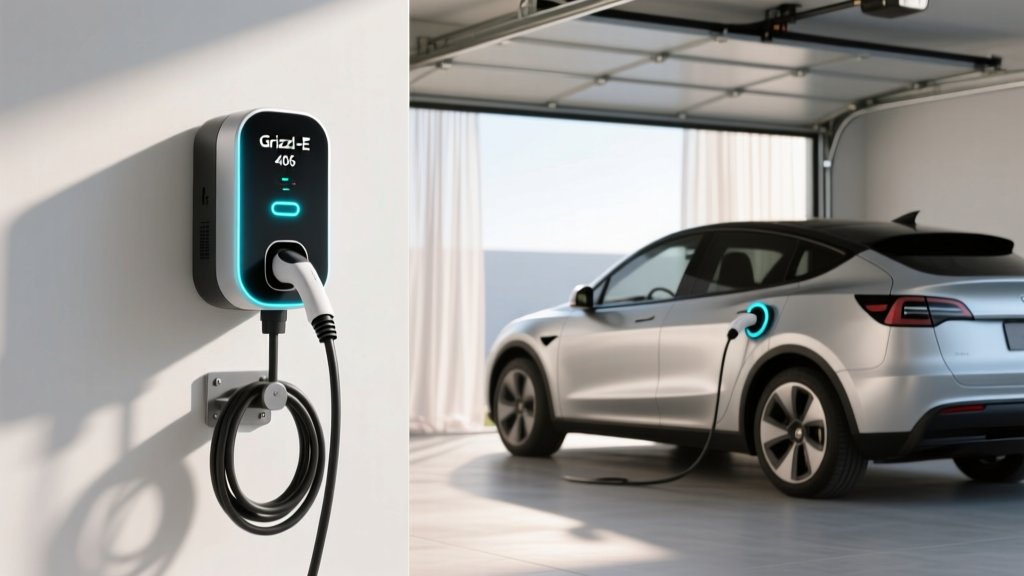
Grizzl-E Smart
- Power Output: Up to 10 kW (40A)
- Connector: J1772 (CCS1 AC compatible)
- Cable Length: 24 feet
- Smart Features: OCPP-compatible, adjustable amperage, extreme-weather rated (-40°F)
- Price: ~$500–$600
- Best For: Cold-climate fleets; ruggedized enclosure, Canadian-built
Note that the Grizzl-E maxes out at 40A (10 kW), which will add roughly 50 minutes to a full 10–80% charge compared to the 48A units. For overnight charging this is negligible, but if you need mid-day top-ups, the ChargePoint or Emporia at 48A is the better choice.
Safety, Electrical Code, and Installation Best Practices
EV charger installations involve high-amperage, continuous-duty circuits that must comply with the National Electrical Code (NEC Article 625). Key requirements for a safe, code-compliant ProMaster EV charger installation:
- Dedicated circuit: The charger must be on its own dedicated circuit — not shared with other appliances or outlets. A 48A charger requires a 60A breaker.
- GFCI protection: NEC 2020 and later requires GFCI (Ground Fault Circuit Interrupter) protection for all EVSE installations. Hardwired units typically have internal GFCI; plug-in units require a GFCI breaker.
- Outdoor rating: If your charger is installed outside (common for driveways and depot lots), the EVSE must carry a NEMA 4 or NEMA 4X rating for weather resistance. All three chargers recommended above carry appropriate outdoor ratings.
- Wire gauge: A 60A circuit requires 6 AWG copper wire (or 4 AWG aluminum) for typical run lengths. Longer runs may require thicker wire to prevent voltage drop — your electrician will calculate this.
- Permit and inspection: Virtually all jurisdictions require a permit for EVSE installation. Skipping this can void homeowner's insurance coverage in the event of an electrical fire and may cause issues at property sale.
Never use an extension cord with an EV charger, and never plug a Level 2 EVSE into a standard 120V outlet via an adapter. The continuous high-current draw of EV charging is fundamentally different from typical household appliance use and demands properly rated infrastructure.
ProMaster EV Ownership: Tax Credits and Fleet Incentives
The Ram ProMaster EV qualifies for potential federal tax incentives under the IRS §30D Clean Vehicle Credit, but eligibility is subject to multiple constraints that change regularly:
- MSRP cap: Vans fall under the $80,000 MSRP cap for the §30D credit (higher than the $55,000 sedan cap).
- Buyer income limits: Modified adjusted gross income must not exceed $150,000 (single) / $300,000 (joint) for the personal-use credit.
- Battery sourcing requirements: The percentage of critical minerals and battery components sourced from FTA-partner countries increases annually. For 2026, these thresholds are strict — verify current-year compliance on fueleconomy.gov before purchasing.
- Commercial clean vehicle credit (§45W): Fleet buyers who don't qualify for §30D personal credits may instead claim the §45W Commercial Clean Vehicle Credit, which has no income or MSRP caps but different qualification criteria. Consult a tax professional.
- Point-of-sale transfer: Eligible buyers can transfer the credit to the dealer at purchase, reducing the upfront price rather than waiting for a tax refund.
State and local incentives vary widely. California's HVIP (Hybrid and Zero-Emission Truck and Bus Voucher Incentive Project), for example, has historically offered significant vouchers for commercial electric vans. Check your state energy office or AFDC incentive database for current programs in your area.
Frequently Asked Questions
How much does it cost to install a home EV charger for the ProMaster EV?
Expect $1,400–$4,100 for a complete Level 2 installation if your electrical panel has sufficient capacity (200A service with available breaker slots). If you need a panel upgrade from 100A to 200A, add $1,500–$4,000, bringing the total to $2,900–$8,100. Always get a load calculation from a licensed electrician before committing.
How fast will each charging level add range to the ProMaster EV?
Level 1 (120V) adds roughly 3–4 miles per hour — impractical for a 110 kWh battery. Level 2 (240V, 48A) adds 22–25 miles per hour and can fully replenish overnight. DC fast charging at 150 kW peak can add 150–180 miles per hour at the top of the charge curve, tapering significantly above 80% SoC.
Which connector does the ProMaster EV use?
The ProMaster EV uses the CCS1 connector natively for both Level 2 AC and DC fast charging. It is compatible with J1772 Level 2 stations (the upper portion of the CCS1 plug) and all CCS1 DC fast chargers. For Tesla Supercharger access, you'll need a CCS1-to-NACS adapter rated for the appropriate power level.
How much does charging the ProMaster EV cost per mile vs gas?
At home off-peak rates ($0.12/kWh), the ProMaster EV costs about $0.24 per mile to charge. The gas ProMaster at 16 MPG and $3.40/gallon costs about $0.21 per mile in fuel alone. However, the EV eliminates oil changes, transmission service, and exhaust maintenance — saving an additional $800–$1,200 per year in commercial use. The total cost of ownership typically favors the EV, especially at fleet scale with commercial electricity rates.
What electrical upgrades might I need for a ProMaster EV home charger?
You need a dedicated 60-amp, 240V circuit. If your home has a 100-amp electrical panel or your panel is near capacity, you'll need an upgrade to 200A service ($1,500–$4,000). Older homes with aluminum wiring, insufficient grounding, or no 240V service at all will require more extensive upgrades. A licensed electrician's load calculation is the definitive answer.
Can I use a DC fast charger every day for the ProMaster EV?
Technically yes, but frequent DC fast charging accelerates battery degradation over time due to the high thermal stress of 150 kW charging. NMC chemistry degrades faster under repeated high-rate charging than LFP chemistry. For long-term battery health, rely on Level 2 overnight charging as your primary method and reserve DC fast charging for mid-day top-ups or route emergencies. Ram's battery warranty covers 8 years/100,000 miles with a minimum 70% capacity retention threshold.