The Real Story Behind Your Prius Prime's Electric Range
If you own or are shopping for a Toyota Prius Prime, you already know its headline appeal: an EPA-estimated 44 miles of electric-only range paired with a combined 52 MPGe when the battery depletes and the hybrid system takes over. But that 44-mile figure — achievable on the SE trim with its 13.6 kWh battery pack — only materializes if you're actually plugging in regularly. Drive it like a conventional hybrid without charging, and you're essentially hauling dead battery weight while getting standard Prius hybrid MPG.
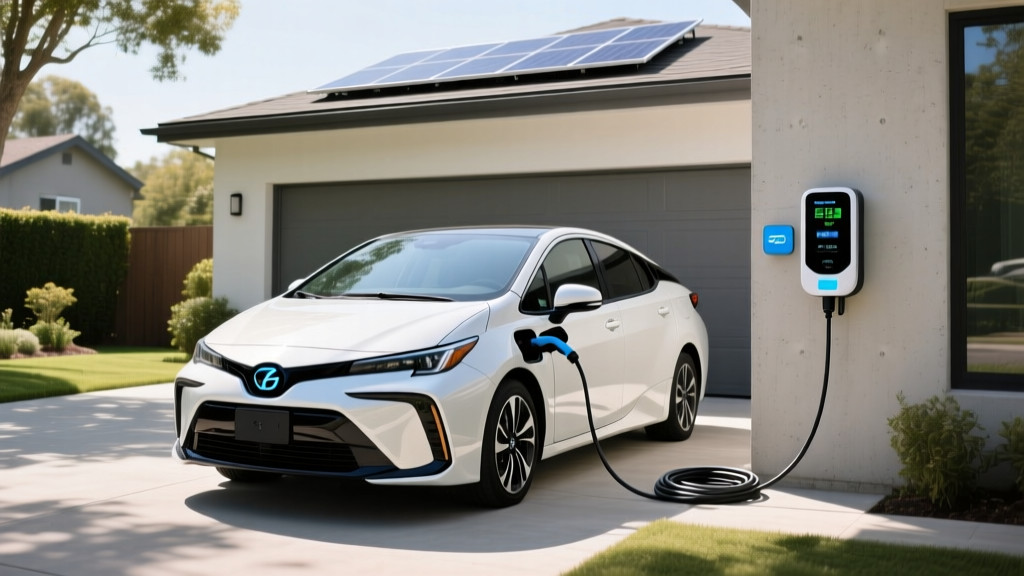
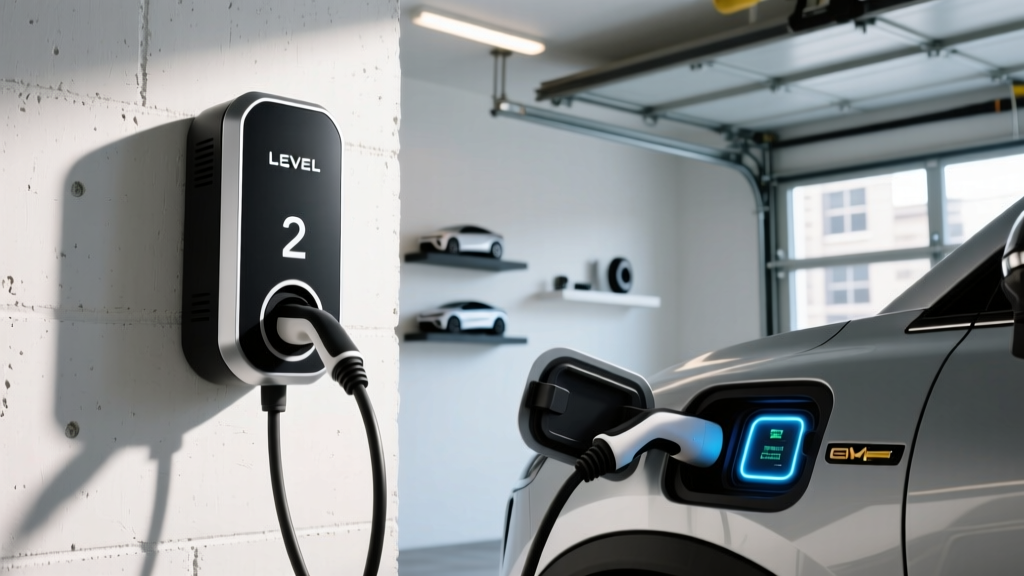
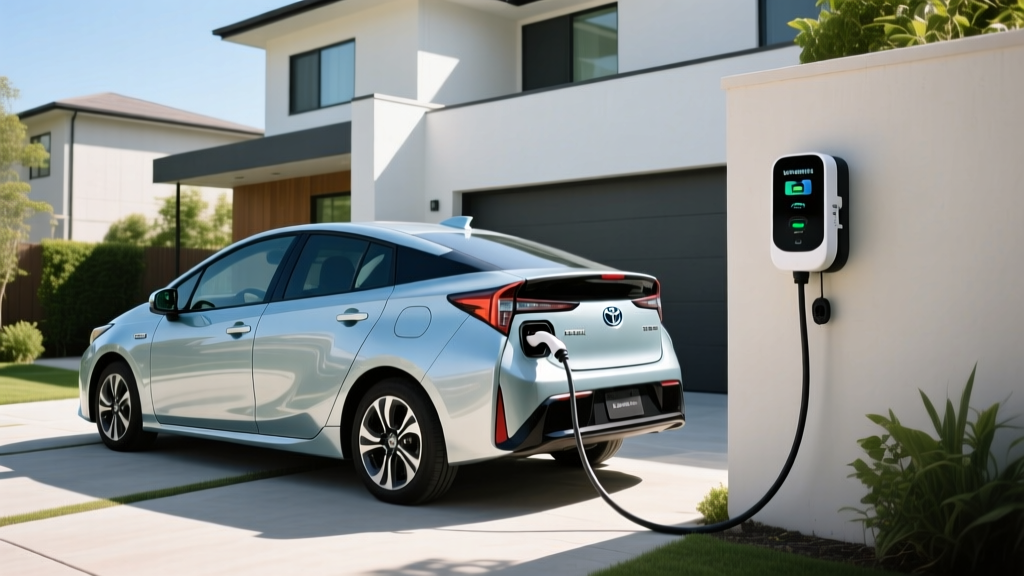
The gap between sticker range and daily reality often comes down to charging infrastructure. A Level 1 household outlet technically works, but it's painfully slow for daily top-offs. A properly installed Level 2 home charger transforms the Prius Prime from a "sometimes electric" vehicle into a genuine daily EV commuter — one that rarely sips gasoline on typical commutes under 40 miles.
EPA Electric Range: 44 miles (SE trim, 2025-2026 model years)
Real-World Expectation: 35-40 miles in mixed driving; 30-35 miles in cold weather or sustained highway speeds above 70 mph. The Prius Prime's relatively small battery means range drops are noticeable — expect roughly 20-25% loss in sub-freezing temperatures without preconditioning.
This guide walks through exactly what you need to charge a Prius Prime at home, what it costs, and how to calculate your per-mile savings versus gasoline.
Charging Levels Explained: Speeds That Matter for a 13.6 kWh Battery
Before comparing equipment, let's establish what each charging level actually delivers. The distinction between kW (kilowatts, the rate of power flow) and kWh (kilowatt-hours, the total energy stored in your battery) is critical. Think of kW as how fast water flows from a hose; kWh is the size of the bucket. The Prius Prime's battery holds 13.6 kWh of usable energy.
| Level | Voltage / Amperage | Power (kW) | Miles of Range Added Per Hour | 0-100% Time (Prius Prime) |
|---|---|---|---|---|
| Level 1 | 120V / 12A | ~1.4 kW | ~3-4 miles | ~10-11 hours |
| Level 2 | 240V / 16-32A | 3.3-7.7 kW | ~12-25 miles | ~2-4 hours |
| DC Fast Charging | 200-500V DC | N/A (Prius Prime has no DCFC port) | N/A | N/A |
The Prius Prime uses a standard J1772 connector for AC charging and does not support DC fast charging — a deliberate Toyota engineering choice to keep costs and weight down. This isn't a significant limitation for a PHEV with a 13.6 kWh battery; DC fast chargers are designed for 60-100+ kWh BEV batteries where 10-80% top-ups matter on road trips.
For the Prius Prime, Level 2 is the practical sweet spot. The onboard charger is rated at 3.3 kW on earlier model years and up to 3.3-3.5 kW on the current generation, meaning even a 40-amp Level 2 circuit won't charge it faster than roughly 3.3 kW. However, installing a higher-capacity circuit (e.g., 48A) future-proofs your setup for a next vehicle — whether that's a BEV or a higher-power PHEV.
Home Charging Installation: Electrical Requirements and Real Costs
Installing a Level 2 charger isn't just about buying a wall box — it's about ensuring your home's electrical system can handle a sustained 240V load safely and legally. Here's what's involved.
Electrical Requirements
A typical Level 2 charger for PHEV use runs on a 240V dedicated circuit at 20-40 amps. For the Prius Prime's 3.3 kW onboard charger, a 20A circuit (delivering ~3.8 kW max, with 80% continuous load = 3.0 kW usable) technically suffices, but most electricians recommend a 40A or 50A circuit for flexibility. The National Electrical Code (NEC) requires EV charging circuits to be rated at 125% of the continuous load — so a 32A charger needs a 40A breaker.
Panel Upgrade Considerations
If your home has a 100-amp main service panel (common in homes built before the 1990s), adding a 40A EV circuit may push total load beyond safe capacity. An electrician will perform a load calculation to determine if a panel upgrade to 200A is necessary. Panel upgrades typically cost $1,500-$3,000 and are the single biggest variable in installation pricing. Homes with 200A panels rarely need upgrades for PHEV charging.
| Cost Component | Typical Range | Notes |
|---|---|---|
| Level 2 Charger (Equipment) | $250 - $700 | Smart Wi-Fi chargers at higher end |
| Electrician Labor | $400 - $1,500 | Depends on run length from panel to garage |
| Electrical Permit | $50 - $200 | Required in most jurisdictions |
| Panel Upgrade (if needed) | $1,500 - $3,000 | Only if existing panel lacks capacity |
| Total (no panel upgrade) | $700 - $2,400 | Most homes with 200A service |
| Total (with panel upgrade) | $2,200 - $5,400 | Older homes with 100A service |
Always hire a licensed electrician and pull a permit. Unpermitted EV charger installations can void homeowner's insurance claims and create fire hazards. The National Electrical Contractors Association maintains a directory of certified installers.
Connector Compatibility: What Plugs Into a Prius Prime
The connector landscape has shifted significantly in 2025-2026, with Tesla opening its Supercharger network and the North American Charging Standard (NACS) gaining adoption. But for AC home and public Level 2 charging, the picture is simpler.
| Connector Type | Used For | Prius Prime Compatible? | Adapter Needed? |
|---|---|---|---|
| J1772 | Level 1 & Level 2 AC charging | Yes — native port | No |
| NACS (Tesla) | Level 2 AC (Tesla Wall Connector) & DC Superchargers | Level 2 AC: with Tesla-to-J1772 adapter. DCFC: No (Prius Prime has no DCFC capability) | Yes, for Tesla AC chargers (~$200-$300 adapter) |
| CCS1 | DC Fast Charging | No — Prius Prime has no DCFC port | N/A |
| CHAdeMO | DC Fast Charging (legacy) | No | N/A |
For home charging, any J1772 Level 2 charger will plug directly into the Prius Prime. If you also own a Tesla or plan to buy one, consider a charger with a J1772 connector and purchase a Tesla-to-J1772 adapter, or buy a dual-connector unit. The key point: you do not need NACS, CCS, or CHAdeMO for Prius Prime charging. J1772 is all you need.
Charging Cost Per Mile: Prius Prime Electric vs. Gasoline
The economic case for plugging in your Prius Prime hinges on local electricity rates versus gasoline prices. Let's run the numbers with the Prius Prime's real efficiency figures.
The Prius Prime consumes approximately 25-28 kWh per 100 miles in electric mode (roughly 3.6-4.0 miles per kWh). In hybrid mode after battery depletion, it achieves about 52 MPG combined on the SE trim.
| Scenario | Rate | Cost Per 100 Miles | Cost Per Mile |
|---|---|---|---|
| Home Charging (national avg. residential) | $0.16/kWh | $4.00 - $4.48 | $0.040 - $0.045 |
| Home Charging (off-peak time-of-use) | $0.09/kWh | $2.25 - $2.52 | $0.023 - $0.025 |
| Public Level 2 (network pricing) | $0.30/kWh | $7.50 - $8.40 | $0.075 - $0.084 |
| Gasoline (hybrid mode, 52 MPG) | $3.40/gallon | $6.54 | $0.065 |
At off-peak home rates, the Prius Prime costs roughly 2.5 cents per mile on electricity — about 60% cheaper than burning gasoline in hybrid mode. Even at standard residential rates, electric driving saves roughly 35-40% per mile. Public Level 2 charging, however, often costs more than gasoline per mile — a strong incentive to charge at home whenever possible.
For a driver covering 12,000 miles annually with 80% electric-mode driving (feasible with daily home charging and a sub-40-mile commute), annual fuel savings versus hybrid-only driving typically reach $300-$500 depending on local rates. The Level 2 installation pays for itself in 2-5 years on fuel savings alone, before factoring in reduced engine wear from fewer gasoline miles.
Recommended Level 2 Chargers for the Prius Prime
Since the Prius Prime's onboard charger caps at ~3.3 kW, you don't need the most powerful charger on the market. But investing in a 32A or 40A unit with smart features makes sense for future vehicles. Here are proven options:
Emporia Level 2 Smart Charger
- Power Output: Up to 48A (11.5 kW at 240V)
- Connector: J1772
- Cable Length: 24 feet
- Smart Features: Wi-Fi, energy monitoring, solar integration, scheduling via app
- Price: ~$350-$400
- Best For: Budget-conscious buyers who want energy tracking and solar pairing
ChargePoint Home Flex
- Power Output: Configurable 16A-50A (up to 12 kW)
- Connector: J1772 (NACS adapter available separately)
- Cable Length: 23 feet
- Smart Features: Wi-Fi, Alexa integration, flexible amperage settings, detailed charging history
- Price: ~$550-$650
- Best For: Multi-EV households needing adjustable amperage
Grizzl-E Smart
- Power Output: Up to 40A (9.6 kW)
- Connector: J1772
- Cable Length: 24 feet
- Smart Features: Wi-Fi, OCPP-compatible, outdoor-rated (NEMA 4), extreme cold tested to -40°F
- Price: ~$450-$550
- Best For: Outdoor installations and cold-climate durability
All three chargers far exceed the Prius Prime's 3.3 kW onboard charging capability, which means the car will only draw what it can accept. The extra capacity benefits you when you eventually upgrade to a BEV with 7-11 kW onboard charging.
Safety, Code, and Installation Best Practices
EV charging places a sustained high-amperage load on your home's electrical system — unlike an oven or dryer that cycles on and off, an EV charger may run continuously for hours. This makes code compliance non-negotiable.
- Dedicated Circuit: Your EV charger must be on its own dedicated breaker — never shared with other appliances.
- GFCI Protection: The 2020 NEC and later require GFCI protection for outdoor receptacles used for EV charging. Many modern Level 2 chargers include built-in GFCI; verify with your electrician to avoid double-GFCI conflicts that cause nuisance tripping.
- Outdoor Rating: If your charging location is exposed to weather, ensure the charger carries a NEMA 4 (or IP65+) rating. The Grizzl-E and ChargePoint Home Flex both meet this standard.
- Cable Management: A 24-foot cable draped across a garage floor is a trip hazard. Wall-mounted cable organizers or retractors ($30-$60) keep things tidy and prevent connector damage.
- Ventilation: Indoor Level 2 charging does not require special ventilation — there are no off-gassing concerns with modern lithium-ion PHEV batteries during normal charging.
Frequently Asked Questions
How much does it cost to install a home EV charger for a Prius Prime?
Expect $700-$2,400 for a standard installation in a home with a 200A electrical panel. This includes the charger ($250-$700), electrician labor ($400-$1,500), and permit fees ($50-$200). Homes with older 100A panels may need a panel upgrade adding $1,500-$3,000. Always get at least two quotes from licensed electricians.
How fast will each charging level add range to my Prius Prime?
Level 1 (standard 120V outlet) adds roughly 3-4 miles of electric range per hour — enough for overnight top-ups if your daily drive is under 20 miles. Level 2 (240V) adds 12-25 miles per hour, fully replenishing the Prius Prime's 44-mile battery in 2-4 hours. The Prius Prime does not support DC fast charging.
Which connector and charger is compatible with my Prius Prime?
Any charger with a J1772 connector works natively. This includes virtually all non-Tesla home chargers and public Level 2 stations. You do not need NACS, CCS, or CHAdeMO for a Prius Prime. If you want to use a Tesla Wall Connector at home, you'll need a Tesla-to-J1772 adapter (~$200-$300).
How much does charging cost per mile versus gasoline?
At the national average residential electricity rate of $0.16/kWh, Prius Prime electric driving costs about 4.0-4.5 cents per mile. Off-peak rates can drop this to 2.3-2.5 cents. Gasoline in hybrid mode at 52 MPG and $3.40/gallon costs about 6.5 cents per mile. Home charging is consistently cheaper; public Level 2 stations at $0.25-$0.35/kWh may cost more than gas.
What electrical upgrades might I need before installing a charger?
The most common upgrade is a panel replacement from 100A to 200A service, needed in older homes where the existing panel lacks spare capacity for a 40A EV circuit. Your electrician will perform a load calculation considering all existing circuits. Other potential upgrades include running a new 240V line from the panel to your garage or carport (cost varies with distance and whether walls need to be opened) and upgrading the meter socket if the utility requires it for higher service amperage.
Does the Prius Prime qualify for any charging equipment tax credits?
The federal Alternative Fuel Vehicle Refueling Property Credit (IRS Form 8911) covers up to 30% of home charger equipment and installation costs, capped at $1,000. However, eligibility depends on your census tract meeting specific low-income or non-urban criteria. Check the latest IRS guidance or consult a tax professional before counting on this credit. Some utilities also offer rebates of $200-$500 for smart Level 2 charger installations — check with your local provider.
For official efficiency and range data, refer to fueleconomy.gov for the latest Prius Prime model year specifications. Toyota's official Prius Prime page provides current trim-level details, battery warranty terms (10 years/150,000 miles for the hybrid battery), and MSRP information.