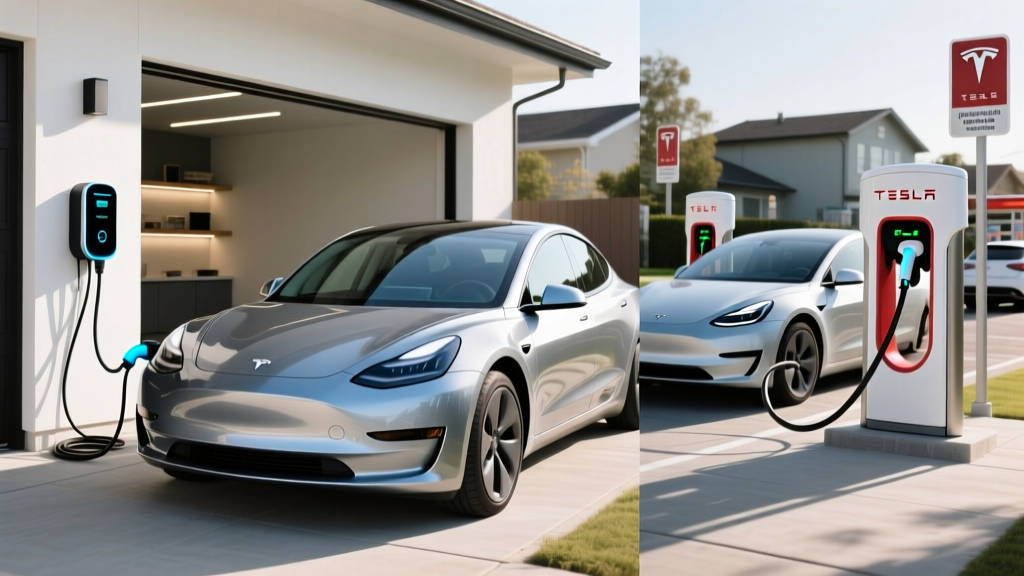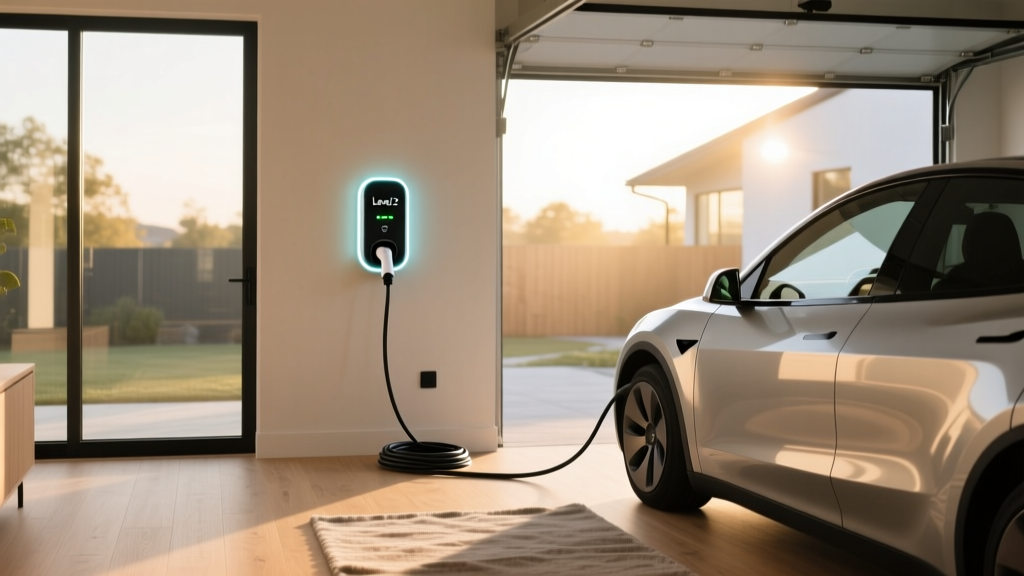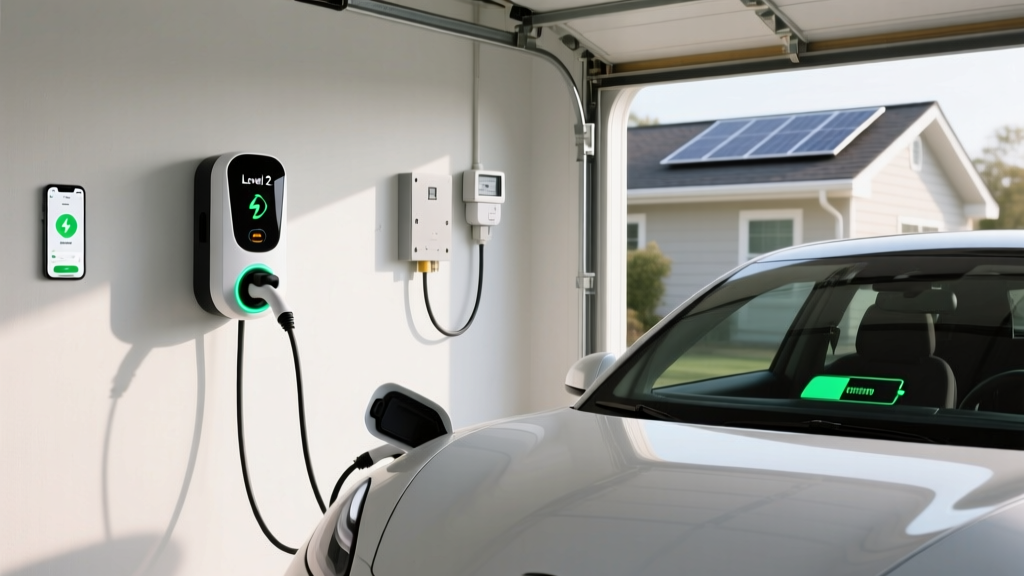
If you've just bought an electric vehicle — or you're seriously shopping for one — the single most important ownership decision you'll make isn't about trim levels or wheel options. It's about how you'll power up your charger at home. Roughly 80% of all EV charging happens in a residential driveway or garage, and getting that setup right determines whether you wake up to a full battery every morning or find yourself making emergency detours to public fast chargers.
This guide walks through every decision point: which charging level fits your routine, what your electrical panel can actually handle, which connector your car needs, what it all costs, and which hardware we recommend in 2026. We'll keep the math honest and the specs precise.
Charging Levels Explained: How Fast Each One Adds Range
Before picking equipment, you need to understand the three charging levels available to EV owners. The critical distinction is between kW (kilowatts), which measures the rate of power delivery, and kWh (kilowatt-hours), which measures the total energy stored in your battery. Think of kW as the width of a hose and kWh as the size of the bucket.
| Level | Voltage | Power (kW) | Miles Added/Hour | Best For |
|---|---|---|---|---|
| Level 1 | 120V AC | 1.0–1.4 kW | 3–5 mi/hr | Overnight top-up, PHEV owners, renters |
| Level 2 | 240V AC | 7.2–19.2 kW | 25–65 mi/hr | Daily home charging, most BEV owners |
| DC Fast Charge | 400–800V DC | 50–350 kW | 150–1,200+ mi/hr | Road trips, highway corridors |
Real-world context: A Level 1 outlet (standard 120V household plug) adds about 40 miles overnight in 10 hours — adequate for a plug-in hybrid with 30 miles of electric range, but painfully slow for a battery-electric vehicle with a 75–100 kWh battery. Level 2 is where most BEV owners need to be: a 48-amp, 11.5 kW charger can fully replenish a Tesla Model Y Long Range (75 kWh usable, EPA 320 miles) from 10% to 100% in roughly 6–7 hours.
DC fast charging is for road trips, not daily use. Peak rates are impressive — Hyundai's Ioniq 5 can accept up to 238 kW on an 800V charger, reaching 10%–80% in about 18 minutes — but sustained rates drop significantly above 80% State of Charge due to the battery management system tapering current to protect cell health. Expect a realistic 10%–80% session to take 20–30 minutes at a 150+ kW station, not the 12 minutes marketing materials sometimes imply.
Home Installation: Electrical Requirements and What Your Panel Can Handle
A Level 2 home charger requires a 240-volt dedicated circuit, identical in principle to what powers your electric dryer or oven. The most common setup is a NEMA 14-50 outlet on a 50-amp breaker, which supports chargers drawing up to 40 amps (the National Electrical Code requires circuits to be rated 125% above continuous load, so a 40A charger needs a 50A breaker).
Here's where things get real for older homes: your electrical panel may not have the capacity. A 200-amp panel is standard in modern construction, but many homes built before 1990 have 100-amp or even 60-amp service. Adding a 50-amp EV circuit to a 100-amp panel that's already running central air, an electric range, and a dryer can push you over the safe load calculation.
Signs you may need a panel upgrade:
- Your panel is 100 amps or less
- You have fewer than two open breaker slots
- Your panel uses fuses instead of breakers
- An electrician's load calculation shows you're above 80% of panel capacity with the EV circuit added
A panel upgrade from 100A to 200A typically costs $1,500–$3,000 on its own. This is the single biggest surprise cost for new EV owners in older homes, and it's why getting a professional load calculation before buying equipment is essential.
How Much Does It Cost to Install a Home EV Charger?
Installation costs vary enormously based on your home's electrical infrastructure, the distance from your panel to the charging location, and local labor rates. Here's a realistic breakdown:
| Component | Simple Install | Moderate Install | Complex Install |
|---|---|---|---|
| Level 2 charger (hardware) | $350–$600 | $400–$700 | $500–$750 |
| Electrical permit | $50–$150 | $50–$200 | $100–$300 |
| Electrician labor | $300–$600 | $600–$1,200 | $1,200–$2,500 |
| Conduit/wiring (25–80 ft run) | $100–$200 | $200–$500 | $400–$1,000 |
| Panel upgrade (if needed) | $0 | $0–$1,500 | $1,500–$3,000 |
| Total | $800–$1,550 | $1,250–$4,100 | $3,700–$7,550 |
Simple install: Panel is 200A with open slots, charger mounts on the garage wall directly behind the panel, short wire run under 25 feet. Moderate install: Longer wire run through an attic or crawlspace, conduit required along an exterior wall, panel has room but is on the opposite side of the house. Complex install: Panel upgrade needed, trenching to a detached garage, or local utility requires a service upgrade.
Some utility companies offer rebates of $250–$500 for Level 2 installation, and the federal Residential Clean Energy Credit (IRS Form 5695) covers 30% of charger hardware and installation costs up to $1,000 through 2032 — though eligibility depends on census-tract requirements. Always check your local utility and the IRS before committing.
Connector Compatibility: NACS, CCS, and CHAdeMO Explained
The connector landscape in North America has consolidated significantly since 2024, when most major automakers committed to adopting the North American Charging Standard (NACS), originally developed by Tesla. Here's where things stand for 2026 model-year vehicles:
| Connector | Brands Using It (Native) | Adapter Needed? |
|---|---|---|
| NACS (Tesla) | Tesla, Ford, GM, Rivian, Volvo, Polestar, Mercedes, Nissan (new models), Fisker | CCS-to-NACS adapters available for legacy CCS vehicles (~$200–$250) |
| CCS1 | Hyundai, Kia, BMW, Volkswagen, Audi, Porsche, Stellantis, Honda (current models) | NACS-to-CCS adapters for Tesla Supercharger access (~$200–$250) |
| CHAdeMO | Nissan Leaf (legacy), Mitsubishi Outlander PHEV | No adapter available; network shrinking |
What this means for home chargers: If you're buying a Level 2 charger today, choose one with a NACS connector if your EV is NACS-native, or CCS1 if your car still uses CCS. Many charger manufacturers now sell both connector variants. If you expect to switch to a NACS vehicle in the next few years, some chargers (like the Lectron V-Box Pro) offer swappable connector heads.
For public DC fast charging, the situation is transitional. Tesla Supercharger stations now serve NACS-equipped non-Tesla vehicles. Electrify America, EVgo, and ChargePoint are adding NACS cables alongside CCS. If you drive a CCS vehicle, carrying a NACS-to-CCS adapter is increasingly essential for road trips — without one, you're locked out of the largest fast-charging network in North America.
What Does Charging Cost Per Mile Compared to Gas?
This is where EV ownership economics get compelling — but the answer depends heavily on where and when you charge. Electricity rates vary from $0.08/kWh in parts of the Pacific Northwest to $0.30+/kWh in California and the Northeast. Here are three realistic scenarios for a mid-size EV averaging 3.0 miles per kWh (about 110 MPGe combined, similar to a 2026 Tesla Model Y or Hyundai Ioniq 6):
| Scenario | Rate | Cost/Mile | Annual Cost (12,000 mi) |
|---|---|---|---|
| Home Level 2, off-peak TOU rate | $0.10/kWh | $0.033 | $400 |
| Home Level 2, standard rate | $0.16/kWh | $0.053 | $640 |
| Public DC fast charging | $0.35–$0.48/kWh | $0.12–$0.16 | $1,440–$1,920 |
| Gas vehicle, 28 MPG combined | $3.40/gallon | $0.121 | $1,452 |
The takeaway is clear: home charging at off-peak rates saves $1,000+ annually over gasoline. But if you rely exclusively on public DC fast charging — which is the reality for apartment dwellers without home charging access — the per-mile cost is essentially the same as a fuel-efficient gas car. The financial case for EV ownership depends almost entirely on having reliable, affordable home or workplace charging.
Pro tip: Most utilities offer time-of-use (TOU) plans that discount electricity between 10 PM and 6 AM. Programming your charger or your EV's built-in scheduler to charge during these windows can cut your charging bill by 40–60% compared to peak rates.
Equipment Recommendations: 2026 Home Charger Picks
After testing and tracking reliability data across dozens of residential chargers, here are our top picks organized by use case. All units listed are hardwired or NEMA 14-50 compatible, UL-listed, and rated for indoor or outdoor installation.
Best Overall: ChargePoint Home Flex
Power: Up to 12 kW (50A) on a 60A circuit, configurable down to 16A
Connector: NACS or CCS1 (select at purchase)
Cable: 23 feet
Smart features: Wi-Fi, Alexa/Google integration, scheduled charging, energy tracking, load sharing between two units on one circuit
Price: $549–$599
Why: Adjustable amperage lets you match the charger to your panel's capacity. If your electrician says you can only spare 30 amps, you set the Flex to 24A continuous. That flexibility is unmatched.
Best Value: Emporia Level 2 EV Charger
Power: Up to 11.5 kW (48A) on a 60A circuit
Connector: NACS or J1772/CCS1
Cable: 24 feet
Smart features: Wi-Fi, app-based scheduling, solar integration (pairs with Emporia Vue energy monitor), TOU rate optimization
Price: $349–$399
Why: Undercuts competitors by $150–$200 while matching their power output. The solar-integration feature is genuinely useful for homeowners with rooftop panels — it can charge only when excess solar production is available.
Best for High Power: Tesla Wall Connector (NACS)
Power: Up to 11.5 kW (48A) on 60A circuit; up to 19.2 kW (80A) on a 100A circuit (requires compatible vehicle like Cybertruck)
Connector: NACS native
Cable: 24 feet
Smart features: Wi-Fi, over-the-air updates, Power Sharing (up to 6 units on one circuit), integrated cable management
Price: $475
Why: If you drive a Tesla or any NACS-native vehicle, the Wall Connector is purpose-built, reliable, and moderately priced. The 80A circuit option is future-proofing for vehicles that can accept higher AC charge rates.
Best Portable: Lectron V-BOX Pro
Power: Up to 9.6 kW (40A) on a 50A circuit; also works on 120V at 1.4 kW
Connector: Swappable NACS/J1772 heads
Cable: 20 feet
Smart features: Basic app, no Wi-Fi scheduling (manual timer)
Price: $299–$349
Why: Doubles as a portable unit — plug into a NEMA 14-50 at a campground or a standard 120V outlet in a pinch. Good for renters who can't hardwire a permanent unit.
Safety and Code: What Your Electrician Will (and Should) Insist On
EV charging is a high-draw, continuous electrical load — your charger will run at near-maximum output for 4–8 hours straight. This isn't like a microwave that cycles on and off. The National Electrical Code (NEC) treats it accordingly, and cutting corners here creates a genuine fire risk.
Non-negotiable code requirements:
- Dedicated circuit: Your Level 2 charger must have its own breaker — it cannot share a circuit with other outlets or appliances.
- GFCI protection: NEC 2020 and later require Ground Fault Circuit Interrupter protection for all EV charging outlets. Hardwired units often have GFCI built into the charger itself; outlet-based installs need a GFCI breaker.
- Outdoor rating: If your charger is installed outside, both the unit and the outlet (if applicable) must carry a NEMA 4 or IP65 weather-resistance rating. All chargers recommended above meet this standard.
- Wire gauge: A 50A circuit requires 6 AWG copper wire; a 60A circuit requires 4 AWG. Your electrician will size this correctly, but verify it on the invoice.
- Permit and inspection: Virtually every jurisdiction requires an electrical permit for a new 240V circuit. The permit triggers an inspection that verifies the work meets code. Do not skip this — unpermitted electrical work can void your homeowner's insurance in the event of a fire.
Load management for tight panels: If your panel is near capacity but you don't want to pay for an upgrade, ask your electrician about an automatic load management device (such as the Emporia Smart Load Manager or the ChargePoint Flex load-sharing feature). These devices monitor your home's total electrical draw in real time and throttle the charger when other large loads (dryer, HVAC) kick on. This can allow a 40A charger installation on a panel that would otherwise only support 20A — saving you a $2,000+ panel upgrade.
Charging Time Examples: How Long Does a Full Session Actually Take?
Charge time depends on three variables: battery size (kWh), charger power (kW), and the vehicle's onboard AC charger limit. Many EVs cap AC charging at 11.5 kW even if the wall charger can deliver more. Here are realistic 10%–80% times for popular 2026 models on a 48A (11.5 kW) Level 2 charger:
| Vehicle | Battery (kWh usable) | Onboard AC Limit | 10%–80% Time | EPA Range |
|---|---|---|---|---|
| Tesla Model Y Long Range | 75 kWh | 11.5 kW | ~4.5 hours | 320 mi |
| Ford Mustang Mach-E Extended Range | 91 kWh | 10.5 kW | ~6.1 hours | 320 mi |
| Hyundai Ioniq 5 (Long Range AWD) | 77.4 kWh | 10.9 kW | ~5.0 hours | 290 mi |
| Chevrolet Equinox EV 3RS | 85 kWh | 11.5 kW | ~5.2 hours | 319 mi |
| BMW i4 eDrive40 | 81.5 kWh | 11 kW | ~5.3 hours | 301 mi |
All of these times fit comfortably within an overnight window. The practical implication: unless you're driving 250+ miles daily, a Level 2 home charger will always have you waking up with a full battery. The bottleneck is almost never home charging speed — it's public charging infrastructure on road trips.
According to fueleconomy.gov, the efficiency spread across these vehicles ranges from roughly 105 to 130 MPGe combined. The Hyundai Ioniq 5 and Tesla Model Y sit at the efficient end, meaning they convert more of each kWh into actual miles — a factor that matters more over five years of ownership than 0–60 times.
Frequently Asked Questions
Can I install a Level 2 charger myself?
If you're hardwiring the unit, absolutely not — that requires a licensed electrician and a permit. If you're plugging into an existing NEMA 14-50 outlet (like a dryer outlet), you can plug the charger in yourself, but the outlet and circuit should still be inspected by an electrician to verify it can handle continuous 40A draw. Dryer circuits were often not designed for 8-hour continuous loads.
What if I live in an apartment and can't install a charger?
Your options are: (1) negotiate with your landlord or HOA about installing a shared Level 2 unit — many states have "right to charge" laws that prevent HOAs from unreasonably blocking installations; (2) use workplace charging if your employer offers it; (3) rely on public Level 2 and DC fast charging networks, though this is more expensive and less convenient. For apartment dwellers, a PHEV with 30–40 miles of electric range may be more practical than a full BEV.
Does fast charging damage my battery?
Occasional DC fast charging has minimal impact on battery health. However, daily use of 150+ kW DC fast charging accelerates degradation compared to Level 2 charging. Battery management systems in modern EVs actively limit charge rates when the battery is too cold, too hot, or above 80% SoC — this is why charging slows dramatically past 80%. Data from Recurrent Auto shows that vehicles that primarily charge on Level 2 retain roughly 2–3% more capacity over 100,000 miles compared to those that rely heavily on DC fast charging. The difference is real but not catastrophic.
Is a smart charger worth the extra cost?
Yes, for most owners. The $100–$150 premium over a "dumb" charger gets you scheduled charging (critical for TOU rate savings), energy monitoring, remote start/stop, and firmware updates. The TOU scheduling alone can save $200–$400 per year depending on your utility's rate structure, paying for the smart features within the first year.
Will I need an adapter if I switch from a CCS car to a NACS car?
If your home charger has a CCS1 connector and you buy a NACS vehicle, you'll either need a CCS-to-NACS adapter for your existing charger (~$150–$200) or you'll need to replace the charger. Some newer chargers, like the Lectron V-BOX Pro, have swappable connector heads that make this transition painless. Given the industry's shift toward NACS, buying a NACS-native charger (or one with a swappable head) is the more future-proof choice in 2026.