Why a Portable EV Charging Station Makes Sense in 2026
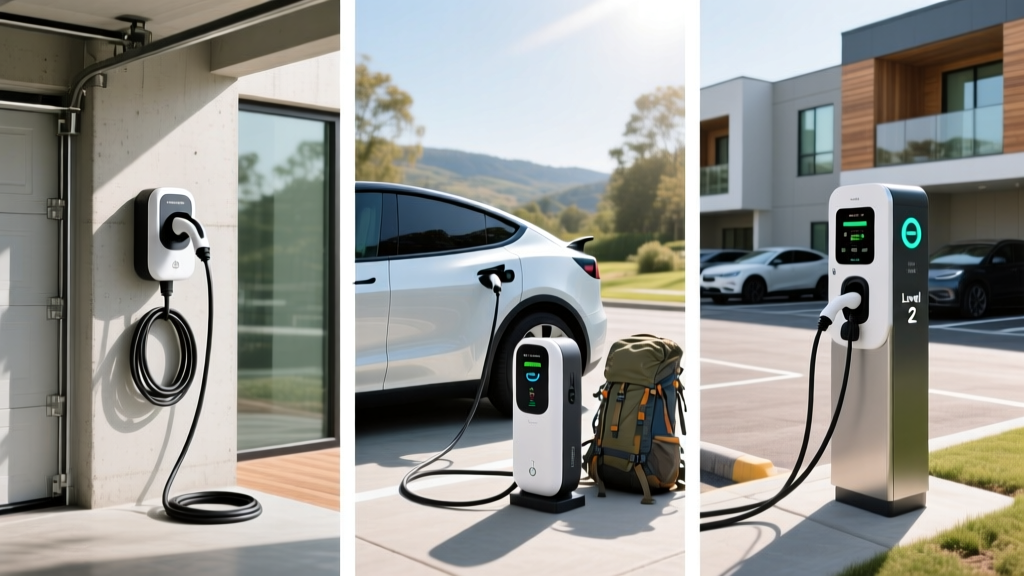
If you own an electric vehicle but split time between two homes, rent an apartment without dedicated EV infrastructure, or take frequent road trips to areas with sparse public charging, a portable EV charging station solves a real problem. Unlike hardwired wall units, these devices plug into existing outlets — either a standard 120V household receptacle (Level 1) or a 240V dryer/RV-style outlet (Level 2) — and travel with you. The trade-off is slightly lower peak power versus a permanently mounted unit, but modern portable chargers now deliver up to 11.5 kW on a NEMA 14-50 circuit, which is enough to fully replenish most EV batteries overnight.
This guide breaks down exactly what portable units can deliver at each charging level, what your home's electrical panel must support, which connector your EV requires, and what you'll actually pay per mile compared to gasoline.
Charging Levels Explained: Speeds, kW, and Miles Per Hour
The single most important distinction in EV charging is between kW (kilowatts), which measures power delivery rate, and kWh (kilowatt-hours), which measures total energy stored in your battery. A 10 kW charger running for one hour delivers 10 kWh of energy. Think of kW as the width of a pipe and kWh as the total volume of water in a tank.
| Level | Voltage / Amperage | Max Power (kW) | Miles of Range Added Per Hour | Typical Use Case |
|---|---|---|---|---|
| Level 1 | 120V / 12A–16A | 1.4–1.9 kW | 3–5 miles | Overnight top-up, PHEVs, emergencies |
| Level 2 (Portable) | 240V / 16A–48A | 3.8–11.5 kW | 14–46 miles | Daily home charging, travel, rental homes |
| Level 2 (Hardwired) | 240V / 48A–80A | 11.5–19.2 kW | 46–75 miles | Primary home charging, large batteries |
| DC Fast Charging | 400V–800V DC | 50–350 kW | 150–1,000+ miles (equivalent) | Road trips, highway corridors |
Real-world charging note: Miles-per-hour figures assume an average EV efficiency of 3.0–3.5 miles per kWh. Vehicles with larger batteries and lower efficiency (like the Ford F-150 Lightning at ~2.0 mi/kWh) will gain fewer miles per hour at the same kW rate. Cold batteries also accept charge more slowly until preconditioned.
How Fast Will Each Level Charge Common EV Batteries?
Below are approximate 10–80% charging times for three popular battery sizes using portable-compatible equipment. These assume the vehicle's onboard charger can accept the full power the portable unit delivers — not all can.
| Battery Size (kWh Usable) | Example Vehicles | Level 1 (1.4 kW) | Portable Level 2 (7.7 kW, 32A) | Portable Level 2 (11.5 kW, 48A) |
|---|---|---|---|---|
| 58 kWh | VW ID.4 Standard, base Hyundai Ioniq 5 | ~29 hours | ~5.3 hours | ~3.5 hours |
| 77 kWh | Tesla Model Y LR, Ford Mustang Mach-E ER | ~38 hours | ~7.0 hours | ~4.7 hours |
| 100 kWh | Ford F-150 Lightning ER, Rivian R1S Max | ~50 hours | ~9.1 hours | ~6.1 hours |
Level 1 charging is practical only for plug-in hybrids with small batteries (10–20 kWh) or BEVs driven under 30 miles daily. For any BEV owner covering typical American mileage, a portable Level 2 unit on a 240V outlet is the minimum viable daily charging solution.
Electrical Requirements: What Your Home Must Support
Before purchasing a portable Level 2 EV charging station, you need to verify your electrical panel can handle the load. Here are the requirements for common outlet types:
| Outlet Type | Voltage / Amperage | Max Continuous Draw (80% Rule) | Charger Power | Common In |
|---|---|---|---|---|
| NEMA 5-15 | 120V / 15A | 12A | 1.4 kW | Standard household outlet |
| NEMA 14-50 | 240V / 50A | 40A | 9.6 kW | RV parks, newer garages, some kitchens |
| NEMA 6-50 | 240V / 50A | 40A | 9.6 kW | Welder outlets, older dryers |
| NEMA 14-30 | 240V / 30A | 24A | 5.8 kW | Dryer outlets (older homes) |
| NEMA 10-30 | 240V / 30A | 24A | 5.8 kW | Legacy dryer (no ground — adapter risk) |
The National Electrical Code (NEC) requires EV charging to be treated as a continuous load, meaning you can only use 80% of a circuit's rated amperage. A 50A circuit supports a maximum continuous draw of 40A (9.6 kW at 240V). A 60A dedicated circuit allows 48A continuous (11.5 kW).
When You'll Need a Panel Upgrade
Most homes built after 2000 have 200A service panels with sufficient spare capacity for a 50A EV circuit. Older homes with 100A or 150A panels may need an upgrade, especially if you already run electric heat, an electric dryer, and an electric oven simultaneously. A licensed electrician will perform a load calculation per NEC Article 220 to determine if your panel has headroom. Signs you may need an upgrade:
- Your panel is 100A total service
- You have fewer than 4 unused breaker slots
- Your panel uses fuses instead of breakers
- An electrician's load calculation exceeds 80% of panel capacity with the EV circuit added
How Much Does It Cost to Install a Home EV Charger?
A portable EV charging station itself requires zero installation if a suitable 240V outlet already exists. However, if you need a new NEMA 14-50 receptacle wired to your panel, here's what to budget:
| Component | Simple Install (panel near garage) | Complex Install (long run, older panel) |
|---|---|---|
| Portable Level 2 Charger (equipment) | $350–$650 | $350–$650 |
| NEMA 14-50 Receptacle + Wiring | $250–$500 | $600–$1,500 |
| Electrician Labor | $300–$600 | $800–$2,000 |
| Electrical Permit | $50–$150 | $50–$200 |
| Panel Upgrade (if needed) | $0 | $1,500–$4,000 |
| Total | $950–$1,900 | $3,400–$8,350 |
According to data from the U.S. Department of Energy, the national average for a Level 2 home charging installation (outlet + labor, no panel upgrade) falls between $500 and $2,000. Always hire a licensed electrician and pull a permit — unpermitted electrical work can void home insurance and create fire risk.
Safety note: Never use a NEMA 10-30 (ungrounded legacy dryer) outlet without having an electrician verify a proper ground path. Many older 10-30 outlets lack a ground wire, which defeats the GFCI protection built into modern portable chargers. Upgrade to a NEMA 14-30 or 6-50 with ground.
Which Connector Is Compatible With Your EV?
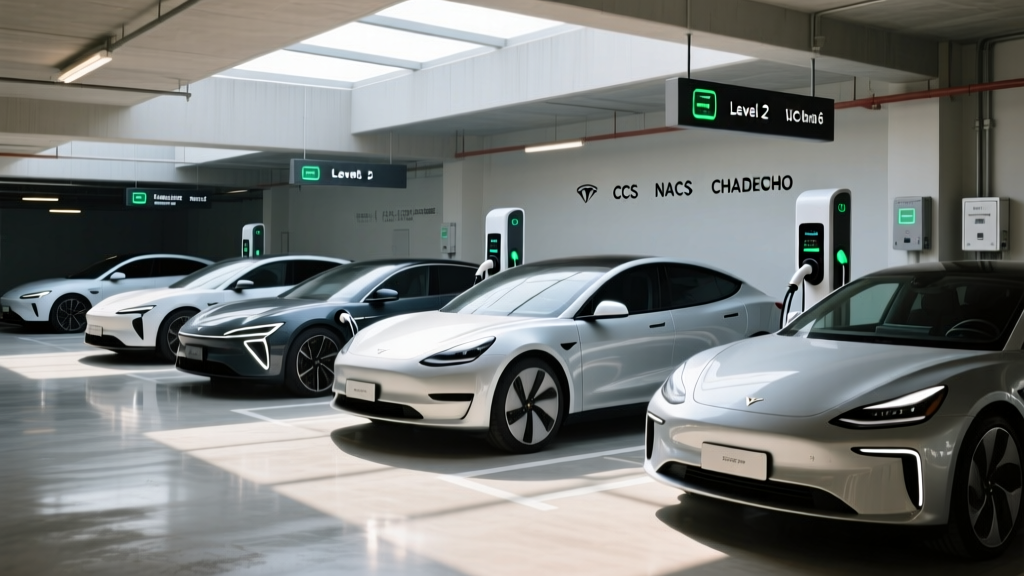
The North American EV market has consolidated around the North American Charging Standard (NACS), originally developed by Tesla, but many vehicles on the road in 2026 still use the CCS1 (Combined Charging System) connector. Here's what you need to know:
| Connector | Brands Using It (2026 Models) | Portable Charger Availability | Adapter Needed? |
|---|---|---|---|
| NACS (Tesla) | Tesla (all), Ford, GM, Rivian, Hyundai/Kia (2025+), Volvo, Polestar | Widely available from Tesla, Lectron, Emporia | No for NACS vehicles; CCS vehicles need NACS-to-CCS adapter (~$150–$250) |
| CCS1 | VW, BMW, older Ford/GM/Hyundai/Kia (pre-2025), Stellantis | Available from ChargePoint, Emporia, JuiceBox | No for CCS vehicles; NACS vehicles need CCS-to-NACS adapter |
| CHAdeMO | Nissan Leaf (legacy only, discontinued) | Limited portable options | No direct adapter to NACS/CCS for Level 2; DC-only standard |
If you're buying a portable EV charging station in 2026, choose a NACS-native unit if your vehicle has a NACS port (which now includes most new models from Ford, GM, Hyundai, Kia, and Rivian). If you drive a CCS-equipped vehicle, buy a CCS-native charger or purchase the manufacturer-approved adapter. Tesla's Mobile Connector ships with NACS and includes a J1772 adapter for Level 2 use on older non-Tesla infrastructure.
Cost to Charge: Per-Mile Economics vs. Gasoline
The financial case for EV charging depends heavily on where you charge. A portable EV charging station used at home on off-peak electricity rates delivers the lowest cost per mile. Here's a breakdown using 2026 average rates:
| Charging Scenario | Cost per kWh | Cost per Mile (at 3.2 mi/kWh) | Equivalent Gas Price (at 30 MPG) |
|---|---|---|---|
| Home Level 2 — Off-Peak (utility time-of-use) | $0.08–$0.12 | $0.025–$0.038 | $0.75–$1.14/gal |
| Home Level 2 — Standard Residential Rate | $0.13–$0.18 | $0.041–$0.056 | $1.23–$1.68/gal |
| Public Level 2 (ChargePoint, EVgo) | $0.25–$0.49 | $0.078–$0.153 | $2.34–$4.59/gal |
| DC Fast Charging (Electrify America, Tesla Supercharger) | $0.30–$0.55 | $0.094–$0.172 | $2.82–$5.16/gal |
| Gasoline (national avg, early 2026) | — | $0.10–$0.13 (at $3.10/gal, 30 MPG) | $3.10/gal |
Home charging with a portable Level 2 station on off-peak rates costs roughly one-quarter to one-third what gasoline costs per mile. Even standard residential rates beat gasoline. However, exclusive reliance on DC fast charging at $0.45+/kWh can approach or exceed gasoline costs — which is exactly why having a portable home charger matters for long-term ownership economics.
Data from fueleconomy.gov shows that most 2026 EVs achieve between 2.5 and 4.0 miles per kWh, with compact sedans at the higher end and large SUVs/trucks at the lower end.
Top Portable EV Charging Stations for 2026
Tesla Mobile Connector (NACS)
- Power Output: Up to 7.7 kW (32A) on NEMA 14-50; 1.4 kW on 120V
- Connector: NACS (Tesla); J1772 adapter included
- Cable Length: 20 feet
- Smart Features: Basic — no Wi-Fi/app scheduling (use vehicle's built-in scheduling)
- Price: ~$300
- Best For: Tesla owners and NACS-equipped Ford/GM/Rivian owners who want the simplest, lightest option
Emporia Vue Smart EV Charger (Portable Config)
- Power Output: Up to 11.5 kW (48A) on NEMA 14-50; adjustable down to 16A
- Connector: NACS or J1772 (select at purchase)
- Cable Length: 24 feet
- Smart Features: Wi-Fi, app scheduling, energy monitoring, solar integration, load management with Emporia Vue panel monitor
- Price: ~$400–$500
- Best For: Homeowners with solar panels or those wanting detailed energy data and load-balancing on smaller panels
Lectron V-BOX Pro (NACS)
- Power Output: Up to 9.6 kW (40A) on NEMA 14-50
- Connector: NACS
- Cable Length: 20 feet
- Smart Features: LED status display, basic app, no energy monitoring
- Price: ~$350
- Best For: Budget-conscious NACS owners who want a reliable, no-frills portable unit for travel
ChargePoint Home Flex (Portable Mode w/ NEMA 14-50 Plug)
- Power Output: Up to 11.5 kW (48A) — configurable via DIP switches for 16A–48A
- Connector: NACS or J1772 (select at purchase)
- Cable Length: 23 feet
- Smart Features: Wi-Fi, Alexa/Google Home integration, app scheduling, charge history, flexible amperage to match circuit
- Price: ~$550–$650
- Best For: Users who want premium smart features, flexible amperage settings, and a proven brand with strong app support
Safety, Code, and Outdoor Use Considerations
Portable EV chargers are safety-certified to UL or ETL standards, but proper use requires attention to a few details:
- Dedicated circuit: Your 240V outlet should be on a dedicated breaker — not shared with other appliances. The NEC requires this for continuous loads like EV charging.
- GFCI protection: Most 2026 portable chargers include built-in GFCI (Ground Fault Circuit Interrupter) protection. However, NEC 2020 and later also require GFCI at the breaker for receptacles in garages. This can cause nuisance tripping with some chargers — if this happens, have your electrician verify compatibility.
- Outdoor rating: If your outlet is outside or in an open carport, choose a charger rated NEMA 4 (weather-resistant). Most portable units are rated NEMA 3R (rain-resistant) at minimum, but NEMA 4 provides better protection against driven rain and ice.
- Cable management: Never use an extension cord with a portable EV charger. If you need more reach, buy a unit with a longer cable or have an electrician relocate the outlet.
- Inspection: After installation, your local electrical inspector will verify the outlet wiring, breaker sizing, and grounding. This is included in your permit fee and typically takes 15–30 minutes.
Frequently Asked Questions
Can a portable EV charging station replace a wall-mounted charger?
For most EV owners, yes — provided you have a properly wired NEMA 14-50 outlet on a dedicated 50A circuit. A portable unit delivering 9.6 kW will fully charge a 77 kWh battery overnight in roughly 8 hours, which covers the needs of all but the highest-mileage drivers. The main advantage of a wall-mounted hardwired unit is higher amperage (up to 80A / 19.2 kW) and theft resistance, but these matter mainly for vehicles with very large batteries like the GMC Hummer EV or Rivian R1T Max Pack.
Is it safe to plug a portable EV charger into a dryer outlet?
Yes, if the outlet is a grounded NEMA 14-30 or 14-50 type and is in good condition. Avoid ungrounded NEMA 10-30 outlets (common in pre-1996 homes). If you plan to share a dryer outlet, use a smart splitter like the NeoCharge Smart Splitter, which automatically switches power between the dryer and EV charger so you never overload the circuit. Never use a simple physical adapter to convert a 10-30 to a 14-50 — this bypasses safety grounding.
How much does it cost to install a NEMA 14-50 outlet for a portable charger?
If your electrical panel is in or near the garage and has spare capacity, expect $500–$1,200 total (electrician labor, wiring, receptacle, permit). If the panel is far from the garage, requires a conduit run through finished walls, or needs a service upgrade, costs can reach $2,500–$5,000+. Always get at least two quotes from licensed electricians and verify they pull a permit — per the National Electrical Code (NFPA 70), all EV charging circuits must be permitted and inspected.
Will a portable Level 2 charger work at RV parks and campgrounds?
Yes — this is one of the biggest advantages of a portable unit. Most RV parks in the U.S. have NEMA 14-50 outlets at each site (50A RV service). With a portable charger and a 20-foot cable, you can add 25–40 miles of range per hour while parked overnight. Verify the park's electrical system is well-maintained; some older campgrounds have voltage drops under load that can trigger charger fault codes.
Do I qualify for a tax credit on a portable EV charger?
The federal Alternative Fuel Vehicle Refueling Property Credit (IRS Form 8911) covers up to 30% of home charging equipment and installation costs, capped at $1,000. However, as of 2026, this credit is only available to taxpayers in census tracts classified as low-income or non-urban. Check your eligibility at the IRS credit page and consult a tax professional. Some states and utilities also offer rebates — your local electric cooperative or municipal utility is the best source for current programs.
What's the difference between kW and kWh?
kW (kilowatts) measures the rate of power delivery — how fast energy flows into your battery. kWh (kilowatt-hours) measures total energy capacity — how much your battery holds. A portable charger rated at 9.6 kW delivering power for 5 hours adds approximately 48 kWh of energy to your battery (minus ~5% charging losses). This is the same relationship as a garden hose: kW is the water pressure, kWh is the total gallons in your bucket.