Why a Portable EV Charger Station Makes Sense in 2026
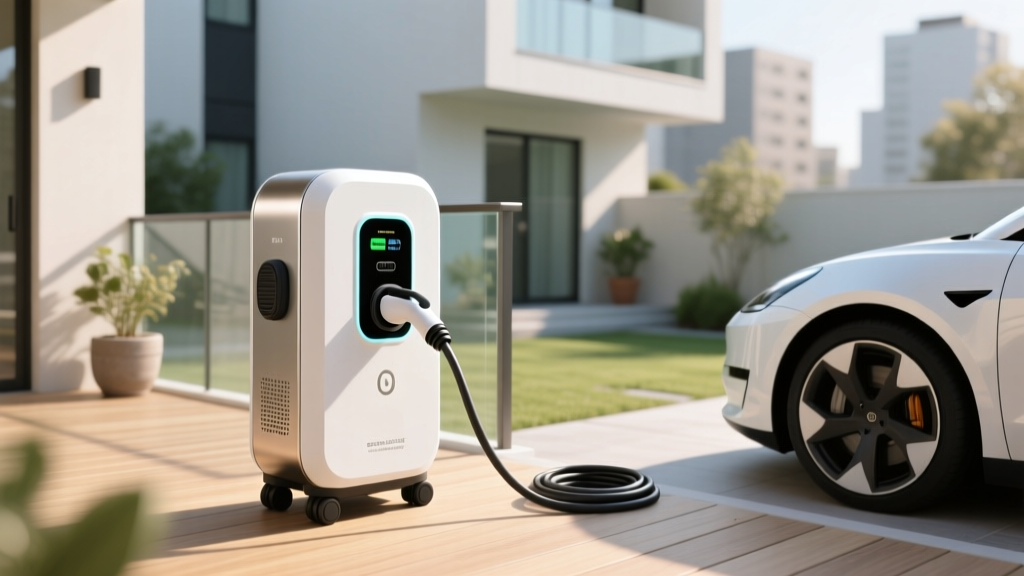
If you rent, move frequently, or simply don't want to commit to a hardwired wall unit, a portable EV charger station gives you Level 2 charging flexibility without permanent installation. These units plug into a 240V outlet (like a dryer receptacle) and deliver anywhere from 16 to 48 amps — adding 12 to 37 miles of range per hour. When you're done, you unplug, coil the cable, and take it with you.
The appeal is practical: you avoid the higher labor cost of hardwiring, retain the charger if you move, and can share one unit between a home outlet and a NEMA 14-50 receptacle at a relative's house or a vacation rental. The trade-off is slightly lower maximum amperage compared to hardwired 60A or 80A units, and the need for a properly installed high-amperage receptacle.
Before picking a unit, you need to understand what each charging level actually delivers, what your home's electrical panel can support, and which connector your vehicle requires. This guide breaks down all of it with exact numbers.
Charging Levels Explained: Speed, Power, and Real-World Range Added
The single most important distinction in EV charging is between kW (kilowatts — the rate of power delivery) and kWh (kilowatt-hours — the total energy stored in your battery). Think of kW as the width of the pipe and kWh as the size of the tank. A 7.7 kW charger fills a 77 kWh battery in roughly 10 hours; a 150 kW DC fast charger can take it from 10% to 80% in about 25 minutes.
| Level | Voltage | Max Power (kW) | Miles of Range Per Hour | Typical Use |
|---|---|---|---|---|
| Level 1 | 120V (standard outlet) | 1.4–1.9 kW | 3–5 mi/hr | Overnight trickle; PHEVs; low-mileage drivers |
| Level 2 (portable plug-in) | 240V (NEMA 14-50) | 7.7–11.5 kW | 25–42 mi/hr | Daily home charging; renters; multi-location use |
| Level 2 (hardwired) | 240V (direct wire) | 11.5–19.2 kW | 37–65 mi/hr | High-capacity homes; large-battery EVs |
| DC Fast Charging | 400–800V DC | 50–350 kW | 150–300+ mi in 20 min | Road trips; commercial fleets; public stations |
For most EV owners driving 30–50 miles daily, a portable Level 2 station delivering 7.7 kW (32A on a NEMA 14-50) replenishes a full day's driving in under two hours. That's the sweet spot for portable units: enough speed to wake up to a full battery every morning without needing a dedicated 60A circuit.
Connector Compatibility: NACS, CCS1, and CHAdeMO
As of the 2026 model year, the North American Charging Standard (NACS) — originally developed by Tesla — has become the dominant connector for new vehicles sold in the US. Ford, GM, Rivian, Volvo, Hyundai, and most other major automakers have adopted NACS on new models. However, millions of vehicles on the road still use the CCS1 (Combined Charging System) connector, and some older Nissan Leafs and Mitsubishi Outlander PHEVs use CHAdeMO.
| Connector | Compatible Brands (New Models) | Legacy Vehicles Still Using | Adapter Availability |
|---|---|---|---|
| NACS (Tesla / SAE J3400) | Tesla, Ford, GM, Rivian, Volvo, Polestar, Hyundai, Kia, BMW, Mercedes | — | CCS-to-NACS adapters widely available ($150–$300) |
| CCS1 | Discontinued on most new 2025+ models | 2019–2024 VW ID.4, Hyundai Ioniq 5, Kia EV6, BMW i4, Audi e-tron, Ford Mustang Mach-E (pre-2025) | NACS-to-CCS adapters available for Tesla Superchargers |
| CHAdeMO | None (discontinued) | Nissan Leaf, Mitsubishi Outlander PHEV | Limited; CHAdeMO infrastructure declining |
When buying a portable EV charger station, match the connector to your vehicle. If you drive a 2025+ Ford F-150 Lightning or a 2026 Hyundai Ioniq 5 (now NACS-equipped), you need a NACS plug. If you own a 2023 VW ID.4, you need CCS1. Many portable chargers are sold in both connector variants, and some third-party units offer swappable connector heads.
Electrical Requirements and Home Installation Costs
A portable Level 2 charger draws significant current from a 240V outlet — typically a NEMA 14-50 (50A circuit, delivering up to 40A continuous to the vehicle) or a NEMA 6-20 (20A circuit, delivering 16A continuous). The National Electrical Code (NEC) requires that continuous loads not exceed 80% of a circuit's rated amperage, so a 50A breaker supports a maximum 40A draw.
Here's what a typical installation looks like:
| Item | Typical Cost Range | Notes |
|---|---|---|
| Portable Level 2 charger (32–40A) | $350–$700 | Varies by brand, cable length, smart features |
| NEMA 14-50 outlet installation | $300–$800 | If panel has capacity and outlet is near panel |
| Electrical panel upgrade (100A → 200A) | $1,500–$3,500 | Required for older homes with insufficient capacity |
| Permit and inspection | $50–$250 | Varies by municipality; some jurisdictions waive for plug-in outlets |
| EVSE mounting bracket / cable organizer | $30–$80 | Optional but recommended for wall-hang of portable unit |
| Total (no panel upgrade) | $730–$1,830 | Most homes built after 2000 with 200A panels |
| Total (with panel upgrade) | $2,230–$5,330 | Older homes or those with high existing electrical loads |
When Will You Need a Panel Upgrade?
Homes with a 100-amp main panel, homes already running multiple high-draw appliances (electric range, dryer, HVAC, water heater), or homes where the desired outlet location is far from the panel (requiring expensive conduit runs) are the most likely candidates for a panel upgrade. A licensed electrician will perform a load calculation per NEC Article 220 to determine if your panel has headroom for a 50A circuit. Don't skip this step — overloading a panel is a fire risk.
The good news specific to portable chargers: some jurisdictions don't require a permit for a plug-in receptacle the way they do for a hardwired EVSE. Check with your local building department. And because the charger itself isn't hardwired, you avoid the $200–$500 in additional labor that hardwiring often entails.
Federal Tax Credit for Home Charging Equipment
The IRS §30D Alternative Fuel Vehicle Refueling Property Credit covers up to 30% of home EV charger equipment and installation costs, capped at $1,000. However, this credit is only available for installations in census tracts classified as low-income or non-urban. Check your eligibility at the IRS credit page and confirm with a tax professional before counting on it.
Real-World Charging Times: How Long to Fill Common EV Batteries
Charging speed isn't linear. Batteries accept power fastest between roughly 10% and 50% State of Charge (SoC), then taper as the battery management system protects cell health. The times below reflect charging from 10% to 80% SoC on a portable Level 2 charger at a NEMA 14-50 outlet (40A / 9.6 kW), which is the most common portable setup.
| Vehicle (2026 Model Year) | Battery (kWh usable) | Energy Needed (10–80%) | Estimated Time |
|---|---|---|---|
| Tesla Model Y Long Range | 78 kWh | ~54.6 kWh | ~5 hours 45 min |
| Hyundai Ioniq 5 (NACS, 84 kWh) | 84 kWh | ~58.8 kWh | ~6 hours 10 min |
| Ford F-150 Lightning Extended Range | 131 kWh | ~91.7 kWh | ~9 hours 35 min |
| Chevrolet Equinox EV 3RS | 85 kWh | ~59.5 kWh | ~6 hours 15 min |
| BMW iX xDrive50 | 105 kWh | ~73.5 kWh | ~7 hours 40 min |
| Toyota RAV4 Prime (PHEV) | 18.1 kWh | ~12.7 kWh | ~1 hour 20 min |
For context, a BEV owner who drives 40 miles per day and plugs in each evening will only need to replenish roughly 12–15 kWh — taking about 90 minutes on a 9.6 kW portable unit. The multi-hour full charges above apply mainly to road-trip recovery or drivers with long commutes. Overnight (8–10 hours) is more than sufficient for virtually any daily driving pattern on Level 2.
Cost to Charge: Home Electricity vs. Gas Per Mile
One of the strongest arguments for home charging is cost. The national average residential electricity rate in early 2026 is approximately $0.17/kWh (EIA data), though rates vary dramatically by state — from around $0.11/kWh in Louisiana and Idaho to over $0.30/kWh in California and Hawaii.
| Scenario | Rate | Vehicle Efficiency | Cost Per Mile |
|---|---|---|---|
| Home charging (national avg.) | $0.17/kWh | 3.5 mi/kWh (286 Wh/mi) | $0.049/mi |
| Home charging (off-peak TOU rate) | $0.09/kWh | 3.5 mi/kWh | $0.026/mi |
| Home charging (California avg.) | $0.31/kWh | 3.5 mi/kWh | $0.089/mi |
| Public Level 2 (network pricing) | $0.35/kWh | 3.5 mi/kWh | $0.10/mi |
| DC Fast Charging (Electrify America) | $0.48/kWh | 3.0 mi/kWh (highway) | $0.16/mi |
| Gas vehicle (30 MPG combined) | $3.30/gal | 30 MPG | $0.11/mi |
| Gas vehicle (22 MPG, truck/SUV) | $3.30/gal | 22 MPG | $0.15/mi |
At the national average, home-charged electricity costs about half what gasoline costs per mile. With time-of-use (TOU) rates — where utilities offer discounted overnight pricing — the savings widen to 75% or more. Even in high-cost California, home charging undercuts gasoline for a 22 MPG vehicle.
The key insight: a portable EV charger station used at home captures nearly all of this savings. Public DC fast charging, by contrast, can cost as much per mile as a fuel-efficient gas car. Home charging is where the economics work best, and a portable unit makes home charging accessible without permanent infrastructure.
Top Portable EV Charger Stations for 2026: Equipment Picks
We evaluated portable chargers on five criteria: power output (kW/amps), cable length, connector options (NACS/CCS), smart features (scheduling, energy tracking), and build quality (NEMA 4 outdoor rating, UL certification). All units below are available with a NEMA 14-50 plug and deliver Level 2 charging.
Emporia Vue Level 2 Portable Charger (40A)
Power: 9.6 kW (40A @ 240V) | Cable: 24 ft | Connector: NACS or CCS1 | Smart features: Wi-Fi, app scheduling, energy monitoring, solar integration | Outdoor rating: NEMA 4 | UL listed: Yes | Price: ~$450
Best for: Solar-panel owners who want to charge from excess generation. The app lets you set charging to solar-only mode, minimizing grid draw. The 24-foot cable is generous for reaching from a garage outlet to a driveway-parked vehicle.
Lectron V-BOX Pro (48A)
Power: 11.5 kW (48A @ 240V) | Cable: 20 ft | Connector: NACS or J1772 (with CCS adapter) | Smart features: LED status display, basic app, no scheduling | Outdoor rating: NEMA 4 | UL listed: Yes | Price: ~$380
Best for: Budget-conscious buyers who want maximum amperage from a NEMA 14-50 outlet. At 48A, this unit pushes the limit of what a 50A circuit allows (80% rule = 40A continuous is safer; confirm your electrician approves 48A on a 60A breaker if used on one). No-frills operation — plug in and charge.
ChargePoint Home Flex Portable (up to 50A, adjustable)
Power: Up to 12 kW (50A, adjustable to 16/24/32/40/48A via dip switch) | Cable: 23 ft | Connector: NACS (2025+ models) or J1772 | Smart features: Wi-Fi, ChargePoint app, Alexa, scheduling, energy reports | Outdoor rating: NEMA 3R | UL listed: Yes | Price: ~$650
Best for: Users who want flexibility across multiple circuit sizes. The adjustable amperage means you can use the same unit on a 20A, 30A, 40A, 50A, or 60A circuit simply by changing an internal setting — ideal if you travel between locations with different outlet capacities. ChargePoint's network integration also provides detailed charging history.
Grizzl-E Smart Portable (40A)
Power: 9.6 kW (40A @ 240V) | Cable: 24 ft | Connector: NACS or J1772 | Smart features: Wi-Fi, OCPP-compatible, app scheduling | Outdoor rating: NEMA 4 (IP67) | UL listed: Yes | Price: ~$500
Best for: Harsh climates. Built in Canada, the Grizzl-E is rated to -40°F and carries one of the best outdoor ratings in the category. OCPP compatibility means it can integrate with utility demand-response programs for potential off-peak discounts.
Safety, Code Compliance, and Outdoor Use
Portable does not mean casual. A NEMA 14-50 outlet delivering 40A continuous for hours generates significant heat at the plug and receptacle. Follow these non-negotiable safety practices:
- Dedicated circuit: Your 14-50 outlet must be on a dedicated breaker — not shared with a dryer, range, or any other appliance. Shared circuits risk tripping breakers or overheating wiring.
- Industrial-grade receptacle: Use a high-quality NEMA 14-50 receptacle rated for EV use (brands like Hubbell or Bryant are preferred over builder-grade units). Cheap receptacles have been linked to melting under sustained EV charging loads.
- GFCI protection: NEC 2020 and later requires GFCI protection on 14-50 receptacles installed in garages. This adds roughly $40–$80 to the installation but is a critical safety feature.
- Outdoor rating: If your outlet is outside, ensure both the receptacle cover (in-use / bubble cover) and the charger unit carry at least a NEMA 3R rating. NEMA 4 or IP67 is better for rain and dust.
- Cable management: Never let the charging cable rest on the ground where vehicles can run over it. Use a wall-mounted cable organizer or holster.
- No extension cords: Never use an extension cord between the outlet and the charger. If the cable doesn't reach, have an electrician relocate the outlet.
Always hire a licensed electrician for the outlet installation and pull a permit where required. A $50 permit fee is cheap insurance against improper wiring that could cause a fire or void your homeowner's insurance.
Portable vs. Hardwired: Which Should You Choose?
Choose a portable EV charger station if:
- You rent your home or expect to move within 3–5 years
- You want to use the same charger at multiple locations (home, family, vacation)
- Your panel supports a 50A circuit but you want to avoid hardwiring labor costs
- You drive under 60 miles daily and a 9.6 kW charge rate is sufficient
- You value the ability to take the charger with you if you sell the home
Choose a hardwired wall charger if:
- You own your home long-term and want maximum charge speed (11.5–19.2 kW on a 60A–80A circuit)
- You drive a large-battery vehicle (F-150 Lightning, Rivian R1T, Hummer EV) and want to minimize overnight charge time
- You want a clean, permanent wall-mounted look with no plug to manage
- Your utility offers demand-response programs that require hardwired, networked EVSE
Frequently Asked Questions
How much does it cost to install a home EV charger?
For a portable Level 2 charger setup, expect $730–$1,830 total if your electrical panel has sufficient capacity (including the charger unit, NEMA 14-50 outlet installation, and permit). If your home needs a panel upgrade from 100A to 200A, add $1,500–$3,500, bringing the total to $2,230–$5,330. The portable charger itself typically costs $350–$700, and the outlet installation runs $300–$800 in straightforward scenarios.
How fast will each charging level add range?
Level 1 (120V) adds 3–5 miles per hour — fine for plug-in hybrids with small batteries. Level 2 on a NEMA 14-50 (9.6 kW) adds 25–37 miles per hour depending on vehicle efficiency. DC fast charging adds 150–300+ miles in a 20-minute session but is not available for home use and costs significantly more per kWh.
Which connector is compatible with my EV?
If you drive a 2025 or newer Tesla, Ford, GM, Rivian, Volvo, Hyundai, or Kia EV, you almost certainly have a NACS port. If your EV is a 2024 or older model from VW, BMW, Audi, or pre-2025 Hyundai/Kia, you likely have CCS1. Check your owner's manual or the port on your vehicle — NACS is smaller and has no locking pins; CCS1 is larger with two DC pins below. CHAdeMO is found only on older Nissan Leafs and is increasingly unsupported.
How much does charging cost per mile vs. gas?
At the national average electricity rate of $0.17/kWh and a typical EV efficiency of 3.5 miles per kWh, home charging costs about $0.049 per mile. A comparable gas vehicle at 25 MPG and $3.30/gallon costs $0.132 per mile — roughly 2.7x more. With off-peak TOU rates, home EV charging drops to $0.026/mile or less.
What electrical upgrades might I need?
The most common upgrade is a panel increase from 100A to 200A, required when your existing panel lacks capacity for a 50A circuit. An electrician will calculate your home's total connected load. Other potential upgrades include running a new 240V circuit from the panel to the desired outlet location (especially in homes with finished walls requiring conduit), upgrading the grounding system, or adding a GFCI breaker per NEC requirements.
Can I use a portable EV charger with a standard 120V outlet?
Most portable Level 2 chargers are designed for 240V only. However, some units (like the Lectron Dual Level or Emporia's Level 1/2 combo) include a 120V adapter cord that lets you charge at Level 1 speeds (1.4 kW, ~4 miles/hour) when a 240V outlet isn't available. This is useful for emergencies or occasional top-ups but is not practical for daily BEV charging.
Is a portable charger safe for outdoor use in rain and snow?
Yes, provided the unit carries a NEMA 4 (or higher) or IP65+ rating. The Grizzl-E and Emporia Vue both meet this standard. Ensure the NEMA 14-50 receptacle has an in-use weatherproof cover and that the connection point between the plug and outlet is shielded from direct water exposure. Never charge in standing water or if the outlet shows signs of corrosion.
Sources: fueleconomy.gov (EPA efficiency data), U.S. Energy Information Administration (electricity pricing), IRS.gov (§30D refueling property credit). Pricing and specifications reflect 2026 model-year data and are subject to change. Consult a licensed electrician for installation and a tax professional for credit eligibility.