Why a Portable EV Car Charger Matters in 2026
If you own or are shopping for an electric vehicle, a portable EV car charger is one of the most practical accessories you can buy. Unlike hardwired wall units, a portable charger gives you flexibility: plug into a standard 120V outlet at a relative's house, connect to a 240V dryer or RV outlet on a road trip, or use it as your primary home charging solution without hiring an electrician for a permanent mount. Modern portable units now deliver up to 16 kW on Level 2 — enough to replenish a 75 kWh battery from 10% to 80% in roughly four hours.
But portable chargers vary widely in power output, connector type, cable length, and smart features. This guide breaks down exactly what to look for, how much you'll pay, and what your home's electrical system can support.
Charging Levels Explained: Speeds in kW and Miles Per Hour
Before choosing a portable EV car charger, you need to understand the three charging levels and the critical difference between kW (kilowatts — the rate of power delivery) and kWh (kilowatt-hours — the total energy stored in your battery). Think of kW as how fast water flows from a hose, and kWh as the size of the bucket.
| Level | Voltage | Max Power (kW) | Miles of Range Added Per Hour | Typical Use |
|---|---|---|---|---|
| Level 1 | 120V AC | 1.0–1.4 kW | 3–5 mi/hr | Overnight trickle; PHEVs; emergency backup |
| Level 2 | 240V AC | 3.3–19.2 kW | 12–70 mi/hr | Home charging; workplace; portable chargers |
| DC Fast | 400–800V DC | 50–350 kW | 150–300+ mi in 20 min | Road trips; public stations (not portable) |
Most portable EV car chargers operate at Level 1 or Level 2. Dual-voltage portables are the sweet spot: they come with interchangeable plugs (NEMA 5-15 for 120V, NEMA 14-50 or 6-50 for 240V) so you can charge wherever you find an outlet. DC fast charging is not available in portable form — those require dedicated commercial-grade equipment.
How Fast Will a Portable Charger Add Range?
Charging speed depends on three factors: the charger's power output (kW), your vehicle's onboard charger capacity, and your battery size. Here are real-world charging time examples for common EV battery sizes at typical portable charger outputs:
| Battery Size | 1.4 kW (Level 1) | 7.7 kW (Level 2, 32A) | 11.5 kW (Level 2, 48A) | 16.0 kW (Level 2, 64A) |
|---|---|---|---|---|
| 60 kWh (e.g., base Tesla Model 3 RWD) | ~30 hrs | ~5.5 hrs | ~3.7 hrs | ~2.6 hrs |
| 75 kWh (e.g., Ford Mustang Mach-E Ext. Range) | ~37 hrs | ~6.8 hrs | ~4.6 hrs | ~3.3 hrs |
| 84 kWh (e.g., Hyundai Ioniq 5 Long Range) | ~42 hrs | ~7.6 hrs | ~5.1 hrs | ~3.7 hrs |
| 100 kWh (e.g., GMC Hummer EV, Lucid Air) | ~50 hrs | ~9.1 hrs | ~6.1 hrs | ~4.4 hrs |
Important caveat: Your EV's onboard charger caps the maximum AC charging rate. A Tesla Model 3 can accept up to 11.5 kW on Level 2, so plugging into a 16 kW portable charger won't charge it any faster. Always check your vehicle's onboard charger spec before buying a high-amperage portable unit.
Connector Compatibility: NACS, CCS1, and CHAdeMO
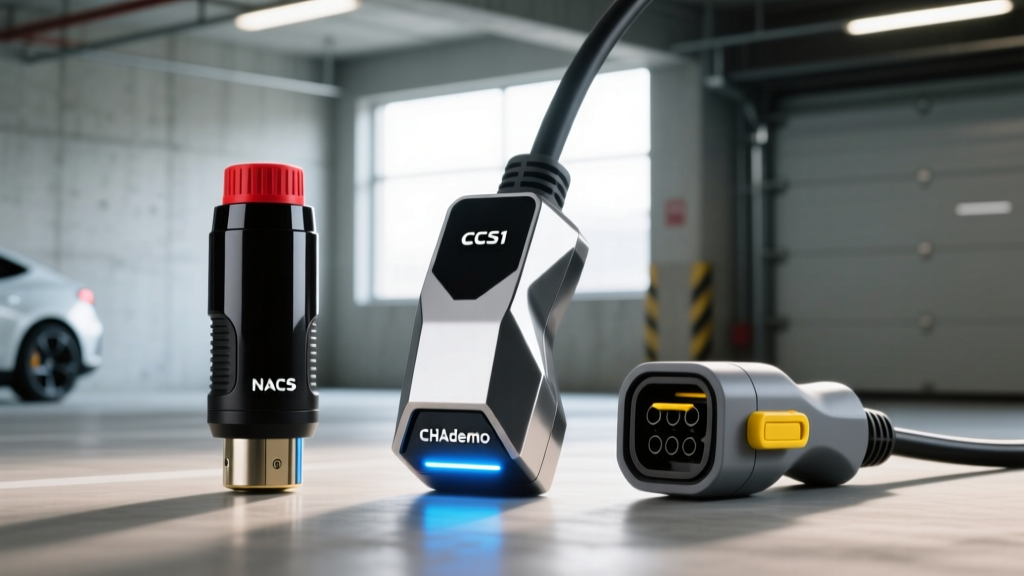
North America has largely standardized on the NACS (North American Charging Standard) connector, originally developed by Tesla. As of the 2025–2026 model years, nearly all major automakers — Ford, GM, Rivian, Volvo, Hyundai, Kia, BMW, and others — have adopted NACS on new vehicles. However, many 2022–2024 EVs still use the CCS1 connector, and older Nissan Leaf models use CHAdeMO.
| Connector | Brands Using It (New Vehicles) | Adapter Availability |
|---|---|---|
| NACS (Tesla-style) | Tesla, Ford, GM, Rivian, Volvo, Polestar, Hyundai, Kia, BMW, Mercedes-Benz (2025+) | N/A — now the standard |
| CCS1 | Legacy 2022–2024 models from most brands; some VW ID.4 (check MY) | CCS1-to-NACS adapters ($150–$250) widely available |
| CHAdeMO | Nissan Leaf (discontinued in US after 2024); Mitsubishi Outlander PHEV (older) | Limited adapters; CHAdeMO infrastructure declining |
When shopping for a portable EV car charger, match the connector to your vehicle. If you drive a 2023 Hyundai Ioniq 5 (CCS1) but plan to upgrade to a 2026 model (NACS), consider a charger with a swappable connector or budget for an adapter. Most portable chargers from ChargePoint, Emporia, and Lectron now ship with NACS as the default.
Home Electrical Requirements and Installation Costs
One of the biggest advantages of a portable EV car charger is that you may not need a permanent installation. If you already have a 240V outlet (like a NEMA 14-50 in a garage or a NEMA 6-50 for a welder), you can simply plug in. But if you need a new outlet installed, here's what's involved.
Electrical Requirements for Level 2 Portable Charging
- 240V dedicated circuit — A Level 2 charger drawing 32A requires a 40A circuit (NEC code requires circuits rated at 125% of continuous load). A 48A charger needs a 60A circuit.
- Panel capacity — Most modern homes have 200A service panels. Adding a 40–60A circuit is usually fine. Older homes with 100A panels may need a panel upgrade ($1,500–$3,000) or a smart load-management device.
- Permit — Most jurisdictions require an electrical permit for new 240V circuits. Your electrician will pull this; cost varies by locality ($50–$300).
- GFCI protection — The 2020 NEC and later require GFCI protection for EV charging circuits in garages. Some portable chargers have built-in GFCI; otherwise your electrician will install a GFCI breaker ($50–$120).
| Component | Typical Cost Range | Notes |
|---|---|---|
| Portable EVSE unit (Level 2, 32–48A) | $300–$700 | Price varies by power output and smart features |
| NEMA 14-50 outlet installation | $250–$800 | Depends on distance from panel; conduit, wire gauge |
| Electrical permit | $50–$300 | Varies by municipality |
| Panel upgrade (if needed) | $1,500–$3,000 | Only for 100A panels or insufficient spare slots |
| GFCI breaker (if not included) | $50–$120 | Required by NEC 2020+ in garages |
| Total (no panel upgrade) | $600–$1,920 | Average: ~$1,100 |
| Total (with panel upgrade) | $2,100–$4,920 | Less common; older homes |
Compare this to a hardwired wall connector installation, which typically runs $800–$2,500 for the electrician work alone. A portable charger with a NEMA 14-50 plug is often the most cost-effective path to Level 2 home charging — and you can take it with you if you move.
Cost to Charge: Per-Mile Cost vs. Gasoline
The economics of EV charging depend heavily on where and when you charge. Here are realistic $/kWh scenarios for 2026 and how they translate to cost per mile compared to a gas car averaging 28 MPG at $3.40/gallon:
| Charging Scenario | Avg. $/kWh | Cost Per Mile (at 3.5 mi/kWh) | Savings vs. Gas (per mile) |
|---|---|---|---|
| Home, off-peak (utility time-of-use rate) | $0.09–$0.13 | $0.026–$0.037 | ~$0.08–$0.09/mi |
| Home, standard flat rate (national avg.) | $0.16–$0.18 | $0.046–$0.051 | ~$0.07/mi |
| Public Level 2 (ChargePoint, EVgo L2) | $0.25–$0.40 | $0.071–$0.114 | ~$0.01–$0.05/mi |
| DC Fast Charging (Electrify America, Tesla Supercharger) | $0.35–$0.55 | $0.100–$0.157 | ~$0.00–$0.02/mi (some parity) |
| Gasoline vehicle (28 MPG, $3.40/gal) | — | $0.121 | Baseline |
At home on off-peak rates, a portable Level 2 charger delivers fuel costs roughly 75% lower than gasoline. Even on standard flat rates, you save about 60%. Public DC fast charging, however, can approach gas-car parity on a cost-per-mile basis — which is why home charging with your portable unit is the financial sweet spot.
Equipment Picks: Top Portable EV Car Chargers for 2026
Based on power output, build quality, smart features, and real-world reliability, here are the portable EV car chargers that stand out this year:
Emporia Vue Level 2 Portable (48A)
- Power: 11.5 kW max (48A on 240V)
- Connector: NACS (CCS1 adapter available)
- Cable length: 24 ft
- Smart features: Wi-Fi, Emporia app scheduling, energy monitoring, solar integration
- Price: ~$399
- Best for: Solar-panel owners wanting energy-tracking and off-peak scheduling
ChargePoint Home Flex (up to 50A)
- Power: Up to 12 kW (50A, adjustable via DIP switch)
- Connector: NACS or CCS1 (configurable at purchase)
- Cable length: 23 ft
- Smart features: Wi-Fi, ChargePoint app, Alexa/Google Home, flexible amperage
- Price: ~$549–$599
- Best for: Users who want adjustable amperage to match their circuit capacity
Lectron V-BOX Pro Dual Voltage (40A)
- Power: 9.6 kW on 240V / 1.6 kW on 120V
- Connector: NACS (J1772 adapter included)
- Cable length: 21 ft
- Smart features: LED status display, no Wi-Fi (simpler operation)
- Price: ~$279–$329
- Best for: Budget-conscious buyers and apartment dwellers who alternate between 120V and 240V outlets
Tesla Mobile Connector (32A)
- Power: 7.7 kW on 240V / 1.3 kW on 120V
- Connector: NACS native
- Cable length: 20 ft
- Smart features: Integrates with Tesla app; basic scheduling
- Price: ~$230
- Best for: Tesla owners who want the simplest OEM solution at the lowest price
All four units are UL-listed or ETL-listed, which is critical for safety and insurance compliance. Avoid uncertified units from unknown brands on Amazon — they may lack proper overcurrent protection, GFCI, or thermal cutoffs.
Safety, Code, and Outdoor Considerations
Portable chargers are designed for safe daily use, but proper setup matters:
- Dedicated circuit: Your 240V outlet should be on a dedicated breaker — not shared with other appliances. Running a dryer and EV charger on the same circuit risks tripping the breaker or overheating wiring.
- Outdoor-rated outlets: If you charge outside, the NEMA 14-50 receptacle must be in a weatherproof enclosure with an in-use cover. Look for portable chargers rated NEMA 4 (splash-proof) or IP66 for outdoor use.
- Cable management: Never run a charging cable across a driveway or walkway where it can be driven over or create a trip hazard. Use cable clips or a conduit channel.
- Ventilation: While the charger and vehicle handle thermal management internally, avoid charging in a fully enclosed, unventilated space in extreme heat.
- Extension cords: Do not use extension cords with a portable EV charger unless the manufacturer explicitly approves a specific gauge and length. Most prohibit them entirely due to voltage drop and overheating risk.
For detailed code requirements, refer to NEC Article 625 (Electric Vehicle Charging System Equipment) and consult a licensed electrician for your specific installation.
Frequently Asked Questions
How much does it cost to install a home EV charger?
For a portable Level 2 charger plugged into a new NEMA 14-50 outlet, expect to pay $600–$1,920 total (equipment + electrician + permit) if your electrical panel has sufficient capacity. If you need a panel upgrade from 100A to 200A, add $1,500–$3,000. A portable charger avoids the higher cost of hardwired wall-unit installations.
How fast will each charging level add range?
Level 1 (120V, 1.4 kW) adds roughly 3–5 miles of range per hour — adequate for PHEVs with small batteries but impractical for full BEVs. Level 2 (240V, 7.7–11.5 kW) adds 25–44 miles per hour, replenishing most EVs overnight in 6–8 hours. DC Fast Charging (50–350 kW) can add 150–300+ miles in 20–30 minutes but is only available at public stations.
Which connector/charger is compatible with my EV?
Check your vehicle's charge port. If you have a 2025 or newer Ford, GM, Hyundai, Kia, Rivian, BMW, or Volvo EV, it almost certainly uses NACS. Tesla vehicles have always used NACS. If you have a 2022–2024 non-Tesla EV, it likely uses CCS1 — and you can buy a CCS1-to-NACS adapter for ~$150–$250. The Nissan Leaf uses CHAdeMO, which is being phased out.
How much does charging cost per mile vs. gas?
Charging at home on off-peak rates costs roughly $0.03/mile — about 75% less than a 28 MPG gas car at $3.40/gallon ($0.12/mile). Even on a standard flat rate of $0.17/kWh, home charging costs ~$0.05/mile. Public DC fast charging ($0.35–$0.55/kWh) narrows the gap to near parity with gas, making home charging the clear economic winner.
What electrical upgrades might I need?
Most homes with 200A panels can support a 40A or 60A dedicated circuit for Level 2 charging without a panel upgrade. Homes with 100A service, older wiring (aluminum or knob-and-tube), or panels with no spare breaker slots may need a panel upgrade ($1,500–$3,000) or a smart load-management device that throttles the charger when other appliances are running. A licensed electrician can assess your panel during a site visit — many offer free or low-cost estimates. For guidance on utility rebates that may offset installation costs, check the U.S. Department of Energy's EV charging resources.
Can I use a portable EV car charger as my only charger?
Yes — many EV owners use a portable Level 2 unit as their sole home charger. Plug it into a NEMA 14-50 outlet in your garage each evening, and it delivers the same charging speed as a hardwired wall unit. The trade-off is that you must manually plug and unplug the unit from the wall outlet, and portable units may have slightly shorter cables than wall-mounted options. For daily use, mounting a holster or hook near the outlet keeps the unit organized.
Are portable EV chargers safe to leave plugged in outdoors?
Most quality portable chargers carry a NEMA 4 or IP66 rating, meaning they can withstand rain and dust. However, the 240V wall outlet itself must be in a weatherproof enclosure with an in-use bubble cover. Avoid leaving the charger on the ground where it can be submerged in standing water or damaged by snow plows. In extreme cold (below -20°F / -29°C), cable stiffness increases — some units include cold-weather cable jackets rated to -40°F.