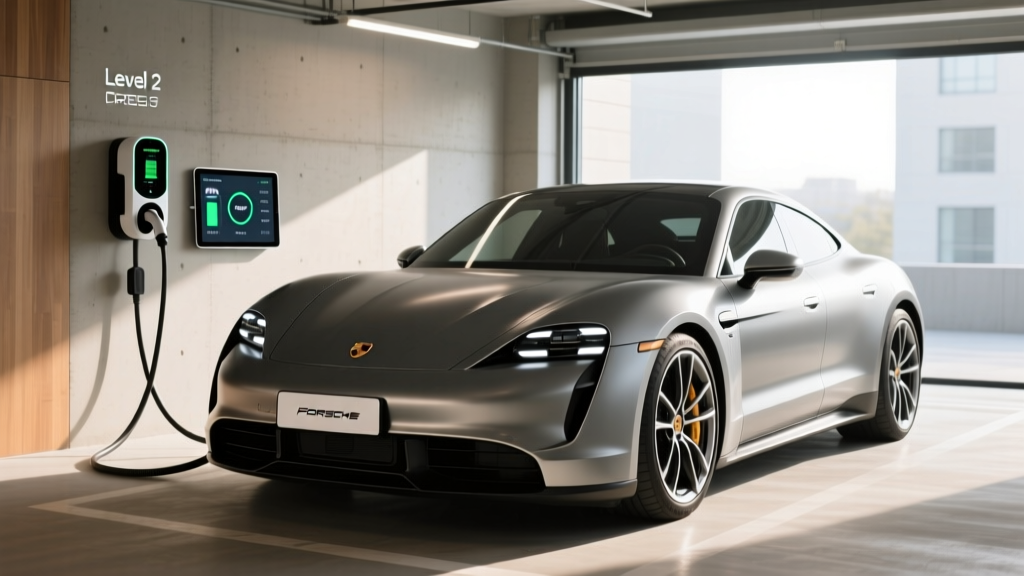
The Porsche Taycan Turbo S is an engineering marvel — 750 horsepower (with Launch Control), a 0-60 mph time of 2.4 seconds, and 800-volt architecture that enables some of the fastest DC fast charging in the industry. But owning a high-performance EV means understanding how to keep its large battery fed efficiently, whether at home or on the road. This guide breaks down everything you need to know about maximizing the Taycan Turbo S's range, selecting the right home charger, and understanding real-world charging costs.
Porsche Taycan Turbo S: Range and Battery Specs at a Glance
Before planning your charging setup, you need to know exactly what you're filling. The 2025/2026 Porsche Taycan Turbo S uses an upgraded battery pack compared to earlier model years, with improved energy density and charging throughput.
| Spec | Value |
|---|---|
| Battery (gross / usable) | 105 kWh / ~97 kWh (NMC chemistry) |
| EPA Range (Turbo S sedan) | 282 miles |
| Real-World Highway Range | ~230–250 miles (70+ mph, mild weather) |
| Real-World Cold-Weather Range | ~190–215 miles (below 32°F) |
| Peak DC Fast Charge Rate | 320 kW (800V architecture) |
| 10–80% DC Fast Charge Time | ~18 minutes (optimal conditions) |
| Max Level 2 AC Charge Rate | 11 kW (onboard charger) |
| MPGe (combined) | 73 MPGe |
| EPA Efficiency | 46 kWh/100 mi |
| 0–60 mph | 2.4 seconds (Launch Control) |
| Horsepower | 750 hp (Overboost) |
| Base MSRP | ~$190,900 |
| Battery Warranty | 8 years / 100,000 miles |
Charging Levels Explained: How Fast Can You Add Range?
Understanding the three charging levels is essential for any Taycan owner. The critical distinction: kW (kilowatts) measures power — how fast energy flows into the battery. kWh (kilowatt-hours) measures energy — the total capacity of the battery. Think of kW as the width of a hose and kWh as the size of the bucket.
| Level | Voltage / Amps | Power (kW) | Miles Added per Hour | 0–100% Time (~97 kWh usable) |
|---|---|---|---|---|
| Level 1 (120V household) | 120V / 12A | ~1.4 kW | ~3 mi/hr | ~69 hours |
| Level 2 (240V home/public) | 240V / 48A | ~11.5 kW | ~25 mi/hr | ~8.5 hours |
| DC Fast Charging | 800V DC | Up to 320 kW peak | ~150+ mi in 10 min | 10–80% in ~18 min |
Level 1 is essentially useless for a 97 kWh battery — it's a trickle charge suitable only for maintaining a parked car or adding a few miles overnight in an emergency. Level 2 is the daily workhorse: plug in at night, wake up to a full battery. DC Fast Charging is for road trips, leveraging the Taycan's 800-volt architecture to charge at rates most 400V EVs cannot match.
The Taycan Turbo S's 320 kW peak charge rate (up from 270 kW in pre-2025 models) is sustained impressively well thanks to Porsche's advanced thermal management. In real-world testing at Electrify America 350 kW stations, the Taycan holds above 250 kW through roughly 40% SoC before tapering. The 10–80% charge takes approximately 18 minutes under optimal conditions — battery preconditioned, ambient temperature 60–80°F. Above 80%, charge speed drops sharply (a phenomenon called the charge curve taper) to protect battery longevity. Expect 80–100% to take an additional 15–20 minutes, which is why road-trip strategy focuses on 10–80% sprints.
Home Charger Installation: Costs, Electrical Requirements, and Gotchas
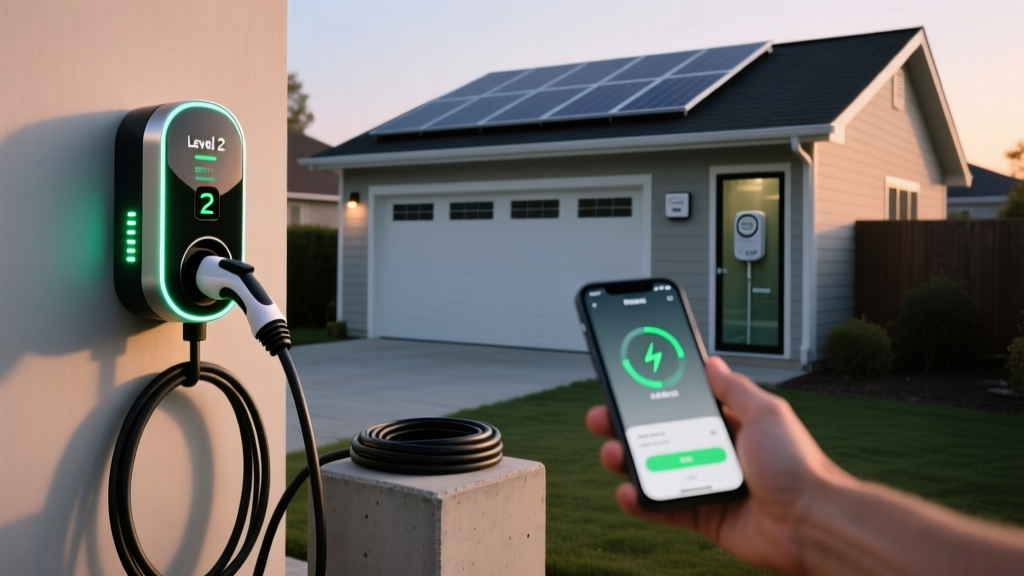
For daily charging, a Level 2 home station is non-negotiable. The Taycan's 11 kW onboard AC charger means you can accept up to 48 amps on a 240V circuit — but your home's electrical panel needs to support it.
Electrical Requirements for a 48A Level 2 Charger
- Circuit: Dedicated 60-amp breaker (NEC requires circuits to be rated 125% above continuous load, so 48A continuous = 60A breaker)
- Voltage: 240V (same as a dryer or oven outlet)
- Wire gauge: 6 AWG copper (or 4 AWG aluminum) for runs up to ~50 feet; thicker wire for longer runs to prevent voltage drop
- Panel capacity: Your main service panel must have spare capacity. A 200-amp panel is typically sufficient; a 100-amp panel in an older home likely requires an upgrade
- GFCI protection: NEC 2020+ requires GFCI protection for EV receptacles in garages — hardwired chargers may be exempt depending on local code
Home Level 2 Charger Installation Cost Breakdown
| Item | Low Estimate | High Estimate | Notes |
|---|---|---|---|
| Level 2 Charger (hardware) | $500 | $1,200 | 48A smart charger (ChargePoint, Wallbox, Porsche) |
| Electrician labor | $500 | $2,000 | Depends on run length, wall type, conduit needs |
| Electrical permit | $50 | $300 | Varies by municipality |
| Panel upgrade (if needed) | $1,500 | $4,000 | 100A → 200A service upgrade; not always required |
| Total (no panel upgrade) | $1,050 | $3,500 | Most homes with 200A panels fall in this range |
| Total (with panel upgrade) | $2,550 | $7,500 | Older homes with 100A or 150A service |
The biggest variable is whether your existing electrical panel has enough spare capacity. An electrician will perform a load calculation — adding up your existing circuits and comparing against your panel's total amperage. If you're already running electric heat, a tankless water heater, and a dryer, a 200A panel may be near capacity even without a 60A EV circuit. In that case, a panel upgrade to 200A or even 320A service (with a sub-panel) becomes necessary. Get at least two quotes from licensed electricians — prices vary significantly by region.
Pro tip: The IRS offers a residential EV charging credit (up to $1,000 for equipment and installation, subject to income and location requirements). Check current-year eligibility with a tax professional.
Connector Compatibility: NACS, CCS, and the Taycan's Charging Port
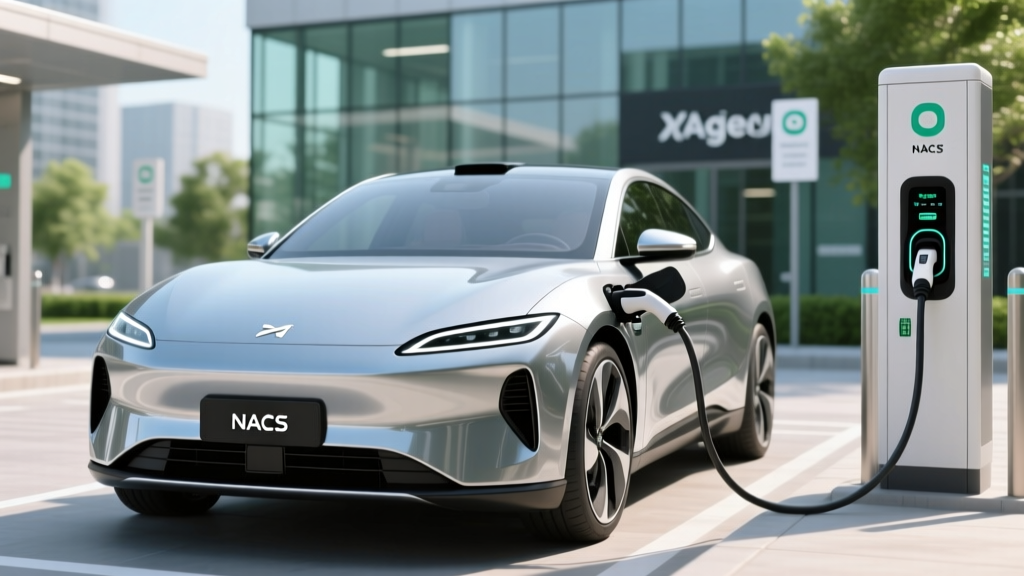
The Porsche Taycan sold in North America uses the CCS1 (Combined Charging System) connector for both Level 2 AC and DC fast charging. However, the EV industry is rapidly shifting toward Tesla's NACS (North American Charging Standard), and this affects your charging options.
| Connector | Type | Taycan Compatibility | Network Access |
|---|---|---|---|
| CCS1 | Native | ✅ Built-in | Electrify America, EVgo, ChargePoint DC |
| NACS (Tesla) | Adapter required | ✅ Via CCS-to-NACS adapter | Tesla Supercharger network (15,000+ stalls) |
| CHAdeMO | Legacy DC | ❌ Not compatible | Nissan Leaf legacy; largely discontinued |
| J1772 | AC Level 2 | ✅ (CCS1 includes J1772) | Public Level 2 stations, home chargers |
As of 2025–2026, Porsche has not switched the Taycan to a native NACS port. However, Porsche provides (or sells) a CCS-to-NACS adapter that unlocks access to Tesla Superchargers — critical for road trips through areas where Electrify America or EVgo coverage is sparse. When using a Supercharger via adapter, expect peak charge rates around 150–200 kW (most Supercharger V3 stalls peak at 250 kW, and the adapter adds slight overhead). This is slower than the Taycan's native 320 kW CCS capability, but the Supercharger network's reliability and geographic density often make it the better road-trip choice.
For home Level 2 charging, any J1772 or NACS-equipped wall charger works. The Taycan's CCS inlet accepts the J1772 portion natively. If you buy a NACS (Tesla Wall Connector) home charger, you'll need the adapter — or simply choose a J1772-terminated charger for convenience.
Recommended Home Chargers for the Taycan Turbo S
The Taycan's 11 kW onboard charger means you want a Level 2 station that can deliver at least 48 amps to maximize overnight charging speed. Here are top picks based on reliability, features, and value:
Porsche Mobile Charger Connect
- Power Output: 9.6 kW (40A) / optional 19.2 kW (with industrial outlet)
- Connector: J1772 (CCS1 compatible)
- Cable Length: 25 feet
- Smart Features: Wi-Fi, Porsche app integration, scheduled charging, solar integration
- Price: ~$1,200 (included with some trims)
- Verdict: Premium integration with the Porsche ecosystem, but 40A doesn't fully saturate the 11 kW onboard charger. The optional industrial plug version is powerful but requires a 100A circuit.
ChargePoint Home Flex
- Power Output: Up to 12 kW (50A) — adjustable via DIP switches
- Connector: J1772 or NACS
- Cable Length: 24 feet
- Smart Features: Wi-Fi, app scheduling, Alexa integration, energy tracking, load sharing
- Price: ~$650
- Verdict: Best overall value. 50A output maxes out the Taycan's AC acceptance. Flexible amperage settings let you match your circuit capacity. Excellent app and reliability track record.
Tesla Wall Connector (Gen 4)
- Power Output: Up to 11.5 kW (48A)
- Connector: NACS (requires CCS-to-NACS adapter for Taycan)
- Cable Length: 24 feet
- Smart Features: Wi-Fi, OTA updates, power sharing between multiple units, integrated cable management
- Price: ~$450
- Verdict: Most affordable quality option, but you'll need the adapter every time you plug in. Best if your household also has a Tesla.
Wallbox Pulsar Plus
- Power Output: Up to 11.5 kW (48A)
- Connector: J1772
- Cable Length: 25 feet
- Smart Features: Wi-Fi + Bluetooth, app control, Eco-Smart mode (solar divert), compact form factor
- Price: ~$550
- Verdict: Compact, well-priced, and solar-integration capable. Great for homes with rooftop solar looking to charge on excess production.
For most Taycan owners, the ChargePoint Home Flex at 50A offers the best combination of output, flexibility, and app experience. If you're deep in the Porsche ecosystem and value brand cohesion, the Porsche Mobile Charger Connect is a solid (if pricier) option.
Charging Cost Per Mile: Taycan Turbo S vs. Gas Performance Cars
One of the biggest ownership advantages of the Taycan Turbo S over its internal-combustion rival — the Porsche 911 Turbo S — is fuel cost. Let's break it down with real numbers.
| Scenario | $/kWh | Cost per 100 Miles | Cost per Mile |
|---|---|---|---|
| Home charging (off-peak utility rate) | $0.13 | $5.98 | $0.06 |
| Home charging (average US rate) | $0.17 | $7.82 | $0.08 |
| Home solar (amortized) | $0.06 | $2.76 | $0.03 |
| Public Level 2 (ChargePoint, etc.) | $0.30 | $13.80 | $0.14 |
| DC Fast Charging (Electrify America) | $0.48 | $22.08 | $0.22 |
| Tesla Supercharger (via adapter) | $0.35 | $16.10 | $0.16 |
Gas comparison: A Porsche 911 Turbo S gets roughly 18 MPG combined on premium fuel. At $4.50/gallon (premium, national average), that's $25.00 per 100 miles, or $0.25 per mile. Even DC fast charging the Taycan is cheaper per mile, and home charging is roughly one-quarter the cost.
Over 15,000 miles per year, a Taycan owner charging primarily at home (off-peak) spends roughly $900/year on electricity. The 911 Turbo S owner spends approximately $3,750/year on premium gas. That's a $2,850 annual savings — or nearly $14,250 over five years — before factoring in the Taycan's lower maintenance costs (no oil changes, less brake wear from regen, no transmission fluid).
Charging Time Examples: What to Expect with the Taycan's 97 kWh Battery
Real-world charging times depend on your starting state of charge, battery temperature, and ambient conditions. Here are realistic scenarios:
- Overnight home charge (10% → 100%, 48A Level 2): ~8.5 hours. Plug in at 10 PM, full by 6:30 AM. The Taycan's preconditioning feature can warm the battery before your scheduled departure time to optimize efficiency.
- Road-trip DC fast charge (10% → 80%, 320 kW station): ~18 minutes. Battery preconditioned via navigation routing to the charger. This adds roughly 190 miles of range.
- Road-trip DC fast charge (10% → 80%, 150 kW Supercharger via adapter): ~30 minutes. Slower due to adapter overhead and Supercharger power limits, but still practical for a rest stop.
- Cold-weather DC fast charge (10% → 80%, 320 kW station, 20°F): ~28–35 minutes. Cold batteries charge slower — the thermal management system uses energy to warm the pack before ramping up charge speed. Always precondition via the Porsche app or navigation before arriving at a charger in cold weather.
- Level 1 emergency top-up (50% → 60%, 120V): ~7 hours for ~30 miles of range. Only use this as a last resort.
Safety, Code, and Best Practices
EV charging involves sustained high-current electrical loads. Cutting corners creates fire risk. Follow these non-negotiables:
- Dedicated circuit: Your Level 2 charger must be on its own dedicated breaker — never share a circuit with other appliances. A 48A charger requires a 60A breaker.
- Hardwired vs. plug: Hardwired installations (no plug) are generally preferred for 48A+ chargers because they eliminate the failure point of a receptacle. If you use a NEMA 14-50 outlet, ensure it's an industrial-grade receptacle rated for daily plug/unplug cycles — residential-grade outlets can overheat over time.
- GFCI protection: The 2020 NEC requires GFCI breakers for EV receptacles in garages. Note: some EV chargers have reported nuisance tripping with GFCI breakers; hardwired installations may avoid this issue (check local code).
- Outdoor rating: If your charger is installed outside (driveway, exterior wall), ensure the unit is rated NEMA 4 (weatherproof). All chargers listed above carry outdoor ratings, but cable management and connector holsters should protect the plug from rain and debris.
- Permit and inspection: Most jurisdictions require a permit and inspection for new 240V circuits. This protects you legally and ensures the work meets code. Skipping permits can void home insurance claims in the event of an electrical fire.
- Cable management: A 25-foot charging cable is heavy and can be a trip hazard. Use a wall-mounted holster or cable retracting system to keep things tidy and safe.
Frequently Asked Questions
How much does it cost to install a home EV charger for the Taycan?
Expect $1,050–$3,500 for a standard installation (48A charger, 240V/60A circuit, no panel upgrade) including equipment, electrician labor, and permit. If your home needs a panel upgrade from 100A to 200A service, add $1,500–$4,000, bringing the total to $2,550–$7,500. Always get a load calculation from a licensed electrician before committing.
How fast will each charging level add range to the Taycan Turbo S?
Level 1 (120V): ~3 miles per hour — essentially useless for a 97 kWh battery. Level 2 (240V, 48A): ~25 miles per hour, filling the battery overnight in about 8.5 hours. DC Fast Charging (320 kW): adds roughly 150+ miles in 10 minutes, with a 10–80% charge in ~18 minutes under optimal conditions.
Which connector does the Porsche Taycan use?
The North American Taycan uses CCS1 natively. For Tesla Supercharger access, you'll need a CCS-to-NACS adapter (available from Porsche or third-party manufacturers). For home Level 2 charging, any J1772-equipped charger works directly — no adapter needed.
Is the Taycan Turbo S's real-world range close to the EPA estimate?
The EPA rates it at 282 miles. In mixed city/suburban driving, many owners report matching or slightly exceeding this figure. On sustained highway driving at 75 mph, expect 230–250 miles. In freezing weather, plan for 190–215 miles. Porsche historically uses conservative EPA testing methodology, so real-world results often exceed the sticker in moderate conditions.
Does the Taycan Turbo S qualify for the federal EV tax credit?
No. The IRS §30D clean vehicle credit has an MSRP cap of $80,000 for sedans. The Taycan Turbo S starts at ~$190,900, making it ineligible regardless of battery sourcing or buyer income. Consult a tax professional for any applicable state or local incentives.
What electrical upgrades might I need for a home charger?
The most common upgrade is a panel capacity increase. If your home has a 100-amp or 150-amp main service panel and is already heavily loaded (electric heat, dryer, oven, AC), you'll likely need a 200-amp upgrade ($1,500–$4,000). Other potential needs: running new conduit from the panel to the garage, upgrading from aluminum to copper wiring for long runs, or installing a sub-panel if your garage is detached. A licensed electrician's load calculation will determine exactly what's required.