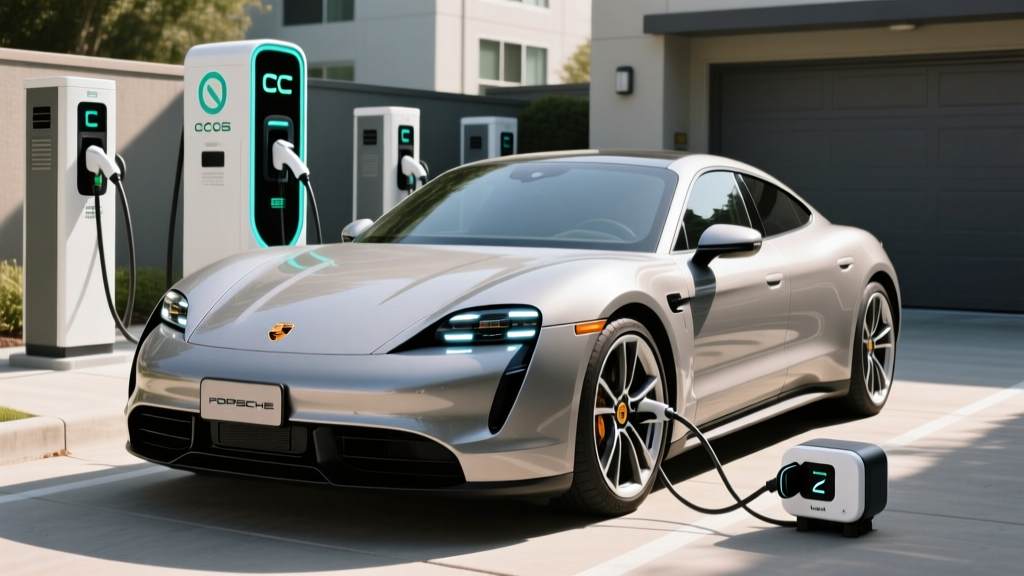
The Porsche Taycan remains one of the most compelling electric performance sedans on the road, but extracting the best Porsche Taycan mile range from its 800-volt architecture depends heavily on how and where you charge. Whether you own a 2025 Taycan with the standard 79.2 kWh battery pack or the upgraded 105 kWh Performance Battery Plus, your charging strategy determines daily usability, road-trip convenience, and long-term battery health.
This guide breaks down every charging tier, the real costs of home installation, connector compatibility for the Taycan's CCS1 port (and the NACS transition underway), and what you will actually pay per mile versus a gas-powered Porsche Panamera.
Porsche Taycan Battery, Range, and Real-World Expectations
Before evaluating chargers, you need the baseline numbers. The 2025 Porsche Taycan lineup offers two battery sizes and multiple body styles, each affecting EPA range.
| Model | Battery (Usable kWh) | Chemistry | EPA Range (mi) | Real-World Highway | Efficiency (MPGe) |
|---|---|---|---|---|---|
| Taycan (RWD, 79.2 kWh) | 71.0 | NMC | 225 | ~190–205 | 83 |
| Taycan 4S (105 kWh) | 97.0 | NMC | 277 | ~235–250 | 85 |
| Taycan Turbo (105 kWh) | 97.0 | NMC | 282 | ~240–255 | 87 |
| Taycan Turbo GT (105 kWh) | 97.0 | NMC | 269 | ~225–240 | 82 |
| Taycan Cross Turismo 4S | 97.0 | NMC | 265 | ~225–240 | 80 |
Charging Levels Explained: Speeds and Range Added Per Hour
Understanding the three charging tiers is essential for any EV owner. A critical distinction: kW (kilowatts) measures power — the rate of energy delivery — while kWh (kilowatt-hours) measures energy — the total capacity of the battery. Think of kW as how fast water flows through a hose, and kWh as the total volume of the tank.
| Level | Voltage / Amperage | Max Power (kW) | Miles of Range Added per Hour | Best Use Case |
|---|---|---|---|---|
| Level 1 (Standard Outlet) | 120V / 12–16A | 1.4–1.9 kW | 3–5 mi/hr | Emergency / overnight trickle for PHEVs |
| Level 2 (Home / Workplace) | 240V / 32–48A | 7.7–11.5 kW | 22–38 mi/hr | Daily home charging, workplace, hotels |
| DC Fast Charging | 400–800V DC | 50–320 kW | 150–600+ mi/hr (peak) | Road trips, rapid top-ups |
The Taycan's 800-volt architecture is its charging superpower. While most EVs use 400V systems, the Taycan can accept up to 320 kW on a compatible DC fast charger, enabling a 10–80% charge in approximately 18 minutes on the 105 kWh pack (22 minutes on the 79.2 kWh pack). However, this peak rate only sustains at low state-of-charge (SoC) and tapers significantly above 50%.
Taycan Charging Time Examples
- Level 1 (1.4 kW): 0–100% on a 97 kWh battery takes approximately 69 hours — impractical for anything beyond maintaining charge while parked for days.
- Level 2 (11.5 kW, 48A): 0–100% in roughly 8.5 hours. A typical 20–80% daily charge takes about 5 hours — perfect for overnight.
- DC Fast (320 kW peak): 10–80% in ~18 minutes (105 kWh) or ~22 minutes (79.2 kWh). Note: speeds drop to ~150 kW above 50% SoC and ~50 kW above 80% due to the charge curve taper.
Home Charger Installation: Electrical Requirements and Cost Breakdown
Installing a Level 2 home charger is the single most impactful upgrade for Taycan ownership. Here is what the project actually involves.
Electrical Requirements
A Level 2 charger for the Taycan requires a 240-volt dedicated circuit. For a 48-amp charger (delivering 11.5 kW), the National Electrical Code (NEC) requires the circuit breaker to be rated at 125% of the continuous load, meaning a 60-amp breaker. The charger draws a maximum of 48 amps continuously.
Key considerations:
- Panel capacity: Most modern homes have 200-amp electrical panels. If your panel is already near capacity (common in older homes with electric heating, A/C, and appliances), you may need a panel upgrade to 300–400 amps — a significant added cost.
- Wire gauge: A 60-amp circuit typically requires 6 AWG copper wire (or 4 AWG aluminum) for runs up to 50 feet. Longer runs may need thicker wire to prevent voltage drop.
- NEMA 14-50 outlet vs. hardwired: A NEMA 14-50 receptacle offers portability (you can unplug and take the charger with you), but a hardwired connection is often more reliable, avoids GFCI nuisance tripping, and may be required by local code for circuits above 40 amps.
Installation Cost Breakdown
| Component | Low Estimate | High Estimate | Notes |
|---|---|---|---|
| Level 2 Charger Equipment | $400 | $750 | 48A smart charger (e.g., ChargePoint Home Flex, Emporia Vue) |
| Electrician Labor | $500 | $2,000 | Depends on panel proximity, wall material, conduit run length |
| Electrical Materials (wire, conduit, breaker) | $150 | $500 | Longer runs and underground conduit increase cost |
| Permit & Inspection | $50 | $300 | Varies by municipality; some jurisdictions waive for EV circuits |
| Panel Upgrade (if needed) | $1,500 | $4,500 | 200A to 300–400A upgrade; not required in most newer homes |
| Total (no panel upgrade) | $1,100 | $3,550 | Typical scenario for homes with adequate panel capacity |
| Total (with panel upgrade) | $2,600 | $8,050 | Older homes or those with high existing electrical load |
Connector Compatibility: CCS1, NACS, and the Taycan
The 2025 Porsche Taycan uses the CCS1 (Combined Charging System) connector for both Level 2 AC and DC fast charging in North America. However, the industry is rapidly transitioning to the NACS (North American Charging Standard) — Tesla's connector — as the universal standard.
| Connector | Used By | Taycan Compatible? | Adapter Needed? |
|---|---|---|---|
| CCS1 | Porsche, VW, Hyundai, Kia, BMW, most legacy EVs | Yes (native) | No |
| NACS (Tesla) | Tesla, Ford, GM, Rivian, Volvo, Polestar (2025+) | Via adapter | Yes — CCS1-to-NACS adapter (~$200–$250) |
| CHAdeMO | Nissan Leaf (legacy); phasing out | No | N/A — not relevant for Taycan owners |
What this means for Taycan owners: You can currently charge at Electrify America, EVgo, and other CCS1-equipped networks natively. As Tesla opens its Supercharger network to non-Tesla EVs, you will need a CCS1-to-NACS adapter to access Tesla stalls. Porsche has indicated that future model years may ship with NACS natively, but for 2025, CCS1 remains the standard. Budget $200–$250 for a quality adapter from a reputable manufacturer like Lectron or A2Z to unlock Supercharger access where available.
Cost to Charge: Per-Mile Comparison vs. Gas
One of the strongest ownership arguments for the Taycan over a comparably performing Panamera is fuel cost. Here is how the numbers break down across charging scenarios.
| Scenario | Rate ($/kWh) | Cost for 10–80% Charge | Cost per Mile (approx.) |
|---|---|---|---|
| Home Off-Peak (utility TOU rate) | $0.08–$0.12 | $5.40–$8.10 | $0.025–$0.04 |
| Home Standard Rate | $0.14–$0.18 | $9.45–$12.15 | $0.04–$0.06 |
| Public Level 2 (ChargePoint, etc.) | $0.25–$0.40 | $16.90–$27.00 | $0.07–$0.11 |
| DC Fast Charging (Electrify America) | $0.35–$0.55 | $23.60–$37.15 | $0.10–$0.15 |
| Tesla Supercharger (via adapter) | $0.25–$0.35 | $16.90–$23.60 | $0.07–$0.10 |
For comparison, a 2025 Porsche Panamera 4S (a gas-powered counterpart) achieves roughly 21 MPG combined and requires premium fuel at approximately $4.50/gallon in most US markets. That works out to roughly $0.21 per mile in fuel cost alone.
Even at the most expensive DC fast-charging rates, the Taycan costs roughly $0.10–$0.15 per mile — still 30–50% less than the Panamera. With home off-peak charging, you are looking at $0.03–$0.04 per mile, an 80% reduction in "fuel" cost. Over 15,000 miles per year, home charging saves approximately $2,400–$2,700 annually compared to premium gasoline.
Recommended Home Charging Equipment for the Taycan
Not all Level 2 chargers are equal. The Taycan's onboard charger accepts up to 11.5 kW (48 amps) on AC, so you want a charger that can deliver the full rate. Here are top picks based on reliability, smart features, and value.
ChargePoint Home Flex
- Power Output: Up to 11.5 kW (48A), configurable down to 16A
- Connector: CCS1 (J1772 + CCS combo)
- Cable Length: 23 feet
- Smart Features: Wi-Fi, app scheduling, utility TOU integration, Alexa
- NEMA 14-50 or Hardwired: Both supported
- Price: ~$550–$650
Best for: Taycan owners who want flexible amperage settings and robust app control.
Emporia Level 2 EV Charger
- Power Output: Up to 11.5 kW (48A)
- Connector: CCS1 (J1772 + CCS combo)
- Cable Length: 24 feet
- Smart Features: Wi-Fi, energy monitoring, solar integration, app scheduling
- NEMA 14-50 or Hardwired: Both supported
- Price: ~$400–$500
Best for: Budget-conscious buyers who want full 48A output and energy tracking without premium pricing.
Porsche Mobile Charger Connect
- Power Output: Up to 9.6 kW (40A)
- Connector: CCS1
- Cable Length: 16 feet (shorter than competitors)
- Smart Features: Porsche-integrated app, timer, remote monitoring
- NEMA 14-50 or Hardwired: Both supported
- Price: ~$750–$900 (often included or discounted with vehicle purchase)
Best for: Owners who want OEM integration and don't mind slightly lower max power output.
Grizzl-E Smart
- Power Output: Up to 9.6 kW (40A)
- Connector: CCS1 (J1772 + CCS combo)
- Cable Length: 24 feet
- Smart Features: Wi-Fi, OCPP protocol, app scheduling
- NEMA 14-50 or Hardwired: Both supported
- Price: ~$450–$550
Best for: Cold-climate owners — built in Canada with extreme temperature ratings (-40°F to 122°F) and a rugged enclosure.
Safety, Code Compliance, and Installation Best Practices
EV charging is a high-draw, continuous electrical load — the equivalent of running an electric oven for 8 hours straight. Safety is not optional.
- Dedicated circuit: Your Level 2 charger must be on its own dedicated breaker. Sharing a circuit with other appliances risks overloading and fire.
- GFCI protection: The 2020 NEC requires GFCI (Ground Fault Circuit Interrupter) protection for outdoor receptacles. However, some EV chargers have built-in GFCI, and stacking two GFCI devices can cause nuisance tripping. Discuss with your electrician whether a hardwired connection (which may not require GFCI in all jurisdictions) is preferable.
- Outdoor rating: If your charger is installed outside (garage exterior, driveway, carport), it must carry a NEMA 4 or IP54+ weather resistance rating. All chargers listed above meet this standard.
- Permit and inspection: Most municipalities require an electrical permit for a new 240V circuit. The inspection ensures the installation meets NEC standards. Skipping the permit may void your homeowner's insurance in the event of an electrical fire.
- Cable management: A 23–24 foot cable is heavy. Consider a wall-mounted cable organizer or retractable reel to prevent tripping hazards and cable damage from being run over.
Public Charging Strategy: Maximizing Taycan Mile Range on the Road
The Taycan's 800V architecture shines at DC fast chargers, but not all public chargers are equal. Here is how to plan effectively.
Preconditioning Is Non-Negotiable
When you set a DC fast charger as your navigation destination in the Taycan, the car automatically preconditions the battery — warming it to the optimal temperature for rapid charging. Without preconditioning, a cold battery may only accept 80–120 kW instead of the 320 kW peak, doubling your charge time. Always navigate to the charger rather than just driving there.
Charging Network Realities
- Electrify America: The most common CCS1 network with 150–350 kW chargers. The Taycan can fully utilize 350 kW stalls. Reliability varies by location — check PlugShare reviews before relying on a specific station.
- Tesla Superchargers (via adapter): Increasingly accessible to non-Tesla EVs at select "Magic Dock" locations. Speeds are typically 150–250 kW — below the Taycan's peak capability, but the network's reliability is unmatched.
- EVgo / ChargePoint DC: Smaller networks with 50–125 kW chargers common in urban areas. Functional but slow for the Taycan's potential — expect 30–45 minutes for 10–80%.
Frequently Asked Questions
How much does it cost to install a home EV charger for the Taycan?
Expect $1,100–$3,550 for a typical installation (48A Level 2 charger, electrician labor, materials, and permit) if your electrical panel has adequate capacity. If a panel upgrade is needed, total costs can reach $2,600–$8,050. Always get a load calculation from a licensed electrician before purchasing equipment.
How fast will each charging level add range to the Taycan?
Level 1 adds 3–5 miles per hour (essentially useless for daily use). Level 2 at 48A adds approximately 30–38 miles per hour — enough to fully replenish a day's driving overnight. DC fast charging at 320 kW can add up to 180 miles in 18 minutes under ideal conditions (10–50% SoC, preconditioned battery).
Which connector is compatible with my Porsche Taycan?
The 2025 Taycan uses CCS1 natively. To access Tesla Superchargers (where opened to non-Tesla EVs), you will need a CCS1-to-NACS adapter, available for approximately $200–$250. CHAdeMO is not compatible and is largely irrelevant for new EVs.
How much does charging cost per mile compared to gas?
Home charging at off-peak rates costs approximately $0.03–$0.04 per mile. Even at public DC fast-charging rates, the Taycan costs $0.10–$0.15 per mile. A comparable gas-powered Porsche Panamera costs roughly $0.21 per mile in premium fuel — making the Taycan 30–80% cheaper to "fuel" depending on your charging habits.
What electrical upgrades might I need for a home charger?
The most common upgrade is a panel capacity increase from 100–150 amps to 200–400 amps, required when your existing electrical load is already near capacity. Other potential upgrades include adding a sub-panel near the garage, running underground conduit for detached garages, or upgrading service entrance wiring. A licensed electrician can determine your needs during a load calculation. Refer to the Department of Energy's home charging guide for additional details.
Does the Porsche Taycan qualify for the federal EV tax credit?
The Taycan is built in Germany and does not currently meet the North American final assembly requirement for the IRS §30D Clean Vehicle Credit. This means it is ineligible for the up-to-$7,500 federal tax credit. However, some state and utility incentives may still apply — check your local programs. Federal credit rules are subject to change; consult a tax professional for current eligibility.