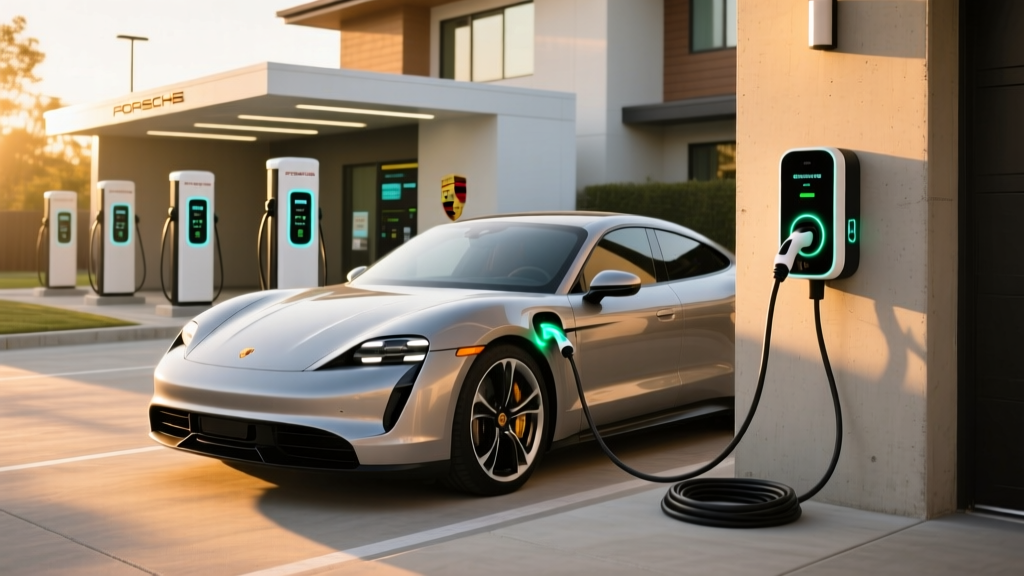
If you own or are considering a Porsche Taycan, charging dynamics are fundamentally different from most other EVs on the road. The Taycan's 800-volt architecture enables DC fast-charging speeds that few competitors can match — but maximizing that advantage requires understanding home electrical requirements, connector compatibility, and the real-world economics of keeping a high-performance EV fueled.
This guide covers every layer of Porsche EV charging for the 2025–2026 Taycan lineup, from the 120V outlet in your garage to the fastest public chargers available. We'll break down exact kW figures, installation costs, and per-mile energy expenses so you can plan with precision.
Porsche Taycan Charging Speeds by Level: What to Expect
EV charging happens at three distinct levels, each defined by voltage and power output measured in kilowatts (kW). Power (kW) determines how fast energy flows into the battery; energy (kWh) is what the battery stores. The 2025–2026 Porsche Taycan comes equipped with a Performance Battery (79.2 kWh usable) or a Performance Battery Plus (97.0 kWh usable), and the charging experience varies dramatically across levels.
| Charging Level | Voltage / Amperage | Max Power (kW) | Miles of Range Added per Hour | Typical Use Case |
|---|---|---|---|---|
| Level 1 (120V) | 120V / 12A | ~1.4 kW | ~3–4 mi/hr | Emergency / overnight trickle only |
| Level 2 (240V) | 240V / 40–48A | 9.6–11.5 kW | ~25–33 mi/hr | Daily home and workplace charging |
| DC Fast Charging | 400–800V DC | Up to 320 kW (2025+ Taycan) | ~170+ mi in ~18 min (10–80%) | Road trips, highway corridors |
Real-world note on DC fast charging: The Taycan's peak charge rate of 320 kW (on 2025+ models with the updated battery) is a maximum, not a sustained average. The charging curve tapers significantly above 80% State of Charge (SoC) to protect battery health. Expect an average rate closer to 200–240 kW across the full 10–80% session, which still delivers one of the fastest fills in the EV market. Earlier 2020–2024 Taycan models peak at 270 kW.
Home Charger Installation: Electrical Requirements and Real Costs
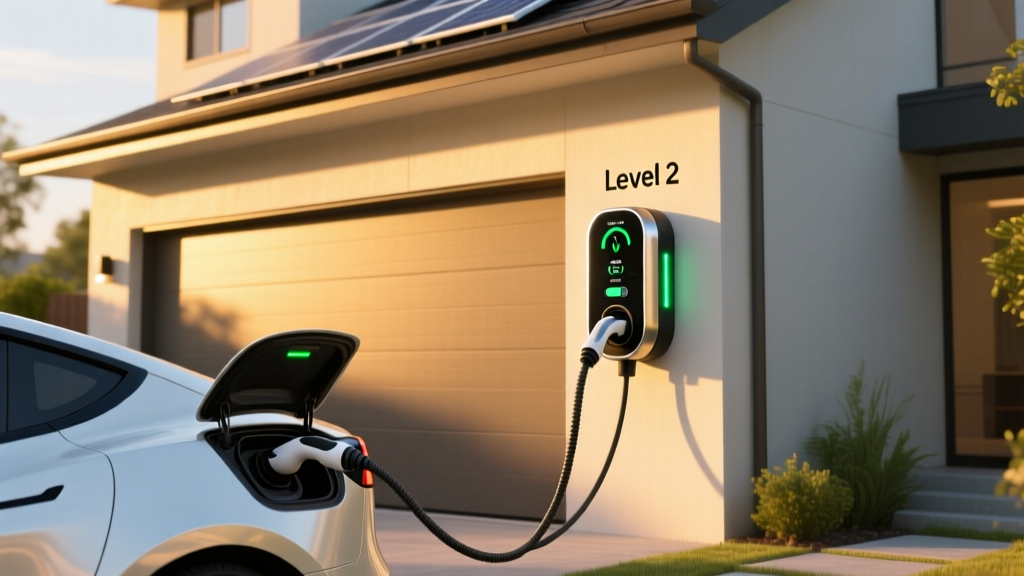
Charging a Taycan at home on Level 2 is where most owners will refuel the majority of their miles. But a proper installation requires a dedicated 240V circuit, and the electrical demands of a Porsche-sized battery mean you'll want a circuit capable of sustained high-amperage output.
Electrical Specifications for Taycan Home Charging
The onboard charger in the 2025–2026 Taycan accepts up to 11 kW (some trims up to 19.2 kW with the optional 22 kW onboard charger). To unlock 11 kW, you need a 240V circuit rated at a minimum of 48 amps (a 60-amp breaker, since the National Electrical Code requires circuits to be rated at 125% of continuous load). For the full 19.2 kW option, you'd need an 80-amp breaker and a 100-amp circuit — something most residential panels cannot support without an upgrade.
Panel upgrade reality: Many homes built before 2000 have 100-amp or 150-amp main service panels. Adding a 60-amp EV circuit to a panel already running electric range, dryer, and HVAC may exceed capacity. A panel upgrade to 200 amps typically costs $1,500–$3,500 depending on your utility and local code. Do not skip this assessment — have a licensed electrician perform a load calculation before committing to equipment.
| Cost Component | Typical Range | Notes |
|---|---|---|
| Level 2 Charger (Equipment) | $400 – $750 | 48A smart charger, 18–25 ft cable |
| Electrician Labor (Standard Install) | $600 – $1,800 | Varies by run length, conduit, wall type |
| Electrical Permit | $50 – $250 | Required by most municipalities |
| Panel Upgrade (If Needed) | $1,500 – $3,500 | 100A → 200A service upgrade |
| Total (No Panel Upgrade) | $1,050 – $2,800 | Most common scenario for newer homes |
| Total (With Panel Upgrade) | $2,550 – $6,300 | Older homes or high-load panels |
Safety and Code Requirements
Any Level 2 installation must comply with NEC Article 625 (Electric Vehicle Charging System Equipment). Key requirements include:
- Dedicated circuit: The EV charger must have its own breaker — no sharing with other appliances.
- GFCI protection: Required for all outdoor receptacles and recommended for indoor garage installations in many jurisdictions.
- Outdoor rating: If your charger is mounted outside or in an unenclosed carport, the unit must carry a NEMA 4 (weatherproof) rating.
- Cable management: NEC requires the charging cable not to cross pedestrian walkways; wall-mounted hooks or retractors are standard practice.
Connector Compatibility: NACS, CCS1, and the Taycan
The connector landscape has shifted dramatically since 2023. Here's where the Porsche Taycan stands as of the 2025–2026 model years:
| Connector Type | Taycan Compatibility | Network Access | Adapter Needed? |
|---|---|---|---|
| CCS1 (Combined Charging System) | Native on 2020–2024 models; still equipped on some 2025 models | Electrify America, EVgo, ChargePoint DC stations | No — built-in port |
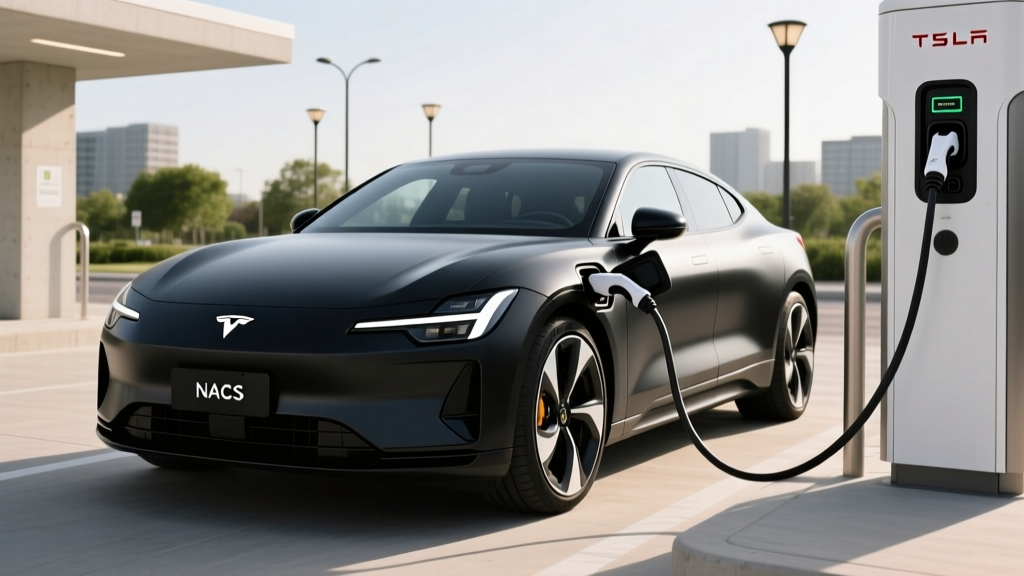
| NACS (North American Charging Standard / Tesla) | Native on 2025+ Taycan models (Porsche transitioned to NACS) | Tesla Supercharger network (17,000+ stalls), plus growing NACS-native networks | No on 2025+; CCS-to-NACS adapter needed for older Taycans at Superchargers |
| CHAdeMO | Not compatible | Largely deprecated in North America | No adapter available |
| J1772 (Level 2 AC) | Compatible via included adapter on NACS-equipped models | Public Level 2 stations, home chargers | NACS-to-J1772 adapter included with 2025+ models |
Critical note for 2020–2024 Taycan owners: Porsche offers an official CCS-to-NACS adapter (approximately $250–$300) that enables access to the Tesla Supercharger network. However, Supercharger stalls deliver power at 400V, meaning your Taycan's 800V architecture advantage is partially negated — expect peak charging around 150 kW via adapter rather than the 270–320 kW possible at Electrify America's 350 kW CCS stations. Third-party adapters are available but verify they carry proper safety certifications before use.
How Much Does Porsche EV Charging Cost Per Mile?
One of the strongest economic arguments for EV ownership is the per-mile fuel cost. The Taycan's efficiency varies by trim, but the 2025 Taycan 4S averages approximately 33–35 kWh per 100 miles (roughly 2.9–3.0 mi/kWh). Let's translate that into dollars.
| Charging Scenario | Cost per kWh | Cost per 100 Miles | Cost per Mile | Equivalent Gas Price (at 25 MPG) |
|---|---|---|---|---|
| Home Off-Peak (Time-of-Use rate) | $0.08 – $0.12 | $2.64 – $4.20 | $0.026 – $0.042 | $0.66 – $1.05/gal |
| Home Standard Rate | $0.13 – $0.18 | $4.29 – $6.30 | $0.043 – $0.063 | $1.07 – $1.58/gal |
| Public Level 2 (ChargePoint, etc.) | $0.20 – $0.35 | $6.60 – $12.25 | $0.066 – $0.123 | $1.65 – $3.06/gal |
| DC Fast Charging (Electrify America / EA Pass) | $0.35 – $0.55 | $11.55 – $19.25 | $0.116 – $0.193 | $2.89 – $4.81/gal |
| Tesla Supercharger (where accessible) | $0.28 – $0.40 | $9.24 – $14.00 | $0.092 – $0.140 | $2.31 – $3.50/gal |
Bottom line: If you charge primarily at home on off-peak rates, your Taycan costs roughly $0.03–$0.04 per mile to "fuel" — equivalent to gasoline at under $1 per gallon. Even regular DC fast charging on road trips generally undercuts premium gasoline (which a Taycan requires) at current pump prices of $3.50–$5.00/gallon.
Recommended Home Charging Equipment for the Taycan
Given the Taycan's large battery (up to 97 kWh usable), you want a Level 2 charger that can deliver sustained high output, smart scheduling for off-peak rates, and a cable long enough to reach from your wall to the charge port (located on the driver's side front fender on the Taycan).
ChargePoint Home Flex
- Power Output: Up to 12 kW (50A) on a 60A circuit; configurable down to 16A for smaller circuits
- Connector: J1772 (use NACS-to-J1772 adapter for 2025+ Taycan) or NACS version available
- Cable Length: 23 feet
- Smart Features: Wi-Fi connected, app-based scheduling, off-peak optimization, energy tracking, Alexa integration
- Price: ~$550–$650
- Best For: Flexibility across amperage levels; ideal if your panel has limited headroom
Wallbox Pulsar Plus (48A)
- Power Output: Up to 11.5 kW (48A) on a 60A circuit
- Connector: J1772 or NACS (select at purchase)
- Cable Length: 25 feet
- Smart Features: Wi-Fi + Bluetooth, load balancing (shares power with other home circuits), Power Sharing for dual-charger setups, app scheduling
- Price: ~$450–$550
- Best For: Tight electrical panels; load-balancing prevents breaker trips on constrained systems
Porsche Mobile Charger Connect (OEM)
- Power Output: Up to 9.6 kW (40A) on a 50A circuit
- Connector: NACS (2025+) or CCS1 depending on model year
- Cable Length: ~16 feet
- Smart Features: Porsche Connect integration, home energy management system (HEMS) compatibility, touchscreen display, remote monitoring
- Price: ~$700–$850 (often included or discounted with vehicle purchase)
- Best For: Owners who want OEM integration and Porsche-specific diagnostics; lower max output is the trade-off
Emporia Vue + Emporia Level 2 Charger
- Power Output: Up to 11.5 kW (48A)
- Connector: J1772 or NACS
- Cable Length: 24 feet
- Smart Features: Whole-home energy monitoring (with Vue panel sensors), solar integration, automatic off-peak scheduling, detailed cost tracking per session
- Price: ~$400 (charger) + ~$250 (Vue monitor)
- Best For: Data-driven owners who want granular energy cost tracking and solar-aware charging
DC Fast Charging: 10–80% Times for the Taycan
The Taycan's 800V architecture is its defining charging advantage. Here's what to expect at public DC fast chargers across common scenarios:
| Model / Battery | Charger Type | Peak kW | 10–80% Time (Approx.) | Notes |
|---|---|---|---|---|
| 2025 Taycan (97 kWh Perf. Battery Plus) | 350 kW CCS (Electrify America) | ~320 kW | ~16–19 minutes | Requires battery preconditioning; 800V station |
| 2025 Taycan (79.2 kWh Perf. Battery) | 350 kW CCS | ~280 kW | ~15–18 minutes | Smaller battery fills faster in absolute time |
| 2024 Taycan 4S (93.4 kWh) | 350 kW CCS | ~270 kW | ~22–25 minutes | Pre-refresh model; slightly slower curve |
| 2025 Taycan (97 kWh) | 150 kW CCS | ~150 kW | ~35–40 minutes | Common at older EA / EVgo stations |
| 2025 Taycan via NACS adapter | Tesla Supercharger V3 (250 kW, 400V) | ~150 kW | ~38–45 minutes | 400V limits Taycan's 800V advantage |
Preconditioning matters: The Taycan's battery management system will warm or cool the battery to optimal temperature before a DC fast-charging session if you navigate to a charger using the built-in navigation. This can improve peak charge rates by 15–30% in cold weather. Always use the nav-directed routing when heading to a fast charger — arriving without preconditioning in winter can cut your charge speed in half.
Public Charging Networks: Where Can You Charge a Porsche?
The Taycan's charging ecosystem depends heavily on your model year and connector:
- Electrify America: The most capable network for CCS-equipped Taycans (2020–2024). EA's 350 kW stalls are among the few that deliver the full 800V experience. Porsche historically included 3 years of complimentary EA charging (30-minute sessions) with new Taycan purchases — verify current program terms with your dealer.
- Tesla Supercharger Network: Now accessible to NACS-equipped 2025+ Taycans natively, and to CCS Taycans via adapter. The network's reliability and density remain industry-leading, though V3 stalls (250 kW, 400V) won't unlock the Taycan's full speed. V4 Superchargers rolling out in 2025–2026 are expected to support higher voltages.
- EVgo / ChargePoint: Mixed station power (50–350 kW). Check station details in-app before driving to a location — many urban stations cap at 50–62.5 kW, which means a 10–80% session could take 60–90 minutes.
Porsche EV Charging FAQ
How much does it cost to install a home EV charger for a Porsche Taycan?
A standard Level 2 home installation (48A charger, 60A circuit, moderate cable run) typically costs $1,050–$2,800 including equipment, electrician labor, and permits. If your home requires a panel upgrade from 100A to 200A service, add $1,500–$3,500, bringing the total to $2,550–$6,300. Always get a load calculation from a licensed electrician before purchasing equipment.
How fast will each charging level add range to my Taycan?
Level 1 (120V) adds roughly 3–4 miles of range per hour — essentially useless for daily use with a 97 kWh battery. Level 2 (240V, 48A) adds 25–33 miles per hour, fully recharging overnight in 8–10 hours. DC fast charging at a 350 kW station adds approximately 170+ miles in an 18-minute session (10–80% SoC).
Which connector is compatible with my Porsche Taycan?
Model year 2025 and newer Taycans ship with the NACS connector natively. Models from 2020–2024 use CCS1. All Taycans can use J1772 Level 2 stations with the appropriate adapter (included with 2025+ models). For 2020–2024 owners wanting Supercharger access, Porsche offers an official CCS-to-NACS adapter.
How much does charging a Taycan cost per mile compared to gas?
At home off-peak rates ($0.08–$0.12/kWh), the Taycan costs approximately $0.03–$0.04 per mile — equivalent to gasoline at under $1.00/gallon. Even DC fast charging on road trips ($0.35–$0.55/kWh) works out to $0.12–$0.19 per mile, still competitive with premium gasoline at $4.00+/gallon in a vehicle getting 20–25 MPG combined.
What electrical upgrades might I need for a Taycan home charger?
The most common upgrade is a panel capacity increase. If your main service panel is 100A or 150A and already serves heavy loads (electric range, dryer, HVAC), a 60A EV circuit may exceed capacity, requiring a 200A panel upgrade ($1,500–$3,500). Additionally, some municipalities require a whole-home surge protector or a GFCI breaker for EV circuits — budget $100–$300 for these additions. A licensed electrician's load calculation will determine your exact requirements. Consult NECA guidelines and your local building department for jurisdiction-specific rules.
Does the Taycan's 800V architecture matter for home charging?
No. Home Level 2 charging is always AC power converted by the car's onboard charger, which operates at standard voltages regardless of the battery architecture. The 800V system's advantage applies exclusively to DC fast charging, where it enables dramatically higher peak power and faster 10–80% times at compatible public stations.
Can I use a standard 120V outlet to charge my Taycan?
Yes, but it's impractical for anything beyond emergency use. At ~1.4 kW, a full charge from 10% to 100% on a 97 kWh battery would take approximately 60–65 hours. Level 1 is viable only as a trickle top-up if you drive fewer than 30 miles per day and can leave the car plugged in for 10+ hours overnight.
Sources: U.S. Department of Energy / fueleconomy.gov, Porsche USA Taycan Specifications, IRS §30D Clean Vehicle Credits.