Porsche Taycan Charging: The Real Numbers Owners Need
The Porsche Taycan is an engineering showcase — 800-volt architecture, blistering acceleration, and one of the most sophisticated thermal management systems in any production EV. But owning one means understanding exactly how Porsche Taycan charging works across Level 1, Level 2, and DC fast charging, because the Taycan's capabilities far exceed what most home electrical systems and older public chargers can deliver.
This guide breaks down every charging scenario a Taycan owner will encounter: home installation requirements and costs, public charging networks and connector compatibility, real-world charging times for the Performance Battery and Performance Battery Plus packs, and what you'll actually pay per mile compared to a gas-powered Panamera.
A quick note on terminology that trips up many new EV owners: kW (kilowatts) measures power — how fast energy flows into the battery, like water pressure from a hose. kWh (kilowatt-hours) measures energy — the total amount stored, like gallons in a tank. The Taycan's Performance Battery Plus holds roughly 84 kWh of usable energy and can accept up to 320 kW of charging power. These are not interchangeable.
Charging Levels: How Fast Each Adds Range to Your Taycan
The Taycan supports three charging levels, but they differ dramatically in speed and practicality. Here's what each delivers for a Taycan with the larger 84 kWh (usable) Performance Battery Plus pack, which carries an EPA range of up to 283 miles depending on trim and wheel size (per fueleconomy.gov). Real-world highway driving at 70+ mph typically yields 230–260 miles; cold weather can reduce that by 15–25%.
| Charging Level | Power (kW) | Voltage / Amperage | Miles of Range Added per Hour | Best Use Case |
|---|---|---|---|---|
| Level 1 (120V household outlet) | ~1.2–1.4 kW | 120V / 12A | ~3–4 miles/hr | Emergency trickle only |
| Level 2 (240V home or public) | Up to 19.2 kW (Taycan onboard charger) | 240V / 80A | ~52–58 miles/hr | Daily home charging, overnight |
| DC Fast Charging | Up to 320 kW (peak) | 800V DC | ~190+ miles in ~18 min (10–80%) | Road trips, rapid top-ups |
Key takeaway: The Taycan's 800-volt architecture is its charging superpower. While most EVs peak at 400V and taper sharply, the Taycan sustains high charge rates deeper into the session. On a 320 kW charger, expect a 10–80% charge in approximately 18 minutes for the Performance Battery Plus. The smaller 71 kWh (usable) Performance Battery achieves 10–80% in roughly 18 minutes as well, peaking at 270 kW.
Home Charging Setup: Electrical Requirements and Installation Costs
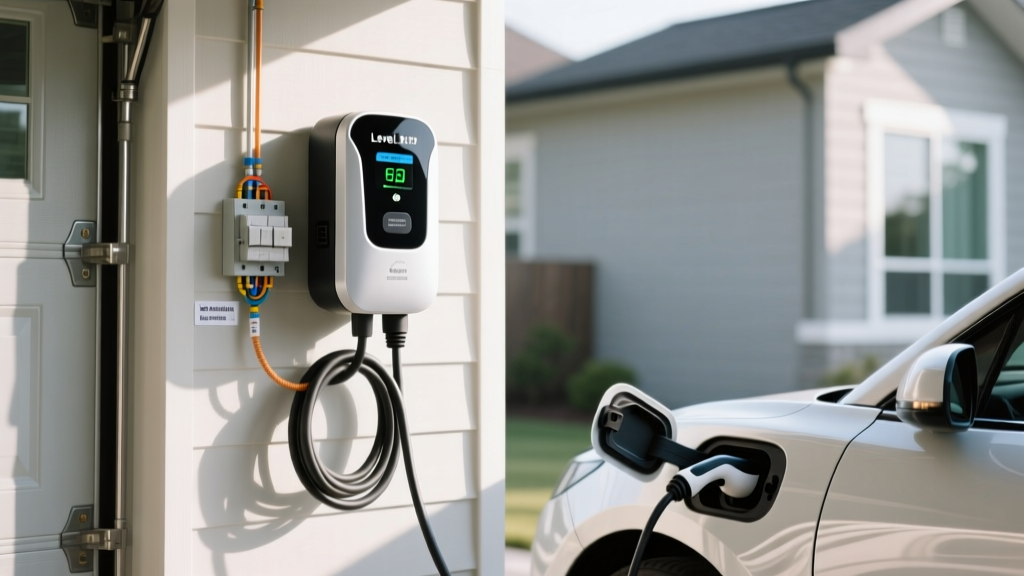
Charging a Taycan at home is where you'll do 85–95% of your charging, and it's also where the biggest upfront investment lies. The Taycan comes with Porsche's Mobile Charger Connect (a portable Level 2 unit), but most owners install a dedicated wall-mounted station for convenience and maximum throughput.
Electrical Requirements for Taycan Home Charging
The Taycan's optional onboard charger supports up to 19.2 kW on Level 2 AC — one of the highest in any production EV. To unlock that speed, you need a 240V circuit rated at 80 amps (a 100A breaker, since NEC code requires circuits to be loaded to no more than 80% of breaker capacity). Most homes don't have this capacity readily available.
Here's what's realistic for common home setups:
- 48A circuit (60A breaker): Delivers up to 11.5 kW — adds roughly 31 miles of range per hour. A full overnight charge (8 hours) restores ~250 miles. This is the most common high-power residential setup.
- 40A circuit (50A breaker): Delivers 9.6 kW — adds roughly 26 miles per hour. Sufficient for most daily driving needs if you charge overnight.
- 32A circuit (40A breaker): Delivers 7.7 kW — adds roughly 21 miles per hour. Common in older homes with 100A service panels.
Panel Upgrade: The Cost Most Buyers Overlook
If your home has a 100A main electrical panel — common in houses built before the 1990s — adding a 48A or higher EV circuit will almost certainly require a panel upgrade to 200A service. This is not optional; it's a code and safety requirement. A panel upgrade alone runs $1,500–$3,500 before you even touch the charger installation.
Homes with existing 200A panels usually have enough headroom for a 48A EV circuit, but a licensed electrician must perform a load calculation to confirm. If you're running central AC, an electric oven, a dryer, and a tankless water heater, available capacity may be tighter than you think.
| Cost Component | Typical Range | Notes |
|---|---|---|
| Level 2 charger hardware (48A–80A) | $500–$1,300 | Porsche Mobile Charger Connect included; wall units cost extra |
| Electrical permit | $50–$300 | Varies by municipality; required for code compliance |
| Electrician labor (new circuit, no panel upgrade) | $800–$2,000 | Depends on run length from panel to garage, drywall work, conduit |
| Panel upgrade (100A → 200A), if needed | $1,500–$3,500 | Major variable; older homes almost always need this |
| Total (no panel upgrade) | $1,350–$3,600 | Most modern homes with 200A service |
| Total (with panel upgrade) | $2,850–$7,100 | Older homes or those near panel capacity |
Permit and inspection are non-negotiable. Unpermitted EV charger installations can void homeowner's insurance claims related to electrical fires and create problems at resale. Your electrician should pull the permit and schedule the inspection as part of the job.
Connector Compatibility: NACS, CCS, and the Taycan's Transition
The Porsche Taycan has historically used the CCS1 (Combined Charging System) connector for DC fast charging in North America, with a J1772 inlet for Level 2 AC charging. However, Porsche announced that beginning with the 2025 model year refresh, the Taycan would transition to the NACS (North American Charging Standard, i.e., Tesla's connector) for new vehicles.
| Connector | Pre-2025 Taycan | 2025+ Taycan (NACS-equipped) | Adapter Needed? |
|---|---|---|---|
| J1772 (Level 2 AC) | Native inlet | NACS inlet (J1772 adapter included or available) | Yes, for 2025+ models at J1772 stations |
| CCS1 (DC fast) | Native inlet | NACS inlet (CCS adapter available) | Yes, for 2025+ models at CCS stations |
| NACS (DC fast + AC) | Not native; adapter needed | Native inlet | Yes, for pre-2025 models at Tesla Superchargers |
For pre-2025 Taycan owners: Porsche and third-party manufacturers offer NACS adapters that allow access to Tesla Supercharger stations (which now open to non-Tesla EVs via adapter). Verify that any adapter supports the Taycan's 800V architecture and rated charge power — cheap adapters can bottleneck your charging speed or fail under high-voltage loads.
For 2025+ Taycan owners: Your native NACS inlet gives you direct access to the Tesla Supercharger network (over 25,000 stalls in North America) plus Electrify America and other networks deploying NACS cables. For legacy CCS stations, a CCS-to-NACS adapter is required.
Public DC Fast Charging: Networks, Speeds, and What to Expect
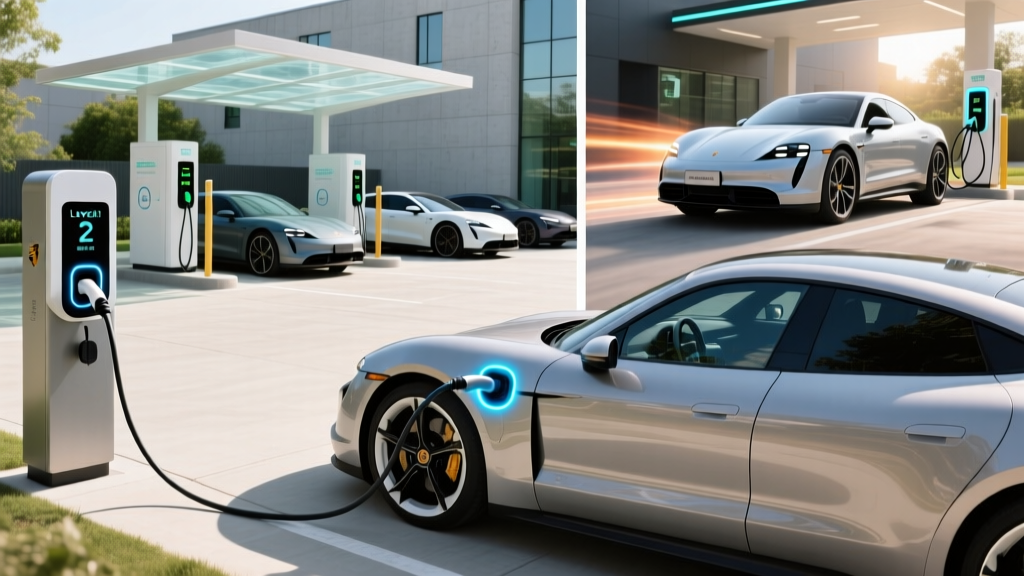
The Taycan's 800V architecture shines on DC fast chargers — but only if the charger can deliver sufficient power. Here's how major networks stack up:
- Electrify America (350 kW stalls): The Taycan can peak near 320 kW on these, achieving 10–80% in ~18 minutes. EA reliability has improved but still varies by station — check the PlugShare or EA app for recent user reports before relying on a specific location.
- Tesla Supercharger V4 (up to 350 kW for NACS vehicles): With the Taycan's NACS adapter (pre-2025) or native inlet (2025+), these deliver excellent speeds. V3 stalls (250 kW) will cap the Taycan slightly below its peak capability but still charge briskly.
- Ionity (Europe, 350 kW): If you're driving a Taycan in Europe, Ionity's CCS2 network is purpose-built for 800V vehicles like the Taycan.
- EVgo / ChargePoint (50–125 kW stalls): These older or lower-power stalls will not unlock the Taycan's full charging potential. Expect 10–80% in 35–55 minutes depending on power level.
Always precondition the battery before arriving at a DC fast charger. The Taycan's navigation system does this automatically when a charger is set as your destination — the thermal management system warms or cools the battery to optimal temperature for maximum charge acceptance. Skipping preconditioning (e.g., driving to a charger without using navigation) can add 5–10 minutes to your session, especially in cold weather.
Cost to Charge: Taycan Electricity Cost vs. Gas Panamera
One of the Taycan's most compelling ownership arguments is fuel cost savings — but only if you charge strategically. Electricity pricing varies enormously by location, time of day, and charging method.
| Scenario | Rate / Price | Cost for 250 Miles (Taycan) | Cost for 250 Miles (Panamera 4, 22 MPG combined) |
|---|---|---|---|
| Home charging (off-peak utility rate) | $0.10/kWh | $8.40 | $42.05 (at $3.70/gal) |
| Home charging (average US residential) | $0.17/kWh | $14.28 | $42.05 |
| Public Level 2 (ChargePoint, EVgo) | $0.30/kWh | $25.20 | $42.05 |
| DC fast charging (Electrify America) | $0.48/kWh | $40.32 | $42.05 |
| DC fast charging (peak pricing, some networks) | $0.60/kWh | $50.40 | $42.05 |
Assumptions: Taycan efficiency of approximately 3.0 miles/kWh (roughly 33 kWh/100mi, per EPA data for the Taycan 4S with Performance Battery Plus). Panamera 4 combined EPA fuel economy of 22 MPG. Gas price of $3.70/gallon (US average, early 2026).
The math is clear: home charging at off-peak rates saves roughly 80% compared to gasoline. Even at average residential rates, you save ~65%. But exclusive reliance on DC fast charging at premium rates can actually exceed the cost of gasoline — a scenario that applies to apartment dwellers without home charging access. This is why home Level 2 installation isn't just a convenience; it's central to the Taycan's economic case.
Recommended Home Chargers for the Porsche Taycan
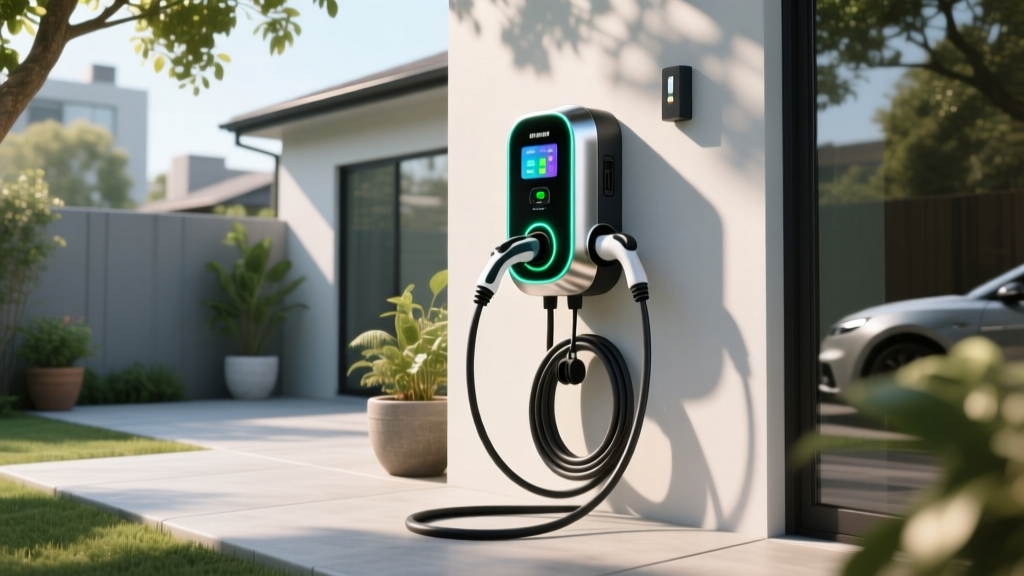
The Taycan's high-power onboard charger (up to 19.2 kW) means you should pair it with a charger that won't bottleneck its capability. Here are purpose-built options:
Porsche Mobile Charger Connect
Power: Up to 9.6 kW (40A) on 240V
Connector: J1772 (pre-2025 Taycan) / NACS (2025+)
Cable length: 25 feet
Smart features: Wi-Fi, Porsche app integration, scheduled charging, energy management
Price: Included with Taycan purchase; replacement ~$900
Verdict: Adequate for overnight charging (~26 miles/hr), but doesn't maximize the Taycan's 19.2 kW onboard capability.
ChargePoint Home Flex (NACS or J1772)
Power: Up to 12 kW (50A) on 240V — configurable from 16A to 50A
Connector: Available in NACS or J1772
Cable length: 23 feet
Smart features: Wi-Fi, app scheduling, Alexa integration, load sharing for dual installations
Price: ~$650 (J1772) / ~$700 (NACS)
Verdict: Best balance of price and performance for most Taycan owners. 50A delivers ~32 miles/hr.
Emporia Level 2 EV Charger
Power: Up to 11.5 kW (48A) on 240V
Connector: J1772 (NACS adapter available)
Cable length: 24 feet
Smart features: Wi-Fi, energy monitoring, solar integration, time-of-use scheduling
Price: ~$400
Verdict: Best value option. 48A is a sweet spot for homes with 200A panels. Energy monitoring helps optimize off-peak charging.
FLO Home X8 (Hardwired)
Power: Up to 19.2 kW (80A) on 240V — hardwired only
Connector: J1772 (25 ft cable)
Cable length: 25 feet
Smart features: Wi-Fi, app control, load balancing, utility demand-response compatible
Price: ~$1,100 + hardwire installation
Verdict: The only residential charger that fully utilizes the Taycan's 19.2 kW onboard charger. Requires 100A breaker and heavy-gauge wiring — expect higher installation costs.
Safety, Code, and Installation Best Practices
EV charging draws sustained high current for hours — more like running an electric furnace than plugging in a phone charger. Here's what keeps it safe and code-compliant:
- Dedicated circuit: Your Level 2 charger must have its own dedicated circuit at the panel — it cannot share with other appliances. A 48A charger needs a 60A breaker; a 32A charger needs a 40A breaker.
- GFCI protection: The 2023 NEC (National Electrical Code) requires GFCI protection for all EV charging outlets (receptacle-based installations). Hardwired installations may be exempt in some jurisdictions. Your electrician will apply the code version adopted in your area.
- Outdoor rating: If your charger is installed outdoors (carport, driveway), it must carry a NEMA 4 or IP65 weather rating. All chargers recommended above meet outdoor standards.
- Wire gauge: A 48A circuit requires 6 AWG copper wire; an 80A circuit requires 2 AWG or larger. Undersized wiring is a fire hazard and will fail inspection.
- Hardwired vs. plug-in: Hardwired installations (no outlet) are preferred for circuits above 48A, as NEMA 14-50 or similar outlets can loosen over time under sustained high-current draw. For 48A and below, a properly installed NEMA 14-50 outlet provides flexibility to take the charger if you move.
Porsche Taycan Charging FAQ
How long does it take to charge a Porsche Taycan from 10% to 80%?
On a 320+ kW DC fast charger with battery preconditioning, the Taycan Performance Battery Plus (84 kWh usable) achieves 10–80% in approximately 18 minutes. On a 150 kW charger, expect 25–30 minutes. On a 50 kW CHAdeMO or CCS charger (increasingly rare), plan for 65–80 minutes.
Can I charge my Taycan on a standard 120V household outlet?
Yes, but it's painfully slow — roughly 3–4 miles of range per hour, meaning a full charge from empty takes over 70 hours. Level 1 is suitable only as an emergency backup or for vehicles driven fewer than 20 miles per day with overnight access.
Does the Taycan qualify for the federal EV tax credit?
Under current IRS §30D rules, the Taycan does not qualify for the $7,500 federal tax credit. The credit has MSRP caps ($55,000 for sedans; the Taycan starts well above $90,000), income limits ($150,000 single / $300,000 joint filer MAGI), and battery critical-mineral sourcing requirements. Always verify current eligibility at irs.gov before relying on incentive projections.
Should I charge my Taycan to 100% every day?
No. Porsche recommends setting a daily charge limit of 85% for routine use to preserve long-term battery health. The Taycan's battery management system includes a substantial buffer (roughly 5–6 kWh below the stated pack capacity is inaccessible to the driver), which provides some protection — but consistently charging to 100% and leaving the car at full state of charge accelerates degradation. Reserve 100% charges for road trips when you need maximum range.
What is the Taycan's battery warranty?
Porsche covers the Taycan's high-voltage battery for 8 years or 100,000 miles, whichever comes first, against defects and capacity loss below 70% of original capacity. This is competitive with most luxury EV manufacturers. The battery uses NMC (nickel manganese cobalt) chemistry, which offers high energy density but benefits from the 85% daily charge limit practice noted above. Full battery replacement costs, if out of warranty, are estimated at $15,000–$25,000+ depending on pack size and labor — a number to factor into long-term ownership planning.
How much does it cost to install a home EV charger for my Taycan?
Expect $1,350–$3,600 for a standard Level 2 installation in a home with an adequate 200A electrical panel. If your home requires a panel upgrade from 100A to 200A, total costs typically range from $2,850–$7,100 including equipment, electrician labor, permits, and the panel work itself. Always get at least two quotes from licensed electricians and verify they have specific EV charger installation experience.