Porsche Taycan Charging Architecture: What Owners Need to Know
The Porsche Taycan's 800-volt architecture remains one of the most capable charging platforms in the EV market. Whether you're taking delivery of a 2026 Taycan or optimizing your existing setup, matching the right charger to this car's potential is the difference between a 22-minute highway stop and a 45-minute wait. This guide covers every charging scenario Taycan owners face — from overnight Level 2 at home to 320 kW DC fast charging on the road — with exact numbers, costs, and equipment recommendations.
Before we get into equipment, a critical distinction: kW (kilowatts) measures charging power — how fast energy flows into the battery. kWh (kilowatt-hours) measures battery capacity — how much energy the battery stores. The Taycan's Performance Battery Plus holds 83.7 kWh usable (93.4 kWh gross, NMC chemistry). A charger rated at 11.5 kW delivers 11.5 kWh of energy per hour into that battery.
- Usable capacity: 83.7 kWh (NMC chemistry)
- Max DC fast charge rate: 320 kW (peak)
- Max AC Level 2 rate: 11.5 kW (onboard charger)
- 10–80% DC fast charge: ~18–22 minutes (preconditioned)
- EPA range: up to 318 miles (Taycan 4S, 2026)
Charging Levels Explained: Speeds in kW and Miles Per Hour
The Taycan accepts three charging levels, but not all are equally useful. Here's how each translates into real range recovery for the Performance Battery Plus configuration.
| Level | Voltage / Amps | Max Power (kW) | Miles of Range Per Hour | Best Use Case |
|---|---|---|---|---|
| Level 1 (120V) | 120V / 12A | 1.4 kW | ~3–4 mi/hr | Emergency / trickle only |
| Level 2 (240V) | 240V / 48A | 11.5 kW | ~28–33 mi/hr | Daily home charging |
| DC Fast (CCS/NACS) | 800V architecture | 320 kW (peak) | ~600+ mi/hr (peak) | Road trips, rapid top-ups |
Real-world context: Level 1 charging on a standard 120V outlet is essentially useless for the Taycan's 83.7 kWh battery — a full charge would take over 60 hours. Level 2 at 11.5 kW fills the battery from empty to full in roughly 7.5 hours, making it ideal for overnight recovery. DC fast charging peaks at 320 kW but sustains that rate only briefly; the charge curve tapers significantly above 80% State of Charge (SoC) to protect the battery. Expect a 10–80% session in 18–22 minutes at a 350 kW Electrify America station when the battery is preconditioned.
Home Level 2 Charger Installation: Electrical Requirements and Costs
The Taycan's 11.5 kW onboard charger means you want a 48-amp Level 2 circuit to extract maximum AC charging speed. This requires a 60-amp dedicated breaker (EV circuits must be derated to 80% continuous load: 60A × 0.8 = 48A usable).
Electrical Specifications
- Circuit: 240V, 60-amp dedicated breaker
- Wire gauge: 6 AWG copper (THHN in conduit or NM-B)
- Connector: NEMA 14-60 outlet (for plug-in chargers) or hardwired
- GFCI protection: Required by NEC 2023/2026 for outdoor receptacles; hardwired units may use the charger's internal GFCI
Panel Upgrade Considerations
Many homes built before 2000 have 100-amp or 150-amp main panels. Adding a 60-amp EV circuit to an already-loaded 100A panel may require a service upgrade to 200 amps. A licensed electrician will perform a load calculation (NEC Article 220) to determine if your panel can handle the additional draw. This is the single largest variable in home charging cost.
| Component | Typical Cost Range | Notes |
|---|---|---|
| Level 2 charger (48A, hardwired) | $500 – $800 | ChargePoint Home Flex, Wallbox Pulsar Plus |
| Electrician labor (standard install) | $800 – $2,000 | Run 6 AWG wire 20–50 ft from panel to garage |
| Electrical permit | $50 – $250 | Varies by municipality |
| Panel upgrade (100A → 200A) | $2,000 – $5,000 | Only if load calculation requires it |
| Total (no panel upgrade) | $1,350 – $3,050 | Most homes with 200A panels |
| Total (with panel upgrade) | $3,350 – $8,050 | Older homes with 100A service |
Federal incentive note: The §30D tax credit applies to new EV purchases, not home charger installation. However, the Alternative Fuel Vehicle Refueling Property Credit (IRS Form 8911) offers up to $1,000 (30% of cost) for qualified home charging equipment installed in eligible census tracts. Check irs.gov for current eligibility rules, as income caps and location requirements apply.
Connector Compatibility: NACS, CCS1, and the Taycan
The 2026 Porsche Taycan sold in North America now ships with the NACS (North American Charging Standard) port, aligning with the industry-wide shift led by Tesla's connector opening. This is a significant change from earlier model years (2020–2024) that used CCS1.
| Model Year | Native Port | DC Fast Network Access | Adapter Needed? |
|---|---|---|---|
| 2020–2024 Taycan | CCS1 | Electrify America, EVgo, ChargePoint | CCS-to-NACS adapter for Tesla Superchargers (~$250) |
| 2025–2026 Taycan | NACS | Tesla Supercharger, EA (via NACS cable) | NACS-to-CCS adapter for older CCS stations (~$200) |
For 2025–2026 Taycan owners, Tesla Supercharger access is native — no adapter required. Electrify America has been rolling out NACS-terminated cables at new stations. For older CCS-only stations, Porsche provides or sells a NACS-to-CCS adapter. Always verify adapter compatibility with your specific charger model before purchasing; not all adapters support the Taycan's full 320 kW peak rate.
Cost to Charge: Home vs. Public vs. Gas Comparison
Charging cost depends on electricity rates, which vary dramatically by location, time of day, and charger type. Here's a realistic breakdown for a Taycan owner driving 12,000 miles per year at an average efficiency of 2.8 miles/kWh (approximately 100 MPGe combined, per fueleconomy.gov).
| Scenario | Rate ($/kWh) | Cost for 10–80% (58.6 kWh) | Cost Per Mile |
|---|---|---|---|
| Home off-peak (utility TOU rate) | $0.08 – $0.14 | $4.69 – $8.20 | $0.03 – $0.05 |
| Home standard rate (national avg.) | $0.16 – $0.22 | $9.38 – $12.89 | $0.06 – $0.08 |
| Public Level 2 (ChargePoint, EVgo) | $0.25 – $0.49 | $14.65 – $28.71 | $0.09 – $0.17 |
| DC Fast (Electrify America, EA Pass+) | $0.36 – $0.56 | $21.10 – $32.82 | $0.13 – $0.20 |
| Tesla Supercharger (V4, NACS) | $0.28 – $0.42 | $16.41 – $24.61 | $0.10 – $0.15 |
Gas comparison: A comparable Porsche Panamera (gasoline, 21 MPG combined) burning premium fuel at $4.50/gallon costs roughly $0.21 per mile. Even at public DC fast charging rates, the Taycan undercuts gasoline on a per-mile basis. Home off-peak charging delivers 4–7× lower fuel cost per mile.
Best Home Chargers for the Porsche Taycan: Equipment Picks
These chargers support the Taycan's full 11.5 kW / 48A AC charging capability and are compatible with NACS (2025–2026 models) or CCS1 (2020–2024 models with appropriate cable or adapter).
ChargePoint Home Flex (NACS)
- Power output: Up to 11.5 kW (48A) on 60A circuit; adjustable down to 16A
- Connector: NACS (also available in J1772 with adapter)
- Cable length: 23 feet
- Smart features: Wi-Fi, app scheduling, Alexa, utility TOU integration, energy tracking
- Installation: Hardwired (recommended) or NEMA 14-50 plug
- Price: ~$649 (NACS version)
Best for: Most Taycan owners wanting reliable smart scheduling and utility rate optimization.
Wallbox Pulsar Plus (48A)
- Power output: Up to 11.5 kW (48A)
- Connector: J1772 (NACS adapter included with 2025+ models)
- Cable length: 25 feet
- Smart features: Wi-Fi + Bluetooth, Power Sharing (two chargers on one circuit), app control, solar integration
- Installation: Hardwired only
- Price: ~$599
Best for: Garages with two EVs sharing a single 60A circuit via Power Sharing.
Tesla Wall Connector (NACS native)
- Power output: Up to 11.5 kW (48A)
- Connector: NACS native — no adapter for 2025–2026 Taycan
- Cable length: 24 feet
- Smart features: Wi-Fi, OTA firmware updates, load sharing (up to 6 units), access control
- Installation: Hardwired
- Price: ~$475
Best for: 2025–2026 Taycan owners wanting the lowest-cost NACS-native option with proven reliability.
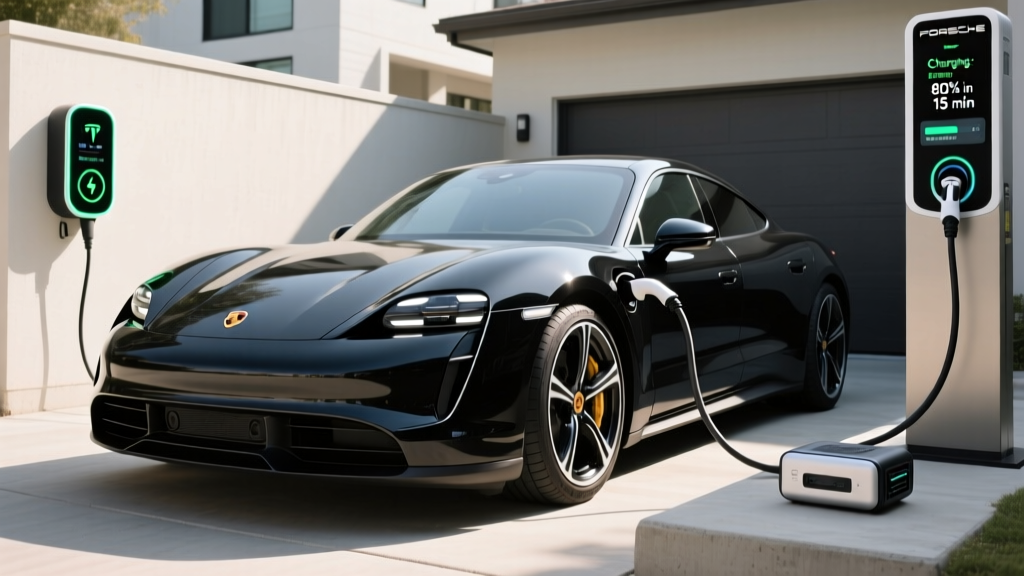
Important: The Porsche Mobile Charger Connect (included with the Taycan) is a portable Level 2 unit rated at 9.6 kW / 40A. It works on a NEMA 14-50 outlet but won't reach the Taycan's full 11.5 kW AC potential. A dedicated wall unit like those above extracts 20% faster AC charging.
Safety, Electrical Code, and Installation Best Practices
The National Electrical Code (NEC) sets the baseline for safe EV charger installation. Key requirements that apply to every Taycan home charger setup:
- Dedicated circuit: The 60A breaker must serve only the EV charger — no shared loads. This prevents breaker trips from simultaneous appliance use.
- GFCI protection: NEC 625.54 requires GFCI protection for all 125V and 250V receptacles used for EV charging in residential garages and outdoor locations. Hardwired chargers with internal GFCI may satisfy this requirement — confirm with your local inspector.
- Outdoor rating: If your charger is mounted outside or in an unenclosed carport, it must carry a NEMA 4 (weather-resistant) or IP65+ rating. All three chargers above meet this standard.
- Wire sizing: 6 AWG copper for 48A continuous load on a 60A breaker. Do not undersize wire — this is a fire hazard and will fail inspection.
- Permit and inspection: Virtually all jurisdictions require an electrical permit for new 240V circuits. The inspection ensures code compliance and protects your home insurance coverage. Never skip this step.
- Cable management: Use a wall-mounted holster and cable organizer to prevent tripping hazards and cable damage. The Taycan's charge port is on the driver-side front fender (left side in LHD markets) — plan your charger placement accordingly.
Public DC Fast Charging: Maximizing the Taycan's 800V Advantage
The Taycan's 800-volt battery architecture allows it to accept charge rates that 400V EVs (most competitors) cannot. At a 350 kW Electrify America station, the Taycan peaks near 270–320 kW depending on SoC and battery temperature. At a 150 kW station, it's limited to that station's maximum regardless of the car's capability.
Preconditioning is non-negotiable. When you navigate to a DC fast charger using the Taycan's built-in navigation, the thermal management system warms the battery to optimal temperature (roughly 35°C / 95°F). Without preconditioning — for example, if you drive to a charger without routing through nav — peak charge rates can drop by 30–50%, especially in cold weather (below 40°F).
Real-world DC fast charging session (350 kW EA station, preconditioned):
- 10–40% SoC: ~8 minutes (sustaining 250–320 kW)
- 40–80% SoC: ~12 minutes (tapering from 180 kW to 100 kW)
- Total 10–80%: ~20 minutes, adding approximately 190 miles of range
For road trips, plan stops at 350 kW stations to leverage the full 800V architecture. The Taycan gains roughly 60 miles of range in just 5 minutes under ideal conditions — competitive with the fastest-charging EVs available in 2026.
Frequently Asked Questions
How much does it cost to install a home EV charger for the Porsche Taycan?
A standard installation with a 200-amp panel and a 50-foot wire run typically costs $1,350–$3,050 (charger + electrician + permit). If your home has a 100-amp panel that needs upgrading to 200 amps, total cost rises to $3,350–$8,050. Always get a load calculation from a licensed electrician before committing.
How fast will each charging level add range to my Taycan?
Level 1 (120V): roughly 3–4 miles per hour — impractical for daily use. Level 2 (240V, 48A): approximately 28–33 miles per hour, enough to fully replenish overnight. DC Fast (350 kW station): up to 600+ miles per hour at peak, but sessions are measured in minutes, not hours — expect 10–80% in 18–22 minutes.
Which connector and charger is compatible with my Taycan?
2025–2026 Taycan models use the NACS connector natively, giving direct access to Tesla Superchargers and newer Electrify America stations. 2020–2024 models use CCS1 and require a CCS-to-NACS adapter (~$250) for Supercharger access. For home Level 2 charging, the Tesla Wall Connector (NACS) and ChargePoint Home Flex (NACS) are top picks for newer models.
How much does charging cost per mile compared to gasoline?
Home off-peak charging costs $0.03–$0.05 per mile. Public DC fast charging runs $0.13–$0.20 per mile. A comparable gasoline Porsche Panamera at 21 MPG on $4.50/gallon premium costs roughly $0.21 per mile. Even the most expensive public EV charging is competitive with or cheaper than gasoline.
What electrical upgrades might I need for a Taycan home charger?
You need a dedicated 240V/60A circuit with 6 AWG copper wire. If your main electrical panel is 100 amps and already near capacity, a panel upgrade to 200 amps ($2,000–$5,000) may be required. An electrician performs a load calculation per NEC Article 220 to determine this. Homes built after 2005 with 200A panels rarely need upgrades.