The Porsche Taycan 4S pairs sports-car performance with a large 83.7 kWh (usable) Performance Battery Plus, delivering an EPA-estimated 227 miles of range in its 2025/2026 model-year configuration. But owning a Taycan 4S isn't just about the 0-60 time — it's about how efficiently you replenish that battery at home and on the road. This guide covers everything a current or prospective Taycan 4S owner needs to know about charging infrastructure, from Level 2 home installs to DC fast-charging realities and the true cost per mile.
Porsche Taycan 4S Range and Battery Specs at a Glance
Before planning your charging setup, understand what you're filling. The Taycan 4S uses an 800-volt architecture — a significant advantage for DC fast charging — paired with an NMC (nickel-manganese-cobalt) lithium-ion pack.
| Spec | Value |
|---|---|
| EPA Range | 227 miles (Performance Battery Plus, 19" wheels) |
| Real-World Highway Range | ~185–205 miles (70+ mph, mild weather) |
| Real-World Cold-Weather Range | ~155–175 miles (below 32°F) |
| Battery Capacity (Usable) | 83.7 kWh (NMC chemistry) |
| Battery Voltage Architecture | 800V nominal |
| Max DC Fast Charge Rate | 270 kW peak |
| 10–80% DC Fast Charge Time | ~22.5 minutes (optimal conditions) |
| Max Level 2 AC Charge Rate | 19.2 kW (onboard charger) |
| MPGe (Combined) | 82 MPGe |
| Efficiency | 41 kWh/100 miles |
| Connector | CCS1 (NACS adapter available via Porsche) |
| Battery Warranty | 8 years / 100,000 miles (70% capacity retention) |
| Base MSRP (Taycan 4S) | ~$107,300 (before destination) |
Charging Levels Explained: Speeds and Miles Per Hour
Understanding the three charging tiers is essential for Taycan 4S ownership. The key distinction: kW (kilowatts) measures power — the rate of energy flow — while kWh (kilowatt-hours) measures energy — the total capacity of the battery. A higher kW charging rate fills your 83.7 kWh battery faster.
| Level | Voltage | Max Power (kW) | Miles of Range Added Per Hour | Typical Use Case |
|---|---|---|---|---|
| Level 1 | 120V AC | 1.4 kW | ~3–4 miles/hr | Emergency / overnight trickle |
| Level 2 | 240V AC | Up to 19.2 kW (vehicle-limited) | ~46–56 miles/hr at 19.2 kW; ~28–34 miles/hr at 11.5 kW | Home daily charging |
| DC Fast Charging | 800V DC | 270 kW peak | ~600+ miles/hr equivalent (10–80% in ~22.5 min) | Road trips, public stations |
The Taycan 4S's 800V architecture is its charging superpower. While most EVs peak at 400V and taper quickly, the Taycan can sustain high charge rates longer thanks to the higher voltage. At a 350 kW Electrify America or Ionity station, you'll see charge rates above 200 kW for a meaningful portion of the session — not just a brief spike.
Charge Curve Reality
Peak kW is not sustained kW. The Taycan 4S's 270 kW peak occurs roughly between 10–30% state of charge. From 30–60%, expect sustained rates around 175–200 kW. Above 80%, charging slows dramatically to protect battery health — typically dropping below 50 kW. This is why manufacturers quote 10–80% times rather than 0–100%.
How Much Does It Cost to Install a Home EV Charger?
For a Taycan 4S owner, a Level 2 home charger is non-negotiable. Level 1 (120V) adds just 3–4 miles per hour — roughly 35 miles over a 10-hour night. That's insufficient for daily use. A proper 240V Level 2 installation is the standard.
Electrical Requirements for the Taycan 4S
The Taycan 4S has an 19.2 kW onboard AC charger, meaning it can accept up to 80 amps at 240V. However, most home installations use a 48-amp or 60-amp circuit for practical and cost reasons:
- 48A circuit (60A breaker): Delivers 11.5 kW — adds roughly 28–34 miles of range per hour. Full charge from 10% in ~7 hours.
- 64A circuit (80A breaker): Delivers 15.4 kW — adds ~38 miles/hr. Requires heavier gauge wire and a larger breaker.
- 80A circuit (100A breaker): Delivers full 19.2 kW — adds ~46–56 miles/hr. Requires a 200A+ electrical panel and significant wiring.
Most Taycan 4S owners opt for the 48A/60A breaker setup, which fully replenishes the battery overnight and balances cost with performance.
| Component | Cost Range | Notes |
|---|---|---|
| Level 2 Charger (Equipment) | $400–$750 | Smart Wi-Fi-enabled units; Porsche Mobile Charger Connect included with vehicle |
| Electrician Labor | $600–$2,500 | Depends on run length from panel to garage; longer runs = higher cost |
| Electrical Permit | $50–$250 | Required in most jurisdictions; varies by municipality |
| Panel Upgrade (if needed) | $1,500–$4,000 | Older homes with 100A service may need upgrade to 200A |
| Conduit & Wiring Materials | $200–$600 | 6 AWG copper for 48A; 4 AWG or 3 AWG for higher amperage |
| Total (no panel upgrade) | $1,250–$4,100 | Typical for homes with adequate 200A service |
| Total (with panel upgrade) | $2,750–$8,100 | Common in pre-2000 homes with 100A panels |
Which Connector and Charger Is Compatible with the Taycan 4S?
The Porsche Taycan 4S sold in North America uses the CCS1 (Combined Charging System) connector for both Level 2 AC and DC fast charging. However, with Tesla opening its Supercharger network and the industry shifting toward NACS (North American Charging Standard), Porsche now provides or supports a NACS adapter for access to Tesla Superchargers.
| Connector | Used For | Taycan 4S Compatibility |
|---|---|---|
| CCS1 | Level 2 AC & DC Fast Charging | Native — built-in port |
| NACS (Tesla) | Tesla Superchargers (DC) & Tesla Destination Chargers (AC) | Via Porsche-approved NACS adapter (check model year; 2025+ models may include NACS port natively) |
| CHAdeMO | Legacy DC Fast Charging | Not compatible; no adapter available |
| J1772 | Public Level 2 AC Charging | Compatible via CCS1 (J1772 is the AC portion of the CCS1 connector) |
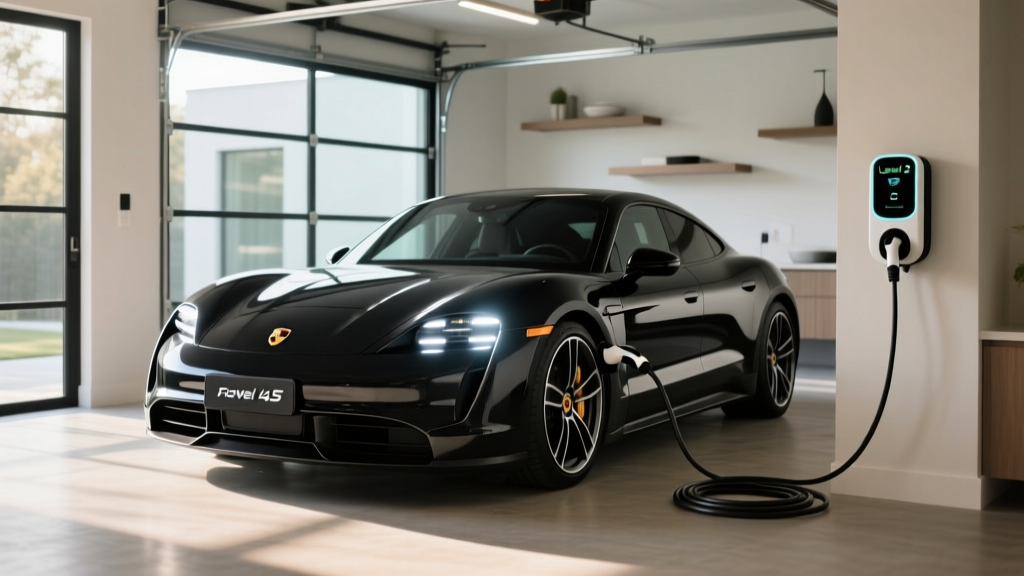
For home charging, you have two paths: use the Porsche Mobile Charger Connect (included with the vehicle, up to 9.6 kW on a NEMA 14-50 outlet) or install a dedicated hardwired wall unit for higher throughput.
Recommended Home Chargers for the Taycan 4S
Given the Taycan's 19.2 kW onboard charger capability, here are three chargers matched to different installation budgets and power goals.
ChargePoint Home Flex
- Power Output: Up to 12 kW (50A) on 240V
- Connector: CCS1 (J1772 plug, fits CCS1 inlet)
- Cable Length: 24 feet
- Smart Features: Wi-Fi, app scheduling, Alexa integration, energy tracking
- Price: ~$550
- Best For: Budget-conscious Taycan owners who want reliable overnight charging
Emporia Vue + Emporia Level 2 Charger
- Power Output: Up to 11.5 kW (48A)
- Connector: J1772 (fits CCS1 inlet)
- Cable Length: 24 feet
- Smart Features: Whole-home energy monitoring, solar integration, app control
- Price: ~$400 (charger) + energy monitor bundle
- Best For: Solar-equipped homes wanting to track EV energy vs. production
FLO Home X8 or Wallbox Pulsar Max
- Power Output: Up to 19.2 kW (80A, FLO) / 11.5 kW (48A, Wallbox)
- Connector: J1772/CCS1 compatible
- Cable Length: 25 feet (FLO) / 18–24 feet (Wallbox)
- Smart Features: Load balancing, Wi-Fi, app scheduling, utility demand-response
- Price: ~$700–$900 (FLO); ~$500–$650 (Wallbox)
- Best For: Maximizing the Taycan's 19.2 kW onboard charger with a hardwired 80A install
Our pick for most Taycan 4S owners: The ChargePoint Home Flex on a 60A breaker (48A continuous). It delivers ~28–34 miles of range per hour — enough to fully recharge the Taycan's 83.7 kWh battery in about 7.5 hours from 10% SoC. For owners who want the absolute fastest home charging, the FLO Home X8 on an 80A circuit unlocks the full 19.2 kW, cutting that to roughly 4.5 hours.
How Much Does Charging Cost Per Mile vs. Gas?
The Taycan 4S consumes approximately 41 kWh per 100 miles (per fueleconomy.gov). Let's compare real charging costs against a performance gas equivalent — say, a Porsche Panamera 4S averaging 21 MPG combined on premium fuel at $4.50/gallon.
| Scenario | Rate | Taycan 4S Cost/Mile | Panamera 4S Cost/Mile |
|---|---|---|---|
| Home Charging (Off-Peak Utility Rate) | $0.12/kWh | $0.049 | — |
| Home Charging (Average US Residential) | $0.17/kWh | $0.070 | — |
| Public Level 2 (e.g., ChargePoint) | $0.28/kWh | $0.115 | — |
| DC Fast Charging (Electrify America) | $0.48/kWh | $0.197 | — |
| Premium Gasoline (Panamera 4S, 21 MPG) | $4.50/gal | — | $0.214 |
The takeaway: Charging at home on an off-peak rate costs roughly $0.05 per mile — less than a quarter of the Panamera's fuel cost. Even DC fast charging at premium public rates ($0.48/kWh) comes in slightly below gas. The Taycan 4S owner who charges primarily at home saves approximately $1,650–$2,000 per year over 12,000 miles of driving compared to a comparable gas sports sedan.
Time-of-Use Savings
Many utilities offer time-of-use (TOU) plans with off-peak rates between midnight and 6 AM. Setting your ChargePoint or Wallbox to charge during these windows can cut your per-mile cost by 40–60% compared to peak rates. The Taycan 4S's 83.7 kWh battery charges fully in one off-peak window on a 48A circuit.
Safety, Electrical Code, and Installation Best Practices
A Level 2 EV charger is a continuous high-amperage load — it runs at full draw for hours. This demands proper installation per the National Electrical Code (NEC) and local amendments.
Key Code and Safety Requirements
- Dedicated Circuit: Your EV charger must be on its own dedicated circuit — no sharing with other appliances. A 48A charger requires a 60A breaker (NEC requires 125% overhead for continuous loads: 48A × 1.25 = 60A).
- GFCI Protection: NEC 2020 and later requires GFCI protection for outdoor receptacles. Hardwired installations may bypass this requirement in some jurisdictions, but a GFCI breaker adds a layer of safety.
- Outdoor Rating: If your charger is mounted outside or in an open carport, ensure it carries a NEMA 4 (weatherproof) rating. The ChargePoint Home Flex, Wallbox Pulsar Max, and FLO Home X8 are all rated for outdoor use.
- Wire Gauge: A 60A breaker requires minimum 6 AWG copper wire. Longer runs (over 50 feet from panel) may require 4 AWG to prevent voltage drop.
- Permit and Inspection: Most municipalities require an electrical permit for new 240V circuits. The permit fee is typically $50–$250, and an inspector will verify the work after completion. Do not skip this step — unpermitted work can void home insurance and complicate future sales.
Hardwired vs. NEMA 14-50 Outlet
The Porsche Mobile Charger Connect can plug into a NEMA 14-50 (50A) outlet, delivering up to 9.6 kW. However, a hardwired charger on a 60A or 80A circuit eliminates the outlet as a failure point and supports higher amperage. For a $107,000+ performance EV, hardwiring is the recommended approach.
DC Fast Charging: Public Network Realities for Taycan Owners
The Taycan 4S's 800V architecture and 270 kW peak charge rate make it one of the fastest-charging EVs available. But real-world DC fast charging depends on the station's capability.
What to Expect at Public Chargers
- 350 kW stations (Electrify America, Ionity): The Taycan 4S can utilize most of this capacity, achieving 10–80% in ~22.5 minutes. These are your best road-trip option.
- 150 kW stations (older Electrify America, some EVgo): The Taycan will charge at roughly 140–150 kW sustained. Expect 10–80% in ~32–35 minutes.
- 50 kW stations (legacy CHAdeMO or older CCS): The Taycan charges at 50 kW (it cannot use CHAdeMO at all). Expect 10–80% in ~85 minutes. Avoid these unless necessary.
- Tesla Superchargers (via adapter): V3 Superchargers peak at 250 kW. The Taycan 4S will charge at roughly 200–225 kW, achieving 10–80% in ~25–28 minutes. Verify adapter compatibility for your model year.
Always precondition the battery before a DC fast-charge session. The Taycan's navigation system does this automatically when you route to a charger — it warms the battery to optimal temperature, enabling faster charge acceptance. Without preconditioning, especially in cold weather, your peak charge rate may drop by 30–50%.
Frequently Asked Questions
How much does it cost to install a home EV charger for the Taycan 4S?
A typical Level 2 home installation with a 48A hardwired charger runs $1,250–$4,100 if your electrical panel has sufficient capacity. If your home needs a panel upgrade from 100A to 200A service, add $1,500–$4,000, bringing the total to $2,750–$8,100. The Porsche Mobile Charger Connect is included with the vehicle and works with a NEMA 14-50 outlet, which may reduce initial costs if the outlet already exists.
How fast will each charging level add range to the Taycan 4S?
Level 1 (120V) adds roughly 3–4 miles per hour. Level 2 at 48A (11.5 kW) adds approximately 28–34 miles per hour. Level 2 at 80A (19.2 kW, maximum onboard capability) adds 46–56 miles per hour. DC fast charging at a 350 kW station adds the equivalent of 600+ miles per hour, with a 10–80% session taking about 22.5 minutes.
Which connector does the Porsche Taycan 4S use?
The Taycan 4S uses CCS1 natively for both AC Level 2 and DC fast charging. For Tesla Supercharger access, a Porsche-approved NACS adapter is required for pre-2025 models; 2025+ models may include a NACS port natively. CHAdeMO is not compatible with any Taycan variant.
How much does charging the Taycan 4S cost per mile compared to a gas car?
At a home off-peak rate of $0.12/kWh, the Taycan 4S costs approximately $0.049 per mile (based on 41 kWh/100 mi efficiency). A comparable Porsche Panamera 4S on premium gasoline at $4.50/gallon and 21 MPG costs $0.214 per mile. Home charging saves roughly $0.16 per mile, or $1,920 over 12,000 annual miles.
What electrical upgrades might I need for a Taycan 4S home charger?
If your home has a 200A electrical panel with available breaker slots and load capacity, you likely need only a new 60A breaker, wiring, and the charger itself. Homes with 100A panels, older wiring (aluminum or undersized copper), or panels near maximum load will need a panel upgrade ($1,500–$4,000) before adding an EV circuit. A licensed electrician will perform a NEC-compliant load calculation to determine your specific requirements.
Does the Porsche Taycan 4S qualify for the federal EV tax credit?
As of current IRS §30D rules, the Taycan 4S does not qualify for the $7,500 federal tax credit. Its MSRP exceeds the $55,000 sedan cap, and its battery sourcing may not meet critical-mineral requirements. Always verify eligibility with a tax professional, as rules and vehicle qualification lists update regularly.